

On Friday 31 July 2026, the US Treasury instructed the New York Federal Reserve to sell euros and buy Japanese yen. Goldman Sachs and Morgan Stanley executed the trades. It was the first time since 1998 that the United States had bought yen in the open market, and the first coordinated US-Japan currency operation of any kind since 2011.
The move looks like a favour to an ally, and the President described it in exactly those terms, telling reporters that Japan “wanted a little bit of help” and that “we’re always there for Japan.” The fuller explanation sits in the US bond market, in the mechanics of the yen carry trade, and in the currencies of Japan’s neighbours. Washington acted because a disorderly yen had become an American problem.
What actually happened in the last week of July?
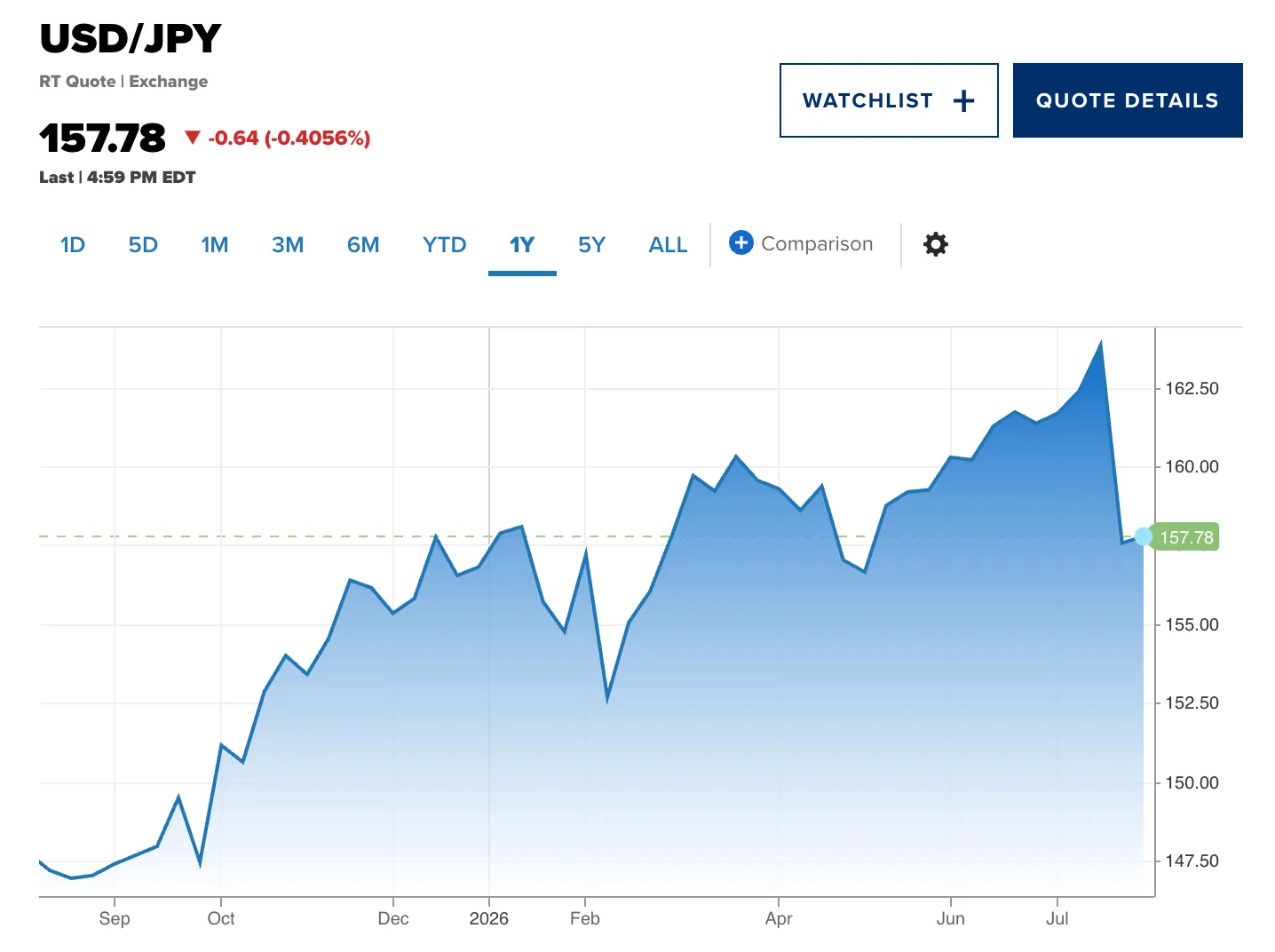
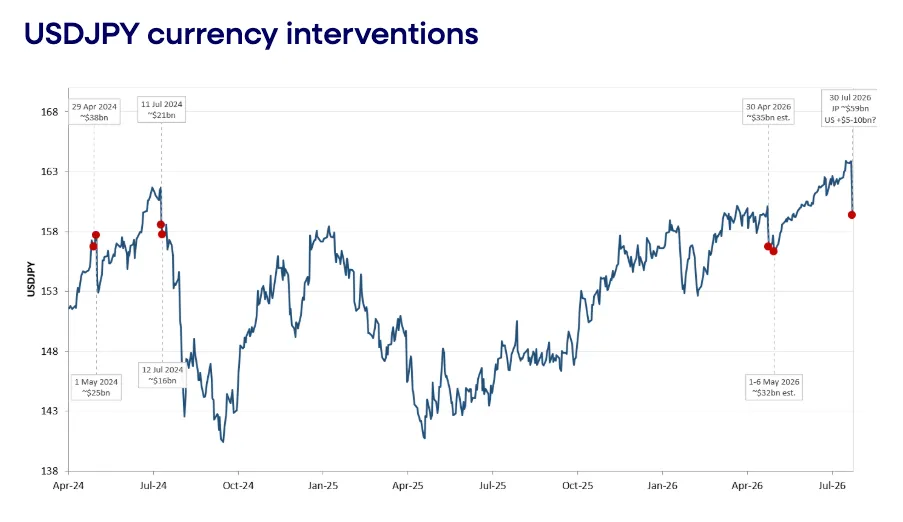
The yen had been sliding all year and reached 164 per dollar in late July, its weakest level against the dollar since 1986. On Thursday 30 July, Japan’s Ministry of Finance stepped into the New York market outside Tokyo trading hours. Bank of Japan data pointed to yen purchases worth close to $59 billion in a single session. The dollar fell from about 163.4 yen to 159.5.
The next day the United States joined. The Treasury sold euros from its reserves, bought yen, and told a number of banks to stand ready for further action. Treasury Secretary Scott Bessent confirmed the operation over the weekend. The size was never officially disclosed, though a photograph taken at Camp David on 31 July captured a notepad in front of him reading “To Do: Buy Japanese Yen (JPY) $5-10 bil.”
Date | What happened | Yen per dollar |
|---|---|---|
Jul 23 to 29 | The yen trades near its weakest level against the dollar since 1986. | 163 to 164 |
Jul 30 | Japan's Ministry of Finance buys yen in New York hours. Bank of Japan data points to close to $59 billion in a single session. | 159.5 |
Jul 31 | The Bank of Japan holds its policy rate at 1%. Hours later the US Treasury sells euros and buys yen through the New York Fed. | 157.4 |
Aug 3 | Both governments confirm the operation and say they will not hesitate to repeat it. | 156.8 |
Aug 7 | The yen surrenders close to half its post-intervention gains. | 157.9 |
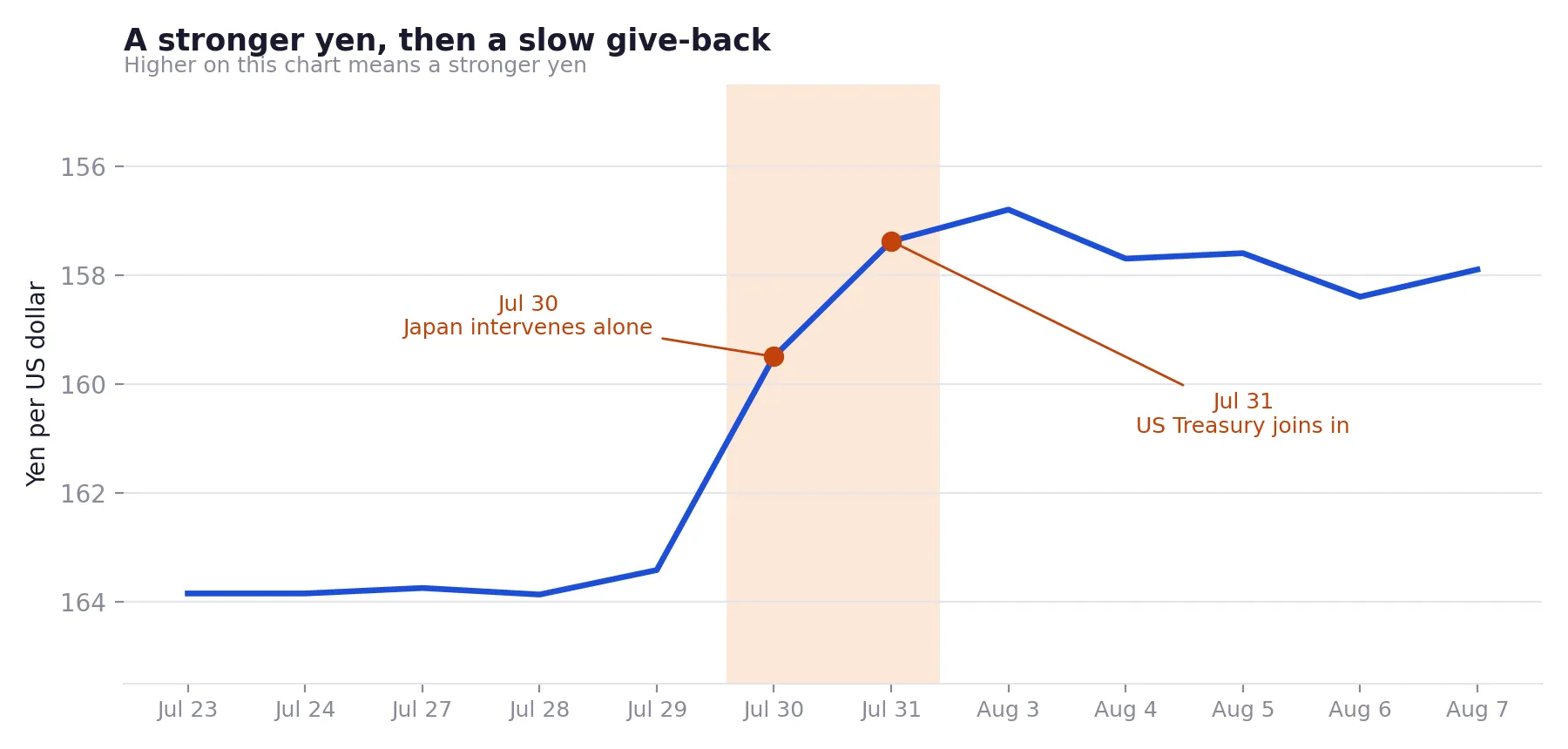
By Monday 3 August the dollar had fallen to roughly 156 yen, about 5% below where the week began.
Check the macro backdrop
GDP, inflation, rates and more — India’s key economic indicators in one dashboard.
Why was the yen falling in the first place?
The rate gap pays traders to sell it
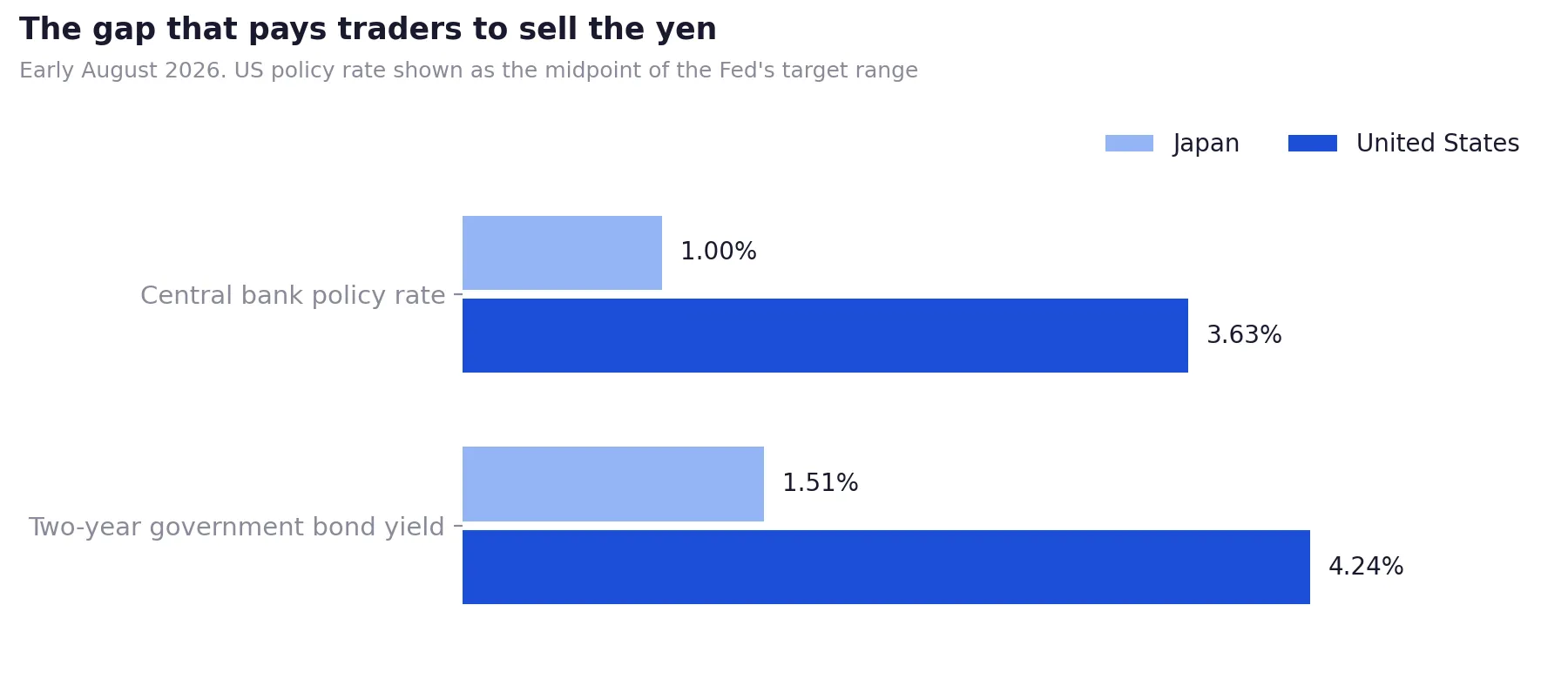
Japan’s policy rate is 1%, its highest since 1995 and still far below every other large economy. The Federal Reserve’s target range sits at 3.5% to 3.75%. A two-year Japanese government bond yields about 1.5%, against roughly 4.25% for the equivalent US Treasury.
That gap funds the carry trade. An investor borrows in yen at a low rate, converts the proceeds into dollars, buys higher-yielding US assets, and keeps the difference. The position earns money for as long as the yen stays weak, and the act of putting it on creates fresh selling pressure on the yen. The trade therefore validates itself, which pulls in more participants. By late July, speculative accounts held net short positions of more than 163,000 yen futures contracts.
Japanese savings keep leaving the country
The rate gap is one half of the story. The other is the steady export of Japanese capital. Domestic returns have been thin for years, so pension funds, insurers, banks and households have moved money abroad. The US Treasury’s July 2026 currency report notes that the United States received 84% of Japan’s outbound portfolio investment in 2025. Each of those flows involves selling yen.
Energy compounds it. Japan imports almost all of its fuel, and the conflict with Iran has kept oil prices elevated through 2026. Japanese producer prices rose 7.1% in June from a year earlier, driven mainly by energy, chemicals and petroleum. Higher import bills mean more yen sold for dollars, and higher prices for households whose wages have only recently started to catch up.
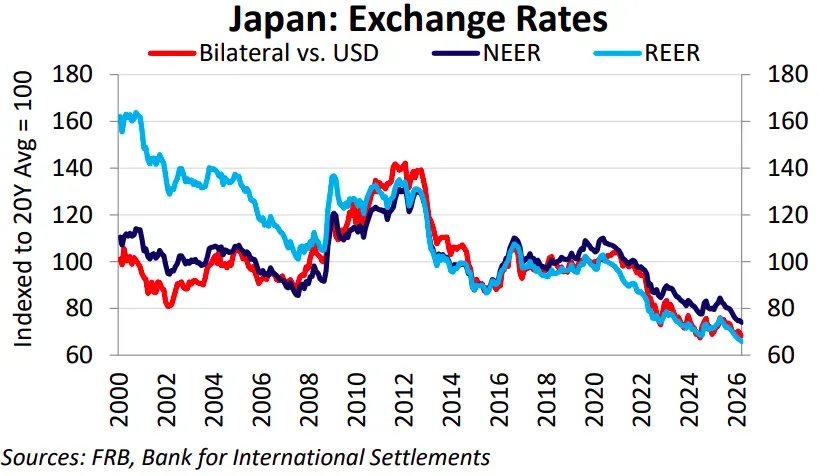
Treasury’s own assessment is blunt. The yen has fallen 51% against the dollar since the end of 2011, and by the same amount once inflation and the currencies of Japan’s other trading partners are taken into account. Treasury stopped short of calling this manipulation. It did describe the currency as substantially undervalued.
Why did Washington treat this as an American problem?
Japan is the largest foreign holder of US government debt
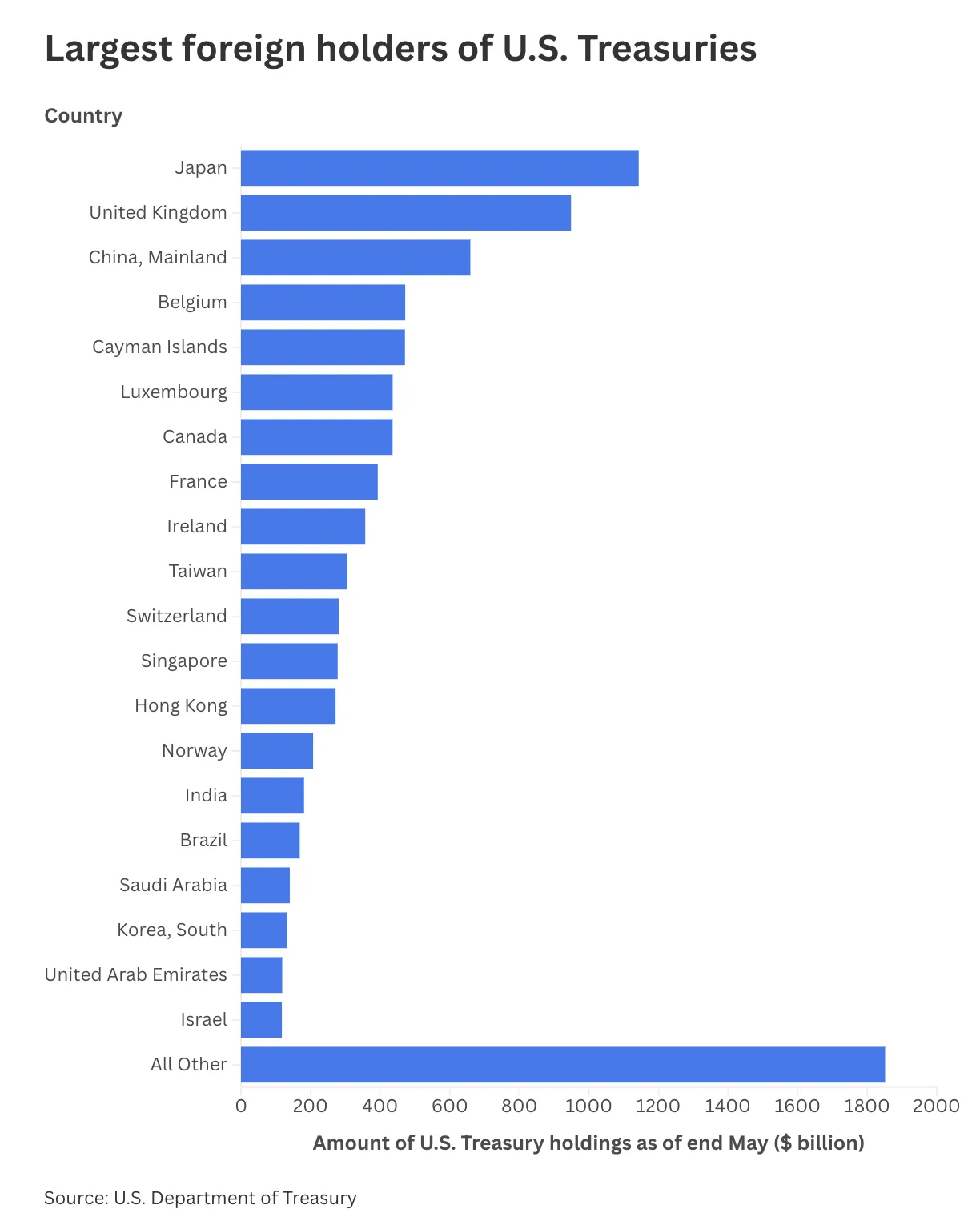
Japan owned about $1.14 trillion of US Treasuries as of May 2026, more than any other foreign government. When Tokyo defends the yen, it needs dollars, and the most obvious source of dollars is that portfolio. Japan’s holdings had already fallen by roughly $96 billion over the previous three months.
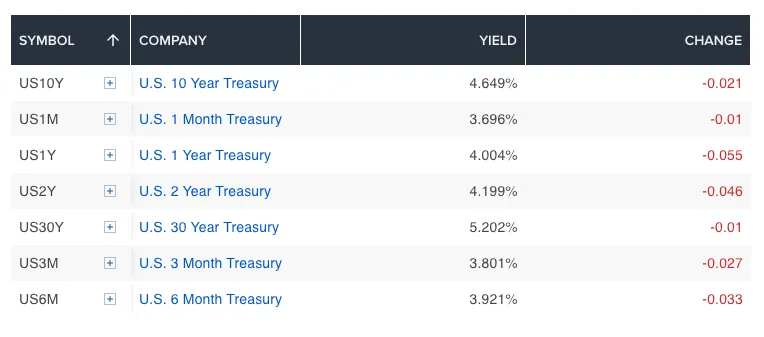
The timing sharpened the concern. On 29 July the 30-year Treasury yield reached 5.24%, its highest since July 2007, and the 10-year sat near 4.67%. Federal debt is above $39 trillion, so every additional basis point at the long end is expensive. A prolonged Japanese currency defence funded by outright Treasury sales would have pushed those yields higher still.
Washington’s response addressed that directly. Alongside the intervention, Bessent pointed Japan toward the Federal Reserve’s FIMA repo facility, which lets approved foreign monetary authorities borrow dollars against their Treasury holdings, up to $60 billion a day. He called it an important backstop. The message to markets was that Japan can raise dollars without selling bonds.
A falling yen drags other Asian currencies with it
Bessent has argued that yen weakness spreads. Japanese exporters compete directly with Korean and Chinese firms, so a cheaper yen pressures Seoul and Beijing to keep their own currencies competitive. He has pointed to the Korean won as the clearest example. The same logic removes any incentive for China to allow the renminbi to appreciate, since that would leave Chinese exporters facing cheaper Japanese rivals. Left alone, a sliding yen invites a round of competitive depreciation across the region.
A weak yen works against the tariff agenda
Currency moves can quietly offset tariffs. As the yen falls, Japanese goods get cheaper in dollar terms, absorbing part of the effect of any duty applied on the American side. Trade is more complicated than the exchange rate alone: Japan’s goods and services surplus with the United States was $55 billion in 2025, down from $62 billion the year before, even with the yen at historic lows. The administration’s stated position is that persistently undervalued Asian currencies pull global investment toward high-surplus economies and away from American manufacturing.
Why did the US sell euros instead of dollars?
This was the strangest feature of the operation, and it drew immediate criticism. The conventional way to strengthen the yen against the dollar is to sell dollars. Selling euros still buys yen, and it leaves the dollar side of the pair untouched.
Bessent described the trade as a reallocation of reserves, arguing that the euro sits close to fair value while the yen sits well below it, and said he had given European officials the same explanation. Two practical considerations sit behind the choice. Selling dollars would signal that Washington wants a weaker dollar in general, which carries consequences reaching far beyond Japan. And the euro balances held in the Exchange Stabilization Fund were simply the assets available to spend.
The criticism is about credibility. Robin Brooks of the Brookings Institution wrote that the twist undercuts the effectiveness of American participation, because markets will wonder why the Treasury avoided funding yen purchases out of dollars. Edwin Truman, a former Treasury assistant secretary for international affairs, called the euro route weird given the stated objective. Currency intervention works largely through conviction, and an operation that looks hedged invites questions.
Get research like this in your inbox
The week’s research that mattered, in five minutes. Joined by 2L+ investors.
Did it work?
Partly, and briefly.
The immediate effect was mechanical and psychological at once. Both governments bought yen, so the price moved. More importantly, anyone short the yen suddenly faced a risk they had discounted. Japan acting alone is predictable, because traders know the likely hours and roughly the levels. With the US Treasury involved, yen buying can arrive from a second balance sheet, at unfamiliar hours, at levels nobody has published. Crowded one-way trades unwind quickly once that uncertainty appears, and the unwind feeds on itself as traders buy yen to cap losses or meet margin calls.
The give-back began almost immediately. By 7 August the dollar was back near 158 yen, surrendering close to half the gains from the intervention. Nothing in the underlying arithmetic had changed.
What would actually change the direction?
Intervention treats the symptom. The cause is the rate gap, and closing it is the Bank of Japan’s job.
Governor Kazuo Ueda held the policy rate at 1% on 31 July in an 8-1 vote, with board member Hajime Takata dissenting in favour of 1.25%. Ueda warned about the cost of waiting too long and said the board would take up the question at its September meeting. The Bank expects underlying inflation to run above its 2% target in the second half of the fiscal year, and business inflation expectations have risen to 2.7%.
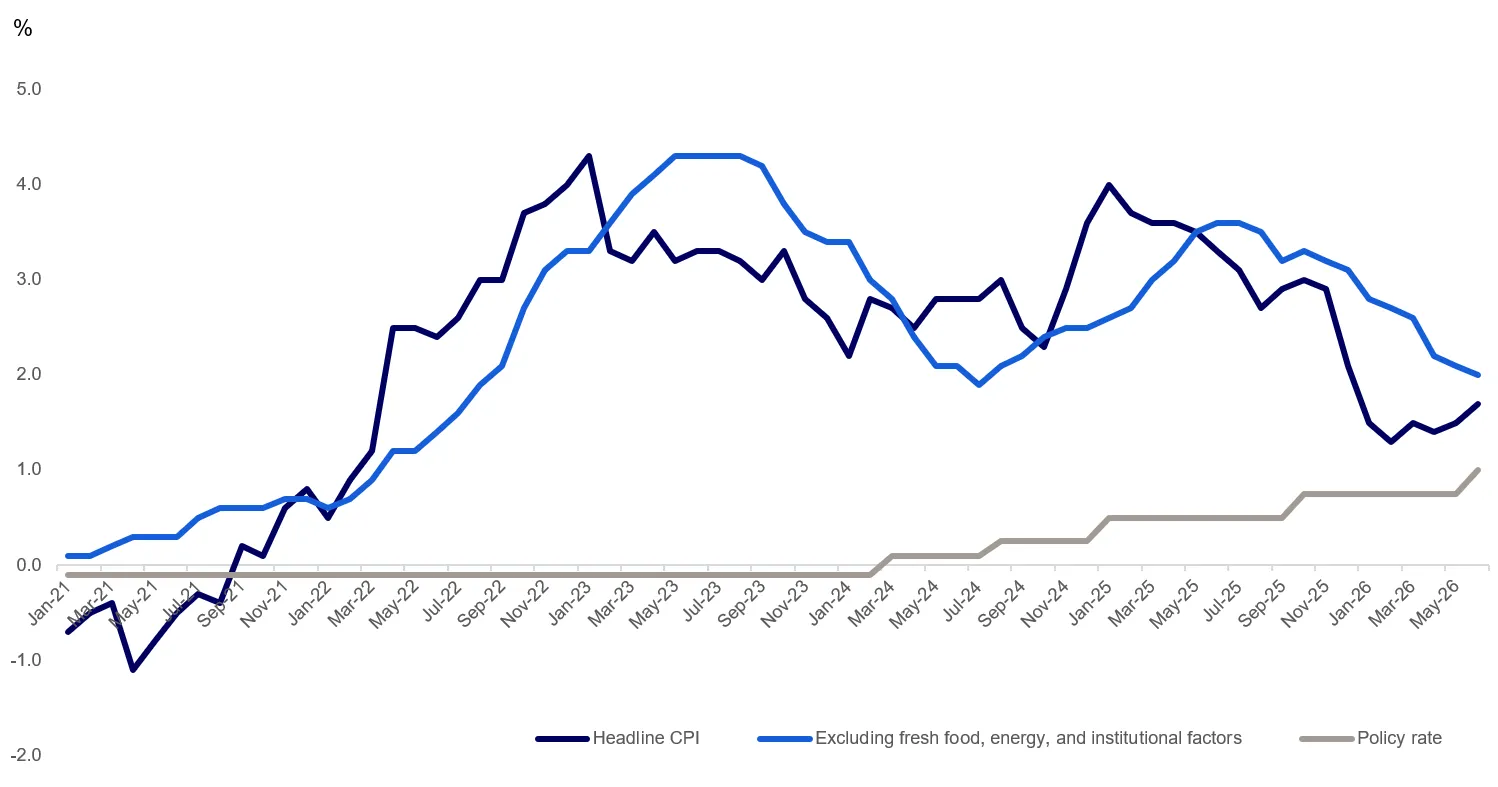
Politics complicates the path. Prime Minister Sanae Takaichi favours loose fiscal policy, loose monetary policy and faster growth at the same time. As ING’s Chris Turner put it, that mix produces a weak yen and an inflation problem. Bessent’s own framing acknowledged the limit of what he had done: intervention gives markets a signal, and policy turns the currency.
How much firepower is left?
Japan has a great deal. The United States has very little.
Japan holds roughly $1.3 trillion in foreign reserves, second only to China, and has spent an estimated $225 billion defending the yen since the start of 2024. That is a substantial sum and a modest share of the total. Tokyo can keep going for some time.
American reserves are a different order of magnitude. Treasury’s own report puts total US foreign exchange reserves at $38.6 billion at the end of 2025. The reported $5 billion to $10 billion committed in July represents a meaningful fraction of that. Washington’s contribution works as a signal, and repeated euro sales would run into a hard limit fairly quickly.
What the intervention changed | What it left in place |
|---|---|
The yen's level, by about 5% at the peak. | A policy rate of 1% in Japan against a Fed target range of 3.5% to 3.75%. |
The assumption that betting against the yen is a low-risk, one-way trade. | The profitability of the carry trade at current rate differentials. |
The predictability of when and where official yen buying arrives. | The steady flow of Japanese savings into foreign assets. |
Japan's ability to raise dollars without selling US Treasuries, through the Fed's FIMA facility. | Elevated energy import costs tied to the conflict with Iran. |
See what markets are pricing in
Live indices, sector moves and market breadth — the backdrop to every story we publish.
What does this mean beyond Japan?
Two things stand out.
First, the US Treasury has shown that it will put its own balance sheet behind foreign exchange objectives. The yen operation followed a $2.5 billion facility extended to Argentina less than a year earlier, which Buenos Aires repaid in full. After two decades of American passivity in currency markets, that shift in posture is worth tracking on its own.
Second, the episode is a reminder of how tightly the yen is wired into global finance. It is the third most traded currency in the world and the funding leg for an enormous volume of positions. A disorderly move in the yen becomes a liquidity event somewhere else, usually with very little warning. That logic explains the timing far better than any statement about friendship.
The trade that drove the yen down remains profitable this morning. Until the rate gap narrows, Washington and Tokyo can interrupt it, punish the traders who assumed it was riskless, and buy time. They cannot end it by buying yen.