


Quick Answer:What Is Smallcase Investment?
A smallcase investment is a basket of stocks or ETFs held directly in your Demat account, built around a specific investment theme or factor strategy by a SEBI-registered research analyst. Unlike a mutual fund, you own the individual stocks, not units of a pooled fund. Wright Research's smallcase portfolios include Concentrated Momentum (15–20 high-momentum stocks), Bull Market (cyclical high-beta exposure), Quality & Low Volatility (steady compounding), and thematic options in EV, Railways, PSU Revival, and Green Energy. Minimum investment: ₹5,000–₹25,000. Annual subscription: ₹500–₹2,000.
Run the numbers on your next investment
Project returns on a lumpsum or SIP with our free calculators.
Why Investors Choose Smallcase Over Traditional Options
You've been investing for a while. Maybe you hold a handful of mutual funds, a couple of direct stocks, and perhaps a fixed deposit or two. But somewhere along the way, a familiar frustration creeps in: you have no idea what you actually own, why the portfolio is structured the way it is, or who is making the decisions behind the scenes.
That's the exact pain point millions of Indian investors face today. And it's precisely why smallcase investment has become one of the most talked-about wealth-building tools in India's financial ecosystem.
A smallcase portfolio gives you something mutual funds don't have: complete transparency. You see every stock, every weight, every rebalancing decision. You don't just invest blindly; you invest with context and conviction. And when you pair that transparency with the research muscle of a SEBI-registered research analyst firm like Wright Research, you're no longer guessing you're investing with a strategy.
In this blog, we'll walk you through everything: how smallcase investment works, what the best smallcase options look like on Wright Research's platform, how they stack up against mutual funds, and what you need to know before you invest even a single rupee.
What Is a Smallcase? Definition, Structure & How It Differs from Mutual Funds
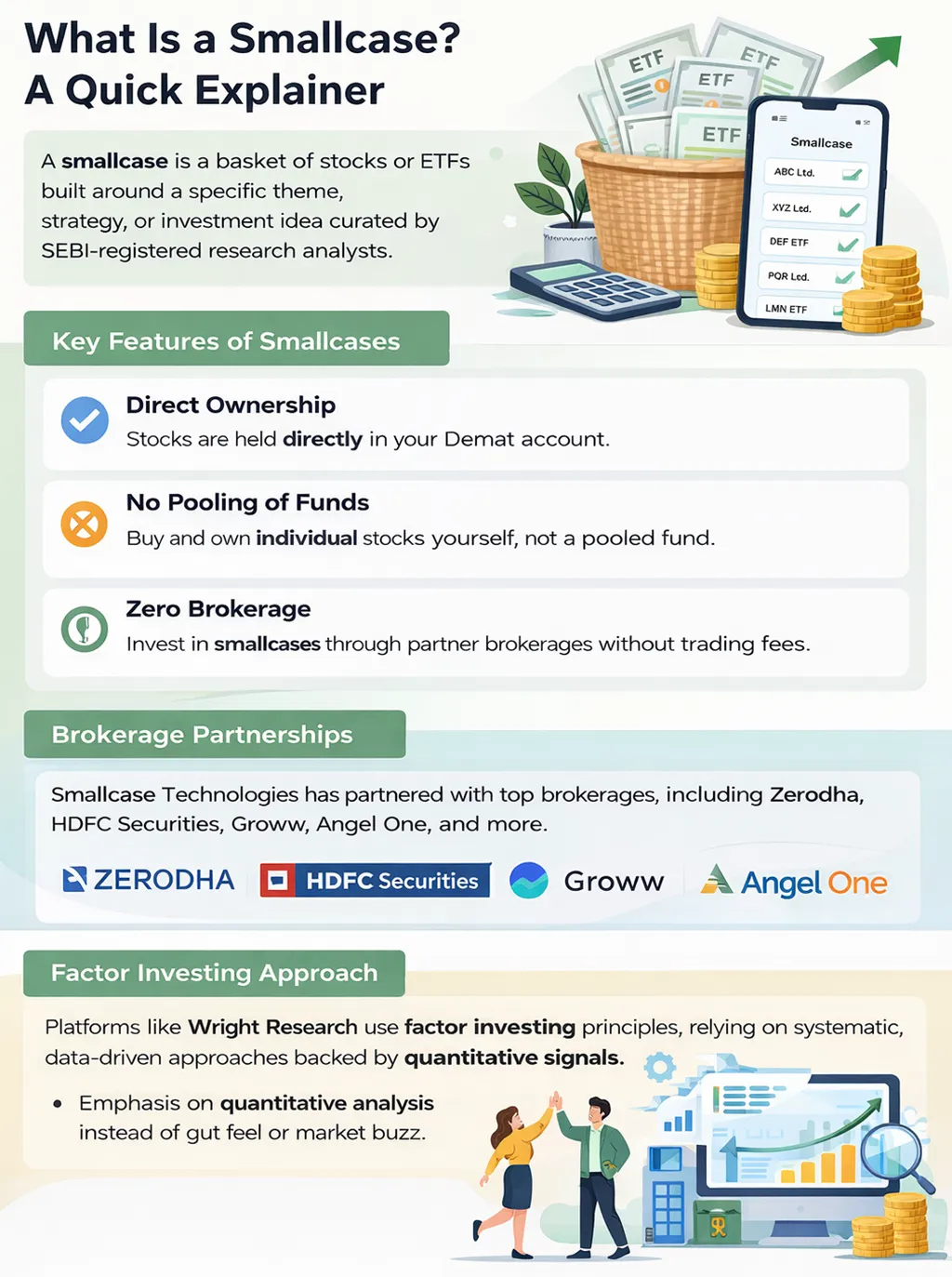
At its simplest, a smallcase is a basket of stocks or ETFs built around a specific theme, strategy, or investment idea. Think of it as a small-case portfolio curated by SEBI-registered research analysts but with one critical difference from a mutual fund: when you invest, the stocks get held directly in your Demat account in your name.
This isn't a pooled fund. There's no fund manager sitting on a corpus of your money. Instead, you buy and own the individual stocks yourself. That's a fundamental structural shift from how small case funds typically work in the traditional sense.
The smallcase company that built and operates this platform Smallcase Technologies has partnered with major brokerages like Zerodha, HDFC Securities, Groww, Angel One, and others. This means you can invest in a smallcase investment directly from your existing brokerage account with zero friction.
What makes platforms like Wright Research particularly powerful is that they use factor investing principles systematic, data-driven approaches rooted in academic research — to construct their smallcase portfolio offerings. Instead of gut feel or market buzz, every stock selection is backed by quantitative signals.
How Smallcase Works: Selection, Investment & Rebalancing
Understanding the mechanics of a smallcase investment is half the battle. Here's how the journey typically looks for an investor:
Step 1 — Choose a Smallcase: You browse the available options on the Wright Research platform, filtered by strategy (momentum, quality, thematic), risk profile, and minimum investment amount.
Step 2 — Review the Small Case Stocks List: Before investing, you get complete visibility into the small case stocks list of every company, its sector, weight in the portfolio, and the rationale behind its inclusion. Transparency is baked in from day one.
Step 3 — Invest Through Your Broker: You connect your brokerage account and place a single order that automatically buys all the stocks in the smallcase portfolio in the right proportions.
Step 4 — Rebalancing: Periodically, typically quarterly Wright Research's research team reviews the portfolio and sends rebalancing alerts. These updates reflect changes in market conditions, stock fundamentals, or factor signals. You approve and execute the rebalance with one click.
This four-step loop is what makes smallcase investment so compelling: you're an active participant, not a passive spectator.
Get research like this in your inbox
The week’s research that mattered, in five minutes. Joined by 2L+ investors.
Best Smallcases on Wright Research Platform
Wright Research offers a curated suite of best smallcase options built around three core investment philosophies: momentum-driven growth, quality with low volatility, and high-conviction thematic bets. Here's a breakdown of what's available and what makes each unique.
1. Momentum-Based Smallcases
Momentum investing is grounded in one of the most robust findings in financial research: stocks that have performed well recently tend to continue performing well in the near term. Wright Research's factor investing framework systematically identifies these high-momentum stocks using quantitative models.
The Concentrated Momentum Smallcase is Wright Research's flagship momentum product. It holds a tight, focused small case stocks list typically 15 to 20 stocks selected purely on the basis of price momentum, earnings momentum, and relative strength signals. This is not a diversified all-weather portfolio; it's designed for investors who want high-octane exposure to the market's strongest performers. The concentrated momentum smallcase has historically delivered strong alpha in trending markets.
For investors who want broader momentum exposure, the Bull Market Smallcase is designed to maximize upside capture during strong market rallies. The bull market smallcase tilts heavily toward cyclical, high-beta sectors financials, industrials, and consumer discretionary that tend to outperform when market sentiment is risk-on. It's an ideal best smallcase to invest during periods of macro tailwinds and strong earnings growth.
2. Quality & Low-Volatility Smallcases
Not every investor is chasing maximum returns at maximum risk. For those who want steady, compounding growth with lower drawdowns, Wright Research's quality-focused smallcase portfolio options are designed to deliver.
These portfolios apply factor investing to screen for companies with consistently high return on equity, low debt-to-equity ratios, strong free cash flow generation, and stable earnings growth. The resulting small case stocks list tends to include large-cap and emerging large-cap companies with durable competitive advantages.
The appeal here is clear: in volatile or bear markets, quality stocks fall less. And because they compound steadily over time, the long-term CAGR of a quality smallcase investment often rivals more aggressive strategies with far less stress for the investor.
3. Thematic Smallcases (EV, Railways, PSU)
India's structural transformation is creating generational investment opportunities in specific sectors. Wright Research's thematic smallcase portfolio offerings allow investors to take concentrated, conviction-based bets on these long-term stories.
The Best Innovation Smallcase focuses on companies driving technological disruption across electric vehicles, defence technology, clean energy, and digital infrastructure. This is the best innovation smallcase for investors who believe India's next decade will be shaped by homegrown tech and deep-science companies. It's higher risk, but the potential upside over a 5-to-10-year horizon is significant.
Other thematic options include Railways & Infrastructure, PSU Revival, and Green Energy — each backed by a detailed investment thesis and regularly updated small case stocks list.
Smallcase Type | Investment Style | Risk Level | Best For |
Concentrated Momentum | Factor — Momentum | High | Aggressive growth investors |
Bull Market | Tactical — Cyclical | High | Bull market opportunists |
Quality & Low Volatility | Factor — Quality | Medium | Long-term compounders |
Best Innovation | Thematic — Disruptive | High | 5–10 year conviction investors |
Railways & Infrastructure | Thematic — Sector | Medium-High | India growth story believers |
Smallcase vs Mutual Funds: Key Differences
The debate between smallcase investment and mutual funds portfolio is one of the most common conversations in personal finance today. Both have merit — but they serve different needs.
Parameter | Smallcase | Mutual Fund |
Ownership | Stocks held in your Demat | Units of a pooled fund |
Transparency | Full — see every stock | Limited — portfolio disclosed monthly |
Tax Harvesting | Possible at individual stock level | Not directly possible |
Minimum Investment | ₹2,000 – ₹5,000+ (varies by portfolio) | ₹500 SIP possible |
Customisation | Can exclude specific stocks | Cannot customise |
Exit | Sell individual stocks | Redeem fund units |
Expense | Subscription fee + brokerage | Expense ratio (0.5%–1.5% for active funds) |
The most significant advantage of a smallcase investment over a mutual funds portfolio is direct stock ownership combined with tax flexibility. You can harvest losses in individual stocks to offset gains something a traditional mutual funds portfolio doesn't allow.
That said, small case funds (as some investors call them) require a slightly higher minimum and a more hands-on mindset. For truly passive, low-ticket investing, a mutual funds portfolio still makes sense. For goal-oriented, strategy-driven investing with transparency smallcase investment wins.
Smallcase Charges, Minimum Investment & Taxation
Understanding costs is non-negotiable before you invest. Here's what you need to know about smallcase investment economics:
1. Subscription Fees
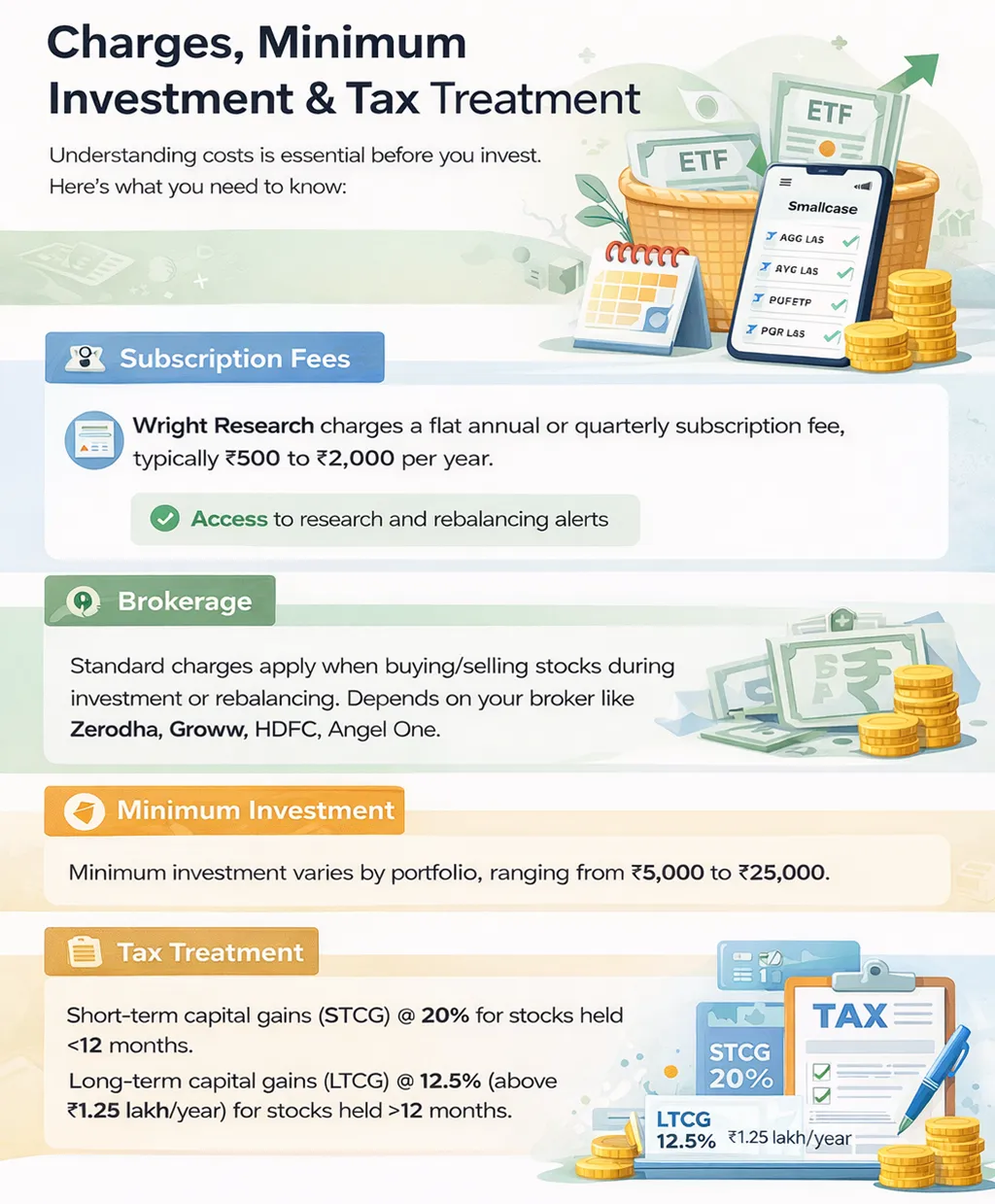
Wright Research charges a flat annual or quarterly subscription fee for access to its research and rebalancing alerts. These fees vary by product but are typically between ₹500 and ₹2,000 per year a fraction of what traditional portfolio management services charge.
2. Brokerage
Standard brokerage charges apply when you buy or sell stocks during investment or rebalancing. This depends on your broker (Zerodha, HDFC, Angel One, etc.).
3. Minimum Investment
The minimum varies by portfolio. Wright Research's smallcase portfolio options typically start between ₹5,000 and ₹25,000 depending on the number of stocks and their prices. This is significantly lower than the ₹50 lakh minimum for most portfolio management services .
4. Tax Treatment
Here's where smallcase investment gets nuanced. Since you own individual stocks, each transaction is taxed independently. Short-term capital gains (STCG) at 20% apply to stocks sold within 12 months. Long-term capital gains (LTCG) at 12.5% (above ₹1.25 lakh per year) apply beyond 12 months. This structure also allows for strategic tax-loss harvesting that a mutual funds portfolio cannot offer.
Disclaimer: Investments are subject to market risk. Past performance is not indicative of future results. Please read all related documents carefully. Wright Research is a SEBI-registered research analyst.
How Wright Research Manages Smallcase Portfolios
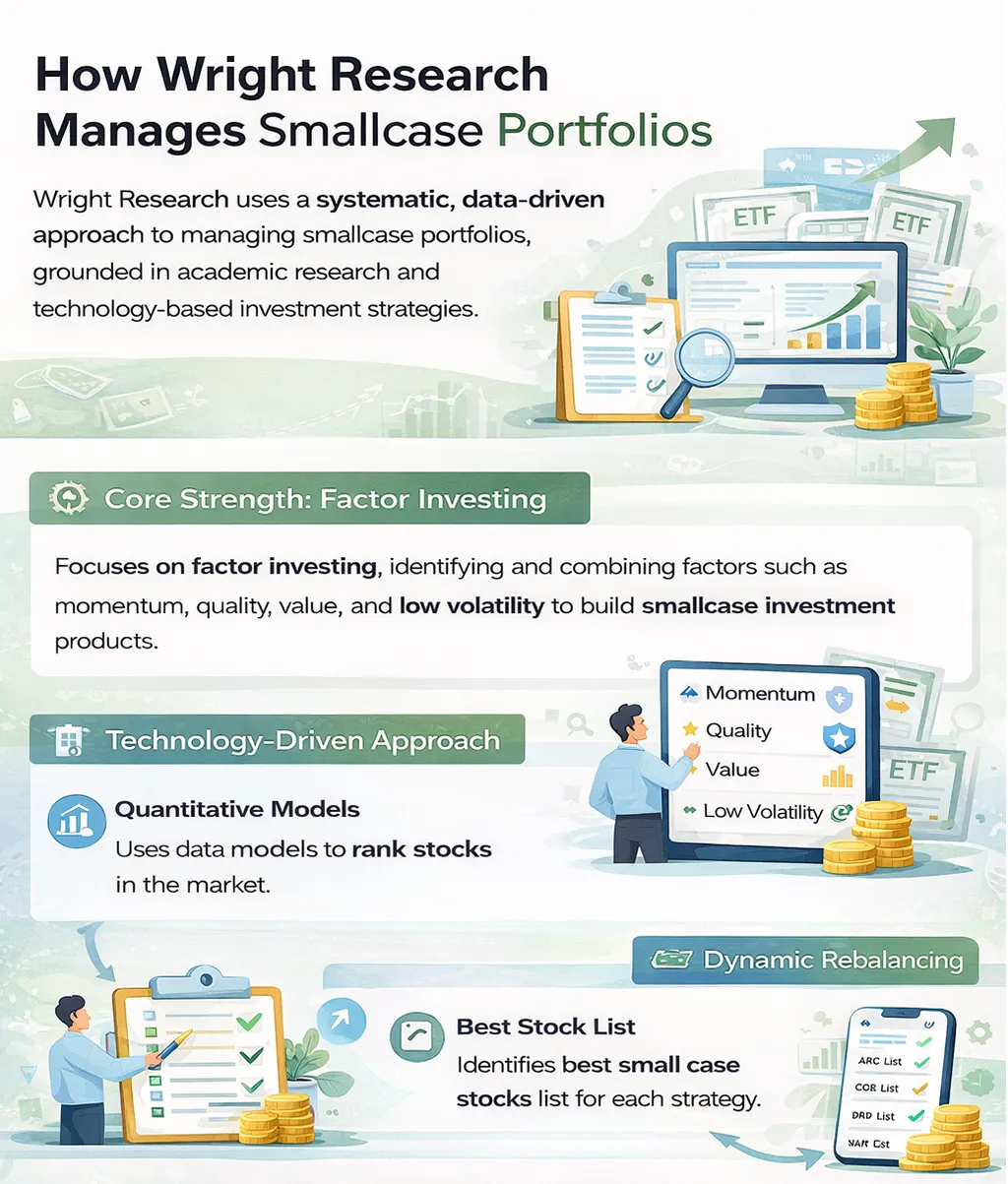
Wright Research isn't just another smallcase company listing pre-built portfolios. It's an investment advisory firm with a deep quantitative research foundation. Every smallcase portfolio on the platform is the output of a disciplined, data-driven process not opinions or market speculation.
The firm's core strength lies in factor investing, a systematic approach that has decades of academic backing. Wright Research builds its smallcase investment products by identifying and combining factors like momentum, quality, value, and low volatility then back-testing them rigorously on Indian market data before launch.
What separates Wright Research from generic portfolio management services is its technology-first approach. The team uses quantitative models to rank stocks across the universe, identify the best small case stocks list for each strategy, and dynamically rebalance as market conditions evolve. Every rebalancing decision comes with a clear rationale not just "buy this, sell that."
For investors exploring the best smallcase to invest in, Wright Research offers a transparent track record of its portfolios. You can see historical performance, drawdown data, risk metrics like Sharpe ratio and standard deviation, and sector allocation all before you invest.
"We built our smallcase investment framework on the belief that systematic, data-driven investing beats emotional decision-making — consistently and measurably." — Wright Research Investment Team
Whether you're looking at the concentrated momentum smallcase for high-growth exposure, the bull market smallcase for tactical opportunities, or the best innovation smallcase for a decade-long thematic bet Wright Research's research infrastructure has you covered. Also Read : Factor Investing Explained for Indian Investors
See what markets are pricing in
Live indices, sector moves and market breadth — the backdrop to every story we publish.
FAQsAbout Smallcase Investment
1. What is the minimum amount to invest in a Smallcase?
The minimum investment for a smallcase investment on Wright Research's platform varies by product typically between ₹5,000 and ₹25,000. This is significantly lower than the ₹50 lakh minimum required for most formal portfolio management services.
2: Are Smallcases better than mutual funds?
Neither is universally better they serve different investor needs. A smallcase portfolio offers complete stock-level transparency, direct ownership, and tax-harvesting flexibility. A mutual funds portfolio is better for fully passive, low-ticket, diversified investing. For strategy-driven investors who want visibility into what they own, smallcase investment is often the better fit.
3: How often are Smallcases rebalanced?
Most Wright Research smallcase portfolio products are rebalanced quarterly, though some factor-driven portfolios like the concentrated momentum smallcase may be reviewed monthly. You receive a rebalancing alert and choose when to execute it you're always in control.
4: What taxes apply on Smallcase gains?
Since you hold individual stocks, standard equity tax rules apply. Short-term capital gains (STCG) are taxed at 20% for stocks held less than 12 months. Long-term capital gains (LTCG) above ₹1.25 lakh annually are taxed at 12.5%. The advantage of a smallcase investment over a mutual funds portfolio is that you can harvest losses at the individual stock level to offset capital gains.
5: How is Wright Research's Smallcase performance tracked?
Wright Research maintains a transparent performance track record for each smallcase portfolio including CAGR since inception, maximum drawdown, Sharpe ratio, and benchmark comparison. You can access this on the Wright Research platform before subscribing to any best smallcase to invest in. All performance data is reported net of rebalancing fees and brokerage.