


After a market recovery, winners grow and quietly reduce your long-term risk. Rebalancing portfolio allocations restores your target mix, locking gains and improving portfolio risk management. Through active portfolio management, balanced portfolios, and moderate risk mutual funds, a diversified mutual fund portfolio stays aligned. A disciplined portfolio rebalancing strategy India investors follow protects any long term mutual fund portfolio, and portfolio advisory services make it effortless.
Introduction
Your portfolio has bounced back. The red is gone, your equity funds are glowing green, and that mid-cap bet you almost sold in panic is now your best performer. It feels good, so good that you'd rather not touch anything. But here's the uncomfortable truth most investors discover too late: a strong recovery quietly makes your portfolio riskier than you ever intended. The very winners that lifted your returns have grown so large that one correction could undo months of gains.
This is the moment when rebalancing portfolio decisions matter most. In this guide, you'll learn exactly how to reset your allocation after a recovery, why it protects your wealth, and how a disciplined approach keeps your goals on track without guesswork.
See what markets are pricing in
Live indices, sector moves and market breadth — the backdrop to every story we publish.
What Does It Mean to Rebalance After Recovery?
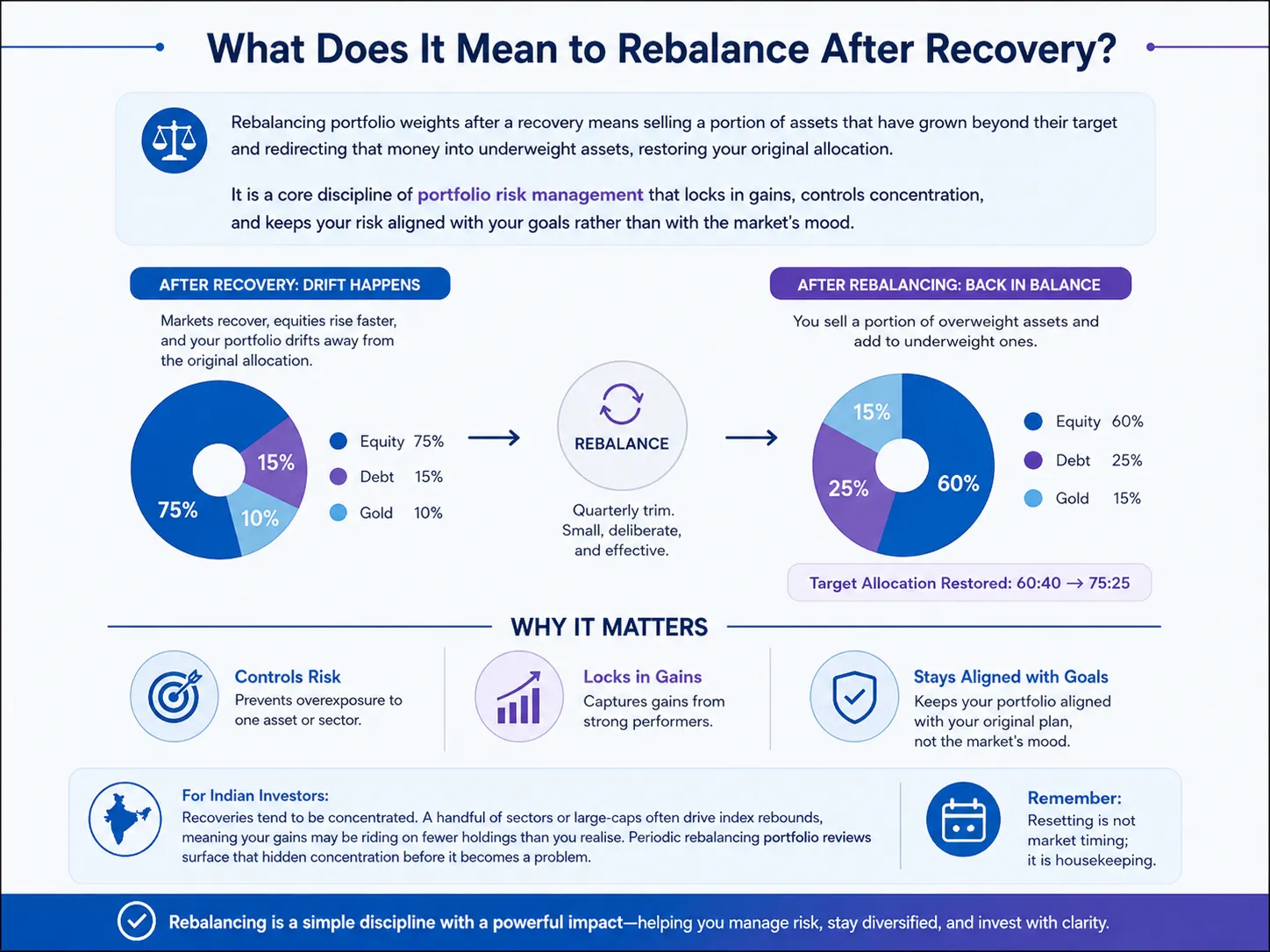
Rebalancing portfolio weights after a recovery means selling a portion of assets that have grown beyond their target and redirecting that money into underweight assets, restoring your original allocation. It is a core discipline of portfolio risk management that locks in gains, controls concentration, and keeps your risk aligned with your goals rather than with the market's mood.
Think of it like trimming a hedge. After a good monsoon, some branches shoot up far faster than others. Left alone, the hedge loses its shape entirely. Rebalancing is that quarterly trim: small, deliberate, and far easier than a drastic overhaul later. When markets recover sharply, equity often races ahead of debt and gold, pushing a once-balanced 60:40 split toward 75:25 without you lifting a finger. Resetting it is not market timing; it is housekeeping.
For Indian investors, this matters because recoveries here tend to be concentrated. A handful of sectors or large-caps frequently drive index rebounds, meaning your gains may be riding on fewer holdings than you realise. Periodic rebalancing portfolio reviews surface that hidden concentration before it becomes a problem.
Why Recovery Quietly Changes Your Portfolio Risk Profile
When you first built your plan, you chose an allocation that matched your comfort with volatility. Perhaps you settled on balanced portfolios that blend equity for growth with debt for stability. That mix represented a deliberate decision about how much loss you could stomach in a bad year.
A recovery breaks that decision silently. Suppose equities surge 40% while your debt allocation grows just 6%. Your carefully chosen 60:40 split drifts to roughly 70:30. You now carry more equity risk than you ever signed up for, and you never made a single trade. This is precisely why portfolio risk management cannot be a one-time setup. It is an ongoing practice because the market is constantly editing your allocation on your behalf.
The danger is psychological too. After a recovery, confidence runs high, and the temptation is to let winners ride indefinitely. But the investor who refuses to trim is the same investor who feels the deepest pain in the next downturn. Sound portfolio risk management accepts that you cannot predict the next correction, so you prepare for it by keeping risk within limits you defined in calmer times. Balanced portfolios stay balanced only if you actively keep them that way.
How to Rebalance Your Portfolio After Recovery
Rebalancing sounds technical, but the process is refreshingly simple once you break it into clear stages. The first step is to review your current allocation against your target. Pull up your holdings and calculate what percentage sits in equity, debt, gold, and cash today versus the mix you originally intended. The gap tells you exactly what has drifted.
Next, identify where the drift is most severe. In a post-recovery scenario, this is almost always your equity sleeve, and often within it, one or two high-flying funds or sectors. A truly diversified mutual fund portfolio should spread risk across market caps, sectors, and strategies, so if a single category now dominates, that is your priority for trimming. Active portfolio management earns its keep here by spotting concentration that a passive set-it-and-forget-it approach would miss entirely.
The third stage is to act with intention rather than emotion. Sell down the overweight portion and channel that capital into underweight assets, perhaps adding to moderate-risk mutual funds that cushion the ride, or topping up debt to restore your safety buffer. The goal is not to exit good investments; it is to return them to their proper size within your diversified mutual fund portfolio.
Finally, factor in taxes and costs before you execute. In India, equity gains held over a year attract long-term capital gains tax beyond the exempt threshold, while shorter holdings are taxed higher. A thoughtful portfolio rebalancing strategy India investors can actually sustain will sequence trades to minimise tax drag, sometimes using fresh inflows or SIPs to rebalance instead of selling. This is where active portfolio management quietly adds value, turning a blunt instrument into a precise one.
Get research like this in your inbox
The week’s research that mattered, in five minutes. Joined by 2L+ investors.
A Practical Portfolio Rebalancing Framework for Indian Investors
The table below shows how a typical drift unfolds after a recovery and what corrective action restores balance. The figures are illustrative, designed to show the logic rather than predict any outcome.
Asset Class |
Target Allocation |
Post-Recovery Drift |
Action Needed |
Large-cap equity |
35% |
42% |
Trim 7% |
Mid & small-cap equity |
20% |
28% |
Trim 8% |
Debt / fixed income |
30% |
20% |
Add 10% |
Gold/commodities |
10% |
7% |
Add 3% |
Cash |
5% |
3% |
Add 2% |
Notice how the equity sleeve has ballooned while debt and gold have shrunk. Restoring the target does two things at once: it books profit from what ran hot, and it strengthens the defensive assets that protect a long-term mutual fund portfolio through the next cycle. Anchoring a diversified mutual fund portfolio to clear targets like these removes emotion from the equation, which is exactly what disciplined active portfolio management is built to deliver.
Calendar vs Threshold Rebalancing: Which Approach Fits Your Portfolio?
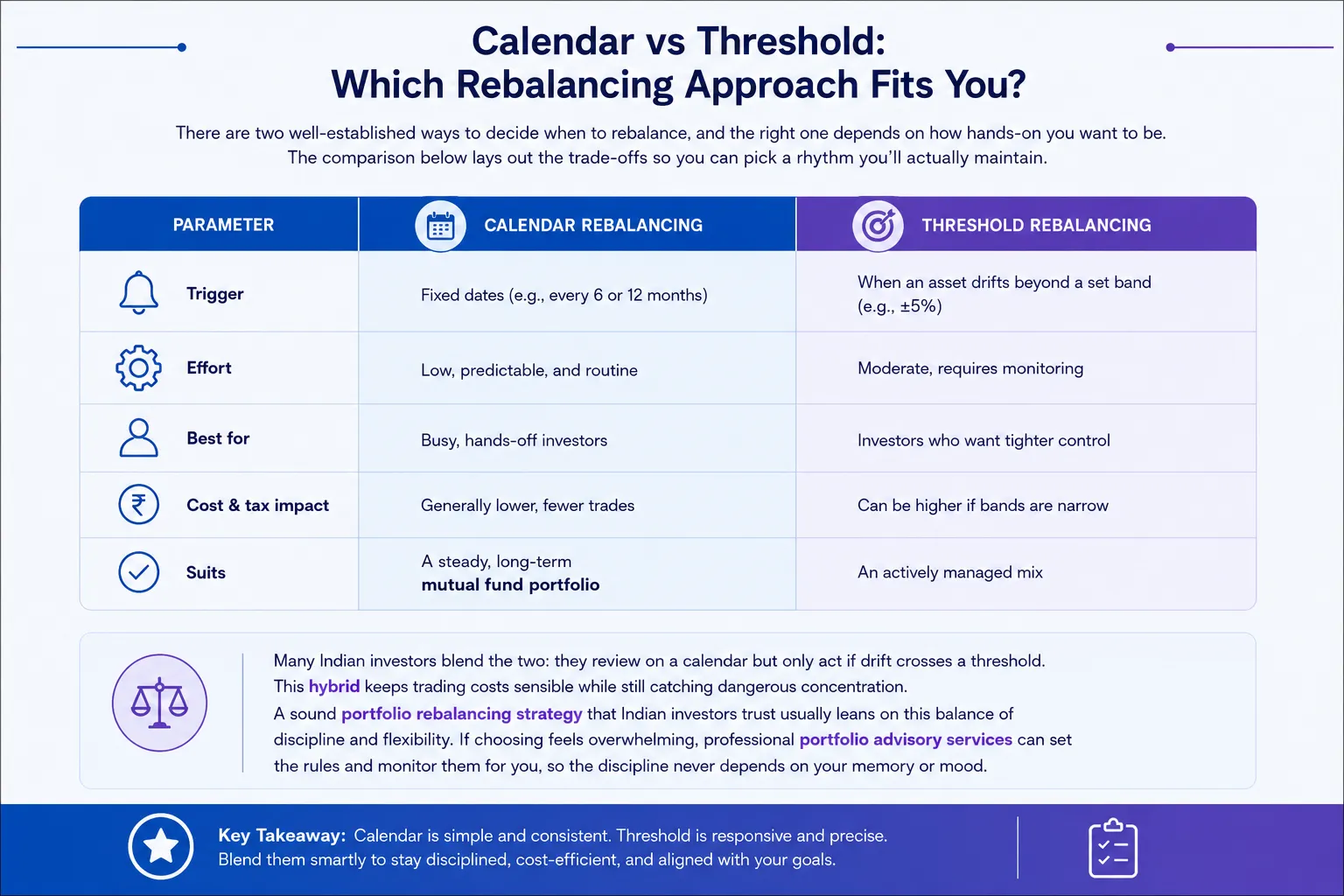
There are two well-established ways to decide when to rebalance, and the right one depends on how hands-on you want to be. The comparison below lays out the trade-offs so you can pick a rhythm you'll actually maintain.
Parameter |
Calendar Rebalancing |
Threshold Rebalancing |
Trigger |
Fixed dates (e.g., every 6 or 12 months) |
When an asset drifts beyond a set band (e.g., ±5%) |
Effort |
Low, predictable, and routine |
Moderate, requires monitoring |
Best for |
Busy, hands-off investors |
Investors who want tighter control |
Cost & tax impact |
Generally lower, fewer trades |
Can be higher if bands are narrow |
Suits |
A steady, long-term mutual fund portfolio |
An actively managed mix |
Many Indian investors blend the two: they review on a calendar but only act if drift crosses a threshold. This hybrid keeps trading costs sensible while still catching dangerous concentration. A sound portfolio rebalancing strategy that India investors trust usually leans on this balance of discipline and flexibility. If choosing feels overwhelming, professional portfolio advisory services can set the rules and monitor them for you, so the discipline never depends on your memory or mood.
Common Portfolio Rebalancing Mistakes to Avoid After Recovery
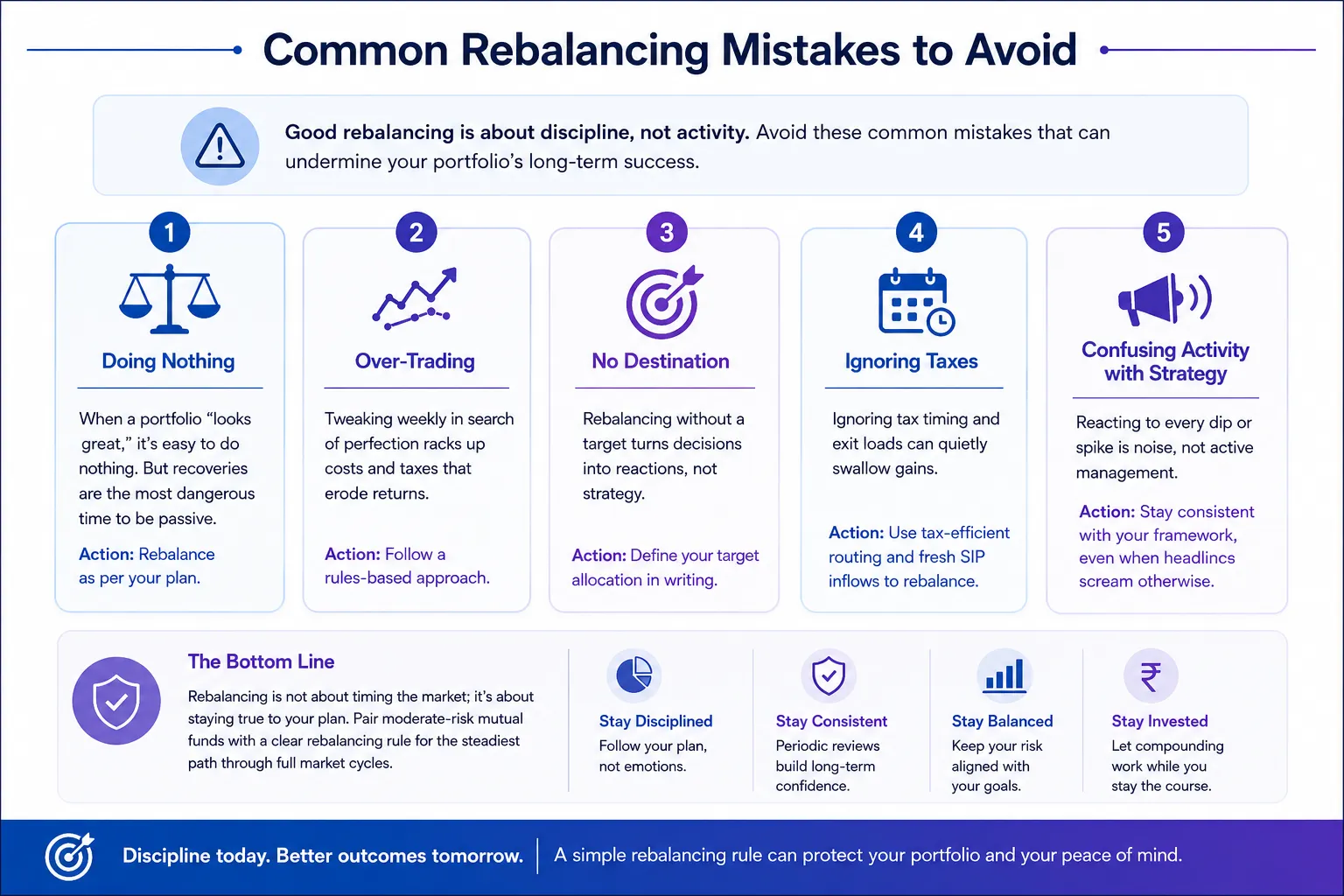
The first mistake is doing nothing because the portfolio "looks great." A recovery is the most dangerous time to be passive, precisely because everything feels safe. The second is over-trading, chasing perfection by tweaking weekly, which racks up costs and taxes that erode the benefit. Genuine portfolio risk management sits between these extremes: deliberate, periodic, and rules-based.
A third error is rebalancing without a destination. Selling winners makes sense only when you know your target allocation; otherwise, you are simply reacting. This is why a written plan, even a one-page note on your intended mix, transforms rebalancing portfolio decisions from anxiety into routine. A fourth, very Indian, mistake is ignoring tax timing and exit loads, which can quietly swallow gains. Using fresh SIP inflows to top up underweight assets is often smarter than selling, and it keeps a long-term mutual fund portfolio intact while still nudging it back toward balance.
Finally, many investors confuse activity with strategy. Buying every dip or selling every spike is noise. True active portfolio management is unglamorous: it means following your framework even when the headlines scream otherwise. The investors who do best are rarely the most active traders; they are the most consistent rebalancers. Pairing moderate-risk mutual funds with a clear rebalancing rule gives most people the steadiest path through full market cycles.
How Wright Research Helps You Rebalance Your Portfolio
At Wright Research , rebalancing is not left to gut feeling. Our quant and factor-based models continuously monitor allocation drift across momentum, quality, and value signals, flagging when balanced portfolios have wandered from their targets. This data-driven active portfolio management removes the human bias that makes most people hold winners too long and act too late.
Whether you invest through our smallcase strategies or seek tailored portfolio advisory services, the principle stays the same: keep your diversified mutual fund portfolio aligned to your goals, not to the market's swings. Our approach suits investors who want a long-term mutual fund portfolio that is reviewed systematically rather than emotionally, with a clear portfolio rebalancing strategy India investors can follow with confidence.
If you'd like a structured framework built around your risk appetite, our team can help you design and maintain it. Explore Wright Research's PMS strategies, compare your options across mutual funds and smallcase, and see how disciplined rebalancing works in practice. Ready to align your portfolio with your goals? Speak with a Wright Research advisor today.
Track the factors behind this research
Momentum, value, quality and low-vol — updated factor performance for Indian markets.
Frequently Asked Questions
What does rebalancing a portfolio after recovery mean?
It means selling part of the assets that grew beyond their target after a market rebound and reinvesting into underweight ones to restore your original mix. Rebalancing portfolio weights this way locks in gains and keeps portfolio risk management aligned with your goals.
How often should I rebalance my portfolio?
Most investors rebalance once or twice a year, or whenever an asset drifts more than 5% from its target. A consistent portfolio rebalancing strategy that India investors follow values discipline over frequency, since over-trading raises costs and taxes while adding little to a long-term mutual fund portfolio.
Who should consider professional portfolio advisory services?
Investors who lack the time or confidence to monitor allocation drift benefit most. Portfolio advisory services suit those wanting balanced portfolios managed systematically, especially when juggling a diversified mutual fund portfolio across equity, debt, and gold, where emotional decisions can quietly increase risk.
Does rebalancing reduce my returns?
Not usually. Rebalancing trims risk rather than growth, and disciplined active portfolio management often improves risk-adjusted outcomes over full cycles. By keeping moderate-risk mutual funds and equity in their right proportions, you avoid the deep drawdowns that derail long-term compounding. Returns are never guaranteed.
What is the most tax-efficient way to rebalance in India?
Use fresh SIP inflows to top up underweight assets instead of selling, and hold equity beyond one year to qualify for long-term capital gains treatment. A thoughtful portfolio rebalancing strategy India investors adopt sequences trades to limit tax and protect a long-term mutual fund portfolio.
How is rebalancing different from market timing?
Market timing guesses when to buy or sell based on predictions. Rebalancing follows fixed rules tied to your target allocation, ignoring forecasts entirely. This makes rebalancing portfolio decisions a tool of portfolio risk management, not speculation: the core habit behind well-run balanced portfolios.