by Wright Research
Published On March 25, 2026
PMS (Portfolio Management Services) is a personalised investment service for investors with a minimum corpus of ₹50 lakhs (as mandated by SEBI). Investors directly own individual stocks in a custom portfolio managed by a professional.
Mutual Funds pool money from multiple investors into a single diversified portfolio. They are accessible from as little as ₹500 via SIP.
Factor | PMS | Mutual Funds |
Minimum investment | ₹50 lakhs | ₹500 (SIP) |
Ownership | Direct stocks in Demat | Fund units |
Customisation | High (personalised) | Low (pooled) |
Fee structure | 1–2.5% + 10–20% performance fee | 0.5–2% expense ratio |
Tax trigger | Per transaction | On redemption |
Best suited for | HNI investors | All investor types |
Crossing the ₹50 lakh investment mark is a major milestone for many investors, and it’s also where the investment conversation begins to shift. In India, ₹50 lakhs is the SEBI-mandated minimum required to access Portfolio Management Services .
Until this stage, most investors rely on mutual funds because they are easy to access, diversified, professionally managed, and relatively low-cost.
However, as portfolios approach this level, investors often start questioning:- In the pms vs mutual funds debate, whether a standard mutual fund structure is still the most efficient way to grow wealth. Mutual funds operate on a pooled model, meaning every investor owns the same portfolio.
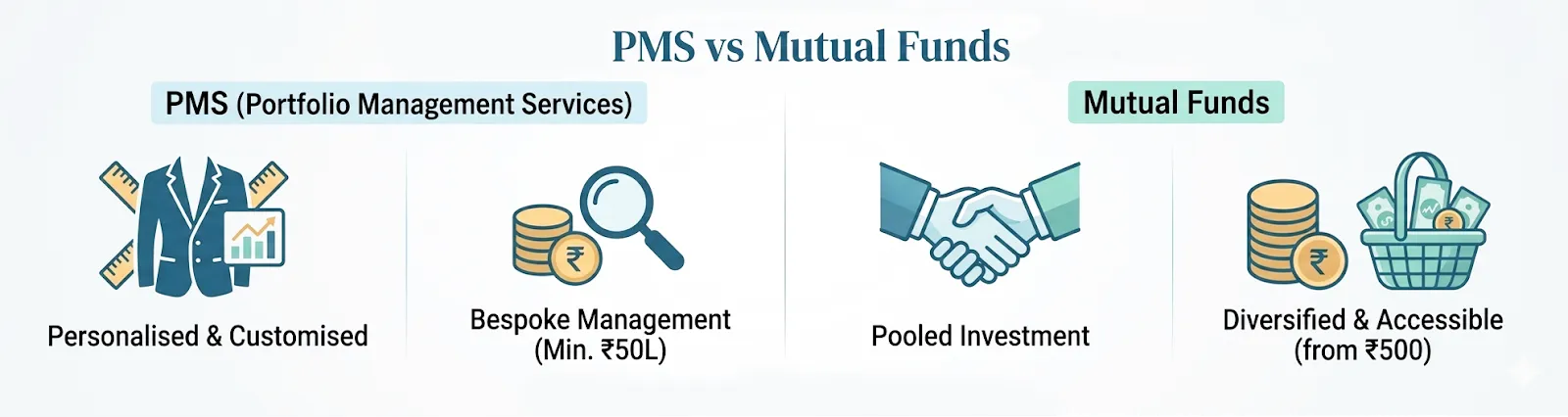
While this offers diversification and simplicity, it limits customization and direct visibility into stock-level decisions.
This is where PMS in investment becomes relevant. Unlike mutual funds, PMS services provide a personalized approach where portfolios are built around an investor’s specific goals, risk tolerance, and time horizon. For investors also evaluating basket-based investing, understanding PMS vs Mutual Funds vs Smallcase can help clarify which structure fits your stage of wealth. Instead of fund units, investors directly hold individual stocks in a customized PMS portfolio, offering greater transparency and control.
Another key factor investors evaluate is cost. Mutual funds typically charge standardized expense ratios, while PMS charges may follow fixed or performance-based structures. Understanding PMS charges is essential when considering PMS in investment, as the pricing reflects the research, customization, and management involved.
For investors seeking deeper strategy and flexibility, PMS services enable focused investment approaches through a tailored PMS portfolio. But before making the transition, comparing PMS charges with mutual fund costs remains an important step.
One of the biggest differences between PMS and mutual funds in India is the level of customization offered. Portfolio Management Services are designed to create personalized portfolios based on an investor’s goals, risk tolerance, and investment horizon. Through active portfolio management, portfolio managers actively select and adjust stocks to align with market opportunities and the investor’s strategy.
This personalized structure allows the implementation of a focused, active portfolio management strategy, where investments are carefully chosen rather than broadly diversified across hundreds of stocks. In contrast, mutual funds follow a pooled structure where all investors hold the same portfolio, limiting customization compared to PMS; the core distinction in any pms vs mutual funds analysis.
Another important distinction is how investors hold their investments. In PMS, investors directly own the individual stocks or securities within their portfolio. This means every investor has a unique portfolio tailored to their strategy, often built using active portfolio management techniques to capitalize on specific opportunities.
The portfolio manager continuously evaluates market conditions and adjusts holdings as part of an evolving active portfolio management strategy. Mutual funds, however, provide investors with units of a pooled fund rather than direct ownership of stocks, which reduces visibility into individual holdings.
Portfolio Management Services typically rely on active portfolio management to make investment decisions. Managers continuously analyze markets, sectors, and individual companies to optimize returns. This allows them to implement a dynamic active portfolio management strategy that can respond quickly to market changes.
Mutual funds also involve professional management, but they usually operate under predefined mandates that may limit flexibility compared to PMS. Many investors seek guidance from a sebi registered investment advisor to determine whether a PMS strategy or mutual fund allocation aligns better with their financial goals.
The minimum investment requirement is another key factor in pms vs mutual funds. Mutual funds are accessible to almost every investor and can be started with relatively small amounts through systematic investment plans (SIPs) . PMS, however, is designed for higher-net-worth investors.
As per SEBI regulations, the minimum investment required for PMS in India is ₹50 lakhs. Because of this higher threshold, investors often consult a SEBI-registered investment advisor to evaluate whether transitioning to PMS is suitable once their investment corpus reaches this level.Investors considering advanced vehicles beyond PMS can also explore the difference between PMS and AIF to understand which structure matches higher-ticket investment goals.
The cost structure of PMS and mutual funds also differs significantly. Mutual funds charge an expense ratio that is embedded in the fund’s returns and shared among investors. PMS, on the other hand, may involve fixed management fees, performance-based fees, or a combination of both due to the personalized services and active portfolio management involved.
Before investing, many individuals seek guidance from a sebi registered investment advisor to understand the fee structure and evaluate the long-term value of a customized active portfolio management strategy compared with traditional mutual fund investments.
Also Read: Who are The Real Winners of the Iran-Israel War? : Sectors, Companies, Countries Gaining from War
Reaching ₹50 lakhs in investable capital is more than just a numerical milestone. It often marks the point where investors begin shifting from simple accumulation strategies toward more sophisticated wealth management approaches. At this level, the investment choices available to you expand significantly,making the pms vs mutual funds question more relevant than ever. Particularly with the eligibility to explore PMS in investment.
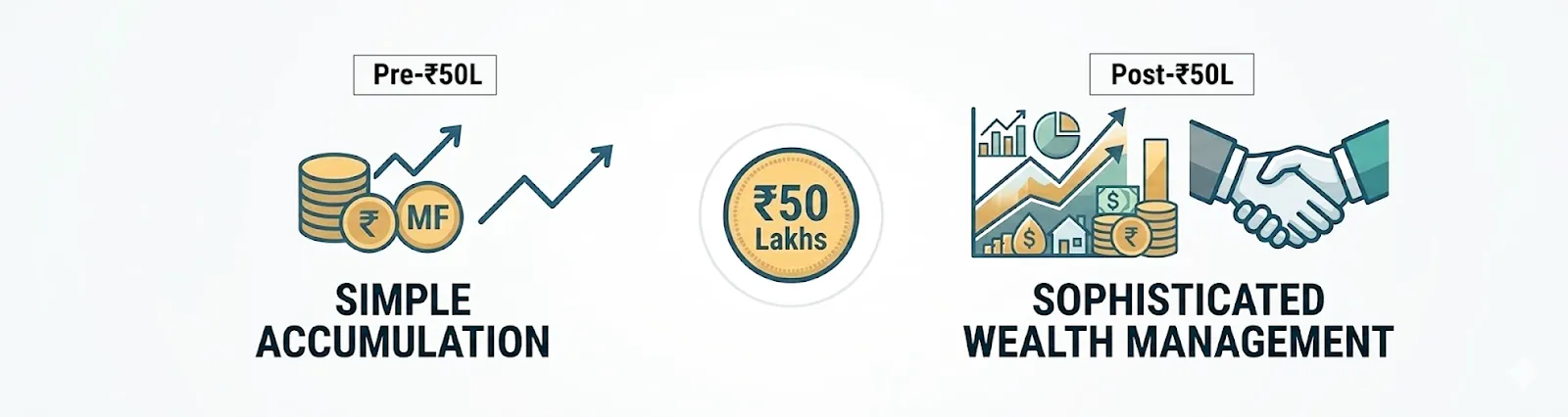
One of the biggest changes at this stage is eligibility for PMS services. As per SEBI regulations, Portfolio Management Services require a minimum investment of ₹50 lakhs. This threshold allows investors to move beyond standardized investment vehicles and consider PMS in investment, where portfolios are managed in a more personalized and strategic manner.
With PMS services, investors gain access to professional portfolio managers who design strategies based on their individual financial goals and risk tolerance. Instead of following a generic fund mandate, the investor’s capital is allocated within a customized PMS portfolio built specifically for them.
Ownership structure is another key difference. In mutual funds, investors hold units of a fund rather than the underlying securities. This means investors indirectly participate in the fund’s performance without owning individual stocks.
However, in PMS services, the investor directly owns securities within their PMS portfolio through their Demat account. This structure provides greater transparency and clarity about exactly where the capital is invested.
Since investors can see the stocks in their PMS portfolio, they often gain better insight into the strategy being implemented under PMS in investment .
Taxation is another factor that becomes more relevant at higher investment levels.
Mutual funds are generally considered more tax-efficient because investors only pay capital gains tax when they redeem or sell their fund units.
However, in PMS in investment, taxation works differently. When a portfolio manager buys and sells stocks within a PMS portfolio, those transactions may trigger capital gains tax in the investor’s account.
Although PMS services aim to optimize returns through strategic buying and selling, investors must consider how PMS charges and taxation together affect overall returns. For a detailed breakdown, read our analysis on the capital gains tax impact on PMS vs mutual funds including post-tax return comparisons across holding periods.
Liquidity is another factor investors should evaluate when transitioning to PMS in investment.
Mutual funds typically offer high liquidity, allowing investors to redeem their units quickly with relatively simple processes.
With PMS services, liquidity may vary depending on the strategy being followed. Some strategies, especially those involving mid-cap or small-cap stocks , may require longer timeframes to liquidate positions.
Additionally, certain PMS providers may impose exit loads or lock-in periods, which means investors should carefully understand the terms before committing capital to a PMS portfolio.
For this reason, analyzing PMS charges, liquidity terms, and exit conditions becomes essential when evaluating PMS services.
Also Read: Why You Should Review Your Mutual Fund Portfolio for Long-Term Wealth Preservation
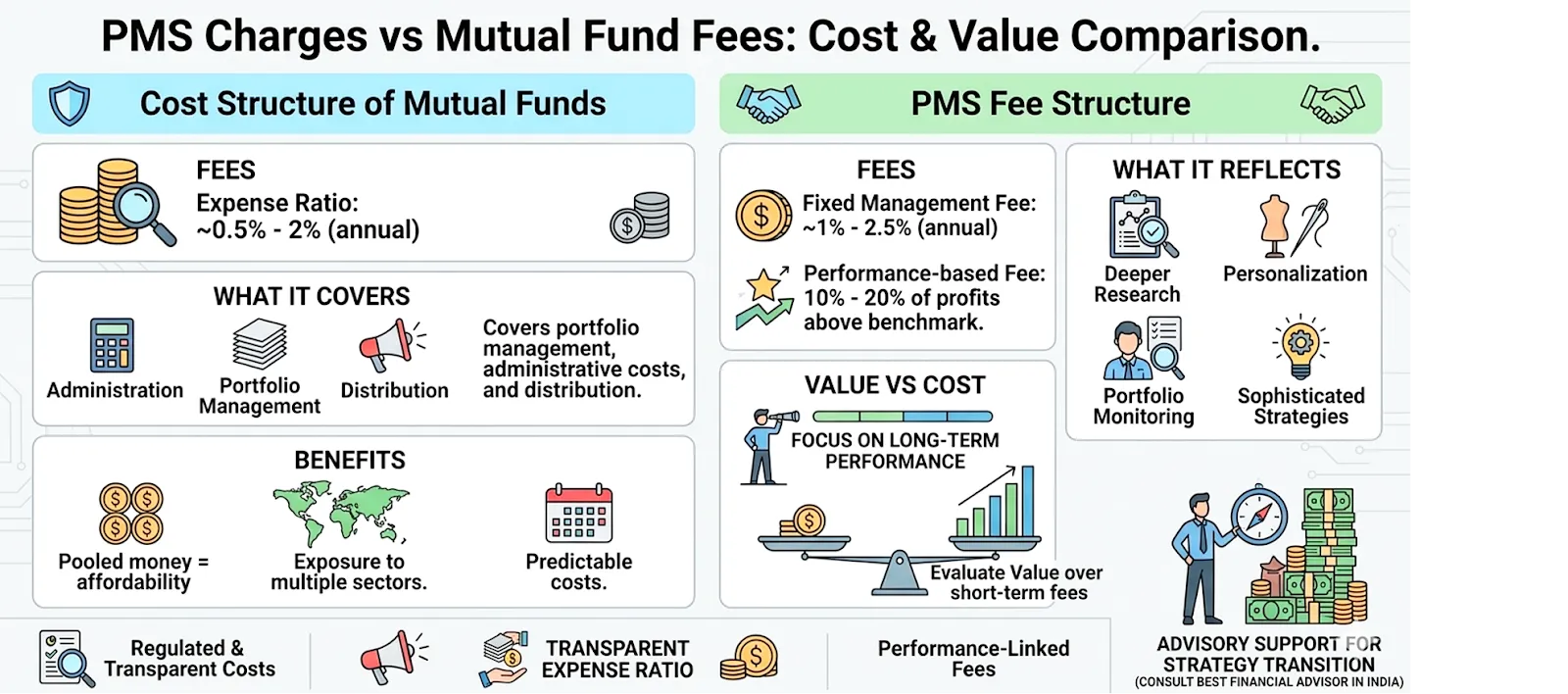
Mutual funds follow a transparent fee structure called the expense ratio, which typically ranges between 0.5% and 2% annually, depending on the type of fund and whether it is direct or regular. This fee covers portfolio management , administrative costs, and distribution expenses.
Because mutual funds pool money from thousands of investors, costs are spread out, making them relatively affordable. This allows investors to build a diversified mutual fund investment portfolio efficiently. A well-constructed mutual fund stock portfolio can provide exposure to multiple sectors while keeping costs predictable.
For this reason, many top financial advisors in India recommend mutual funds as the foundation of the best mutual fund portfolio for long-term investing.
Portfolio Management Services follow a different pricing model. Instead of an expense ratio, PMS providers typically charge a fixed management fee of around 1% to 2.5% annually, along with performance-based fees that can range between 10% and 20% of profits above a benchmark.
Because PMS portfolios are customized and actively managed, portfolio managers spend more time on research, stock selection, and portfolio monitoring. This higher level of personalization is why many investors consult the best financial advisor in India or the best stock market advisor in India before transitioning from a mutual fund investment portfolio to PMS strategies.
Although PMS fees may appear higher, they reflect personalized portfolio management and deeper research. Many top financial advisors in India suggest evaluating long-term performance rather than focusing only on fees.
Mutual funds remain attractive due to regulated expense ratios, allowing investors to maintain a diversified mutual fund stock portfolio and build the best mutual fund portfolio without unpredictable costs.
Also Read: Why India’s Private Capex Crisis Has Been Falling and Why the Floor May Be Near
Choosing between PMS and mutual funds depends on your investment capital, financial goals, and how actively you want your portfolio to be managed.
Mutual funds are often ideal for investors seeking diversification, simplicity, and lower costs. They allow individuals to gradually build a strong mutual funds portfolio with relatively small investments. Because funds pool money from multiple investors, they naturally create a diversified mutual fund portfolio across sectors and companies.
Investors typically combine different fund categories to manage risk and returns. For example, conservative mutual funds focus on stability and capital preservation, while moderate risk mutual funds aim to balance growth and stability. Those seeking aggressive growth opportunities may allocate a portion of their mutual funds portfolio to high-return mutual funds.
By combining conservative mutual funds, moderate risk mutual funds, and high return mutual funds, investors can construct a well-balanced diversified mutual fund portfolio suited to their risk appetite.
On the other hand, Portfolio Management Services (PMS) are designed for high-net-worth investors who want customized strategies and direct stock ownership. PMS requires a minimum investment of ₹50 lakhs and offers personalized portfolios managed by professionals.You can explore Wright Research PMS and equity portfolios to see data-driven strategies built for different risk profiles and investment horizons.
Many investors consult top financial advisory firms in India when deciding whether to transition to PMS or continue strengthening their mutual funds portfolio. These experts often recommend maintaining a diversified mutual fund portfolio built with conservative mutual funds, moderate risk mutual funds, and high return mutual funds while exploring other advanced strategies.
Also Read: Is the World Running Out of Copper?
At ₹50 lakhs, the real question is not which product is better, but which structure fits your financial goals, tax situation, risk tolerance, and investment horizon most efficiently.
PMS in investment offers direct ownership, customization, and concentrated active management, but it comes at a higher cost. These costs, including PMS charges, are only justified when the manager consistently generates genuine alpha over market cycles.
On the other hand, a best mutual fund portfolio built through direct plans and diversified across conservative mutual funds, moderate risk mutual funds, and growth-oriented equity funds can deliver strong long-term returns for many investors at a much lower cost, while also offering liquidity and transparency.
The top financial advisors in India, especially those operating as sebi registered investment advisors, can help evaluate this decision objectively. Their role is to guide investors based on suitability rather than product-driven incentives.
Understand the structure, evaluate performance history, review PMS charges, and build a portfolio aligned with your goals, not someone else’s revenue model.
PMS cost refers to the fees charged for managing investments under Portfolio Management Services. It typically includes a fixed management fee of around 1%–2.5% annually and may also include a performance fee of 10%–20% on profits above a benchmark. These costs cover research, portfolio management, and personalized investment strategies.
PMS can be a good investment for high-net-worth investors who want customized portfolios, direct stock ownership, and active portfolio management. It allows concentrated strategies tailored to specific goals. However, PMS involves higher fees and requires a minimum investment of ₹50 lakhs, so its value depends on the manager’s ability to generate consistent long-term returns.
The best PMS provider depends on your goals, risk tolerance, and investment strategy. Some well-known PMS providers in India include Wright Research, Motilal Oswal PMS, Marcellus Investment Managers, ASK Investment Managers, ICICI Prudential PMS, and Kotak PMS. Before investing, evaluate their track record, strategy, transparency, and fee structure, and consult a SEBI-registered investment advisor for unbiased guidance.
Some of the top financial advisory firms in India include Motilal Oswal Financial Services, ICICI Securities, Kotak Wealth Management, ASK Investment Managers, Marcellus Investment Managers, Anand Rathi Wealth, IIFL Wealth & Asset Management, Edelweiss Wealth Management, DSP Investment Managers, and Wright Research.
These firms offer services like portfolio management, wealth planning, and investment advisory for individual and institutional investors.
Mutual funds can be moderate-risk investments, but the risk level depends on the type of fund. Equity mutual funds generally carry higher risk, while debt or conservative mutual funds have lower risk. Moderate risk mutual funds, such as hybrid or balanced funds, combine equity and debt to offer a balance between growth potential and stability.
To diversify your mutual fund portfolio, invest across different categories such as large-cap, mid-cap, and international equity funds, along with debt or conservative mutual funds for stability. You can also include moderate-risk mutual funds like hybrid funds. Spreading investments across sectors and asset classes helps reduce risk and improve long-term portfolio balance.
As per SEBI regulations, the minimum investment for Portfolio Management Services (PMS) in India is ₹50 lakhs. This threshold distinguishes PMS from mutual funds, which are accessible to all investors regardless of corpus size.
Discover investment portfolios that are designed for maximum returns at low risk.
Learn how we choose the right asset mix for your risk profile across all market conditions.
Get weekly market insights and facts right in your inbox


It depicts the actual and verifiable returns generated by the portfolios of SEBI registered entities. Live performance does not include any backtested data or claim and does not guarantee future returns.
By proceeding, you understand that investments are subjected to market risks and agree that returns shown on the platform were not used as an advertisement or promotion to influence your investment decisions.
"I was drawn to Wright Research due to its multi-factor approach. Their Balanced MFT is an excellent product."

By Prashant Sharma
CTO, Zydus
By signing up, you agree to our Terms and Privacy Policy
"I was drawn to Wright Research due to its multi-factor approach. Their Balanced MFT is an excellent product."
By Prashant Sharma
CTO, Zydus
Skip Password
By signing up, you agree to our Terms and Privacy Policy
"I was drawn to Wright Research due to its multi-factor approach. Their Balanced MFT is an excellent product."
By Prashant Sharma
CTO, Zydus
"I was drawn to Wright Research due to its multi-factor approach. Their Balanced MFT is an excellent product."
By Prashant Sharma
CTO, Zydus
Log in with Password →
By logging in, you agree to our Terms and Privacy Policy
"I was drawn to Wright Research due to its multi-factor approach. Their Balanced MFT is an excellent product."
By Prashant Sharma
CTO, Zydus
Log in with OTP →
By logging in, you agree to our Terms and Privacy Policy
"I was drawn to Wright Research due to its multi-factor approach. Their Balanced MFT is an excellent product."
By Prashant Sharma
CTO, Zydus
Answer these questions to get a personalized portfolio or skip to see trending portfolios.
Answer these questions to get a personalized portfolio or skip to see trending portfolios.
(You can choose multiple options)
Answer these questions to get a personalized portfolio or skip to see trending portfolios.
Answer these questions to get a personalized portfolio or skip to see trending portfolios.
Answer these questions to get a personalized portfolio or skip to see trending portfolios.
(You can choose multiple options)
Investor Profile Score
We've tailored Portfolio Management services for your profile.
View Recommended Portfolios Restart