


Portfolio management services (PMS) are SEBI-regulated investment vehicles ideal for NRIs and HNIs seeking active portfolio management in India. With a PMS minimum investment of ₹50 lakhs, PMS offers customized HNI portfolio management, professional portfolio risk management, and transparent PMS charges. Wright Research provides PMS for NRI India through quant-driven strategies for superior, long-term wealth creation.
Introduction
You've worked hard, saved diligently, and built a substantial corpus. Maybe you're settled abroad and want your Indian wealth to work harder. Maybe you're an HNI who's tired of mutual fund returns that just mirror the index. Either way, you've probably asked yourself: "Is there something more sophisticated, more personalised, something actually built for someone at my level?"
There is. And it's called Portfolio Management Services.
This guide breaks down everything you need to know about portfolio management services for NRIs and HNIs in India, from how they work, what the charges look like, and why Wright Research's quant-driven approach makes a compelling case for serious investors.
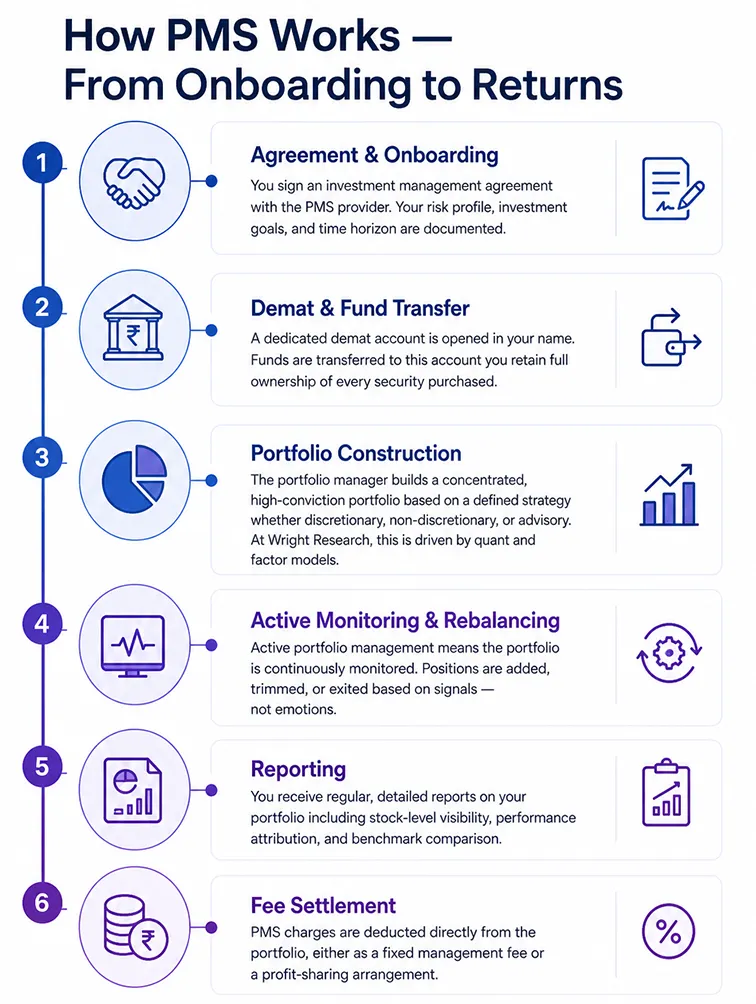
How PMS Services Work: From Onboarding to Returns (6 Steps)
Understanding how PMS services function end-to-end removes much of the mystery and the hesitation. Here's the process:
Step 1 Agreement & Onboarding: You sign an investment management agreement with the PMS provider. Your risk profile, investment goals, and time horizon are documented.
Step 2 Demat & Fund Transfer: A dedicated demat account is opened in your name. Funds are transferred to this account and you retain full ownership of every security purchased.
Step 3 Portfolio Construction: The portfolio manager builds a concentrated, high-conviction portfolio based on a defined strategy whether discretionary, non-discretionary, or advisory. At Wright Research, this is driven by quant and factor models.
Step 4 Active Monitoring & Rebalancing: Active portfolio management means the portfolio is continuously monitored. Positions are added, trimmed, or exited based on signals not emotions.
Step 5 Reporting: You receive regular, detailed reports on your portfolio individual stock-level visibility, performance attribution, and benchmark comparison.
Step 6 Fee Settlement: PMS charges are deducted directly from the portfolio, either as a fixed management fee or a profit-sharing arrangement.
See what markets are pricing in
Live indices, sector moves and market breadth — the backdrop to every story we publish.
Portfolio Management Services in India: Key Data, SEBI Rules and Facts
Before making any decision, here are the numbers that matter for portfolio management services in India:
Parameter |
PMS |
Mutual Funds |
Direct Equity |
Minimum Investment |
₹50 Lakhs |
₹500–₹5,000 |
No minimum |
Regulation |
SEBI (Portfolio Managers) |
SEBI/AMFI |
NSE/BSE |
Ownership |
Direct (in your demat) |
Units of the pooled fund |
Direct |
Customisation |
High tailored to the investor |
Low pooled strategy |
Full (but self-managed) |
Transparency |
Stock-level visibility |
NAV-level only |
Full |
Active Management |
Yes dedicated manager |
Varies |
Fully DIY |
Ideal For HNIs, NRIs Retail & all investors Experienced DIY investor
Tax Treatment Pass-through (investor's hands) Fund-level tax events Investor's hands
Portfolio management services' minimum investment , as mandated by SEBI, is ₹50 lakhs, a threshold that aligns with the HNI and NRI investor profile. This minimum ensures the service remains exclusive, accountable, and genuinely customised.
For NRI wealth management, India's PMS landscape offers a particularly strong case: the Indian equity market has historically outperformed many developed markets over 10–15 year cycles, and having a professionally managed portfolio analysis and management setup captures this potential with institutional-grade discipline.
Who Should Consider PMS NRI & HNI Profiles
Portfolio management services are not for everyone, but for the right investor, they are transformational. Here are the profiles that benefit most:
The NRI Professional Abroad: You've accumulated savings in USD, GBP, or AED. You want India exposure, but you can't track markets daily, you don't have time to research stocks, and you want a SEBI-regulated manager doing it for you. PMS for NRI is precisely designed for this. You can invest through NRE or NRO accounts, and your portfolio is managed entirely by professionals.
The Business Owner / HNI in India: You have significant liquidity from a business exit, property sale, or inheritance. You want HNI wealth management that goes beyond standard mutual fund allocations, something that captures alpha, not just beta.
HNI portfolio management through PMS allows a concentrated, high-conviction portfolio built around your specific goals.
The Retiree Seeking Growth + Capital Preservation: You want your corpus to grow while managing downside risk. A well-structured PMS with portfolio risk management protocols, stop-losses, diversification discipline, and rebalancing triggers protects capital while generating long-term returns.
The Returning NRI: You're coming back to India and want to consolidate and grow your accumulated wealth. Wealth management for NRI through a structured PMS for NRI India offering gives you a seamless transition from NRE/NRO to a fully managed equity portfolio.
PMS Charges What You Actually Pay
Transparency on PMS charges is non-negotiable, and frankly, it's one of the things that differentiates a trustworthy PMS provider from one you should avoid.
There are typically three fee structures in PMS services :
Fixed Fee Model: A fixed annual management fee, usually 1–2.5% of AUM, charged regardless of performance. Simple, predictable, and common for large portfolios.
Profit-Sharing / Performance Fee Model: No fixed fee, but the manager earns a share (typically 10–20%) of profits above a hurdle rate (e.g., Nifty 50 returns). This aligns the manager's incentives with yours; they only earn if you do.
Hybrid Model: A lower fixed fee combined with a performance component above a benchmark. This is increasingly common among leading portfolio advisory services providers.
Beyond the management fee, PMS charges can include:
Brokerage costs (for transactions within the portfolio)
Custodian charges
Depository (DP) charges
Exit load (if you redeem before a specified lock-in period typically 1–3 years)
GST on management fees
A good PMS provider will walk you through every component of the fee structure before you sign. If they don't, that's a red flag.
Get research like this in your inbox
The week’s research that mattered, in five minutes. Joined by 2L+ investors.
PMS vs Mutual Funds Which Is Right for You?
This is the question most HNIs and NRIs ask when evaluating their best investment options for NRI in India. Here's a clean comparison:
Parameter |
PMS |
Mutual Funds |
Minimum Investment |
₹50 Lakhs |
₹500 onwards |
Personalisation |
High built for you |
None pooled |
Transparency |
Full stock visibility |
NAV only |
Active Management |
Dedicated manager |
Varies by fund |
Tax Efficiency |
Investor controls exit timing |
Redemption triggers tax |
Concentrated Bets |
Yes high conviction |
Diversified by default |
Reporting |
Detailed, individual |
Standard NAV statements |
Suitable For |
HNIs (₹50L+), NRIs |
All retail investors |
If you're investing below ₹50 lakhs or prefer simplicity and diversification, the best investment for NRI in India through mutual funds is a solid choice. But if you have the corpus and want customisation, accountability, and the potential for alpha portfolio management services , offer something mutual funds structurally cannot.
Why Wright Research for HNI Wealth Management and NRI Portfolio Management
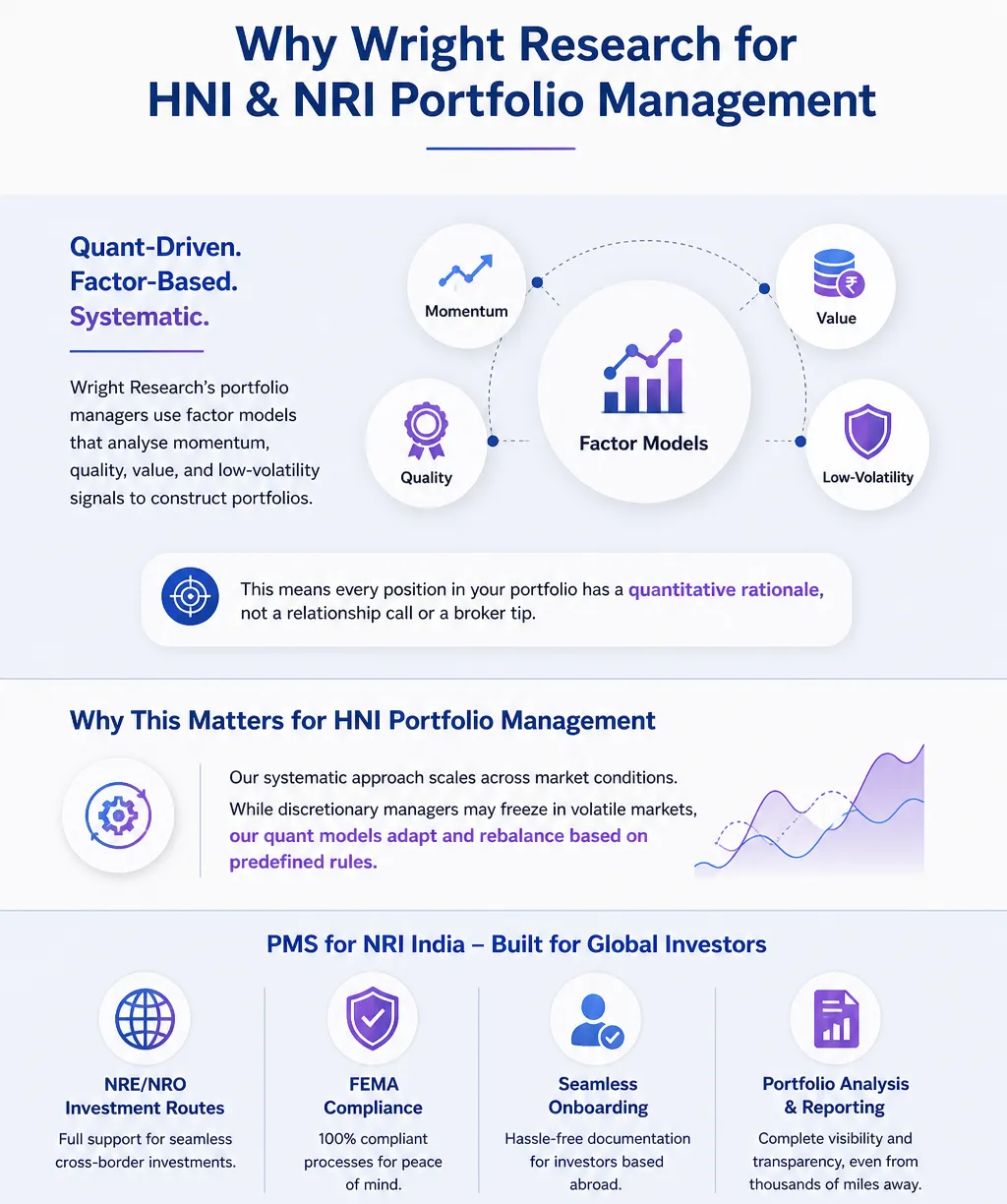
Not all PMS providers are equal. What sets Wright Research apart is its quant-driven, factor-based approach to active portfolio management removing emotional bias and replacing it with systematic, data-backed decision-making.
Wright Research's portfolio managers use factor models that analyse momentum, quality, value, and low-volatility signals to construct portfolios. This means every position in your portfolio has a quantitative rationale not a relationship call or a broker tip.
For HNI portfolio management, this systematic approach matters because it scales across market conditions. While discretionary managers may freeze in volatile markets, quant models adapt and rebalance based on predefined rules.
Wright Research also offers PMS for NRI India with full support for NRE/NRO investment routes, FEMA compliance, and seamless onboarding for investors based abroad. Their portfolio analysis and management reporting give NRI investors complete visibility, even from thousands of miles away.
How to Get Started with PMS?
Getting started with portfolio management services is straightforward:
Step 1 Initial Consultation: Speak with the Wright Research team to understand your investment goals, risk appetite, and time horizon. This call is obligation-free.
Step 2 Suitability Assessment: Based on your profile, the team recommends the most suitable PMS strategy growth-focused, balanced, or capital preservation-oriented.
Step 3 Documentation: Complete KYC, sign the investment management agreement, and open your demat account (if you don't have one). NRI investors will need NRE/NRO account details and additional FEMA documentation.
Step 4 Fund Transfer & Portfolio Construction: Once funds are received, your portfolio is constructed within the agreed mandate and time frame.
Step 5 Ongoing Monitoring & Reporting: Receive regular performance reports, rebalancing updates, and direct access to your relationship manager.
Ready to explore PMS services designed for serious investors? Talk to Wright Research today and let your money work as hard as you do.
Is your portfolio built for what’s coming?
Get a free AI-powered review of your holdings — risk, overlap and quality in minutes.
Conclusion
Wealth at a certain level deserves a strategy built to match it. For NRIs navigating cross-border finances and HNIs who've outgrown standard investment products, portfolio management services offer something genuinely different: personalisation, accountability, professional active portfolio management, and the kind of transparency that lets you sleep well at night regardless of market noise.
The case for pms in investment isn't just about chasing higher returns. It's about bringing structure, discipline, and institutional-grade portfolio risk management to wealth that took years, sometimes decades to build. Whether you're exploring PMS for NRI India for the first time or evaluating providers as an HNI ready to move beyond mutual funds, the fundamentals remain clear: the right PMS manager, with the right strategy, makes a meaningful difference over a full market cycle.
Frequently Asked Questions
1. What is the minimum investment for PMS in India?
As per SEBI regulations, the portfolio management services' minimum investment is ₹50 lakhs.
This threshold applies to all SEBI-registered PMS providers in India and ensures the service is offered to financially sophisticated investors who can absorb the associated risks. Some providers may have a higher internal minimum.
2. Can NRIs invest in PMS in India?
Yes. PMS for NRI is fully permitted under FEMA regulations. NRIs can invest through their NRE (Non-Resident External) or NRO (Non-Resident Ordinary) accounts. Pms for nri india requires standard KYC documentation, FEMA compliance, and PIS (Portfolio Investment Scheme) permission from the investor's bank.
3. What are the typical PMS charges?
Pms charges vary by provider and fee model. Most PMS providers charge a fixed management fee of 1–2.5% per annum, a performance-based fee of 10–20% above a hurdle rate, or a hybrid of both. Additional charges include brokerage, custodian fees, and GST. Always ask for a full fee disclosure before investing.
4. How is PMS different from mutual funds?
Portfolio management services hold securities directly in the investor's demat account, offer customized strategies, and provide full stock-level transparency. Mutual funds are pooled vehicles where investors own units, not individual stocks. Hni portfolio management through PMS allows concentrated, high-conviction strategies not possible within a mutual fund structure.
5. What kind of portfolio risk management does PMS offer?
PMS providers use several portfolio risk management tools, including position sizing limits, sector concentration caps, drawdown triggers, and systematic rebalancing protocols. At Wright Research, quant models add a layer of discipline by continuously evaluating factor signals and adjusting allocations to manage downside risk.
6. Is PMS the best investment option for NRIs in India?
For NRIs with a corpus of ₹50 lakhs or more and a long-term horizon, PMS for NRI is among the best investment options for NRIs in India. It offers professional wealth management for NRI, personalisation, full transparency, and the potential to outperform passive benchmarks over market cycles, all with SEBI-regulated oversight.
Disclaimer
Investments in securities markets are subject to market risks. Past performance is not indicative of future returns. Please read all related documents carefully and consult your financial advisor before investing. This content does not constitute investment advice.