


Introduction
Momentum is one of the most talked-about investment strategies today and for good reason. In rising markets, a momentum fund, momentum mutual funds, and even a momentum index fund can significantly outperform traditional equity strategies by capturing stocks that are already trending upward. This is why many investors actively search for the best momentum mutual funds during bull phases.
But the story isn’t one-sided. While momentum mutual funds thrive in strong, sustained rallies, data shows they can face sharper drawdowns when trends reverse. A momentum fund follows past performance, which means a momentum index fund may react with a lag during market corrections. This makes choosing among the best momentum mutual funds less about chasing returns and more about understanding risk.
This blog goes beyond theory to explain how a momentum fund, momentum mutual funds, and a momentum index fund actually behave across market cycles so investors can identify the best momentum mutual funds with clarity, not just momentum-driven hype.
See what markets are pricing in
Live indices, sector moves and market breadth — the backdrop to every story we publish.
What Makes a Momentum Mutual Fund Different from Other Equity Funds?
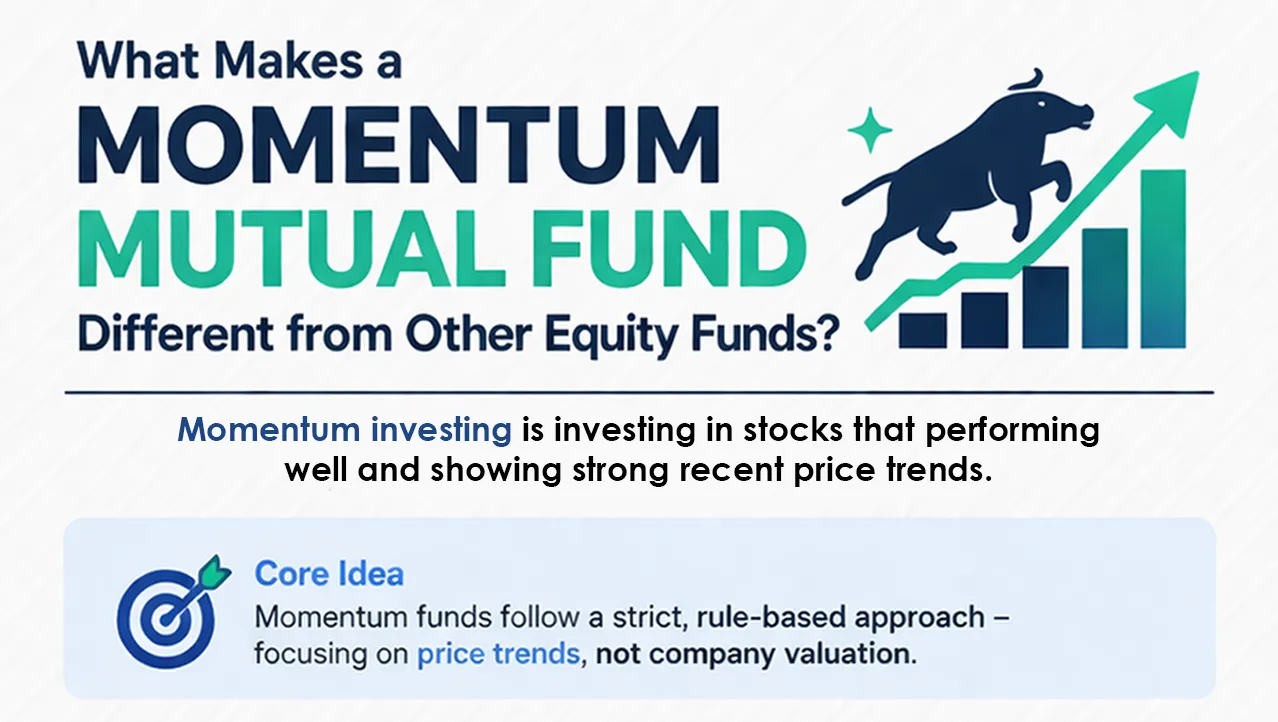
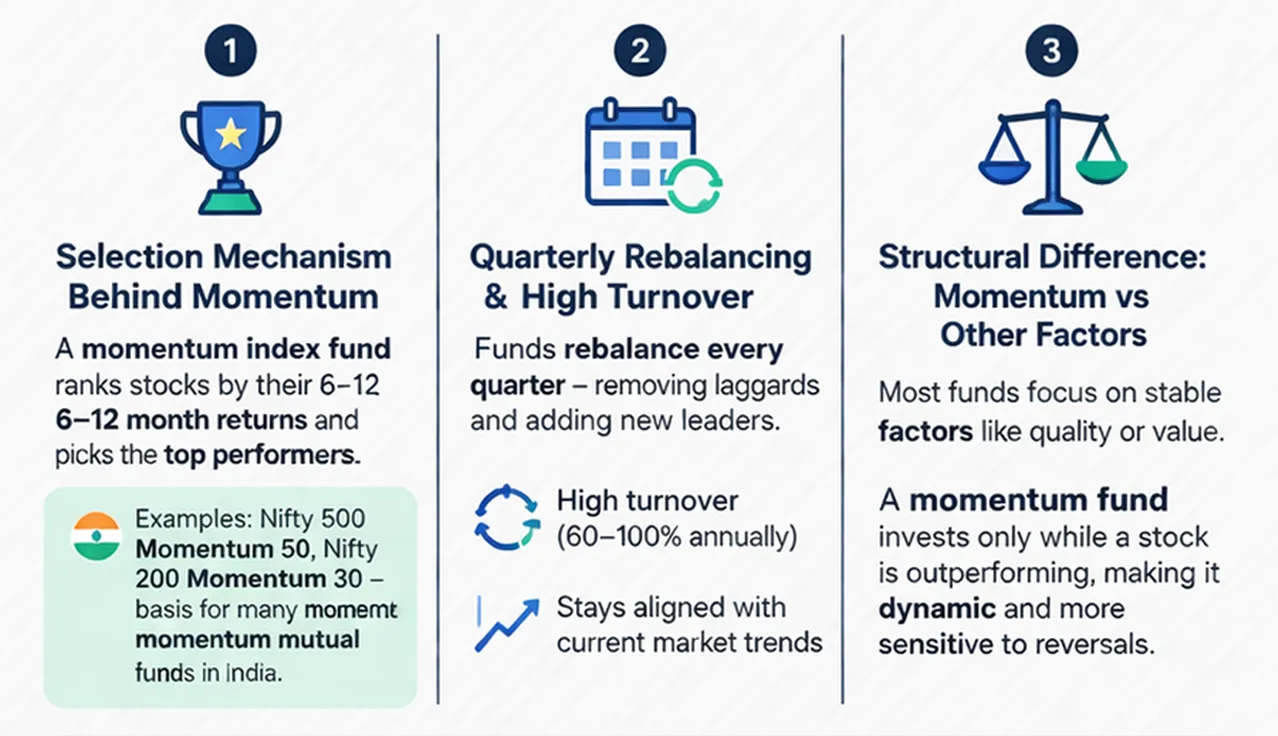
At its core, momentum investing is based on a simple idea: stocks that have performed well recently tend to keep performing well. A momentum fund applies this through a strict, rule-based approach, unlike traditional funds that focus on valuation or fundamentals.
1. The Selection Mechanism Behind Momentum
A momentum index fund ranks stocks based on 6–12 month returns and selects the top performers. Indices like Nifty 500 Momentum 50, Nifty 200 Momentum 30 follow this method, forming the base for many momentum mutual funds and some of the best momentum mutual funds in India .
2. Quarterly Rebalancing and High Turnover
Momentum mutual funds rebalance every quarter, removing laggards and adding new leaders. This leads to high turnover (60–100% annually). Each rebalance ensures a momentum fund stays aligned with current market trends.
3. Structural Difference: Momentum vs Other Factors
Unlike stable factors like quality or value, momentum is temporary. A stock stays in a momentum fund only while it outperforms. This makes momentum mutual funds more dynamic but also more sensitive to reversals, something investors in the best momentum mutual funds must understand.
4. Passive vs Active Momentum Strategies
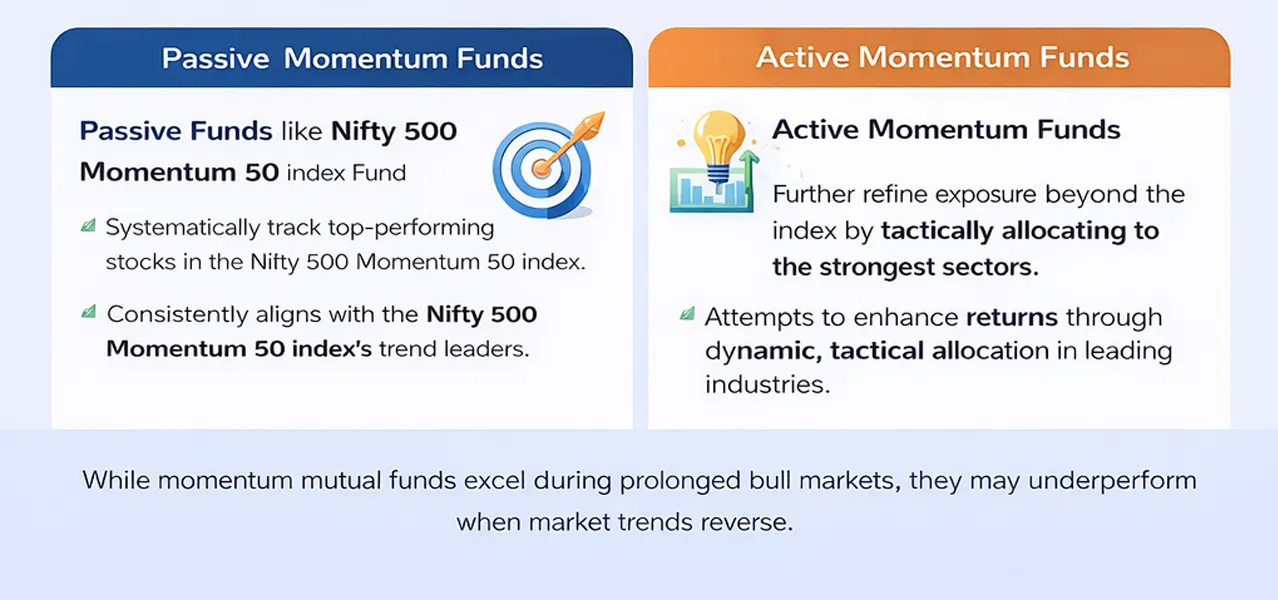
A passive momentum index fund follows index rules exactly, offering low cost and transparency key reasons they are often seen among the best momentum mutual funds.
An active momentum fund like Quant Momentum Fund or Kotak Active Momentum Fund can apply additional filters and adapt faster. Both approaches exist within momentum mutual funds, each with its own advantages.

Why Momentum Stands Apart?
A momentum fund focuses purely on price trends, making it unique among equity strategies . A momentum index fund follows this signal without deviation, while momentum mutual funds deliver disciplined exposure to market leaders. This is what sets apart the best momentum mutual funds: clarity of strategy, not prediction.
Also Read: Why You Should Review Your Mutual Fund Portfolio for Long-Term Wealth Preservation
How Momentum Mutual Funds Perform in Bull Markets: What the Data Shows?
The performance case for momentum in rising markets is compelling, and Indian data clearly supports it. Indices like the Nifty 500 momentum 50 have consistently delivered strong returns across bull phases. For instance, in FY 2023–24, the index delivered ~34.6% returns, close to the Nifty 500’s 36.8%, while in earlier years it outperformed meaningfully.
Since April 2016, the Nifty 500 momentum 50 index fund benchmark has compounded at a higher rate than the parent index, with most alpha generated during sustained rallies.
A strong example is the Edelweiss Nifty Midcap 150 Momentum 50, which delivered a 2-year CAGR of 30.9% vs 31.8% for its benchmark, highlighting how passive strategies like a Nifty 500 momentum 50 index fund closely track index performance. At the same time, an active momentum fund may attempt to enhance returns through tactical allocation, especially during strong cycles.
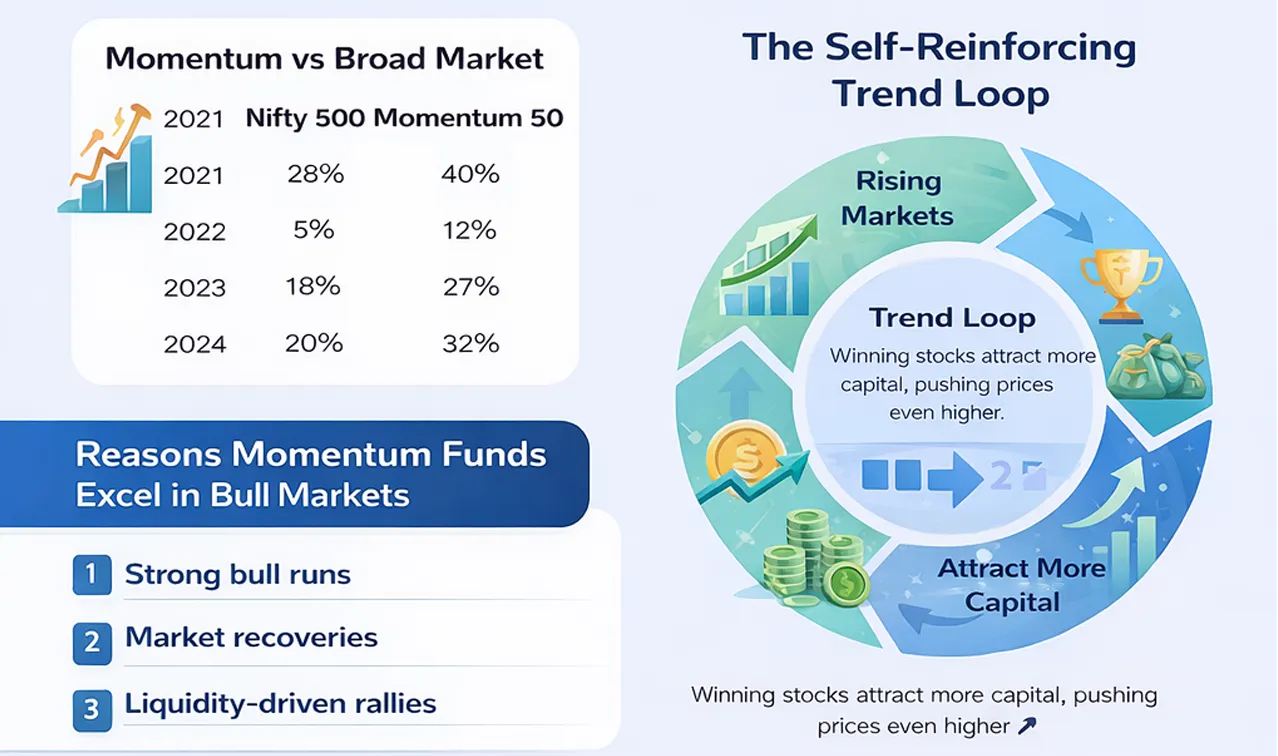
Momentum vs Broad Market
Year | Nifty 500 | Nifty 500 Momentum 50 |
2021 | 28% | 40% |
2022 | 5% | 12% |
2023 | 18% | 27% |
2024 | 20% | 32% |
This consistent outperformance explains why investors actively search for the best momentum funds in India during bull markets. Both passive options tracking the Nifty 500 momentum 50 and strategies like a Nifty 500 momentum 50 index fund benefit from the same core mechanism.
The driver behind this is the self-reinforcing trend loop. As markets rise, winning stocks attract more capital, pushing prices even higher. A nifty 500 momentum 50 index fund systematically captures these leaders, while an active momentum fund may further refine exposure. This is why many of the best momentum funds in India deliver strong returns during:
Strong bull runs
Market recoveries
Liquidity-driven rallies
Fund houses also acknowledge that momentum is designed to thrive in such environments. The strategy intentionally concentrates on leading sectors, whether it was IT and pharma earlier or capital goods and defence more recently, because the Nifty 500 momentum 50 reflects where market leadership exists.
The result is clear: both passive and active momentum fund strategies can outperform during prolonged rallies, making them some of the best momentum funds in India in bullish phases. However, this outperformance comes with a trade-off, one that becomes visible when market trends reverse.
Also Read: Decoding the Iran–Israel Conflict for Portfolios: Timeline, Markets, Oil Prices, Macro Transmission
What the Data Shows When Markets Correct: The Bear Market Problem
This is where the real story of momentum emerges.
Between September 2024 and January 2025, the average momentum strategy lost ₹21,000 per ₹1 lakh invested, compared to ₹12,600 for the broader market, a 67% deeper drawdown. Even portfolios tracking the Nifty 500 momentum 50 or a Nifty 500 momentum 50 index fund were not immune. This clearly highlights the core issue: momentum fund risk is not just volatility, but structural.
The key reason is rebalancing lag.
A nifty 500 momentum 50 index fund typically rebalances quarterly. If markets reverse mid-cycle, the portfolio remains locked into previous winners, often the very stocks that fall the fastest. This delay, which can last up to 90 days, is what amplifies downside risk across both passive strategies and any active momentum fund.
Why Drawdowns Differ Across Market Corrections?
In a flash crash like March 2020, momentum suffers the most. Stocks leading the Nifty 500 momentum 50 quickly become the biggest losers, and a Nifty 500 momentum 50 index fund has no time to adjust. Even an active momentum fund struggles to react instantly in such sharp declines.
In a slow grind like the 2018 IL&FS crisis, the impact is more contained. Gradual declines allow rebalancing cycles to partially adjust exposure. Here, both passive and active momentum fund strategies perform relatively better, though still volatile.
The most dangerous scenario is a sector-led correction. Momentum portfolios often become concentrated in leading sectors. When those sectors reverse, as seen in IT (2022) or broader corrections (2024), the Nifty 500 momentum 50 becomes heavily exposed. A nifty 500 momentum 50 index fund reflects this concentration directly, while an active momentum fund may attempt diversification but cannot fully escape the trend reversal.
The Real Risk Investors Miss
Most investors searching for the best momentum funds in India focus on returns in bull markets but ignore this structural downside. The reality is that both passive strategies tracking the Nifty 500 momentum 50, and any active momentum fund are inherently exposed to delayed exits.
This is why selecting the best momentum funds in India is not just about performance; it’s about understanding how they behave when trends break. The same design that makes them powerful in bull markets also makes them vulnerable in corrections.
Also Read: Who are The Real Winners of the Iran-Israel War?: Sectors, Companies, Countries Gaining from War
Get research like this in your inbox
The week’s research that mattered, in five minutes. Joined by 2L+ investors.
Active vs Passive Momentum Funds: Which Handles Market Cycles Better?
The Indian momentum investing landscape is divided into two distinct approaches, passive and active, and they are not interchangeable. Understanding this difference is critical to evaluating momentum factor investing strategies and managing momentum fund risk.
Passive options like Nifty 200 Momentum 30, Nifty 500 Momentum 50 index fund, and Nippon India Nifty 500 Momentum 50 follow NSE’s methodology exactly. They offer low costs (0.20–0.40%) and, importantly, come with an ~8-year track record (since 2016), covering multiple market cycles. This makes passive momentum investing more transparent and evidence-backed.
Active funds like Quant Momentum Fund and Kotak Active Momentum Fund attempt to enhance momentum factor investing through dynamic allocation and proprietary signals. However, most were launched post-2023, meaning their ability to manage momentum fund risk across full cycles remains largely untested. Only the Quant Momentum Fund has a relatively longer history.
Structural Comparison
Factor | Passive Momentum | Active Momentum |
Track Record | ~8 years | Mostly post-2023 |
Expense Ratio | 0.20%–0.40% | 0.50%–1%+ |
Reaction Speed | Fixed (quarterly) | Potentially faster |
Concentration | Rule-based | Flexible |
Bear Market Data | Available | Limited |
Passive strategies like Nifty 200 momentum 30 offer proven, low-cost exposure to momentum investing, with clearly visible drawdowns and behavior. Active strategies aim to reduce momentum fund risk through flexibility, but lack sufficient long-term data.
For now, passive momentum factor investing remains the more evidence-driven choice, while active funds represent potential but unproven enhancements to the momentum investing approach.
Also Read: From Coal to Cloud: Mapping India’s Shift from Conventional Power to Sustainable Infrastructure
How to Position Momentum Funds in Your Portfolio?
The most important rule for investors: momentum is a satellite allocation, not a core one.
Momentum strategies are designed to capture trends, not provide stability. That’s why exposure should typically be 15–25% of your equity portfolio , depending on risk tolerance. Whether you choose options like Quant Momentum Fund, UTI Nifty 200 Momentum 30 Index Fund, Nippon India Nifty 500 Momentum 50, or Kotak Active Momentum Fund, the role remains the same: to enhance returns, not anchor the portfolio.
Why Positioning Matters?
A common mistake is treating a momentum strategy as a core holding. Funds like Quant Momentum Fund or Kotak Active Momentum Fund can deliver strong returns in bull markets, but their volatility makes them unsuitable as a foundation. Similarly, passive options like UTI Nifty 200 Momentum 30 Index Fund or Nippon India Nifty 500 Momentum 50 carry the same structural risks.
SIP Over Lump Sum: A Structural Necessity
Momentum strategies are most attractive after strong rallies, exactly when risk is highest. Entering a Quant Momentum Fund, UTI Nifty 200 Momentum 30 Index Fund, or Nippon India Nifty 500 Momentum 50 via lump sum at market peaks exposes investors to sharp drawdowns. Even an actively managed option like Kotak Active Momentum Fund cannot fully avoid this timing risk.
A Systematic Investment Plan (SIP) helps average entry points and reduce this risk, making it the preferred route across both passive and active momentum strategies.
Investor Suitability
Investor Type | Suitable | Allocation |
Aggressive Growth | Yes | 20–25% |
Moderate | Selective | 10–15% |
Conservative | Limited | 0–10% |
Aggressive investors with long horizons can allocate more to strategies like the Quant Momentum Fund or the Kotak Active Momentum Fund, accepting volatility for higher potential returns. Moderate investors should limit exposure and prefer disciplined SIPs into funds like UTI Nifty 200 Momentum 30 Index Fund or Nippon India Nifty 500 Momentum 50. Conservative investors should keep allocations minimal, if any.
Investors searching for the right approach shouldn’t just compare returns across Quant Momentum Fund, UTI Nifty 200 Momentum 30 Index Fund, Nippon India Nifty 500 Momentum 50, or Kotak Active Momentum Fund. The real edge lies in positioning and allocation discipline.
Also Read: What the Iran-Israel-US War Means For India's & World's Fertilizer Industry?
Conclusion
Momentum is powerful, but not foolproof.
A momentum fund, momentum mutual funds, and even a momentum index fund have a well-established place in India’s equity landscape , backed by NSE methodology and strong bull market performance data. This is why many investors actively seek the best momentum mutual funds during rising markets.
But the same structure that drives outperformance also explains the downside. The sharper drawdowns seen in corrections are not failures; they are how a momentum fund is designed to behave when trends reverse and rebalancing lags.
The real edge is not in chasing the best momentum mutual funds, but in using momentum mutual funds correctly. Treat every momentum fund or momentum index fund as a satellite allocation, invest through SIPs , and combine them with more stable strategies.
Bull markets reward momentum. Bear markets expose it. Smart investors use momentum mutual funds as a tool, not a shortcut to returns.
Is your portfolio built for what’s coming?
Get a free AI-powered review of your holdings — risk, overlap and quality in minutes.
Frequently Asked Questions
1. Which momentum fund is the best?
There is no single “best” momentum fund. Options like Quant Momentum Fund, Nippon India Nifty 500 Momentum 50, and UTI Nifty 200 Momentum 30 Index Fund serve different needs. The best choice depends on cost, strategy (active vs passive), and your risk tolerance.
2. Is it safe to invest in momentum funds?
Momentum funds are not fully “safe” as they carry higher volatility and drawdown risk. They perform well in bull markets but can fall sharply during corrections due to rebalancing lag and concentration. They are safer when used as a limited, diversified allocation.
3. Is the Momentum fund good for long-term investment?
Momentum funds can deliver strong long-term returns, but only when used strategically. They work best over full market cycles and as part of a diversified portfolio, not as a core holding, due to periods of underperformance in volatile or bear markets.
4. What are active momentum funds in India?
Active momentum funds in India include Quant Momentum Fund, Kotak Active Momentum Fund, and ICICI Prudential Momentum Fund. These funds use fund manager discretion and additional filters to improve momentum investing, unlike passive funds that strictly track momentum indices.