by Wright Research
Published On March 25, 2026
Your mutual funds portfolio may be too conservative if it was built for caution rather than your current goals. Here are five clear signals:
For investors with a 7–15 year horizon, a conservative mutual funds portfolio (70–80% debt) can cost more in lost compounding than a market correction ever would. Equity has historically delivered 12–15% CAGR over 10 years versus 6.5–7.5% for debt instruments in India.
Investments are subject to market risk. Past performance is not a guarantee of future returns.
There is a version of financial safety that quietly bleeds your future dry. It looks responsible. It sits in debt funds, liquid funds, and fixed deposits. It never loses on paper. And over a 10-year horizon, it can cost you more than a market correction ever would.
If your mutual funds portfolio has not been reviewed in the last 12 months, there is a reasonable chance it still reflects a risk appetite you had three years ago, a life stage you have moved past, or a market environment that no longer exists. The investor who began SIPs during the COVID-era caution, is not the same investor who now has a 7-year time horizon, a stable income, and a real wealth goal that requires equity to deliver.
The conversation nobody has often enough is not about whether to take a risk. It is about whether the risk you are currently taking is calibrated or whether it is simply a residue of inertia. An active portfolio management strategy demands that you ask this question on a schedule, not just after a market drawdown.
This blog is for investors who have been responsible, cautious, and consistent and who may now be leaving serious long-term returns on the table. The goal is not to push you toward recklessness. It is to help you identify whether your current mutual funds portfolio still matches where you are going, and to understand what a more growth-aligned mutual fund portfolio actually looks like in 2026.
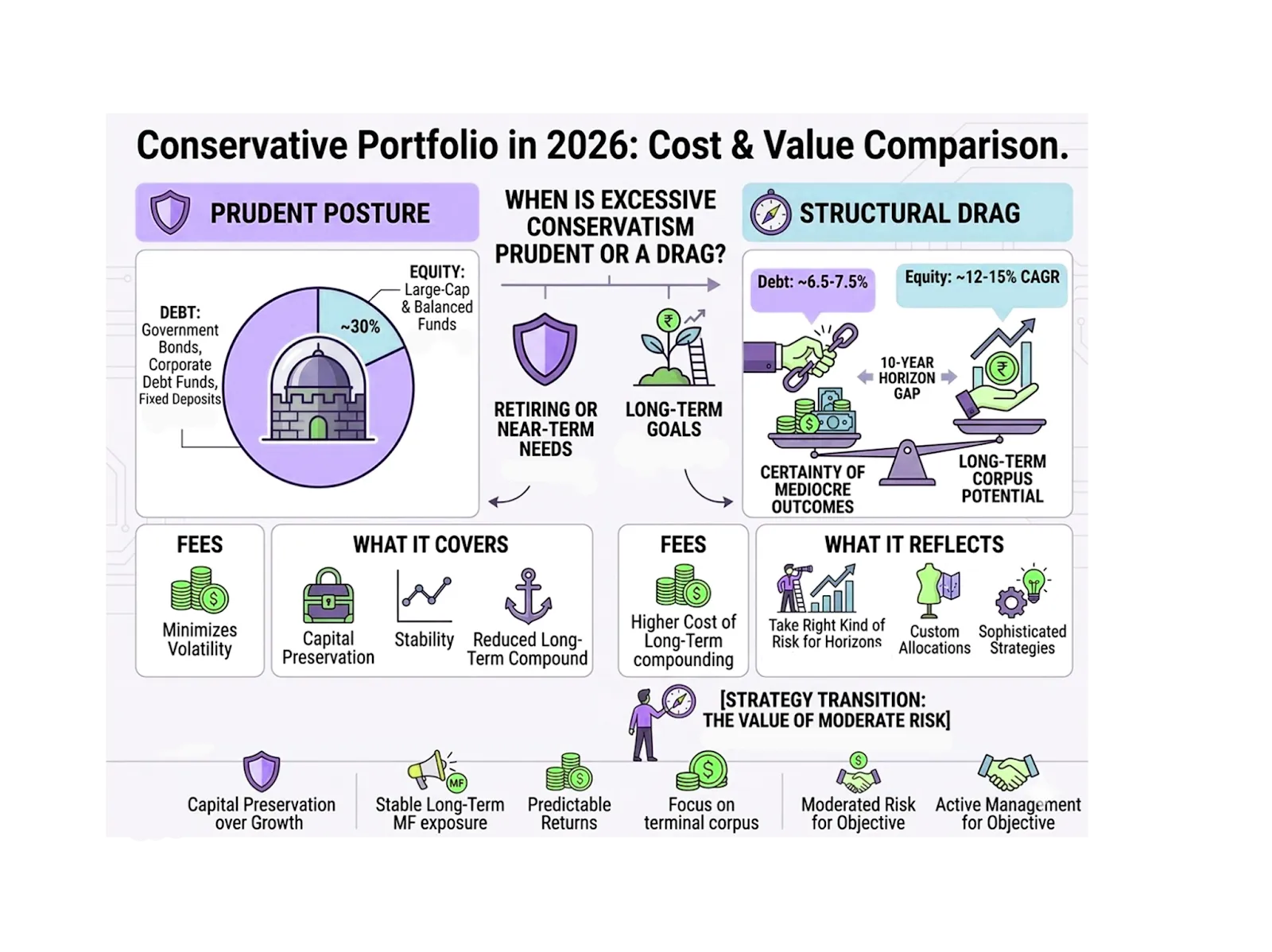
A conservative portfolio in the Indian context typically sits 70–80% in debt instruments, government bonds, corporate debt funds, liquid funds, fixed deposits, and allocates 20–30% to equity, usually large-cap or balanced funds. A mutual funds portfolio of this kind prioritises capital preservation over growth, and it minimises volatility at the cost of long-term compounding.
For an investor within five years of retirement, or managing funds they cannot afford to lose, this posture makes complete sense. Portfolio risk management for that investor rightly prioritises stability.
But for an investor with a 7–15 year horizon, a stable income, and no near-term liquidity requirement, a conservative portfolio becomes a structural drag. Debt instruments in India are currently yielding 6.5–7.5% in real terms. Equity, over a 10-year compounding period, has historically delivered 12–15% CAGR through diversified large-to-mid cap exposure.
The gap between those two outcomes, compounded across a decade, is not marginal. It is life-changing in terms of terminal corpus size.
The irony is that many investors holding moderate risk mutual funds or aggressively conservative allocations believe they are being prudent. What they are actually doing is accepting certainty of mediocre outcomes in exchange for avoiding the discomfort of short-term volatility. Portfolio risk management is not about eliminating risk; it is about taking the right kind of risk for your specific time horizon and financial objective.
Also Read: From Coal to Cloud: Mapping India’s Shift from Conventional Power to Sustainable Infrastructure
Many investors increase monthly contributions over time, which is excellent discipline. But if those growing SIPs are still going into the same large-cap or balanced mutual funds you chose five years ago without a review, you may be building a bigger version of an underperforming allocation rather than an optimised one.
Discomfort with volatility is natural. But if your long term mutual fund portfolio has never included mid-cap exposure through a full up-and-down cycle, you have also never experienced what the recovery phase of that cycle does to a portfolio's compounding power.
Run a simple projection: at your current return assumption, what does your portfolio look like in 10 years? If the answer is materially below your target, the only levers available are higher contribution, longer horizon, or higher expected return. An aggressive investment strategy , within reason, addresses the third lever directly.
Investors built many portfolios during 2020–2022 to reflect the anxiety of that period rather than a considered long-term framework. If your mutual funds portfolio was calibrated for COVID-era uncertainty, it deserves a 2026 review against your current circumstances.
Self-directed investing through apps and platforms is valuable. But without a structured review by a SEBI registered investment advisor, many investors do not know what risk they are actually taking versus what risk their time horizon and goals can support. That gap, not market timing, is usually the biggest source of suboptimal outcomes.
Also Read: Who are the Real Winners of Iran-Israel War? : Sectors, Companies, Countries, Gaining from War
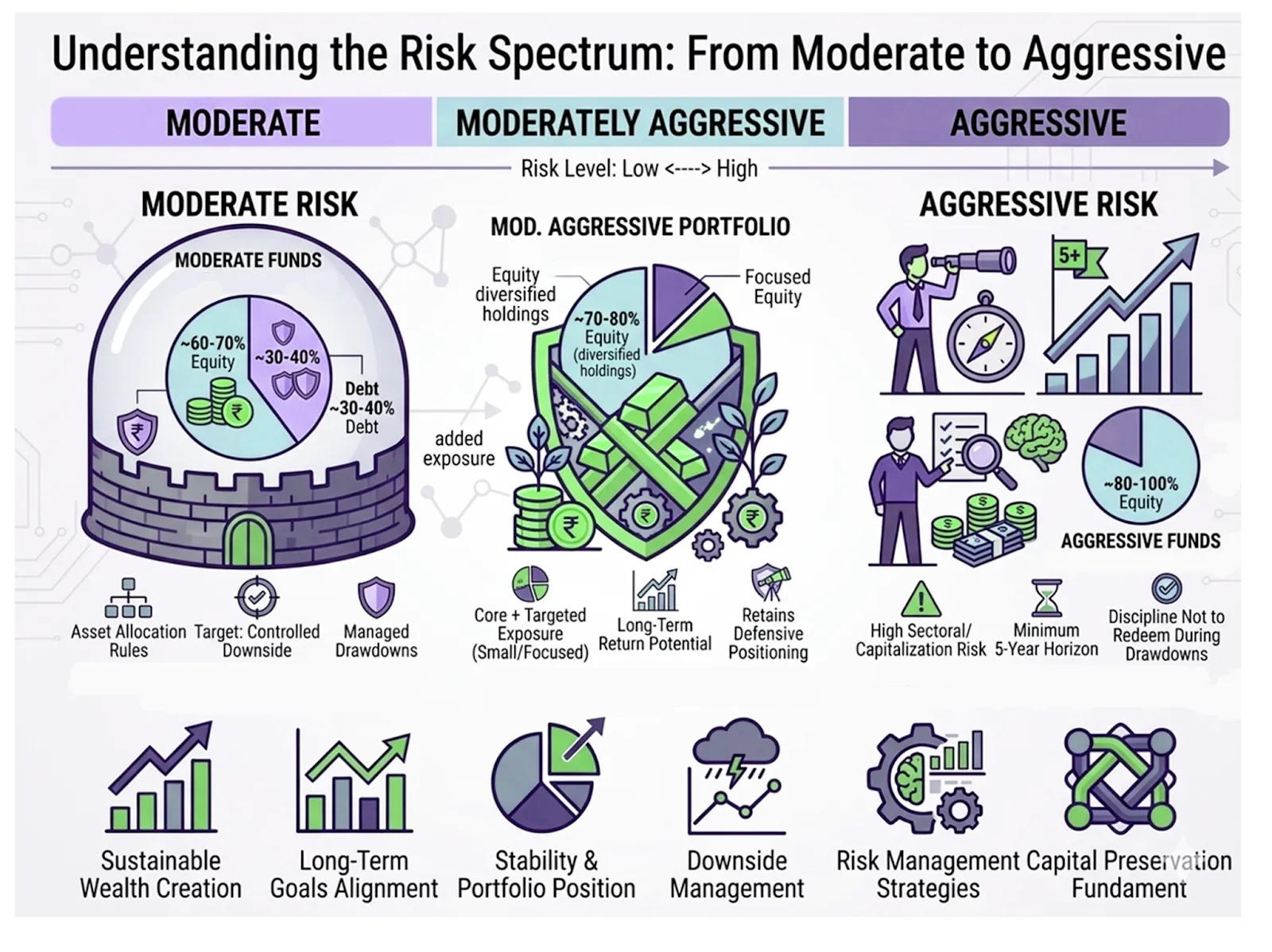
The mutual fund universe in India provides a remarkably well-structured set of options across the risk spectrum. Understanding where your current portfolio sits, and where it could sit, is the starting point for any rebalancing conversation.
Moderate risk mutual funds , multi-cap, flexicap, balanced advantage funds typically target 60–70% equity with dynamic allocation. They are appropriate for investors who want equity participation with managed downside. Returns over 7–10 years tend to track the broader market with lower drawdown depth.
A moderately aggressive portfolio adds small-cap or focused fund exposure alongside the core balanced allocation, bringing expected long-term returns closer to pure equity outcomes while retaining some defensive positioning.
Best balanced mutual funds sit in the hybrid category, balanced advantage, or aggressive hybrid, and use asset allocation rules to reduce equity exposure when valuations are stretched and increase it during corrections.
They are not conservative; they are tactical. The distinction matters because many investors categorise all hybrid funds as "safe" without understanding that an aggressive hybrid fund can hold 65–80% in equity.
The best aggressive mutual funds in the Indian market today, whether small-cap, sectoral, or focused equity, are appropriate only when the investor has a genuine 5-year-plus horizon and the discipline not to redeem during drawdowns. Over that horizon, the probability of underperforming a conservative allocation narrows significantly.
Understanding your actual position on this spectrum, rather than the position you assume you are in, is the foundation of good portfolio risk management.
Also Read: Decoding the Iran–Israel Conflict for Portfolios: Timeline, Markets, Oil Prices, Macro Transmission
The set-and-forget approach to mutual fund investing has a real cost that compounds quietly over years. An investor who chose a portfolio in 2019 and never reviewed it has likely missed multiple rotation opportunities from large-cap to mid-cap as valuations shifted, from debt to equity as rate cycles moved, and from domestic to international as global diversification became relevant.
Active portfolio management does not mean trading frequently or chasing performance. It means reviewing allocation against your goals on a structured schedule, rebalancing when drift has taken your equity-debt ratio meaningfully away from target, and adjusting fund selection when the macro or fund-level thesis has changed. For a deeper look at how this works in practice, read our guide on how portfolio rebalancing works in practice , including the key triggers, challenges, and disciplines involved.
Active investing through mutual funds is best understood as active allocation rather than active trading. The research consistently shows that most of the return gap between investors who do well and those who do not comes from asset allocation decisions, not from fund selection or market timing.
An active portfolio management strategy also includes decisions about when to shift from best balanced mutual funds toward more aggressive positioning, for example, after a correction that has materially improved the risk-reward profile of mid and small-caps, and when to reintroduce defensive positioning as a cycle matures.
Wright Research's PMS and portfolio advisory services are built around exactly this kind of structured, evidence-based active portfolio management. The goal is not activity for its own sake. It is a disciplined allocation that evolves with the market environment and with your life stage.
Also Read: Why You Should Review Your Mutual Fund Portfolio for Long-Term Wealth Preservation
Not every investor should hold the best aggressive mutual funds. But many investors who should hold them do not because the category name generates anxiety without context.
An aggressive investment strategy in the mutual fund context typically means a portfolio tilted toward mid-cap, small-cap, and focused or thematic funds, with limited or no debt allocation. The volatility is real. A small-cap fund can fall 30–40% in a correction and recover over 18–24 months. For investors who understand this and can hold through it, the long-term compounding advantage is substantial.
The data from India's last full market cycle (2019–2024) illustrates the point clearly. Mid-cap indices delivered approximately 25–30% CAGR over that period versus 14–16% for large-cap indices. A portfolio anchored in best aggressive mutual funds over that period significantly outperformed one anchored in balanced or large-cap funds, assuming no panic-driven redemptions during 2020 or 2022 drawdowns.
The caveat is horizon and discipline, both of which a SEBI registered investment advisor can help you establish before you allocate.Investors ready to act can explore Wright Research's aggressive mutual funds portfolio , an AI-powered, auto-rebalancing basket built for high-growth equity allocation. Best aggressive mutual funds work when they are held through the cycle, not treated as tactical positions to be exited at the first sign of volatility.
An aggressive investment strategy also does not mean concentration in one sector or theme. Diversification across market caps, sectors, and fund managers is as important in an aggressive portfolio as in a conservative one; the difference is where on the risk curve the diversified exposure sits.
Factor investing has emerged as one of the most intellectually rigorous frameworks for taking equity risk in a structured, evidence-backed way. Rather than picking stocks based on narrative or momentum, a factor investing portfolio systematically tilts toward factors that have demonstrated persistent return premia over time: quality, value, momentum, low volatility, and size.
In the Indian market, factor-based investing is available through smart beta ETFs and increasingly through PMS strategies that combine multiple factors. A factor investing portfolio built on quality (high ROCE, low leverage, consistent earnings) combined with momentum (price and earnings trend) has historically delivered alpha over the broader index with manageable tracking error.
For an investor transitioning from a conservative mutual funds portfolio toward a moderately aggressive portfolio, factor-based equity exposure can be a useful bridge. It offers more predictable risk characteristics than a pure small-cap or thematic tilt, while delivering equity-level expected returns. A factor investing portfolio also sidesteps the fund manager dependency risk of active funds. You know exactly what systematic exposures you are taking and why.
Wright Research integrates factor-based thinking across both its PMS strategies and equity advisory work. The Wright Balanced Multifactor portfolio is a live example, a dynamic, moderate-risk multi-factor strategy built across quality, value, momentum, and low volatility factors with monthly rebalancing. If you are building a long term mutual fund portfolio with a genuine 10-year horizon, understanding factors is increasingly a baseline competency rather than a specialist interest.
Also Read: Why India’s Private Capex Crisis Has Been Falling and Why the Floor May Be Near
The single biggest risk in portfolio rebalancing is not taking too much equity risk. It is making the transition to a more aggressive allocation based on gut feel, recency bias, or market FOMO and then abandoning the position at the first major drawdown because the allocation was never grounded in a coherent framework.
A SEBI-registered investment advisor provides the structural discipline that prevents this. SEBI registration requires advisors to pass competency examinations, maintain a fiduciary relationship with clients (meaning they must act in the client's interest, not earn commissions on product placement), and provide written investment policy statements that anchor allocation decisions to documented goals and risk tolerance.
Working with a SEBI registered investment advisor means your decision to shift from moderate risk mutual funds toward a moderately aggressive portfolio — or from balanced to aggressive equity is documented, justified by your specific financial plan, and reviewed on a schedule rather than left to drift.
Active portfolio management through an advisor also means your diversified mutual fund portfolio is stress-tested against scenarios of what happens to your plan if equity falls 30% in Year 2. What if your income interrupts for 6 months? These questions are answered before they become crises, not during them.
A diversified mutual fund portfolio in 2026 is not simply "some equity and some debt." It is a considered combination of exposures across market caps, sectors, geographies, and instruments structured to deliver target returns within your specific risk tolerance, time horizon, and liquidity needs.
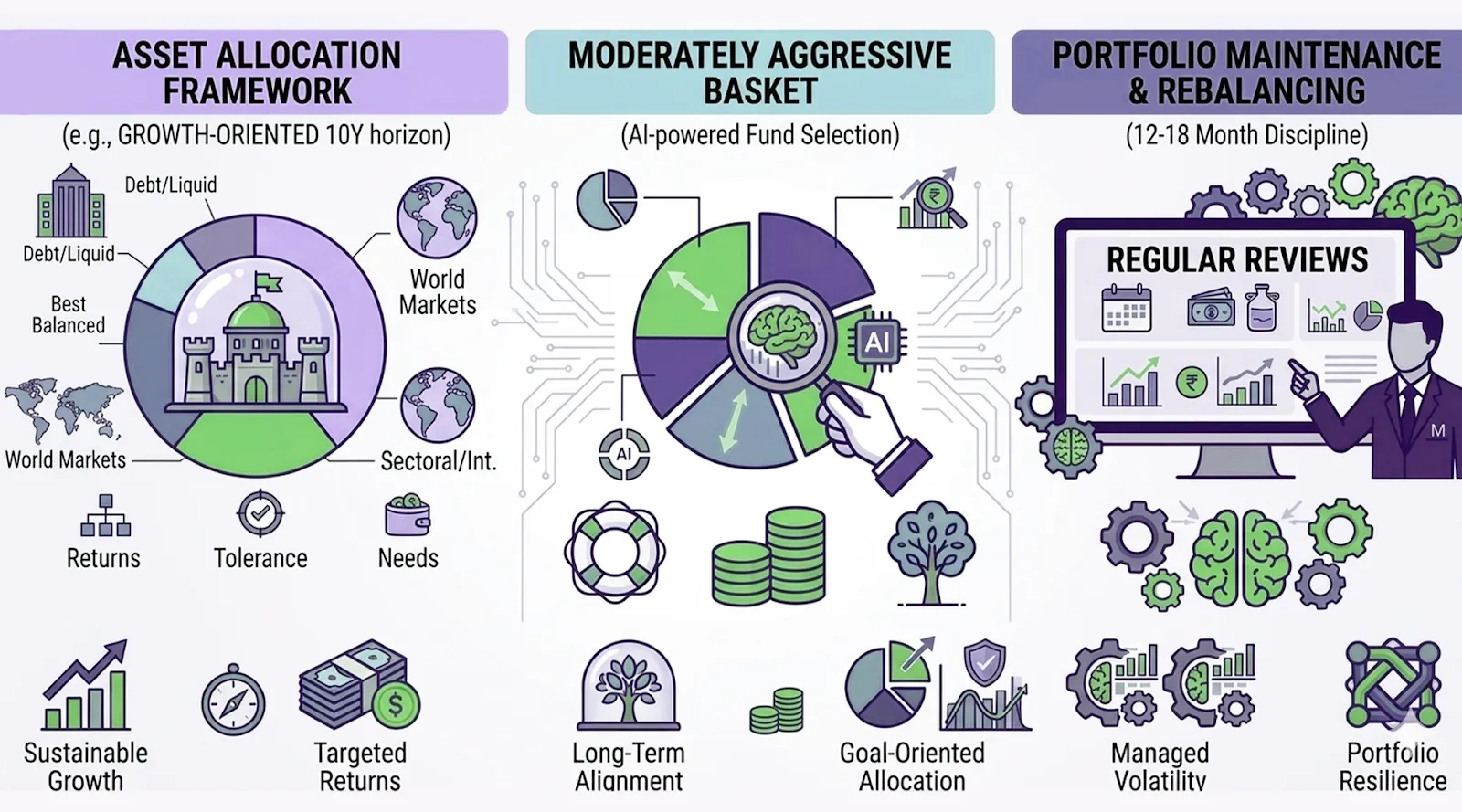
For a growth-oriented investor with a 10-year horizon, a sensible starting framework might look like: 40% in large-cap or flexicap core funds providing market-linked returns with managed volatility, 25% in mid-cap or small-cap funds for compounding acceleration, 15% in international or sectoral funds for non-correlated exposure, 10% in best balanced mutual funds for tactical flexibility, and 10% in debt or liquid funds for near-term needs and portfolio stability.
This is a moderately aggressive portfolio, not reckless, but genuinely growth-oriented. Investors looking for a ready-made structure can review the moderately aggressive mutual fund basket , precision-targeted for 20–40% debt allocation with AI-powered fund selection. It uses active portfolio management to shift weightings as the macro cycle evolves, and it relies on a diversified mutual fund portfolio structure to ensure no single drawdown event destroys disproportionate value.
Long term mutual fund portfolio construction requires revisiting this structure every 12–18 months and asking three questions: Has my goal horizon shortened? Has my income or liquidity situation changed? Has the market environment shifted the risk-reward profile of any segment meaningfully? The answers determine whether rebalancing is warranted, and an active investing discipline ensures it happens on a plan rather than in reaction to headlines.
Wright Research builds these structures for clients across PMS and advisory formats, with allocation frameworks grounded in quantitative analysis and reviewed against current market conditions on an ongoing basis.
Also Read: Indian Pharma Q3FY26: Results, Themes, Headwinds and Key Takeaways
The investor who never loses on paper and never achieves their financial goal has not been prudent. They have been comfortable at the cost of their own future. Portfolio risk management is not about avoiding risk it is about taking the right risks, in the right proportions, at the right time in your investment life.
If you have read this far and recognise your portfolio in any of the five warning signs above, that is not a cause for alarm. It is a prompt for action. Review your mutual funds portfolio against your actual goals. Consider whether best aggressive mutual funds or a moderately aggressive portfolio might serve your 10-year objective better than the allocation you set three years ago. Engage a SEBI registered investment advisor if you want that review done rigorously rather than intuitively.
The structural case for equity in India remains intact and the range of instruments available, from best balanced mutual funds to factor-tilted equity and listed REITs, means that active portfolio management has never been more accessible or more effective for the individual investor. The only question is whether you will use it.
Aggressive mutual funds typically include small-cap and thematic equity funds that target high growth with higher risk. Examples include funds like Nippon India Small Cap Fund, SBI Small Cap Fund, and Axis Small Cap Fund. These funds can deliver strong returns but are more volatile and suitable for investors with a long-term, high-risk appetite.
Yes, balanced mutual funds can be a good investment for investors seeking both growth and stability. These funds invest in a mix of equity and debt, helping reduce risk while still offering return potential. Examples include HDFC Balanced Advantage Fund and ICICI Prudential Balanced Advantage Fund. They are suitable for moderate-risk, long-term investors.
Yes, mutual funds are generally considered moderate-risk investments, but the risk level depends on the type of fund. Equity funds carry higher risk, debt funds are lower risk, and hybrid funds offer balanced risk. Overall, mutual funds diversify investments across multiple assets, which helps reduce risk compared to investing in individual stocks.
Moderate-risk investments include balanced or hybrid mutual funds, index funds, dividend-paying stocks, corporate bonds, and balanced advantage funds. These investments aim to provide steady returns while limiting volatility through diversification. Examples include HDFC Balanced Advantage Fund and ICICI Prudential Balanced Advantage Fund. They are suitable for investors seeking growth with controlled risk.
A good diversified mutual fund portfolio spreads investments across large-cap, mid-cap, small-cap, and hybrid funds to balance risk and returns. For example, investors may combine funds like SBI Bluechip Fund, Kotak Emerging Equity Fund, and HDFC Balanced Advantage Fund to achieve diversification and stable long-term growth.
The most aggressive investments typically include small-cap stocks, thematic equity funds, derivatives trading, and venture capital investments. These options offer high return potential but also carry significant volatility and risk. For example, funds like Nippon India Small Cap Fund are considered aggressive because they invest in high-growth but more volatile companies.
Discover investment portfolios that are designed for maximum returns at low risk.
Learn how we choose the right asset mix for your risk profile across all market conditions.
Get weekly market insights and facts right in your inbox


It depicts the actual and verifiable returns generated by the portfolios of SEBI registered entities. Live performance does not include any backtested data or claim and does not guarantee future returns.
By proceeding, you understand that investments are subjected to market risks and agree that returns shown on the platform were not used as an advertisement or promotion to influence your investment decisions.
"I was drawn to Wright Research due to its multi-factor approach. Their Balanced MFT is an excellent product."

By Prashant Sharma
CTO, Zydus
By signing up, you agree to our Terms and Privacy Policy
"I was drawn to Wright Research due to its multi-factor approach. Their Balanced MFT is an excellent product."
By Prashant Sharma
CTO, Zydus
Skip Password
By signing up, you agree to our Terms and Privacy Policy
"I was drawn to Wright Research due to its multi-factor approach. Their Balanced MFT is an excellent product."
By Prashant Sharma
CTO, Zydus
"I was drawn to Wright Research due to its multi-factor approach. Their Balanced MFT is an excellent product."
By Prashant Sharma
CTO, Zydus
Log in with Password →
By logging in, you agree to our Terms and Privacy Policy
"I was drawn to Wright Research due to its multi-factor approach. Their Balanced MFT is an excellent product."
By Prashant Sharma
CTO, Zydus
Log in with OTP →
By logging in, you agree to our Terms and Privacy Policy
"I was drawn to Wright Research due to its multi-factor approach. Their Balanced MFT is an excellent product."
By Prashant Sharma
CTO, Zydus
Answer these questions to get a personalized portfolio or skip to see trending portfolios.
Answer these questions to get a personalized portfolio or skip to see trending portfolios.
(You can choose multiple options)
Answer these questions to get a personalized portfolio or skip to see trending portfolios.
Answer these questions to get a personalized portfolio or skip to see trending portfolios.
Answer these questions to get a personalized portfolio or skip to see trending portfolios.
(You can choose multiple options)
Investor Profile Score
We've tailored Portfolio Management services for your profile.
View Recommended Portfolios Restart