

Gold prices in India have reached unprecedented heights in 2025, with 24-karat gold crossing ₹1,22,000 per 10 grams for the first time in history. This remarkable surge of has positioned gold as one of the best-performing asset classes, outpacing traditional investments like equities and fixed deposits. The current rally represents gold's 39th record high of 2025, driven by global uncertainties, central bank purchases, and expectations of monetary easing. For Indian investors, this presents both an opportunity and a challenge whether to capitalize on the momentum or exercise caution at these elevated levels.
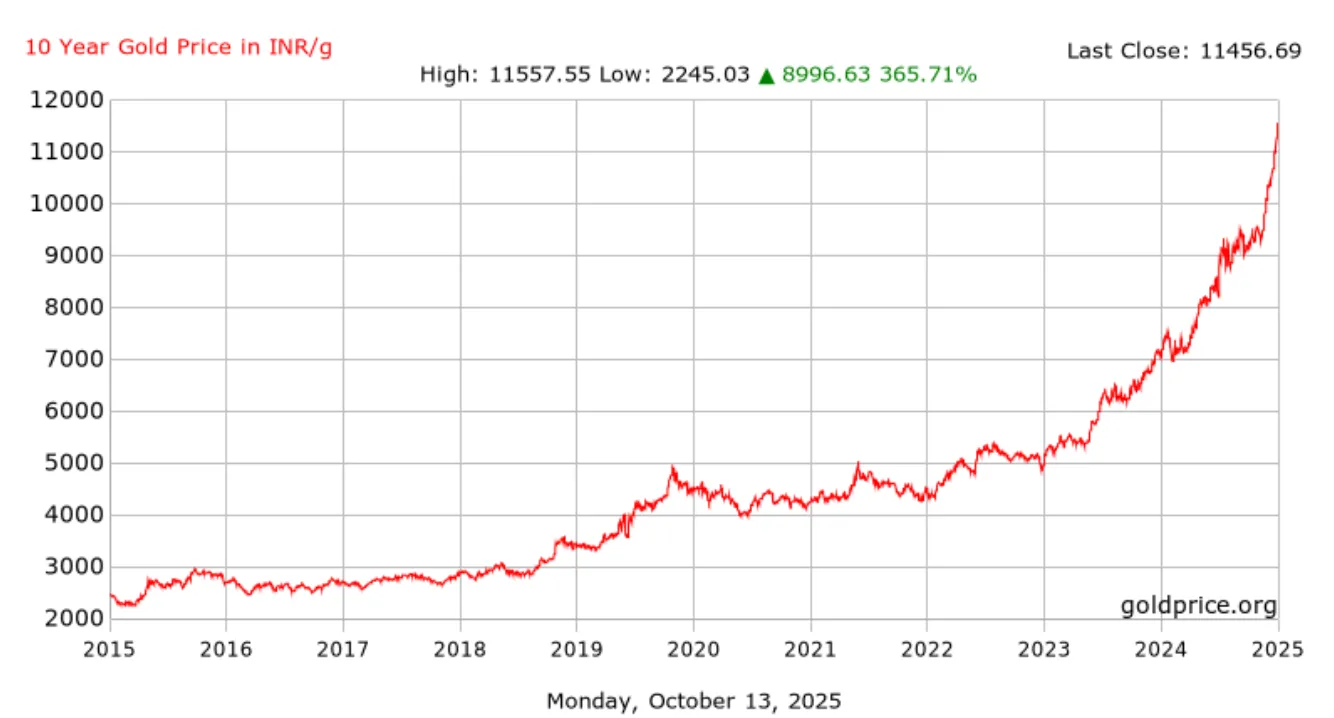
Source : Goldprice.Org
Check the macro backdrop
GDP, inflation, rates and more — India’s key economic indicators in one dashboard.
Understanding the Current Gold Price Surge
The extraordinary rise in gold prices throughout 2025 stems from a confluence of global and domestic factors that have created an almost perfect storm for the precious metal. Gold futures on the Multi-Commodity Exchange (MCX) have surged to record levels, with spot gold internationally crossing $4,000 per ounce for the first time in history. This represents a staggering 52% increase year-to-date, following a strong 27% gain in 2024.
The primary drivers behind this unprecedented rally include persistent global economic uncertainty, with events such as banking sector instability and recessionary fears in major economies pushing investors toward safe-haven assets. Geopolitical tensions, particularly the ongoing Russia-Ukraine conflict and Middle East instabilities, have further reinforced gold's appeal as a defensive investment. Additionally, expectations of interest rate cuts by major central banks, especially the US Federal Reserve, have reduced the opportunity cost of holding non-yielding assets like gold.
Central bank gold purchases have provided structural support to prices, with institutions like the People's Bank of China buying gold for eleven consecutive months as of September 2025. This institutional demand, combined with record exchange-traded fund inflows of $17.3 billion in September alone, has created sustained upward pressure on gold prices. The weakening US dollar has also contributed significantly, making gold more attractive to international buyers and reducing import costs for dollar-denominated purchases.
Domestically, India's position as the world's second-largest gold consumer has amplified these global trends. The Indian rupee's depreciation against the dollar has made gold imports more expensive, pushing domestic prices even higher. Seasonal demand during festivals like Diwali and Dhanteras has added further momentum to the price rise, with cultural affinity for gold during auspicious occasions driving significant retail purchases.
Gold Investment Options in India
Modern investors in India have access to a diverse range of gold investment vehicles, each catering to different risk profiles, investment amounts, and liquidity preferences. Understanding these options is crucial for making informed investment decisions in the current high-price environment.
Physical Gold Investment
Traditional physical gold remains popular among Indian investors, encompassing jewelry, coins, bars, and artifacts. The minimum investment typically starts around ₹6,000 for a one-gram gold coin. Physical gold offers the psychological comfort of tangible ownership and serves cultural purposes during festivals and weddings. However, it comes with significant drawbacks including making charges ranging from 8-20%, goods and services tax of 3%, storage costs, and security concerns. The lack of standardization in purity and the need for physical verification during sales can also complicate transactions.
Gold Exchange-Traded Funds (ETFs)
Gold ETFs have emerged as a sophisticated alternative, offering exposure to gold prices without physical ownership hassles. These funds track domestic gold prices and are backed by physical gold stored in bank vaults. With minimum investments as low as ₹50-100, gold ETFs provide excellent liquidity through stock exchange trading during market hours. The expense ratios range from 0.20% to 0.48%, making them cost-effective compared to physical gold. Leading options include Nippon India ETF Gold BeES, SBI Gold ETF, and Kotak Gold ETF, each offering transparent pricing and easy trading mechanisms.
Gold Mutual Funds
Gold mutual funds invest primarily in gold ETFs and provide an alternative for investors without demat accounts. These funds offer systematic investment plan (SIP) facilities with minimum investments starting at ₹100, making gold investing accessible to small investors. The expense ratios typically range from 0.47% to 0.55%, slightly higher than direct ETF investments. Popular funds include Quantum Gold Savings Fund, Aditya Birla Sun Life Gold Fund, and SBI Gold Fund, each providing professional fund management and diversification benefits.
Sovereign Gold Bonds (SGBs)
Government-issued Sovereign Gold Bonds represent the most tax-efficient gold investment option, though new issues have been temporarily suspended by the Reserve Bank of India. SGBs offer an additional 2.5% annual interest rate over gold price appreciation and provide complete tax exemption on capital gains if held to maturity after eight years. The minimum investment is one gram of gold (approximately ₹5,000), with a maximum limit of 4 kilograms for individuals. Existing SGBs can be purchased from the secondary market, though liquidity may be limited compared to other options.
Digital Gold
Digital gold platforms allow fractional gold ownership starting from as little as ₹1, making it extremely accessible for micro-investments. These platforms typically charge 0.5-3% in fees and provide the option to convert digital holdings into physical gold when needed. While convenient and liquid, digital gold lacks regulatory oversight and may have higher spreads between buying and selling prices. The 3% GST applies to digital gold purchases, similar to physical gold.
Comparison of different Investment option in India
Investment | Min. Inv. | Charges | Liquidity | Tax Benefit | Suitability |
|---|---|---|---|---|---|
Physical Gold | ₹6k ( 1g) | Making+GST | Medium | No | Traditional |
Gold Etf | ₹50-100 | 0.2-0.48% | High | 20% LTCG 3yr | Active Traders |
Gold MFs | ₹100 | 0.47-0.56% | High | 20% LTCG 3yr | SIP Investors |
SGBs | ₹5k(1g) | Nil | Low (8yr) | Tax Free+2.5% | Long Term |
Digital Gold | ₹1 | 0.5-3% | High | 20% LTCG 3yr | Small Inv |
Get research like this in your inbox
The week’s research that mattered, in five minutes. Joined by 2L+ investors.
Portfolio Strategy and Allocation Considerations
Determining the optimal gold allocation in the current environment requires careful consideration of individual circumstances, market conditions, and long-term objectives. Financial experts have been notably bullish on gold allocations in 2025, with recommendations ranging from traditional 5-10% allocations to more aggressive 15-25% positions for certain investor profiles.
Morgan Stanley's Chief Investment Officer Mike Wilson has proposed a 60/20/20 portfolio strategy, allocating 60% to equities, 20% to bonds, and 20% to gold. This framework represents a significant evolution from the traditional 60/40 equity-bond allocation, acknowledging gold's superior hedging characteristics in the current inflationary environment. Wilson argues that gold has become more effective than Treasury bonds as a hedge against economic uncertainty and inflation.
For Indian investors, portfolio allocation decisions must account for cultural factors and domestic market conditions. Conservative investors focused on capital preservation might consider 5-8% allocations, providing meaningful diversification without sacrificing growth potential. Moderate investors seeking balanced growth and protection could justify 8-10% allocations, while those specifically concerned about inflation and currency risks might increase allocations to 10-15%.
Market Outlook and Investment Strategy
The outlook for gold prices remains constructive despite the dramatic appreciation already witnessed in 2025. Multiple structural factors continue to support higher gold prices, though the magnitude of recent gains has introduced new considerations for investors entering the market at current levels.
Goldman Sachs' projection of $4,900 per ounce by the end of 2026 represents a 22.5% additional gain from current levels, suggesting that the bull market may have further room to run. This forecast is based on continued central bank demand, expectations of Federal Reserve rate cuts, and persistent geopolitical tensions that maintain safe-haven demand for precious metals.
The structural demand from central banks shows no signs of abating, with China's consistent purchasing pattern reflecting a broader trend toward reserve diversification. The shift away from US dollar reserves by major central banks provides a fundamental floor for gold demand regardless of short-term market fluctuations. This institutional buying has historically provided stable price support during periods of retail investor uncertainty.
However, the rapid price appreciation has also created potential risks that investors must acknowledge. Gold's 50%+ gain in 2025 may have captured much of the positive fundamental developments, potentially limiting near-term upside. The fear of missing out (FOMO) factor that analysts identify as contributing to recent buying could reverse if investor sentiment shifts or if some of the supporting factors resolve favorably.
Technical analysis suggests that gold faces natural resistance at current levels, with some profit-taking already evident in recent trading sessions. The vertical nature of the price increase has created conditions typically associated with market tops, though the timing of any significant correction remains uncertain. Investors should prepare for increased volatility and potential pullbacks from current levels.
See what markets are pricing in
Live indices, sector moves and market breadth — the backdrop to every story we publish.
Conclusion
Gold's historic price surge in 2025 reflects a unique convergence of monetary, geopolitical, and economic factors that have created exceptional conditions for precious metals investment. With prices exceeding ₹1,23,000 per 10 grams, Indian investors are witnessing one of the most dramatic gold rallies in modern history, presenting both unprecedented opportunities and significant decision-making challenges.
The multiple investment vehicles available today provide flexibility for different investor profiles and objectives. While Sovereign Gold Bonds offer superior tax efficiency for long-term investors, Gold ETFs provide optimal liquidity and convenience for active portfolio management. Digital gold enables micro-investments for budget-conscious investors, while physical gold maintains its cultural significance and tangible ownership benefits. Each option carries distinct cost structures, tax implications, and suitability factors that require careful evaluation.
The decision to invest in gold at current levels ultimately depends on individual circumstances, risk tolerance, and investment objectives. Those seeking portfolio protection and inflation hedging may find value despite elevated prices, while growth-focused investors may prefer limited exposure. Regardless of allocation decisions, the unprecedented market conditions of 2025 underscore the importance of professional guidance and comprehensive financial planning in navigating complex investment environments.
Gold's role as a cornerstone asset for wealth preservation and portfolio diversification has been reinforced by recent market developments. As investors continue to grapple with economic uncertainty and monetary policy shifts, gold's position as both insurance and opportunity remains more relevant than ever in modern portfolio construction.