


India’s gold market now includes a security that connects vaulted bullion with exchange trading. Electronic gold receipts represent standardised physical gold stored within a regulated vaulting and depository system. Investors hold the receipt in demat form and can trade it through an enabled exchange segment.
The EGR India framework is different from unregulated “digital gold”. EGRs are notified securities under the Securities Contracts (Regulation) Act, their vault managers are registered with SEBI, and exchange trades pass through clearing and settlement. The structure improves formalisation, but it does not eliminate gold-price or liquidity risk.
What Are Electronic Gold Receipts (EGR)?
Electronic gold receipts are dematerialised securities evidencing beneficial ownership of eligible physical gold. The gold remains in a vault managed under SEBI’s framework, while the receipt is maintained by a depository and can move between demat accounts through exchange settlement.
The ecosystem separates functions. Vault managers accept, verify, store and release gold. Depositories create the electronic record and coordinate extinguishment on withdrawal. Exchanges provide trading, and clearing corporations settle cash and receipts between buyers and sellers.
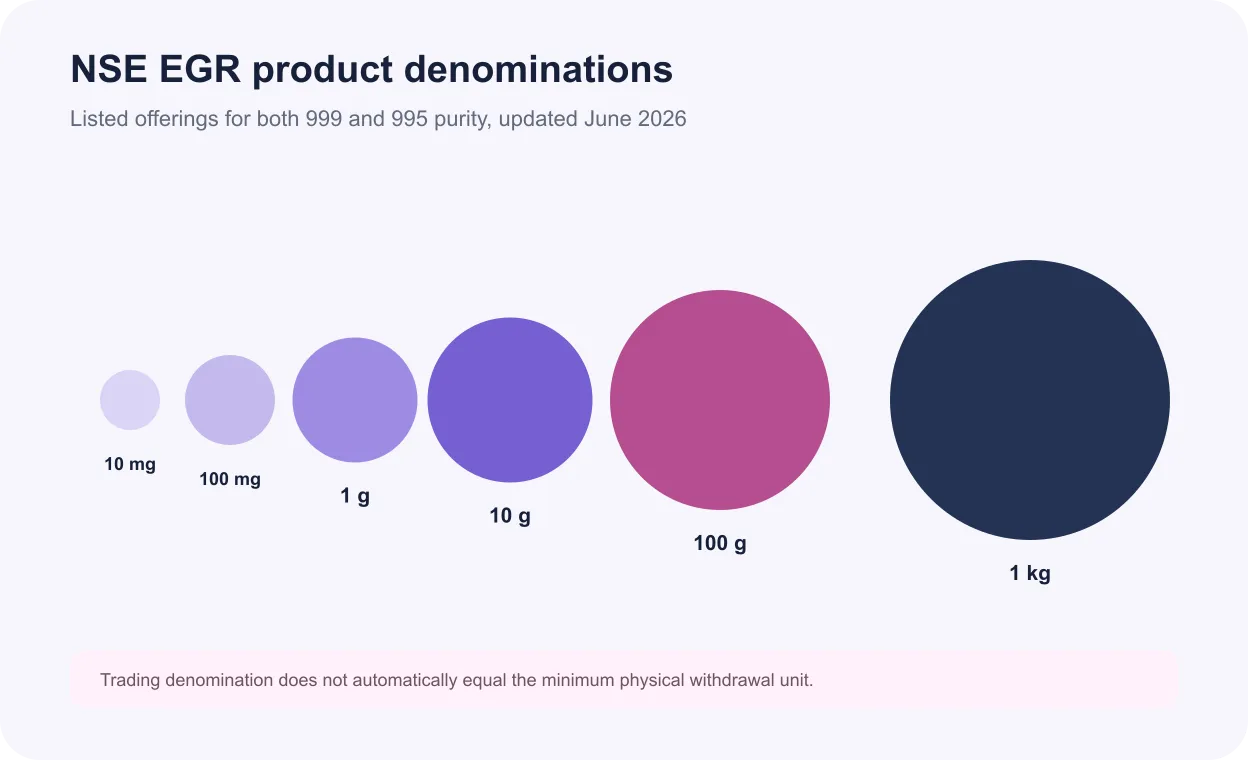
For EGR India investors, one receipt’s denomination and purity depend on the listed product. NSE currently displays 999 and 995 purity products in denominations ranging from 10 milligrams to one kilogram. Availability, liquidity and conversion units must be checked on the live contract specification.
Check the macro backdrop
GDP, inflation, rates and more — India’s key economic indicators in one dashboard.
How EGR Trading Works on the Exchange
EGR trading resembles cash-market security trading. An investor uses a broker with access to the EGR segment, selects the product symbol and places a buy or sell order. The exchange matches orders, while the clearing corporation transfers cash and receipts under the applicable settlement cycle.
NSE commenced live EGR trading on 18 May 2026. Its published framework currently specifies T+1 settlement, VaR, extreme-loss and mark-to-market margins, and extended weekday market hours. Product rules can change, so the order screen and exchange circulars take priority.
The traded price reflects domestic gold value, purity, denomination, supply and demand, currency, taxes, carrying costs and market liquidity. A receipt can trade at a premium or discount to another gold route. Use limit orders and compare equivalent grams and purity rather than unit prices alone.
| Check | Why it matters |
|---|---|
| Exchange and symbol | Identifies purity, denomination and product rules |
| Price per equivalent gram | Allows comparison with domestic gold and other instruments |
| Bid-ask spread and depth | Shows immediate execution cost and liquidity |
| Settlement and charges | Affects cash, demat delivery and total cost |
| Withdrawal specification | Trading units may differ from physical delivery units |
Converting Physical Gold to EGR: The Process
Conversion begins with eligible gold, not household jewellery. The depositor delivers qualifying bars to a collection centre or vault manager and completes know-your-depositor and traceability documentation. The vault manager verifies weight, purity and approved refinery standards before accepting the deposit.
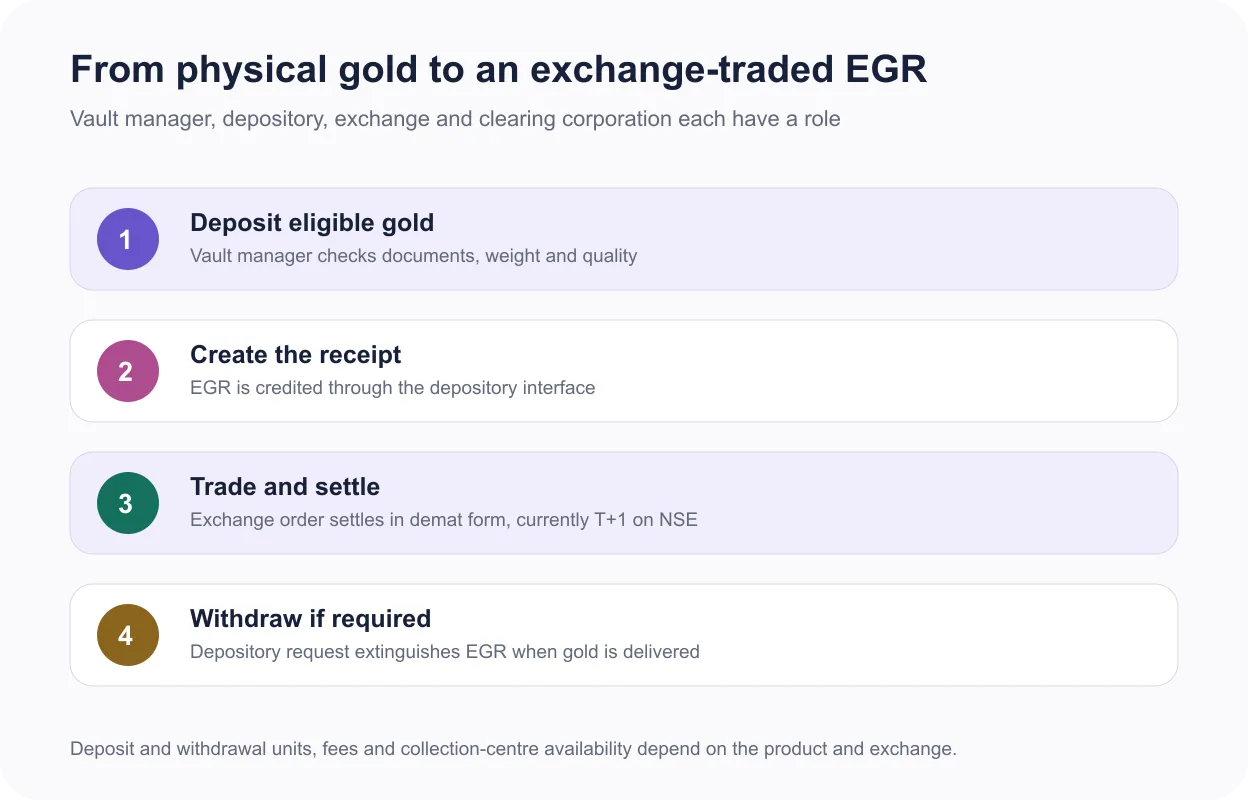
After acceptance, the vault manager enters the details in the common interface and creates electronic gold receipts in the depositor’s name. The depository assigns the appropriate security identifier and credits the demat account, making the receipt eligible for trading.
For withdrawal, the beneficial owner instructs the depository. The request passes to the vault manager, which delivers gold according to the product’s location, quantity and fee rules. The corresponding receipt is extinguished so electronic holdings remain matched with vaulted metal.
The EGR India process can involve assaying, storage, handling, transportation and withdrawal charges. Deposit and withdrawal units may be much larger than the smallest exchange-trading unit, so small holders should not assume immediate physical redemption is economical.
EGR Benefits: Why Investors Are Choosing Electronic Gold Receipts
The primary EGR benefits are regulated ownership records, standardised purity and reduced personal storage. Investors can transfer exposure electronically instead of repeatedly moving and testing bullion. Exchange quotes also support transparent price discovery.
Another advantage is fungibility within the prescribed framework. Eligible gold deposited through one registered vaulting route can support a standard receipt, and the depository reconciles electronic balances with vault records. The structure may help jewellers, traders and investors use one formal market.
Smaller listed denominations can broaden access, while physical conversion preserves a link to bullion. These EGR benefits are most valuable when the chosen contract has sufficient liquidity and when vaulting or withdrawal costs fit the intended holding size.
The receipt format can also improve auditability for businesses that routinely buy or sell standardised bullion. Instead of relying only on privately issued paperwork, ownership changes appear through regulated market infrastructure. That does not remove the need for accounting, tax and inventory controls, but it can reduce avoidable friction in verification and transfer.
For allocation decisions, Wright Research’s EGR India portfolio framework can help place gold alongside equities and fixed income rather than treating it as a standalone return promise.
Get research like this in your inbox
The week’s research that mattered, in five minutes. Joined by 2L+ investors.
EGR vs Gold ETF: What's the Difference?
EGR vs gold ETF compares direct receipt-based ownership with a pooled fund unit. An EGR represents eligible physical gold within the vault-depository framework. A gold ETF is a mutual fund scheme that seeks to track domestic gold prices using gold and permitted instruments, net of expenses.
| Feature | EGR | Gold ETF |
|---|---|---|
| Legal form | Security representing vaulted gold | Unit of a mutual fund scheme |
| Physical conversion | Built into the framework, subject to units and charges | Retail investors usually trade units; large-unit redemption follows scheme rules |
| Portfolio layer | Receipt maps to eligible vaulted metal | Fund portfolio, cash and expenses create tracking difference |
| Liquidity | Depends on EGR contract order book | Depends on ETF order book and market-making |
| Ongoing costs | Vaulting, custody and transaction-related charges may apply | Expense ratio plus trading costs |
The right EGR vs gold ETF choice depends on liquidity, cost, desired physical conversion and operational convenience. Investors can compare available gold funds through Wright Research’s mutual fund platform , while separately checking live EGR spreads and withdrawal terms.
Who Can Trade in EGRs?
NSE identifies retail investors, jewellers, bullion traders and refineries among market participants. A retail user generally needs KYC-compliant trading and demat accounts plus a broker that supports the separate EGR segment.
Depositing physical gold has additional requirements because the vault manager must establish the depositor, traceability and product eligibility. Trading an existing receipt does not mean any buyer can deposit jewellery or unverified bars.
Before placing an order, confirm broker activation, exchange membership, product symbol, settlement account and applicable charges. Access may differ across brokers even when an exchange lists the security.
Risks and Points to Consider
Gold-price risk remains central. A physically backed receipt can fall when domestic gold prices decline. Currency movement, global prices, duties, taxes and local demand can all affect the rupee price.
Liquidity is also important because EGR India is a developing market. A wide bid-ask spread or shallow order book can make entry and exit expensive. The presence of physical backing does not guarantee a buyer at the last traded price.
Operational risks include vaulting, record reconciliation, broker access, settlement and withdrawal logistics. SEBI’s framework assigns duties to registered entities, but investors should still verify the vault manager, depository record and complaint route.
Concentration is another consideration. Gold may diversify a portfolio because its drivers differ from those of many companies, but it does not produce business earnings or contractual interest. The allocation should therefore reflect the investor’s horizon, liquidity needs and tolerance for price swings rather than a recent rally. A staggered purchase plan may reduce timing risk, although it cannot prevent losses.
Tax treatment can materially alter the net return and may differ from that of fund units or physical transactions. Investors should confirm the rules applying on the transaction date, maintain contract notes and deposit or withdrawal records, and seek professional advice when the holding is used for business inventory or converted into physical metal.
Finally, compare total costs. Storage, insurance, assaying, delivery, exchange charges, brokerage and taxes can affect the result. Electronic gold receipts can simplify ownership, but a very small physical withdrawal may be impractical if the contract requires a larger delivery unit.
See what markets are pricing in
Live indices, sector moves and market breadth — the backdrop to every story we publish.
FAQ
What are Electronic Gold Receipts?
They are securities representing ownership of standardised physical gold stored with a SEBI-registered vault manager. The receipts are held in demat form and can be traded on a recognised exchange.
How do I trade Electronic Gold Receipts in India?
Use a broker that provides access to an exchange’s EGR segment, maintain the required demat and trading accounts, select the correct purity and denomination, and place an order after checking liquidity, price and charges.
What is the difference between EGR and gold ETF?
An EGR is a receipt for specified vaulted gold and supports conversion between eligible physical gold and the receipt. A gold ETF is a mutual fund unit that tracks domestic gold prices through a regulated portfolio and does not give each retail holder a direct claim to a specific receipt.
How is physical gold converted into EGR?
Eligible standardised gold is deposited with a registered vault manager, which verifies documentation, weight and quality, records the deposit and creates the receipt through the common depository interface.
Is investing in EGR safe?
The framework is regulated and physically backed, but market-price, liquidity, operational, vaulting, purity, settlement and intermediary risks remain. Investors should verify the product and service providers.
Where can I buy Electronic Gold Receipts?
They can be bought through brokers offering access to recognised exchange EGR segments. NSE commenced live EGR trading in May 2026, and BSE also maintains an EGR segment and product specifications.