


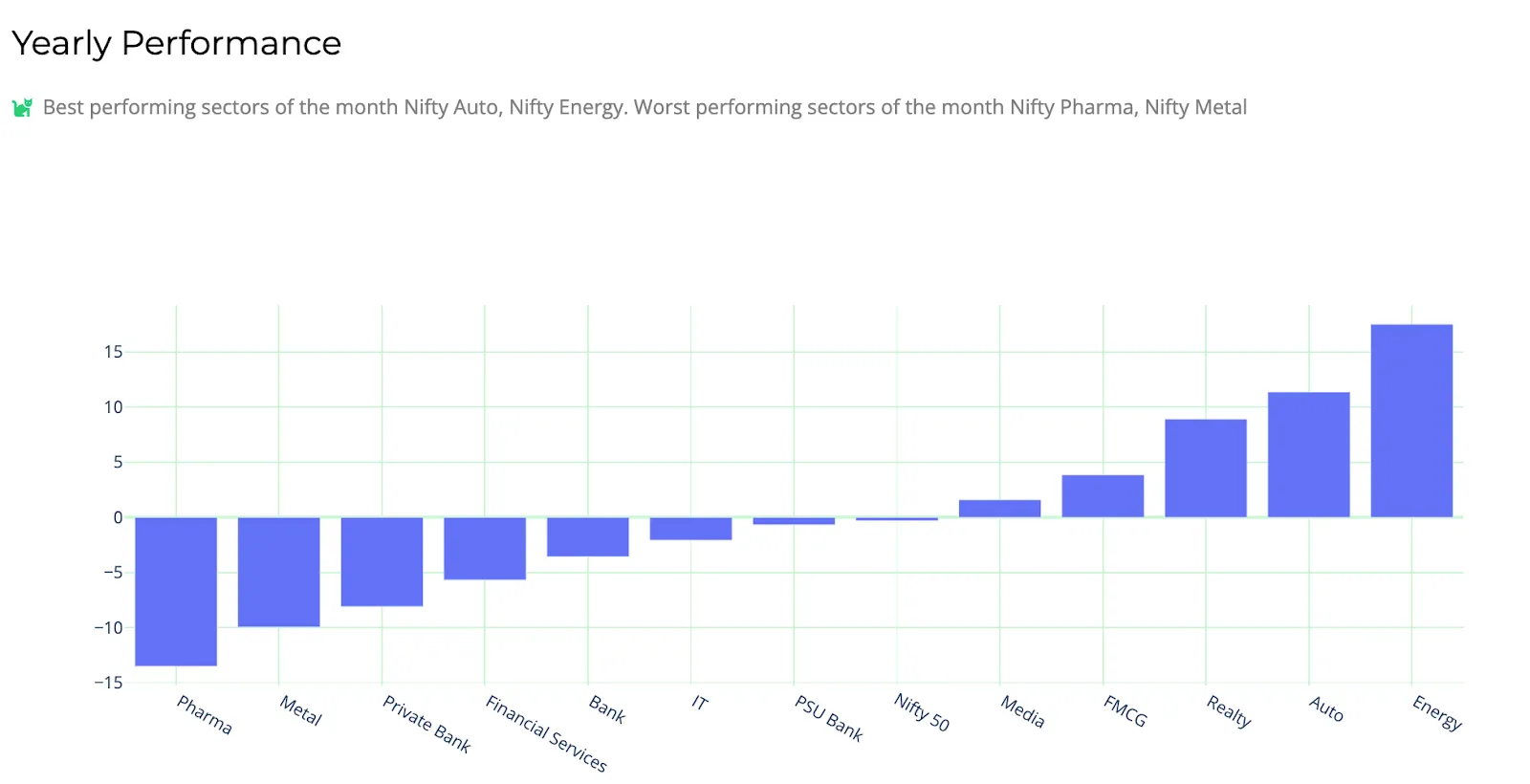
Most sectors in the Indian economy have had a tough time in the last year. While Nifty itself has turned negative in a yearly time frame, energy auto and FMCG are still positive on the annual horizon. On the other hand, Pharma, metals, and private banks have had a bad year.
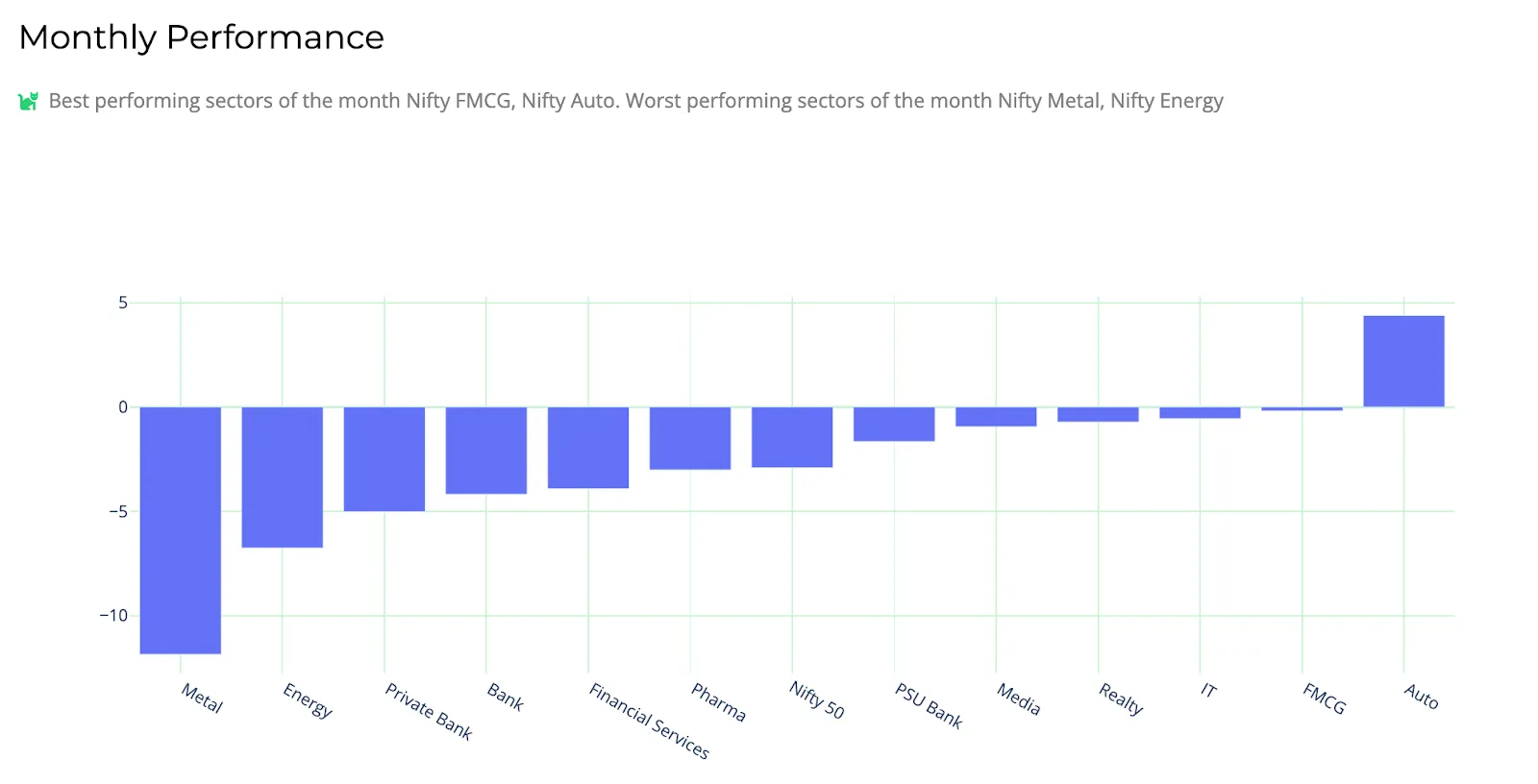
If we look at more recent prices, the Auto sector is taking the lead on a monthly horizon, followed by FMCG. Metals, energy, and banks are trailing the most.
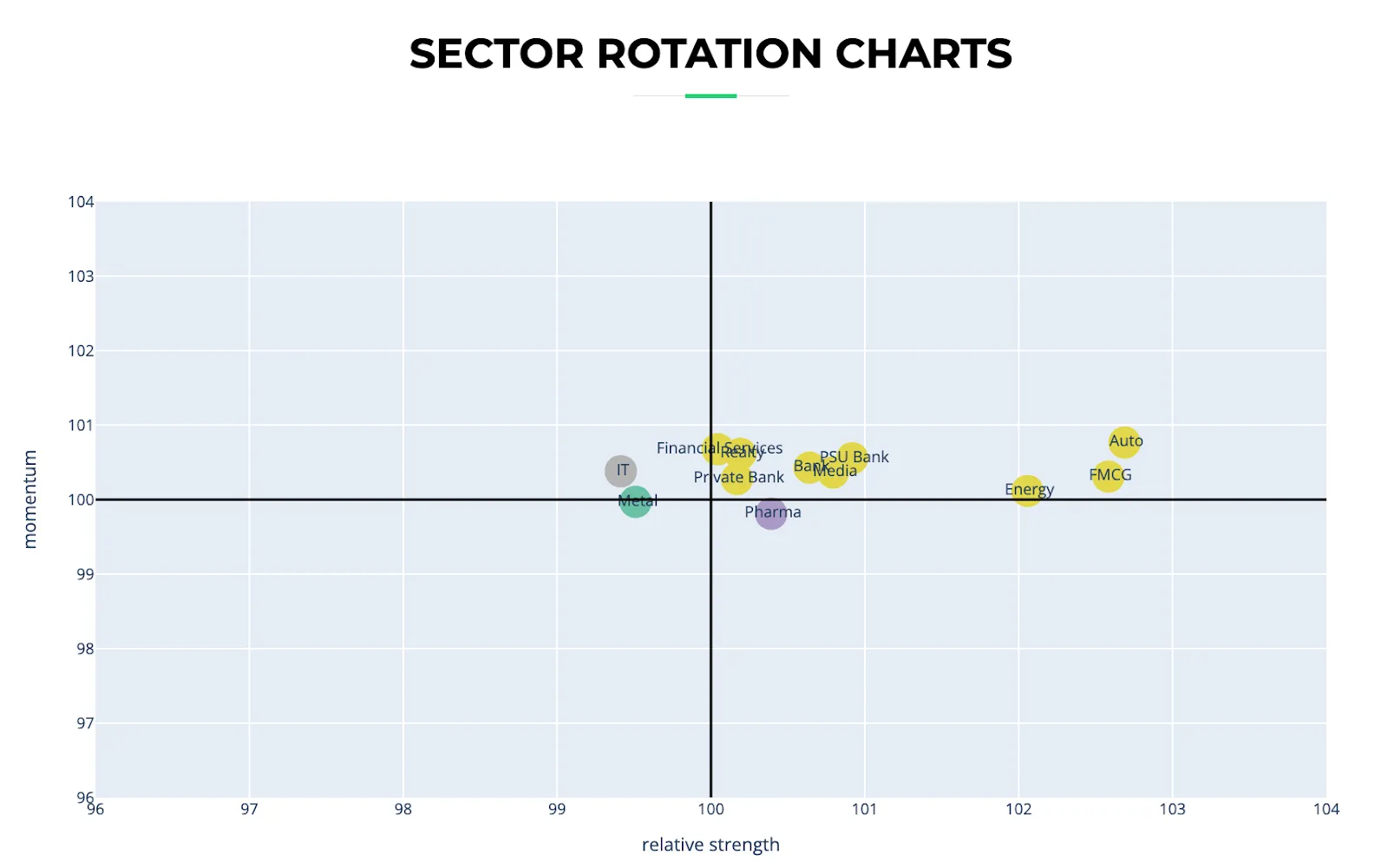
Based on sector rotation charts, The leading sectors are Auto, Bank, Energy, and FMCG. The Lagging sector is Metal, the Improving sector is IT, and the Weakening sector is Pharma.
Let’s look at the outlook on the various sectors one by one:
Auto🚗
Auto is a clear winner. In 2022, the BSE Auto index has increased by 2.9% & in the past week, Nifty Auto was up 6.80%. Rally cycles in the auto industry typically span 24 to 30 months. However, since they improved during the past six months, they may do better for the next two years.
Due to supply-side issues, weak consumer demand, and margin pressure brought on by high raw material costs, auto stocks have been under pressure in the past year. However, because metal costs have been declining recently and there are indications that demand is strengthening for passenger vehicles, investors have begun to see an opportunity in the auto sector.
Check the macro backdrop
GDP, inflation, rates and more — India’s key economic indicators in one dashboard.
FMCG 🧼
In the past month, Nifty FMCG has fallen about 1.25%. The government's encouragement and whether the typical monsoons would be favourable this time are the main signs of hope for the FMCG sector.
The FMCG sector in India is witnessing a slowdown as consumption is dropping due to product prices going up, as companies need to account for higher input costs. Input costs for manufacturers are at an all-time high due to a labour shortage and rising gasoline prices, which have significantly impacted margins.
The sector saw a 6% increase in the January–March quarter. However, due to price hikes, sales volume fell by 4 per cent—the most since the previous three quarters as customers are more frugal with their money.
Information Technology (IT) 🖥
Fears concerning the protracted slowdown in US IT spending have contributed to a severe fall in Indian IT stock prices in 2022.
We must note that Indian IT firms do not face problems on the top-line as they have signed multi-year contracts. Instead, the fall in prices of IT stocks results from a correction in high valuations. Valuation corrections will likely accompany these market declines unless macroeconomic fundamentals remain stable.
The Nifty IT index has fallen about 2.43% in the past month and is about 0.97X volatile as Nifty.
Pharma 💉
Indian pharma firms have grown to be reliable sources for international pharma firms and have developed excellent competencies. As they are globally competitive and have a sizable market share in most markets, Indian pharmaceutical companies are better positioned to take advantage of opportunities.
The Pharma index has regularly outperformed the benchmark indexes over the past two years, generating solid returns of 50% instead of the benchmark's gains of 37%. Moreover, it's anticipated that strong outperformance will persist. Just in the past week, Nifty Pharma was up 3.08%.
Get research like this in your inbox
The week’s research that mattered, in five minutes. Joined by 1.6L+ investors.
Banks💵
As the banking industry posted its most significant profit in the previous 26 quarters and private banks have been the better performers, profit momentum for India's banking sector will be maintained from 2021 to 2022.
Substantial recoveries and upgrades improved the banking sector's asset quality, while fewer quarter-over-quarter (QoQ) slippages ensured that credit costs stayed on the lower side. As a result, this sector's overall operating profit increased 4.6 per cent YoY and 3.8 per cent QoQ to Rs 103,614 crore.
Irrespective of global banks hiking interest rates and market volatility, Nifty Bank was up 2.9% in the past week.
Energy🛢
The energy sector has had a good year but lags behind this month with a -6.5% return.
The energy sector's growth was due to rising crude and natural gas prices during the last year. However, with crude oil prices showing signs of easing, we are not highly excited by the energy sector’s prospects.
Many of the stocks in the energy sector have high dividend payouts, which could be interesting during bear markets.
Realty 🏡
Like all other industries, real estate suffered greatly from the pandemic. A disturbed supply chain stopped building, a labour shortage, and low budget spending in the sector all derailed India's real estate market's momentum.
In the middle of the general market instability on the global stage, the Indian real estate sector is mainly under pressure from rising prices and supply chain interruptions.
Despite experiencing several highs and lows over the past 1.5 years, the Indian economy has shown resilience. It is currently on a path of K-shaped recovery supported by timely government initiatives. In the past week, Nifty Realty was up 0.27%.
Metals🪨
With the Nifty Metals index down roughly 33% to 4,540.9 from its 52-week high of 6,825.65, metal stocks appeared to be melting in a furnace in recent sessions. As a result, Nifty Metal is almost at its lowest point since April 2021.
Up to the start of April, the Russia-Ukraine conflict drove a significant increase in metal prices. However, since then, lockdowns related to COVID and a recession in China have put pressure on prices. Other important factors for the fall include central banks boosting interest rates to combat inflationary pressures and an anticipated economic slowdown.
The government placed the export levy on steel to lower domestic steel prices. Steel prices adjusted within a week, producing the expected effect. In the past week, Nifty Metal was down 2.50%.
See what markets are pricing in
Live indices, sector moves and market breadth — the backdrop to every story we publish.
Sector Allocation in Momentum ⚡️
Interestingly, the sector allocation of the Momentum portfolio has shifted towards Automobile and FMCG now. A few months ago we were heavily allocated to the IT sector.
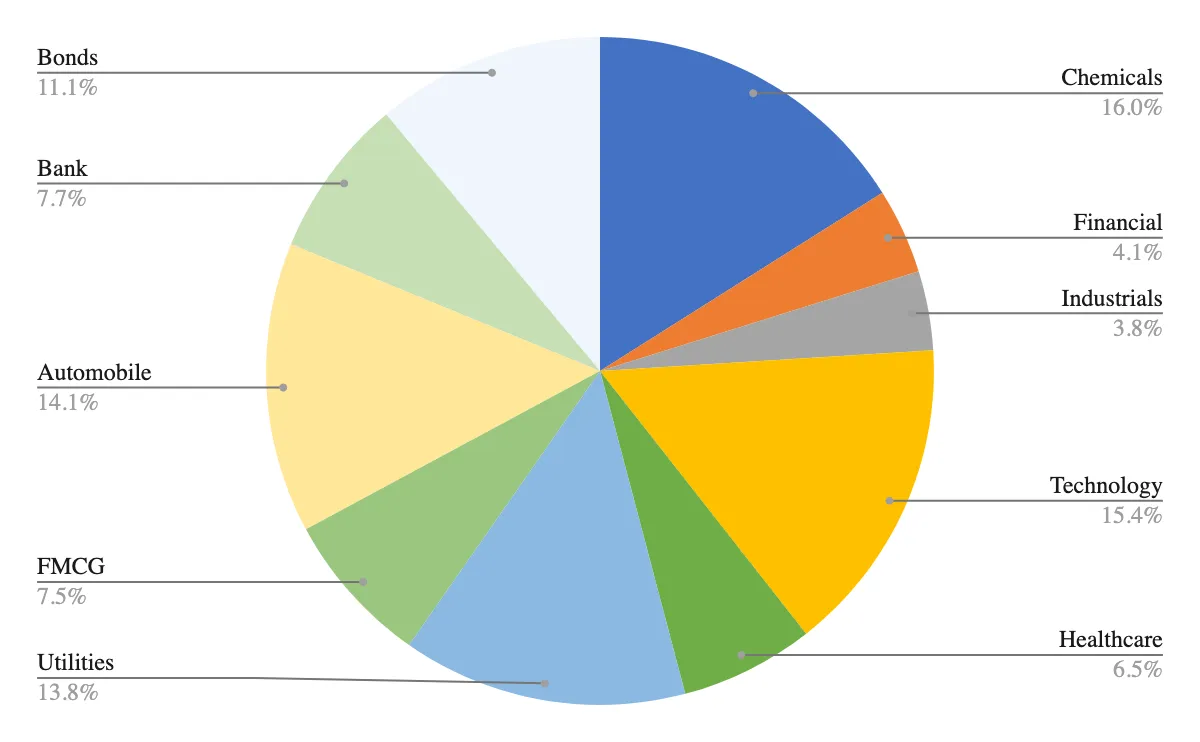
You can check the Wright Momentum portfolio here: