by Wright Research
Published On March 24, 2026
Defensive portfolio management services (PMS) are professionally managed investment strategies designed to protect investor capital during market downturns while delivering steady long-term growth. They use:
Strategy | Purpose |
Strategic asset allocation | Reduces concentration risk across sectors |
Quality stock selection | Focuses on stable, low-volatility companies |
Active portfolio monitoring | Adjusts exposure during uncertain market phases |
Diversification | Limits the impact of any single drawdown |
High-water mark fee structure | Ensures performance fees are charged fairly |
Minimum investment: ₹50 lakh (SEBI mandated)
Fee structure: Fixed management fee (1–3% p.a.) + performance fee (10–20% of profits above benchmark)
Investments are subject to market risk. Past performance is not a guarantee of future returns.
Defensive portfolio management services (PMS) help protect and grow investor wealth by reducing volatility while maintaining long-term growth potential. Through diversification, high-quality stock selection, and dynamic asset allocation. Managers build resilient portfolios that can navigate uncertain market conditions.
By focusing on stable sectors and using hedging strategies, these portfolios aim to provide downside protection while enabling steady capital appreciation.
However, market volatility often disrupts investors’ wealth-building journeys. Sudden corrections, geopolitical events, and economic uncertainty can quickly turn a well-performing portfolio into a stressful experience. Many investors struggle to balance growth with capital protection, and traditional strategies often leave portfolios exposed to sharp fluctuations.
This is where portfolio management services become valuable. Working with a sebi registered investment advisor helps investors implement disciplined strategies that focus on both returns and risk control. A structured PMS in investment approach focuses on building a diversified PMS portfolio designed for consistency rather than chasing short-term momentum.
A professionally managed PMS portfolio prioritizes quality companies and balanced sector exposure to remain aligned with long-term financial goals. Investors looking for a structured starting point can explore Wright Research's active portfolio management services , built around data-driven strategies for long-term wealth creation.
Investors also consider transparency around PMS charges when evaluating PMS as an investment opportunity. Clear PMS charges help investors understand the value of professional research, asset allocation, and portfolio monitoring. With transparent PMS charges, a well-managed PMS portfolio can provide stability, downside protection, and sustainable long-term wealth creation.
Capital preservation refers to an investment approach focused on protecting the investor’s original capital while still pursuing stable long-term returns . In a professionally managed PMS in investment, the primary goal is not only growth but also safeguarding wealth during market downturns. For investors new to PMS, understanding the full types and benefits of portfolio management services provides essential context before evaluating defensive strategies.
A well-structured PMS portfolio uses diversification, high-quality stock selection, and risk management techniques to minimize losses during volatile market conditions.
Investors evaluating PMS in investment opportunities often prioritize strategies that balance growth with protection. This is where capital preservation becomes a key element of a resilient PMS portfolio, helping investors stay invested through market cycles without experiencing significant drawdowns.
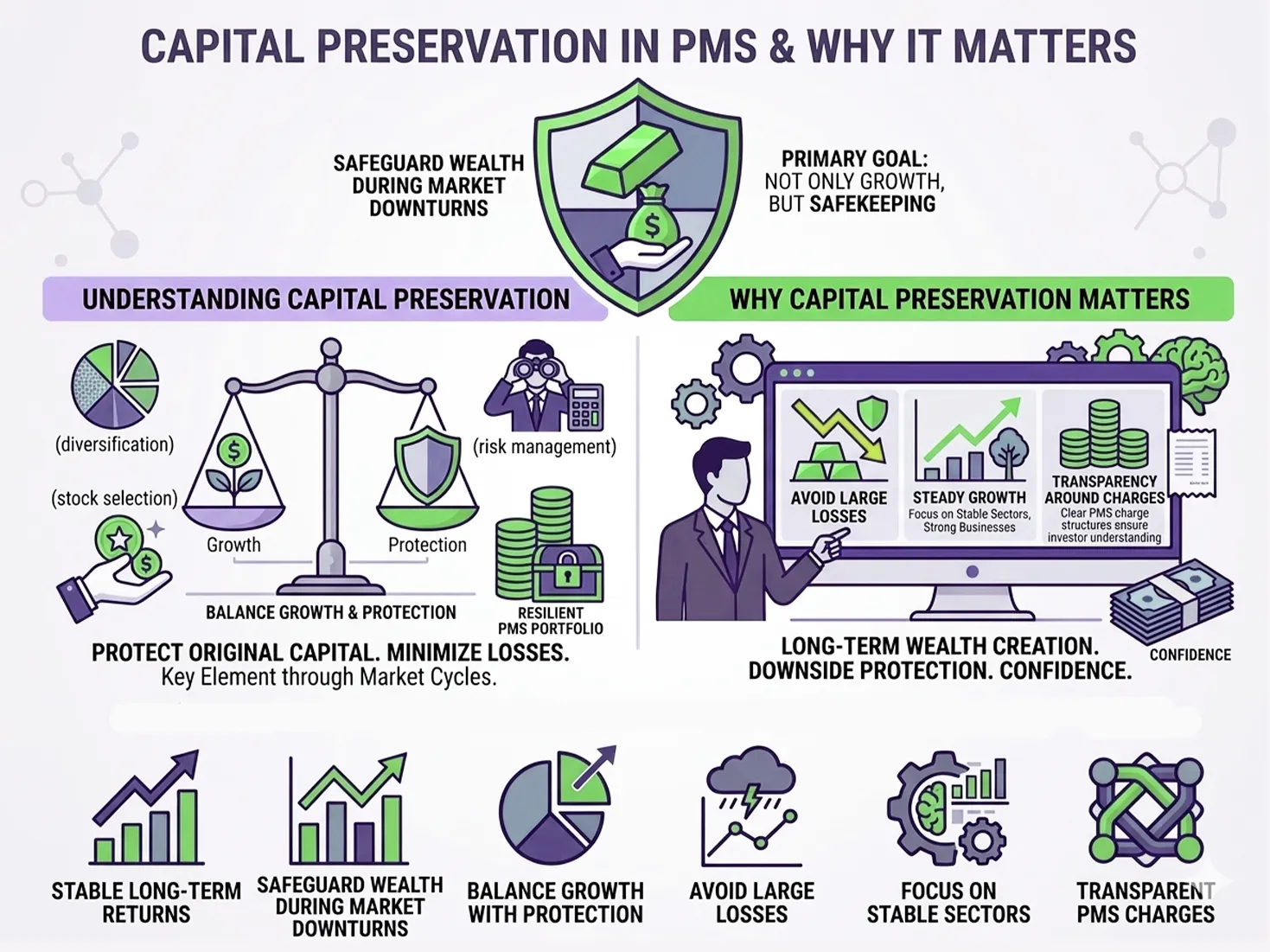
Capital preservation plays a critical role in long-term wealth creation because avoiding large losses helps portfolios recover faster and grow steadily over time. In a disciplined PMS in investment strategy, portfolio managers focus on stable sectors, strong businesses, and diversified allocations, to maintain the strength of the PMS portfolio even during uncertain markets.
Investors also assess transparency around PMS charges when choosing portfolio management services. Clear PMS charge structures ensure investors understand the cost of professional management and the value of research, portfolio monitoring, and risk management that support capital preservation. When supported by transparent PMS charges, a professionally managed PMS portfolio can deliver stability, downside protection, and sustainable long-term wealth creation.
Also Read: Who are The Real Winners of the Iran-Israel War? : Sectors, Companies, Countries Gaining from War
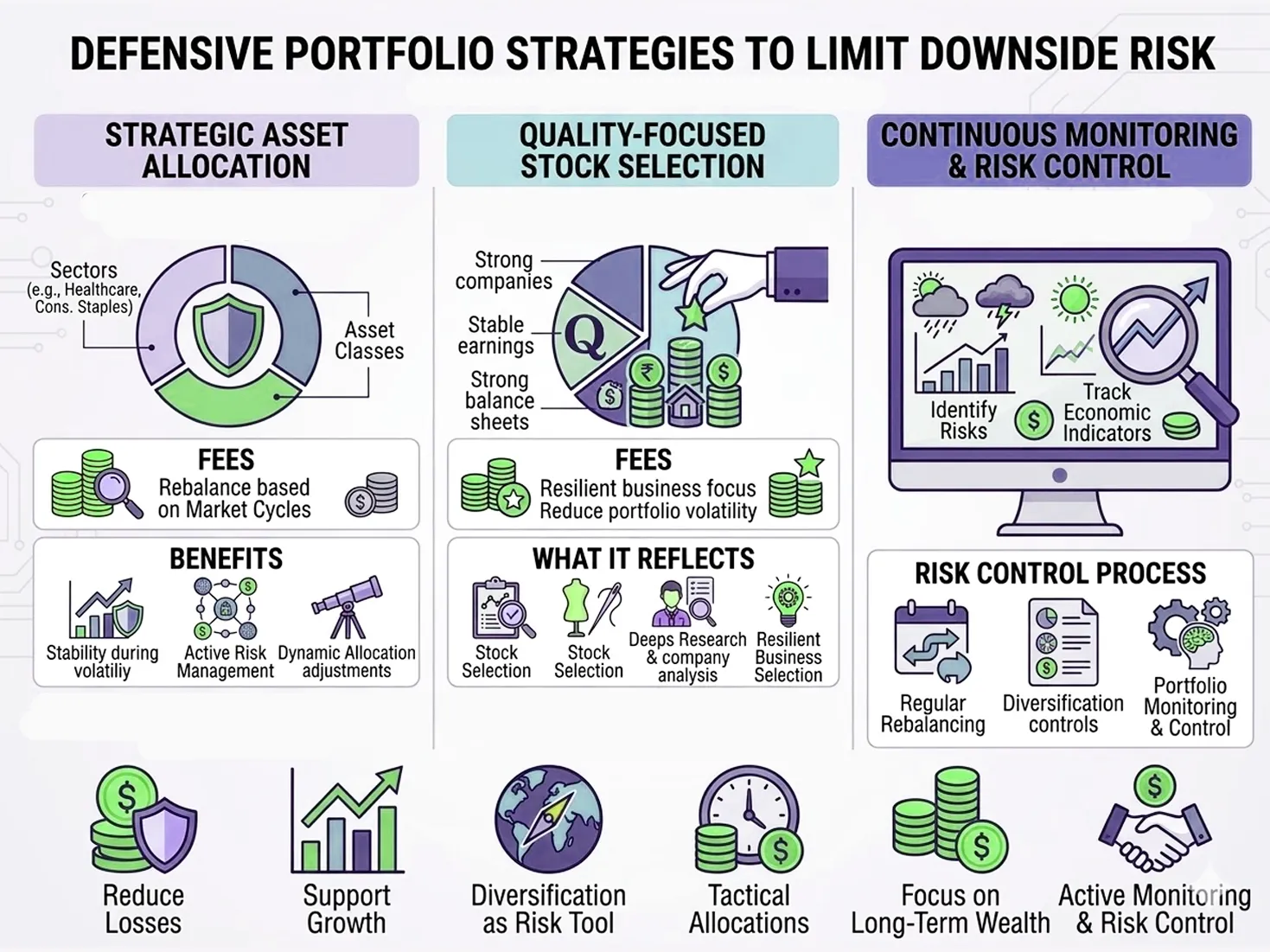
Defensive portfolio strategies aim to reduce losses during market downturns while supporting long-term growth . Since markets move through cycles of expansion, correction, and recovery, portfolios require disciplined risk management to remain stable.
This is where active portfolio management becomes important. Instead of simply tracking the market, active portfolio management allows managers to adjust allocations based on economic conditions and market trends.
Through active portfolio management, managers can reduce exposure to high-risk assets during uncertain periods while maintaining growth opportunities.
Professional PMS portfolio management services use research-driven insights to build resilient portfolios that can withstand market volatility.
Diversification and asset allocation are central to defensive investing. Spreading investments across sectors and asset classes helps reduce the impact of market swings.
Through an active portfolio management strategy, managers rebalance portfolios based on changing market conditions. During uncertain phases, allocations may shift toward defensive sectors such as healthcare and consumer staples.
This active portfolio management strategy helps maintain stability during volatile periods. Many PMS portfolio management services rely on research-based allocation decisions, and top financial advisors in India often emphasize diversification as a key risk management tool.
Defensive portfolios prioritize financially strong companies with stable earnings and strong balance sheets.
Managers practicing active portfolio management analyze company fundamentals before including them in the portfolio. A disciplined, active portfolio management strategy focuses on selecting resilient businesses that can perform across market cycles.
Leading PMS portfolio management services use this approach to reduce portfolio volatility. Many top financial advisors in India believe that investing in quality companies helps limit downside risk.
Markets evolve rapidly, making continuous monitoring essential. Through active portfolio management, managers track economic indicators and market trends to identify risks.
A structured active portfolio management strategy includes regular portfolio rebalancing and diversification controls. Professional PMS portfolio management services use analytics and research to maintain stability, and top financial advisors in India rely on these disciplined processes to protect long-term investor wealth.
Also Read: From Coal to Cloud: Mapping India’s Shift from Conventional Power to Sustainable Infrastructure
In a low-volatility Portfolio Management Service strategy, portfolio risk management focuses on protecting capital while delivering stable long-term returns. Instead of simply chasing market-beating performance, the strategy emphasizes controlling volatility and reducing downside risk.
Through active portfolio management, managers continuously evaluate market conditions, sector trends, and company fundamentals to ensure portfolios remain aligned with risk objectives. This disciplined approach allows active portfolio management to adjust exposures during uncertain market phases while maintaining long-term growth potential.
The primary goal of risk management in low-volatility strategies is protecting investor capital during market corrections. Through active portfolio management, portfolio managers may reduce exposure to highly volatile stocks and focus on companies with strong fundamentals and stable earnings.
A disciplined, active portfolio management strategy ensures that portfolios are structured to fall less than the broader market during downturns, helping investors maintain stability and confidence in their investments. Before committing capital, investors should also review the risks of investing in portfolio management services , a comprehensive breakdown of concentration, liquidity, and manager risk.
Diversification is a key component of defensive investing. Professional PMSs ' portfolio management services spread investments across sectors and industries to reduce concentration risk. By applying a structured active portfolio management strategy, managers ensure that no single asset or sector contributes excessively to overall portfolio volatility.
Many PMS portfolio management services rely on portfolio analytics and risk metrics to monitor diversification and maintain a balanced portfolio structure.
Markets constantly evolve, making continuous monitoring essential. Through active portfolio management, managers track economic indicators, interest rate trends, and company performance to identify emerging risks.
An effective active portfolio management strategy also includes periodic portfolio rebalancing, where investments are adjusted to maintain the desired risk level. According to many top financial advisors in India, this disciplined monitoring process is essential for maintaining portfolio stability.
Ultimately, portfolio risk management aims to generate consistent returns with controlled volatility. Rather than focusing solely on raw performance, PMS portfolio management services evaluate portfolios using risk-adjusted performance metrics.
According to many top financial advisors in India, combining disciplined monitoring with active portfolio management helps investors achieve stable, long-term wealth creation while minimizing exposure to sudden market shocks.
Also Read: Why You Should Review Your Mutual Fund Portfolio for Long-Term Wealth Preservation
Portfolio Management Services in India typically require a minimum investment of ₹50 lakh and provide customized investment strategies managed by professionals. Investors often choose portfolio management services for their personalized approach, disciplined research, and structured investment process. A SEBI registered portfolio manager can help investors understand how these services work, how fees are structured, and how PMS services deliver long-term investment value. While costs are an important consideration, the real value of professional portfolio management services comes from strategic asset allocation, expert research, and strong portfolio risk management frameworks that aim to deliver stable long-term returns.
Most PMS services charge a fixed management fee based on the assets under management (AUM). This fee generally ranges between 1% and 3% annually and is often billed quarterly. The management fee covers research, portfolio construction, monitoring, and investment strategy execution.
A SEBI-registered investment advisor typically explains the fee structure in detail to ensure transparency for investors choosing professional portfolio management services. These fees support the investment expertise, technology platforms, and system portfolio management processes used to monitor portfolios and manage risk effectively.
Many portfolio management services also follow a performance-linked fee structure where the portfolio manager receives a share of the profits generated for the investor. Typically, this performance fee ranges from 10% to 20% of profits and is charged only when the portfolio delivers returns above a predefined benchmark or hurdle rate.
A SEBI-registered investment advisor often highlights that this model aligns the interests of the investor and portfolio manager. Through disciplined portfolio risk management, professional PMS services aim to generate consistent, risk-adjusted returns while maintaining investment discipline.
A common feature in many PMS services is the high-water mark principle. Under this rule, performance fees are charged only when the portfolio value exceeds its previous highest level. This protects investors from paying fees on recovered losses.
Many portfolio management services use structured system portfolio management frameworks to track portfolio performance and ensure transparency in fee calculations. This systematic approach strengthens investor trust and supports disciplined portfolio risk management practices.
Beyond fees, the value of professional portfolio management services lies in strategic investment frameworks designed to balance growth and stability. Many investors choose PMS services because they support a conservative investment strategy focused on quality companies and diversified allocations.
A SEBI-registered investment advisor may recommend a conservative investment strategy for investors seeking stability in volatile markets. Investors specifically seeking fixed-income focused capital protection can explore the Wright Debt Fund PMS for capital preservation , a FIPMS strategy focused on stable returns through debt instruments. This strategy emphasizes capital preservation by prioritizing strong businesses and disciplined asset allocation.
The long-term success of professional PMS services depends on effective portfolio risk management and disciplined investment execution. Through continuous monitoring and system portfolio management, portfolio managers adjust investments based on market conditions and economic indicators.
A well-structured conservative investment strategy combined with strong portfolio risk management helps investors achieve capital preservation while still benefiting from market growth opportunities. Ultimately, capital preservation remains a key objective for investors who want stability and sustainable wealth creation through professional portfolio management.
Also Read: Indian Pharma Q3FY26: Results, Themes, Headwinds, and Key Takeaways
Volatility will always be a part of financial markets, but it does not have to define an investor’s experience.
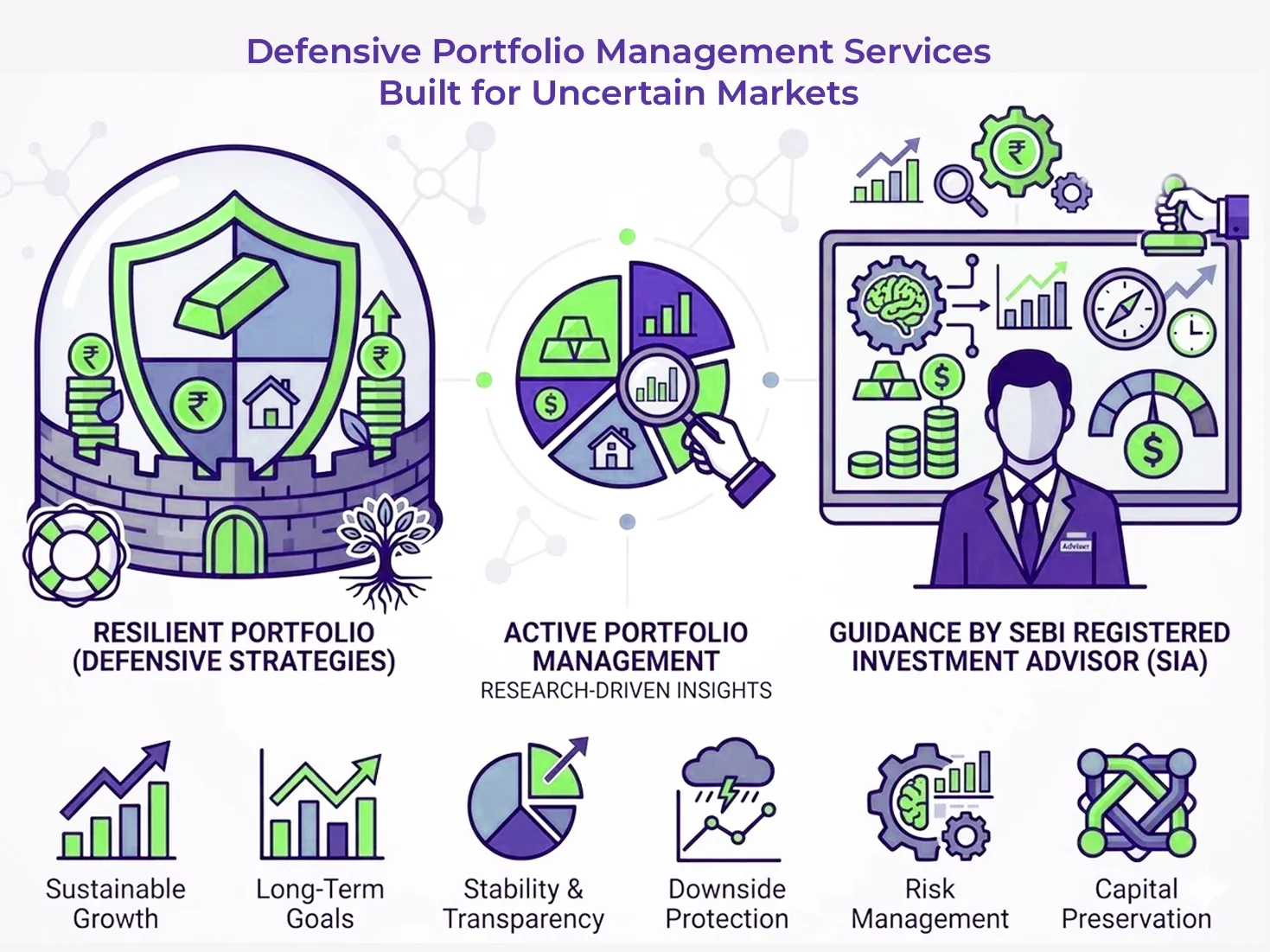
Through disciplined strategies, professional oversight, and structured portfolio analysis and management, investors can build resilient portfolios that withstand market fluctuations. With the support of portfolio management services, investors gain access to research-driven strategies designed to balance risk and long-term growth.
Working with a sebi registered investment advisor can further help investors implement structured investment frameworks that focus on stability, transparency, and disciplined portfolio decisions. Modern portfolio management services provide investors with sophisticated strategies that combine growth opportunities with risk management.
By combining capital preservation, downside protection, and active portfolio management, investors can pursue long-term financial success with greater confidence. Guidance from a sebi registered investment advisor ensures that investment decisions remain aligned with financial goals and market realities.
For investors seeking a balanced approach to wealth creation, professional PMS portfolio management services offer a powerful solution, delivering disciplined investment strategies that protect wealth while enabling sustainable growth.
A PMS cost refers to the fees charged for Portfolio Management Services to professionally manage an investor’s portfolio. These costs typically include a management fee (around 1%–3% of assets annually), performance fees (10%–20% of profits), and additional charges like brokerage, custodial, and audit fees. PMS in India usually requires a minimum investment of ₹50 lakh.
Yes, PMS can be a good investment for high-net-worth investors seeking personalized portfolio management and professional expertise. It offers customized strategies, active portfolio monitoring, and potential for higher risk-adjusted returns. However, PMS involves higher costs and market risks, so it is most suitable for investors with a long-term horizon and a minimum investment of ₹50 lakh.
There is no single “best” PMS provider, as the right choice depends on an investor’s goals, risk appetite, and investment style. However, some well-known PMS providers in India include Wright Research, Motilal Oswal Asset Management Company, ASK Investment Managers, ICICI Prudential Asset Management Company, Kotak Mahindra Asset Management Company, and Marcellus Investment Managers. Investors should compare track record, strategy, fees, and risk management before choosing.
Some of the top financial advisor companies in India include Wright Research, ICICI Prudential Asset Management Company, HDFC Asset Management Company, Kotak Mahindra Asset Management Company, Motilal Oswal Asset Management Company, ASK Investment Managers, Marcellus Investment Managers, Anand Rathi Wealth Limited, IIFL Wealth Management, Edelweiss Wealth Management, and DSP Asset Managers.
Capital preservation techniques focus on protecting invested capital while allowing modest growth. Common methods include diversification across asset classes, investing in high-quality and low-volatility stocks, maintaining a balanced asset allocation, using hedging strategies, and following a conservative investment strategy. Regular portfolio rebalancing and disciplined risk management also help limit downside risk during market volatility.
The four main portfolio management strategies are active portfolio management, where managers actively buy and sell assets to outperform the market; passive portfolio management, which tracks market indexes; discretionary portfolio management, where managers make investment decisions on behalf of clients; and non-discretionary portfolio management, where investors make final decisions with advisor guidance.
Portfolio management services reduce volatility through diversification across sectors and asset classes, active rebalancing when market conditions change, quality-focused stock selection that prioritises stable earnings businesses, and continuous portfolio monitoring by professional managers. The combination of these strategies aims to ensure the portfolio falls less than the broader market during corrections.
Discover investment portfolios that are designed for maximum returns at low risk.
Learn how we choose the right asset mix for your risk profile across all market conditions.
Get weekly market insights and facts right in your inbox


It depicts the actual and verifiable returns generated by the portfolios of SEBI registered entities. Live performance does not include any backtested data or claim and does not guarantee future returns.
By proceeding, you understand that investments are subjected to market risks and agree that returns shown on the platform were not used as an advertisement or promotion to influence your investment decisions.
"I was drawn to Wright Research due to its multi-factor approach. Their Balanced MFT is an excellent product."

By Prashant Sharma
CTO, Zydus
By signing up, you agree to our Terms and Privacy Policy
"I was drawn to Wright Research due to its multi-factor approach. Their Balanced MFT is an excellent product."
By Prashant Sharma
CTO, Zydus
Skip Password
By signing up, you agree to our Terms and Privacy Policy
"I was drawn to Wright Research due to its multi-factor approach. Their Balanced MFT is an excellent product."
By Prashant Sharma
CTO, Zydus
"I was drawn to Wright Research due to its multi-factor approach. Their Balanced MFT is an excellent product."
By Prashant Sharma
CTO, Zydus
Log in with Password →
By logging in, you agree to our Terms and Privacy Policy
"I was drawn to Wright Research due to its multi-factor approach. Their Balanced MFT is an excellent product."
By Prashant Sharma
CTO, Zydus
Log in with OTP →
By logging in, you agree to our Terms and Privacy Policy
"I was drawn to Wright Research due to its multi-factor approach. Their Balanced MFT is an excellent product."
By Prashant Sharma
CTO, Zydus
Answer these questions to get a personalized portfolio or skip to see trending portfolios.
Answer these questions to get a personalized portfolio or skip to see trending portfolios.
(You can choose multiple options)
Answer these questions to get a personalized portfolio or skip to see trending portfolios.
Answer these questions to get a personalized portfolio or skip to see trending portfolios.
Answer these questions to get a personalized portfolio or skip to see trending portfolios.
(You can choose multiple options)
Investor Profile Score
We've tailored Portfolio Management services for your profile.
View Recommended Portfolios Restart