


Introduction
Imagine this. You strongly believe India's defence sector is about to take off. Or that the EV revolution will reshape the auto industry over the next decade. Or that digital payments will only grow from here. But you don't know exactly which stock to bet on. You want exposure — diversified, professionally managed, without putting everything on one company.
This is the problem that thematic mutual funds solve. And in India's rapidly evolving economy, they've gone from a niche product to a mainstream investment conversation. Yet most investors either don't fully understand them or confuse them with sectoral funds and end up making costly mistakes.
In this blog, we break down what thematic funds are, how contra mutual funds , focused mutual funds, and value mutual funds each work differently, which are the best thematic funds in India right now, and most importantly, how much of your mutual fund portfolio should actually go into them.
Run the numbers on your next investment
Project returns on a lumpsum or SIP with our free calculators.
What Are Thematic Mutual Funds?
Let's start with a definition that most finance websites consistently get wrong.
A thematic mutual fund invests across multiple sectors that are united by a single overarching economic idea. Think digital India, which covers IT, fintech, telecom, and e-commerce simultaneously. Or the energy transition theme spanning power, EVs, solar, and green infrastructure. The fund follows the theme, not a single industry. The fund manager has the freedom to own a fintech company, a telecom tower operator, and an IT services firm, all within the same portfolio, as long as they're each tied to the digital India story.
A sectoral fund, by contrast, is confined to one industry. A banking sectoral fund only holds banking stocks. A pharma fund only holds pharma. There's no flexibility to stray. Thematic mutual funds give the manager far more room to express a macro thesis across sectors.
This distinction matters enormously in practice. If India's digital economy theme plays out, the winner might be a fintech company, a cloud infrastructure provider, or a digital payment network, not necessarily a pure-play IT firm. A thematic fund captures all of that. A sectoral IT fund captures only the last one.
SEBI classifies both under the same "Sectoral/Thematic" category in its mutual fund framework, which is why the confusion persists. But for any investor building a mutual fund portfolio, the strategic difference is significant. Thematic mutual funds offer structural diversification within their theme, and that's their first real advantage over sector funds.
Why Thematic Funds Have Exploded in Popularity in India
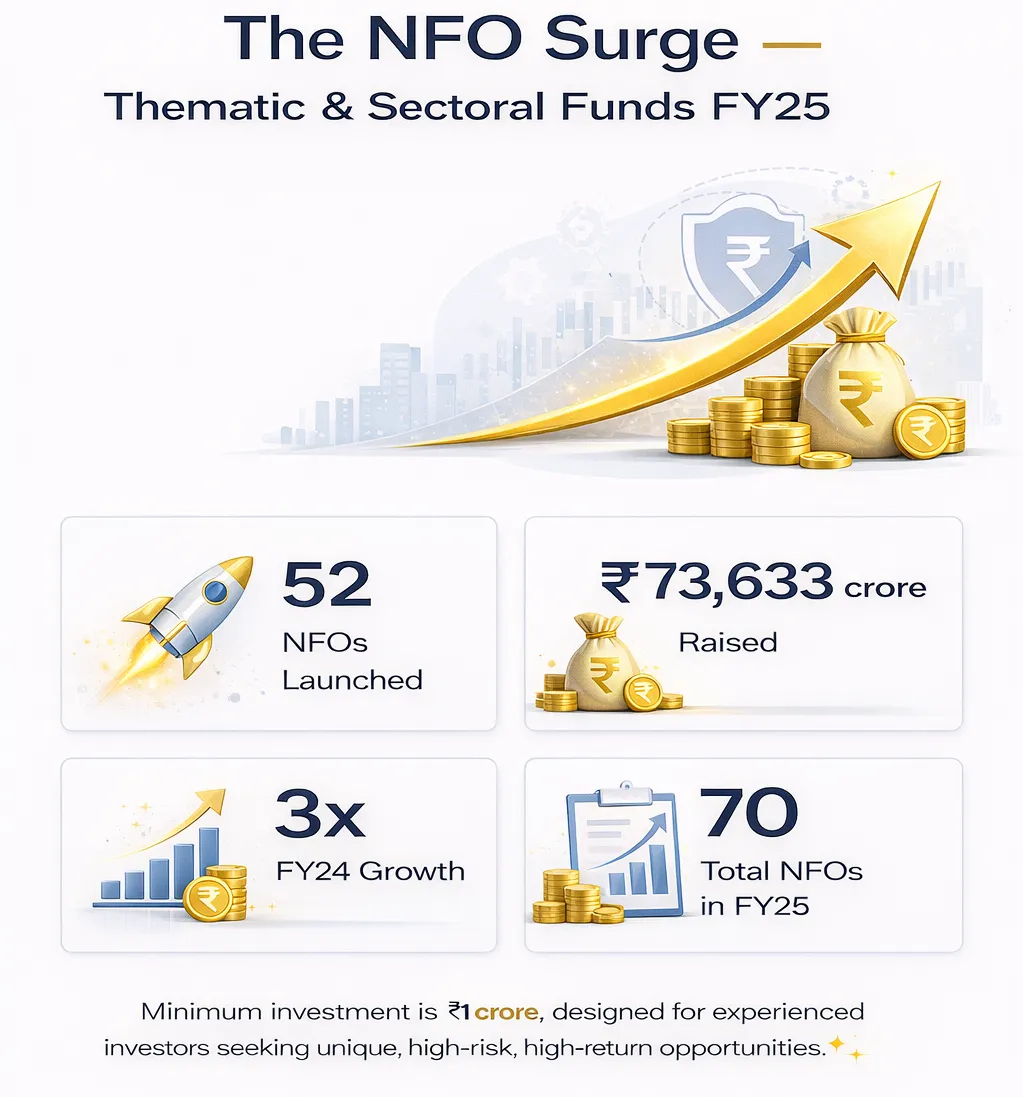
The numbers make this hard to ignore. In FY2024–25, 52 out of 70 NFOs launched in India were in the sectoral or thematic category. Together, they raised over ₹73,633 crore, roughly three times the collections from FY2024.
That's not a coincidence. India's economy is going through multiple large structural transitions at the same time: digital infrastructure, defence indigenisation, energy transition, manufacturing growth under PLI schemes, and a middle class that is spending more than any previous generation. These aren't short-term cyclical plays. They're multi-year structural shifts that thematic funds are designed to capture.
For investors, thematic mutual funds offer a way to express a macro conviction "I believe India's defence sector will grow five times in the next decade" without having to pick individual stocks and carry that specific risk. For fund houses, they offer a differentiation story. That mutual incentive has flooded the market with new themes.
But abundance creates complexity. Not every theme plays out. Not every thematic fund ends up being a high-return mutual fund . Understanding what you're buying before you invest is the critical first step, which is why the next section matters most.
Types of Thematic Funds: A Framework for Indian Investors
The broad label "thematic fund" actually covers four very different investment philosophies. Treating them as the same thing is a mistake.
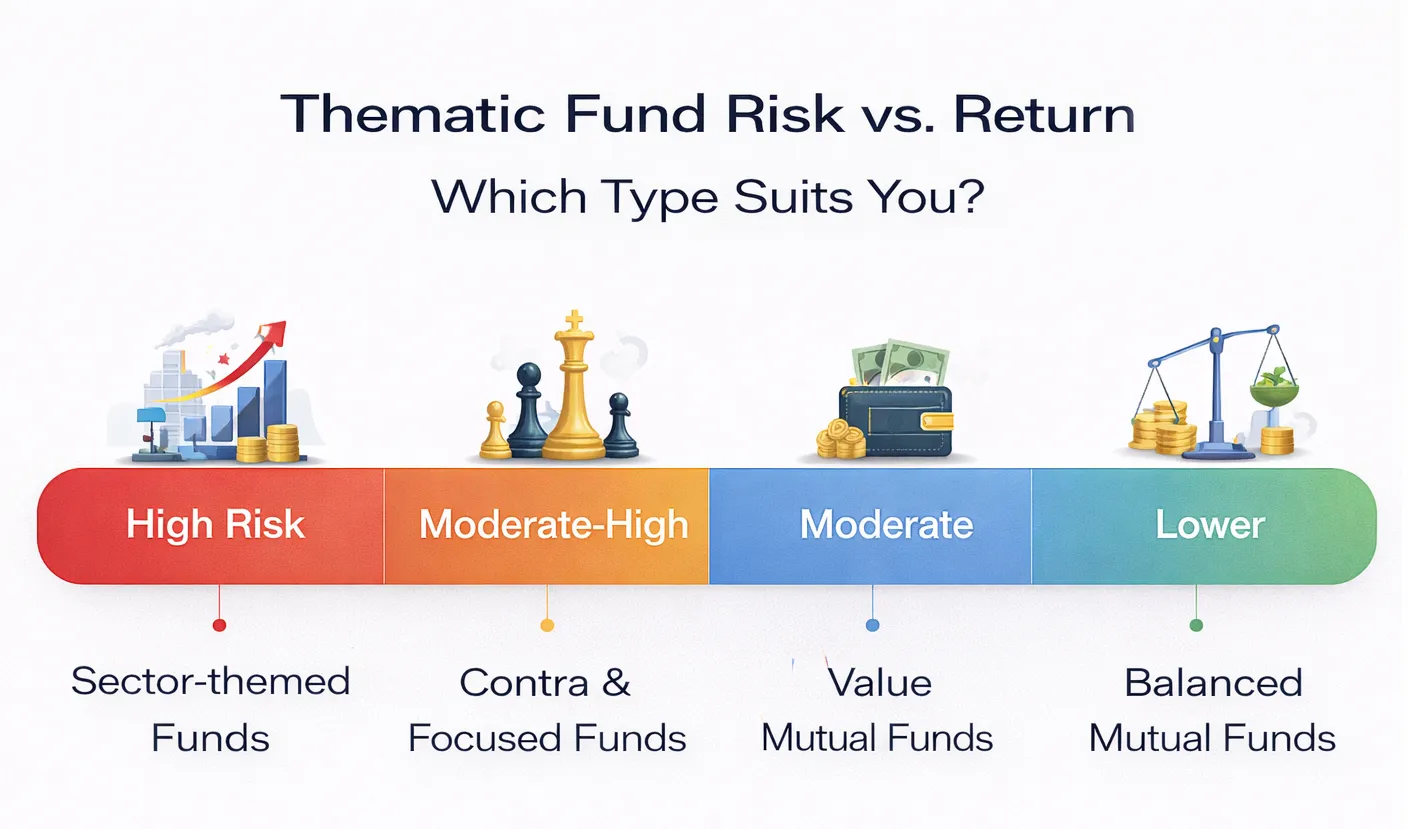
Type | Core Strategy | Risk Level | Ideal Horizon | Best For |
Sector-Themed Funds (Defence, EV, Digital) | Concentrated sector/theme exposure | High | 5–7+ years | Aggressive, theme-savvy investors |
Contra Mutual Funds | Buy out-of-favour stocks; wait for mean reversion | Moderate-High | 5–10 years | Patient contrarian investors |
Focused Mutual Funds | High-conviction portfolio of max 30 stocks | Moderate-High | 3–7 years | Investors backing a fund manager's edge |
Value Mutual Funds | Invest in underpriced stocks vs. intrinsic value | Moderate | 5+ years | Moderate risk investors, capital preservation focus |
Each of these fits into a different corner of a mutual fund's portfolio . None of them should form its core. But, selectively deployed based on your risk profile and time horizon, they can meaningfully enhance returns and add a layer of intentionality to how your money is working. Let's go deeper on each.
Contra Funds Explained: The Contrarian Bet That Pays Off
Of all the thematic fund varieties, contra mutual funds are the most intellectually interesting and the most misunderstood.
The contra mutual fund meaning is rooted in one idea: buy what the market is avoiding. The contra fund mutual fund strategy involves identifying stocks that have been abandoned, over-punished by sentiment, or stuck in cyclical troughs and buying them when everyone else is selling. Then, waiting for mean reversion to do its work.
This is not reckless contrarianism. A well-managed contra mutual fund is not buying broken businesses. It's buying fundamentally sound businesses whose stocks have been dragged down by temporary headwinds, sector-wide pessimism, or market overreaction. The gap between the stock's price and its actual worth is the opportunity the manager is exploiting.
India's market cycles make this strategy particularly relevant here. PSU banks were deeply out of favour in 2017–18. IT stocks got hammered in 2022. Pharma went through extended periods of underperformance. In each case, the businesses hadn't fundamentally deteriorated; the market had simply overreacted. A good contra fund mutual fund manager would have been buying through those periods.
Top Contra Mutual Funds in India
Fund Name | 3Y CAGR (Indicative) | 5Y CAGR (Indicative) | AUM (Approx.) |
SBI Contra Fund | ~25% | ~28% | ₹35,000+ Cr |
Kotak India EQ Contra Fund | ~21% | ~23% | ₹3,500+ Cr |
Invesco India Contra Fund | ~22% | ~24% | ₹15,000+ Cr |
Past performance is not a guarantee of future returns. Data indicative as of early 2026. Source: AMFI/AMC factsheets.
The best contra mutual fund is not the one with the highest recent return — it's the one where the manager has demonstrated genuine contrarian conviction across multiple market cycles. Patience and discipline are the defining qualities. For investors who can hold through 3–5 years of potential underperformance before a theme turns, contra mutual funds have historically delivered well in India.
The best contra fund is also a test of investor temperament. If you'll sell the moment it lags the index for two quarters, this is not the right strategy for you.
Focused Funds: High Conviction vs. Over-Diversification
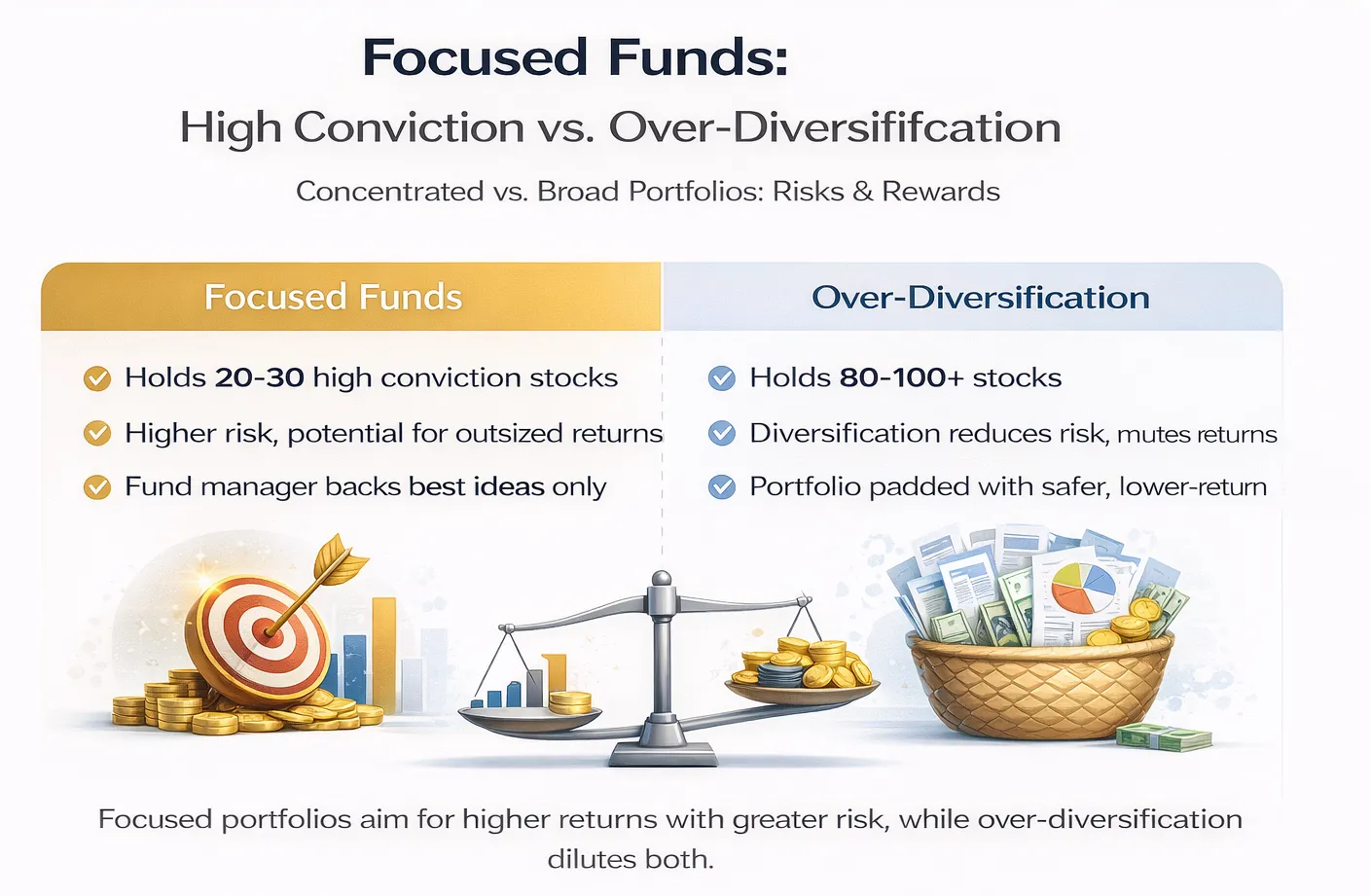
India has a long history of fund managers diversifying their way into mediocrity. When a fund holds 80–100 stocks, even the best idea in the portfolio barely moves the needle. You end up owning the market in an expensive wrapper.
Focused mutual funds are SEBI's answer to this. By mandating a maximum of 30 stocks per fund, SEBI forces managers to back only their highest-conviction ideas. No hiding behind a hundred positions. No padding the portfolio with safe, low-return names to avoid drawdowns.
The result is clean: when the manager is right, the best-focused funds can dramatically outperform the benchmark. When they're wrong, the concentration cuts both ways. That's the trade-off every investor in a best-focused equity fund needs to understand before investing.
When Do Focused Funds Outperform?
Focused mutual funds tend to do best in stock-picker's markets when individual companies are rewarded on their own merits rather than getting swept up in a broad rally. In sideways or selective markets, a manager with a genuine edge and a tight portfolio can generate real alpha.
In broad bull runs, though, a diversified fund often matches or beats a focused one through sheer breadth. This means your choice of best focused mutual funds should begin with the fund manager's track record across multiple types of markets not just how they did in the last 12 months of a bull run.
Top Focused Mutual Funds in India
Fund Name | Stocks (Max) | 3Y CAGR (Indicative) | 5Y CAGR (Indicative) | AUM (Approx.) |
HDFC Focused 30 Fund | 30 | ~26% | ~25% | ₹15,000+ Cr |
Nippon India Focused Equity Fund | 30 | ~24% | ~22% | ₹7,000+ Cr |
SBI Focused Equity Fund | 30 | ~21% | ~21% | ₹31,000+ Cr |
Mirae Asset Focused Fund | 30 | ~23% | — | ₹10,000+ Cr |
Data indicative as of early 2026. Past performance is not a guarantee of future returns.
The best focused equity fund for you is not necessarily the largest or most popular. It's the one whose manager has shown the ability to make the right calls on 25–30 stocks across volatile market conditions consistently, over the years. That takes deep research. Not consensus-following.
Get research like this in your inbox
The week’s research that mattered, in five minutes. Joined by 2L+ investors.
Value Mutual Funds: The Undervalued Asset in Your Portfolio
Value investing as a philosophy goes back to Benjamin Graham and Warren Buffett. But in the Indian context, it has its own flavour shaped by domestic market cycles, PSU dynamics, and the kind of temporary mispricings that India's retail-heavy market tends to produce.
Value mutual funds look for companies trading at a discount to their intrinsic worth. The metrics vary by fund; some focus on price-to-earnings, others on price-to-book or free cash flow yield, but the core idea is consistent: buy cheap, be patient, and let the market catch up.
The appeal of best value funds for Indian investors comes from three angles.
First, they offer a degree of capital preservation because buying a quality business at a discount gives you a margin of safety. If you're wrong about the timing, you've at least not overpaid for the business.
Second, value mutual funds tend to be less correlated to market euphoria. In periods when every stock is expensive and the market is running on optimism, value investing disciplines you to wait rather than chase. That's a meaningful behavioural anchor for investors who struggle with FOMO.
Third, value mutual funds are natural companions to factor investing, the systematic, quantitative approach of targeting specific return-generating characteristics like value, momentum, quality, and low volatility. This is exactly where Wright Research's approach finds its edge. More on that below.
For investors seeking moderate risk mutual funds that don't give up on returns, best value funds sit in a productive sweet spot. They're not as volatile as aggressive thematic plays, and they're still genuinely aimed at long-term wealth creation rather than just capital preservation at the cost of growth.
Best Thematic Funds in India (2026 — Top Picks Across Categories)
Category | Top Fund Pick | Why It Stands Out | 5Y CAGR (Indicative) |
Best thematic funds in India (Sector-themed) | Mirae Asset Great Consumer Fund / ICICI Pru India Opp Fund | Broad theme exposure, experienced management | ~22–26% |
Best contra mutual fund | SBI Contra Fund | Largest AUM in category, proven cycle management | ~28% |
Best focused equity fund | HDFC Focused 30 Fund | Consistent high-conviction picks, strong track record | ~25% |
Best value funds | ICICI Pru Value Discovery Fund | Oldest value fund in India, robust value investing process | ~26% |
Best sectoral thematic funds (Infra/Defence) | DSP India T.I.G.E.R. / Nippon India Power & Infra | Infrastructure theme with strong policy tailwinds | ~27–30% |
Past performance is not indicative of future results. Data sourced from AMC factsheets and AMFI. Not investment advice.
When Should You Invest in Thematic Funds And How Much?
Here's the most important guardrail in this entire blog: thematic mutual funds — of any variety should represent no more than 10–15% of your total equity allocation. They are satellite holdings, not core positions.
Your core equity portfolio should already rest on a foundation of large-cap, flexi-cap, or multi-asset strategies that provide broad market participation without dangerous concentration. Balanced mutual funds and diversified equity funds form that core. Thematic funds sit on top of that as targeted bets only where you have genuine conviction and a long enough time horizon.
Three questions every investor should answer honestly before putting money into any thematic fund:
Do you genuinely understand and believe in the theme not because of an NFO ad, but because you've followed the sector's fundamentals?
Can you stay invested for at least five years through periods where the theme underperforms? Because most of the best thematic funds in India will have stretches of that.
Does this theme overlap significantly with the exposure you already carry in your diversified or sectoral funds? Doubling up concentration without realising it is one of the most common portfolio mistakes in India.
For investors who use factor investing and growth investing principles targeting quality, value, momentum, and low volatility, systematically thematic funds play a complementary role. They add concentrated directional exposure on top of a scientifically constructed base. This is the logic behind Wright Research's PMS and Smallcase approach, where factor investing and value investing principles are embedded into portfolio construction from the ground up.
Investor Profile: Is a Thematic Fund Right for You?
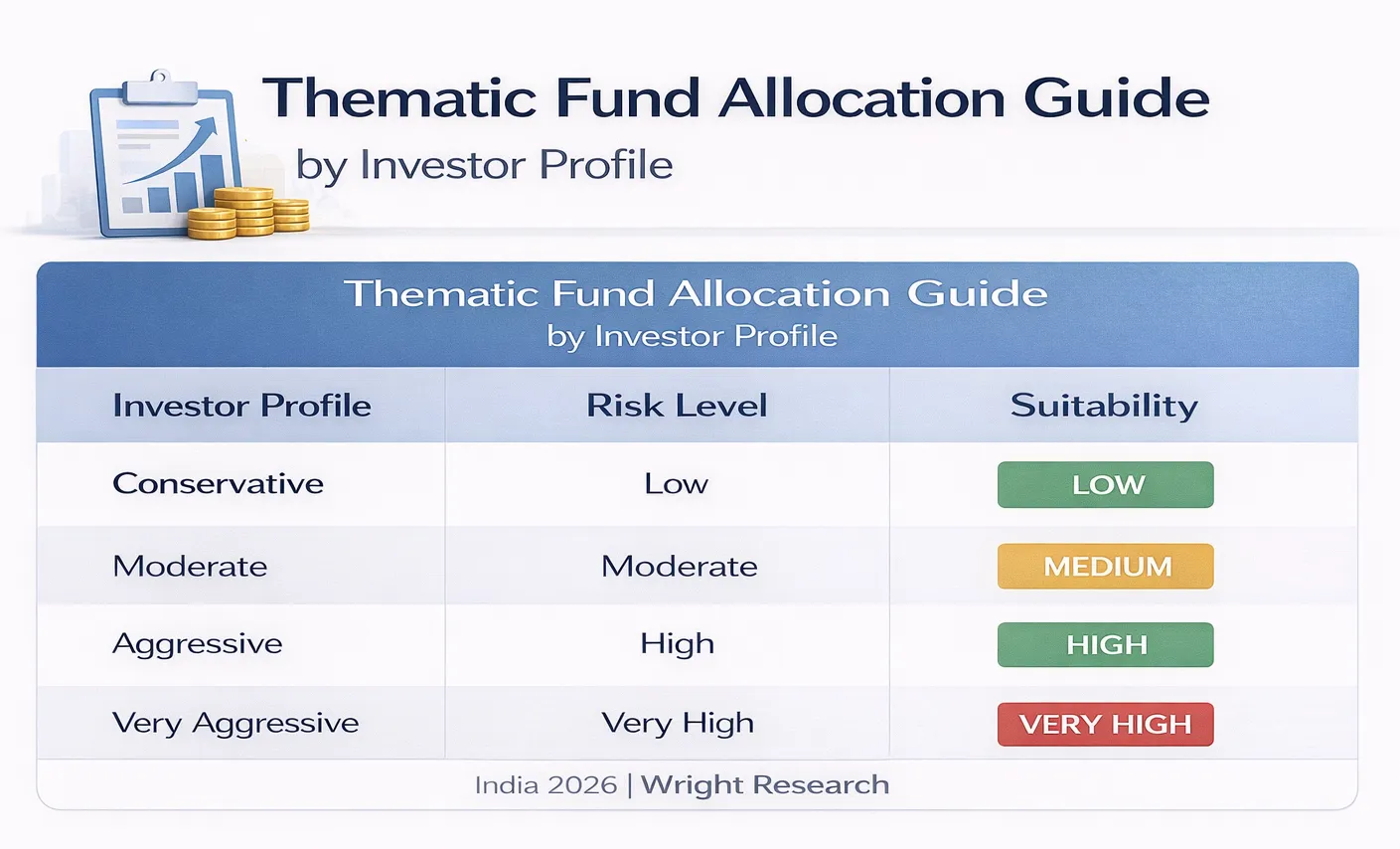
Investor Profile | Suitable for Thematic? | Suggested Allocation | Best Sub-Category |
Conservative — capital preservation focus | No (or below 5%) | Avoid / negligible | Balanced mutual funds preferred |
Moderate risk mutual funds seeker | Partial — select types only | 5–8% of equity | Value mutual funds, contra mutual funds |
Balanced growth investing focus | Yes | 10–12% of equity | Focused mutual funds, value investing funds |
Aggressive — high conviction investor | Yes | 12–15% of equity | Best sectoral thematic funds, best contra fund |
HNI — PMS-level investor | Yes — via PMS/AIF | Custom allocation | Factor-based PMS strategies (Wright Research) |
Notice that even aggressive investors are capped at 15%. The goal is to use thematic funds as a precision tool not as the load-bearing wall of your portfolio. When high return mutual funds in this category deliver, they add significant upside. When they don't, the portfolio's core holds you together.
The Wright Research Edge: Factor-Based Systematic Investing in India
Most investors approach thematic mutual funds reactively. They hear about a trending theme, say, defence or green energy, and chase the NFO at peak hype. At Wright Research, the approach is built differently.
Through our quant-driven PMS and Smallcase strategies, we embed factor investing principles, value, quality, momentum, and low volatility directly into portfolio construction. Rather than betting on a single theme and hoping for the best, our portfolios systematically rotate across factors and sectors based on data-driven signals.
This captures the upside of thematic concentration when themes are turning, while the factor-based framework provides a disciplined exit signal when momentum reverses.
This matters because the hardest part of investing in thematic mutual funds isn't getting in. It's knowing when to get out and having the framework to actually do it.
For investors who want exposure to best thematic funds in India but with a more systematic, risk-managed approach, Wright Research's PMS strategies offer a compelling structure. Our Portfolio Management Service is built for investors who want genuine alpha — not just market returns dressed up in a theme narrative.
If you're exploring best-focused mutual funds, contra mutual funds, or want a research-backed approach to growth investing and value investing, our Smallcase strategies are a good place to start. Each portfolio is built on quantitative research, not gut feel or marketing cycles.
See what markets are pricing in
Live indices, sector moves and market breadth — the backdrop to every story we publish.
Frequently Asked Questions
What is the difference between thematic and sectoral mutual funds?
A thematic mutual fund invests across multiple sectors aligned to a single economic idea — like digital India, EV transition, or defence giving fund managers flexibility to pick opportunities across industries. A sectoral fund is confined to one specific sector (e.g., only IT or only pharma). Thematic funds carry broader exposure within their theme; sectoral funds carry deeper but narrower concentration risk.
What is a contra mutual fund, and how does it work?
The contra mutual fund meaning is rooted in buying what the market avoids. A contra fund mutual fund buys stocks that are undervalued, out of favour, or in temporary distress — and waits for mean reversion when sentiment improves. The thesis is that markets overreact to negative news, creating buying opportunities for patient investors. The best contra mutual fund managers are disciplined, research-driven, and comfortable holding unpopular positions through market cycles.
Are thematic mutual funds good for long-term investment in India?
Yes, with important conditions. Thematic mutual funds work best when the underlying theme has genuine structural tailwinds (not just short-term hype), when the investor has a 5–7 year horizon, and when they're allocated as a satellite position (10–15% of equity) rather than a core holding. High return mutual funds in this category can add significant alpha over time — but they demand patience and a real understanding of the theme's fundamentals.
What is a focused mutual fund in India?
Focused mutual funds are SEBI-mandated equity funds holding a maximum of 30 stocks, forcing managers to back only their highest-conviction ideas. Unlike diversified funds that hold 60–100 stocks and dilute alpha, the best focused funds are concentrated and conviction-driven. The best-focused equity fund depends on the manager's track record across multiple market cycles, not just recent performance in a bull run.
How much of my portfolio should I allocate to thematic mutual funds?
Thematic funds, whether contra mutual funds, value mutual funds, or sector-themed, should represent a maximum of 10–15% of your total equity portfolio. Your core should consist of diversified equity or balanced mutual funds that provide broad market exposure. Thematic funds work as satellite holdings not as the foundation of your mutual fund portfolio.