

What is Algorithmic Trading?
Before we get into the exciting world of algorithmic trading, let's go on a fascinating trip back in time. Imagine the stock market floor as a wild symphony of traders shouting bids and offers, desperately trying to get the best deals. In the early days of trading, people used their instincts and maths to make decisions. This was exciting, but it also meant that people could make mistakes and be influenced by their emotions. Then, the digital revolution change brought about the age of algorithmic trading.
What is algorithmic trading, then? Imagine a group of computer programs working together to carefully make trades based on rules and mathematical models that have already been set. These programs use and process a lot of market info most efficiently, leaving little room for mistakes. Algorithmic trading is the art of making trade decisions automatically using the language of numbers and patterns to act quickly and correctly on chances. Algorithmic trading software are the best example of financial automation because it is no longer limited by what people can do.
In this article, we will demystify the concept of algorithmic trading, breaking it down into simple terms for beginners and providing valuable insights for those looking to sharpen their skills. We will talk about everything you need to know to get started in the exciting world of algorithmic trading, from the basics to the techniques, the tools, to the way you think.
See what markets are pricing in
Live indices, sector moves and market breadth — the backdrop to every story we publish.
Getting Started with Algorithmic Trading
Getting started with automated trading is both fun and challenging. Going into it with a good plan and knowledge of how financial markets work is essential.
To get started, you need to learn about things like fundamental analysis and technical analysis, as well as trading jargon like "short," "long," "stop loss," "take profit," and so on. One also needs to grasp mathematics and statistical concepts like mean, standard deviation, correlation, etc. Languages like Python, R, or C++ for writing code. Python is often used for algorithmic trading because it has many libraries for data analysis, backtesting, and automating trade. When you know all of this, you'll be in a good position to start making your own trade algorithms.
You can start by getting the real-time and historical data you'll need to implement your strategy and test it. There are many places to find info, such as Yahoo Finance, the Reserve Bank of India, Bloomberg, etc.
Now that you have the correct data set, you can start making algorithms that include your trade logic. Most trading methods have conditions for when to enter, trade, and leave. It could be a simple moving average crossover strategy or a more complicated algorithm with much math, like machine learning methods.
How Does Algorithmic Trading Work?
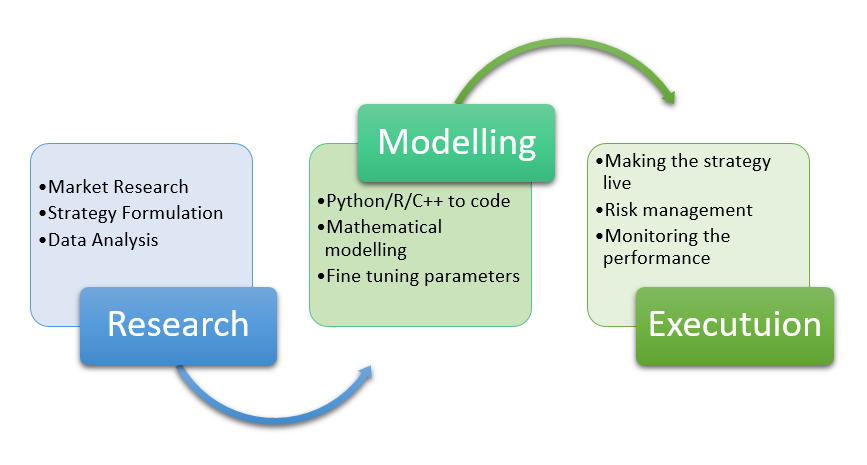
Algorithms make it possible to make trades based on thorough data analysis and respond quickly to price changes. It builds models that help us trade using mathematical and statistical methods. The algorithmic trading method is mostly made up of three steps.
 1. Research and Strategy Formulation
This includes doing the initial study and coming up with a plan. Traders work to gather information like past prices, essential ratios, news sentiment, and articles about a particular stock or portfolio. They use this information to come up with trading ideas.
Market research is carried out first to explore potential inefficiencies in the market. It involves analysing historical data, macroeconomic indicators and other relevant market analysis.
This leads to formulation of trading algorithms. Traders will make mathematical models and set rules for when to enter and leave a trade. Strategies can be based solely on statistics and technical indicators or a mix of Machine Learning and fundamental analysis.
2. Modelling and Optimization
Once a trading strategy is developed, it can be put into a computer program using languages like Python, R, etc. Python is the most popular choice among traders because it is easy to use and has a lot of tools. The approach can be based on simple regression models, advanced machine learning techniques, or time series. It depends on how complicated the strategy is. Backtesting is done to understand the power of logic after the plan is implemented. Optimization tools are used to fine-tune strategy parameters so that returns are maximized, and risks are kept to a minimum.
3. Execution and Implementation
Once the algorithms have been created and optimized, they can be used in the market. Risk management is the most critical part of any trading plan that wants to minimize losses. For a trading system to be profitable and reliable over the long term, it needs good risk management. Typical parts of risk management are stock size, stop loss limits, etc. Visit our blog to learn how we manage risk at Wright Research.
After putting a solid risk management plan in place, the next important step is to monitoring your trades. It checks to see if the algorithms are working as predicted and try to figure out how the market works so that changes can be made in the future. Read our article on What are the different types of Algo Trading?
Get research like this in your inbox
The week’s research that mattered, in five minutes. Joined by 2L+ investors.
Examples of Algorithmic Trading
There are many ways to trade using algorithms. Here are just a few examples:
- Asset A usually moves before asset B. We can buy or sell A based on behaviour of asset B.
- Make a trading signal based on news about a particular asset.
- A group of stocks within a sector usually move together. One stock moved in unusual direction. So, we can buy or sell this stock in hope that it will revert to normal.
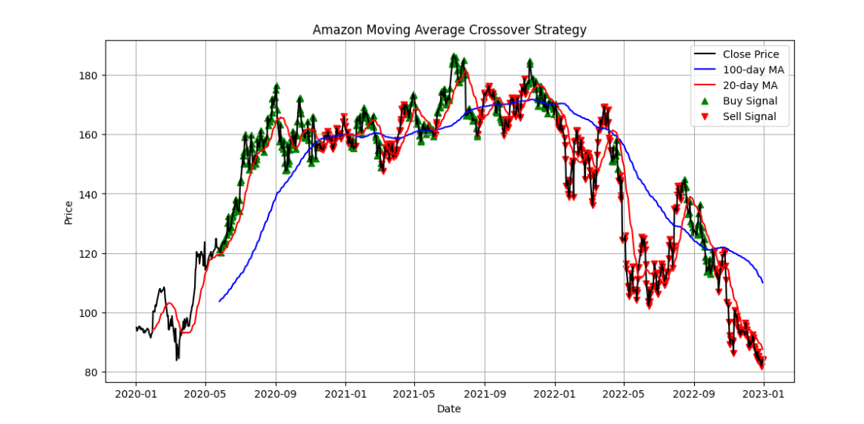
Let’s take a closer look at a simple strategy using python. It is called the Moving Average Crossover Strategy. Let’s take a stock of Amazon. We build a simple trading strategy based on short term and long-term moving averages crossover.
In this example we calculated 20-day MA and 100-day MA for amazon stock. The signals are generated using following logic:
20-Day MA > 100-day MA: Signal Buy
20-Day MA < 100-day MA: Signal Sell
Many algorithmic trading techniques exist, like Momentum , Mean-Reversion, and Pairs Trading. Visit our blog for an extensive guide on trading pairs with Python.
Benefits of using Python for algorithmic trading
Using Python, the above example can be coded in minutes. So, let's consider why Python is the best choice for algorithmic trading. Python is becoming more and more famous these days. Since it has access to many integrated APIs and functions, it is the best choice for algorithmic trading. Some of the most important reasons to use Python are:
- Python is easy to learn because its syntax is similar to simple English.
- It has many libraries, like NumPy, pandas, and matplotlib, that are good for analyzing financial data and making trading plans.
- It has a lot of quantitative finance tools, like PyFolio, Zipline, and Quantlib. These make it easier to test the past and manage risk.
- Python's Machine Learning and AI tools, such as scikit-learn, PyTorch, and TensorFlow, work well together. Making itself the first choice of more skilled coders.
- It works well with big data tools like Apache Spark, which makes it easy for traders to handle a lot of financial data.
- Python algorithms can be used for trading with low latency on cloud platforms, dedicated computers, and even microcontrollers.
So, Python is undoubtedly the best way to start with algorithmic trading.
Benefits of Algorithmic Trading
We all now know what algorithmic trading is and how it works. It has a lot of benefits, which is the main reason why it is so prevalent in the market. Here are some of the good things about it.
- It eliminates the possibilities of human errors such as entering incorrect details or missing trade opportunities. Hence it makes trading faster and efficient.
- It eliminates emotional bias and makes choices solely based on data and rules.
- It lowers the need for manpower and manual checking, saving money.
- It can handle many trades and manage various portfolios at once.
- Algorithms can be fully backtested using historical data to see how well they work in different market conditions. So, it makes it possible to optimize the logic correctly.
Read our article on Best Algo Trading Platforms in India: Our Recommendations
Track the factors behind this research
Momentum, value, quality and low-vol — updated factor performance for Indian markets.
Conclusion
This piece gave us a general idea of algorithmic trading and how it works. We also looked at how Python is used in algorithmic trading today. To sum up, algorithmic trading allows traders to automate their trading activities and take advantage of technological advances to make more informed and efficient trades. Traders can make their approach fit their wants and goals by choosing different strategies. However, its crucial to carefully plan, backtest and monitor these strategies to ensure their effectiveness and manage risks.