
In Moneycontrol, we have featured traders and fund managers who are mostly independent, while some have created a corporate structure to participate in the market. Most have used their own money or managed clients’ money to grow.
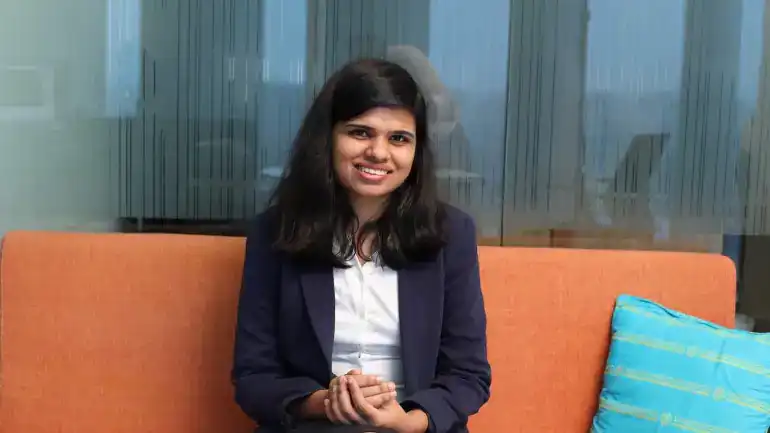
This week we feature Sonam Srivastava, a chemical engineering from IIT Kanpur and a Masters in Financial Engineering from Worldquant University, who not only trades and manages money but has created a company that has been granted investment via the Government of India Nidhi Seed Support System (SSS).
Wright Research, a SEBI registered corporate Investment Advisor, the company formed by Sonam Srivastava, uses machine learning and algorithms to give better than market return with low drawdowns.
Sonam not only has got her numbers right but has also been a competitive athlete. Apart from running and swimming to stay fit, she likes to read books across all genres and travel, though the markets and the coronavirus have of late restricted her travel.
In the interview with Moneycontrol, Sonam Srivastava talks about her trading style and market journey.
RELATED STORIES



Q: Can you walk us through your journey to the market?
A: I was born and brought up in eastern UP, and I did most of my schooling from Varanasi. My family lives in Lucknow. I completed my undergraduate in Chemical Engineering from IIT Kanpur and have a Masters in Financial Engineering from Worldquant University.
I loved maths as a kid, and I pursued algorithms and numerical methods courses and projects in my college. Studying at IIT, we heard from various alumni that trading jobs were one of the most thrilling, but it was the quantitative side of trading that attracted me to the field.
When I was in school, my father, a retired chief electrical engineer, used to trade quite actively. My first memory of the markets is my father letting me operate his trading account and me chasing chart patterns like a video game.
After graduating from college, most of my peer group was looking for a finance job. I too became fascinated by financial markets and pursued courses like CFA. I loved quantitative finance as a subject that clicked for me due to my love for numbers.
I got my first real job in finance as an algorithm developer at a Mumbai based boutique hedge fund called Forefront Capital in 2012. During my first few weeks, I remember that we saw significant improvements in an algorithm that we were trading and made a lot of profit. I loved that high, and it got me hooked!
After six months, I joined Edelweiss as an algorithm designer on the institutional cash and derivatives trading floor, a high volume and high-stress desk. Initially, I was intimidated by the aggressive trading floor and counted the seconds during the high-pressure expiry day for it to be over!
It took me some time to adapt to the environment, but my passion for trading led me to have an exceptional first year. I got a chance to work with many fantastic traders on various new and innovative algorithms like cash-futures arbitrage, option multi-leg algorithms, etc.
I did make mistakes-- some of them caused literal price spikes in the markets. But in the four years there, I had lots of guidance, which gave me the confidence to build challenging trading products.
Q: How did you gain confidence in the market?
A: I think self-belief and persistence helped me survive and do well on the trading floor and in trading in general. I firmly believe that in-depth research of the concept, especially if you are passionate about it, without getting intimidated is what takes you all the way.
I am fortunate enough to have excellent guides at every step of the way, which speaks volumes about the trading community's richness. As an algorithm designer, I received lots of encouragement from senior traders and dealers who shared the tricks of the trade with me and helped me design execution, arbitrage, and options algorithms that enabled them to trade huge volumes.
Working in a community of hundreds of traders and researchers, I had guidance to experiment with everything from small-cap stock picking to trading FX spreads to using machine learning to model high-frequency order books!
I joined HSBC in 2016 on a Europe-based low-frequency quantitative strategies desk, which was something I wanted to pursue. My boss there, who headed the trading desk in London, really encouraged my ideas and his support and encouragement helped me find my groove.
I have always had a quantitative approach to trading and investing. I spent the initial years working on high-frequency trading (HFT) strategies and later forayed into medium and low-frequency systems. While HFT is more about speed, low and medium frequency strategies are more statistics and factor-driven.
I consciously moved to statistics and factor strategies because my approach is inherently data-science and machine-learning driven. I did a very rigorous practice-driven Masters in Financial Engineering course from Worldquant University, which helped me transition. I spent weekends working on research projects and trading strategies while working on a full-time trading job. The conscious effort to comprehensively study the field that fascinated me helped me get better at my job and improve as a trader.
I used to work in a silo of algorithm design or research roles at the beginning of my career. Working with real risk capital brought on my full passion, and doing consistently well on client capital is what gave me immense confidence.
Q: What was the most difficult aspect of trading?
A: I think trading is very similar to any other profession, but trading risks and rewards are much more immediate. So while knowing the markets, the instruments, the models and skill set is vital, if you don't have the grit to take and tackle risk, you can't even get started in the field.
The confidence in taking risks has come gradually for me. In my nine-year career in the field, I have seen huge highs and lows. When you are a new trader, risk intimidates you. But the more you understand the basis of the trade, the more confident you get taking a risk. Now, I don't get swayed much by the calculated risk I take based on research, and I focus religiously on the accuracy of the data, the model, and the execution.
What can be taxing for a trader is seeing whole trading desks shutting down in a day due to management decisions to cut risk. I had this experience in my last job. But because I was confident about what I was doing, I started my investment advisory called Wright Research, which has been the defining moment for me as an investor and a trader. Bringing in risk capital and then delivering consistent returns on it made me more self-confident.
Q: How do you presently trade?
A: At Wright Research, we follow a data-driven approach to investing. We source high-quality data from company fundamentals to technical to events to economic and alternative data and do extensive statistical analysis of over 20 years to come up with an investment hypothesis.
With an idea in place, we do position and risk management. We use quantitative models with machine learning for this step. We have a market regime driven, dynamic approach, and we focus a lot on keeping the costs under control.
We trade based on ‘factors’. A simple way to understand factors is by looking at an example of, say, the momentum factor. Momentum means trend following. We look at the price pattern, identify the trend in prices, and participate in the trending stocks. For example, suppose you look at the chart below of Adani Enterprises. In this case, the Momentum indicator shows that the price trend is high, making it a suitable stock for a high momentum portfolio.
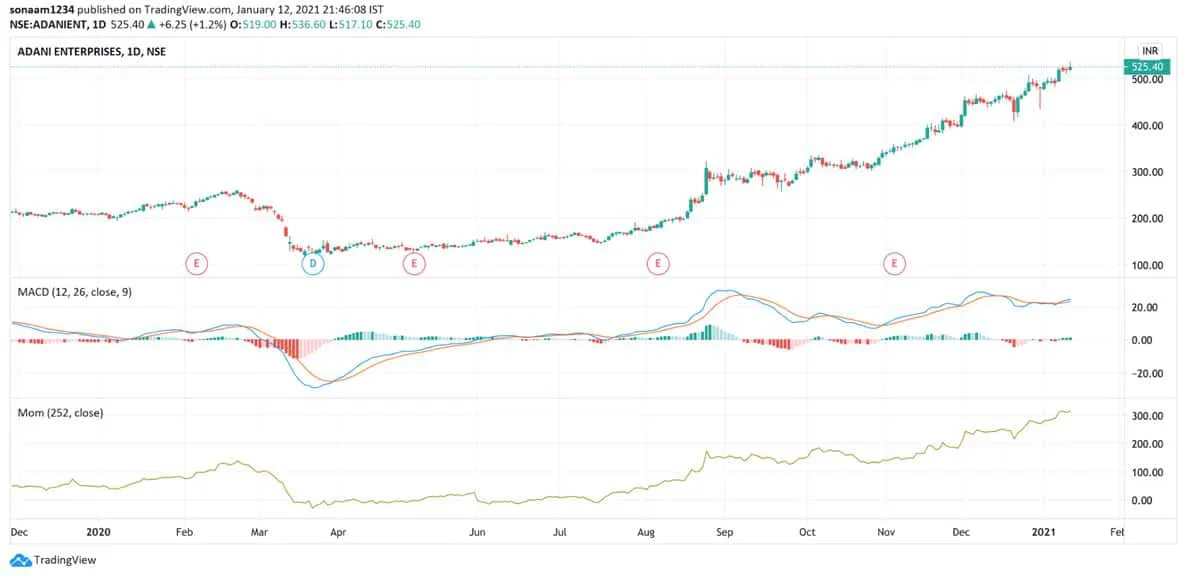
We use various nuances in finding the correct indicator to look for. For example, instead of creating candles based on time, we calculate the candles based on volumes, which is why we are more reactive in times like March 2020 and much more passive in low volume times.
The same logic goes for the other factor portfolios. For example, we are looking at high earnings growth for a growth portfolio to select stocks, and for a low volatility portfolio, we are looking at low volatility stocks. We look at a diverse set of technical and fundamental factors.
We offer aMulti-Factor Tactical portfoliowhere we tactically allocate to such equity factor baskets along with bonds, liquid, and gold ETFs. This is a monthly traded long-only portfolio based on factor selection and asset allocation for the changing market conditions. So right now, we have momentum stocks in our portfolio during the equity rally, but as market conditions change, maybe the growth factor or the low volatility factor might start performing better, and we will allocate capital to them.
How do we select the correct factors? We try to identify the market regime,which is like saying - is this a bull market or a bear market. In a bull market, trend-following stocks will do well, but in a bear market, maybe low volatility and undervalued stocks start doing better. We try to predict the market regime for the next month using artificial intelligence models.

We also have a derivatives-basedlong-short strategy, which we started around six months back. Here, we create a market-neutral, or fully hedged portfolio, using stock futures by going long and short an equal number of futures. We target high-risk individuals with this product and aim to achieve uncorrelated capital appreciation at low risk using this strategy.
For long-short trading, we look at short-term technical signals like relative strength index, moving average convergence divergence (MACD), put-call ratio, open interest trends, etc., along with some long term fundamental movements. We use machine learning to combine the various signals to build a low risk and low drawdown portfolio that gives consistent returns.
We also offer some thematicsmall-cap basedandmomentum-basedportfolios.
Q: Can you throw some light on your trading performance.
A: Our trading performance speaks for itself.
The Long Only Multi-Factor Tactical strategy has given a performance of 60% in the 18 months that it has been live, at a Sharpe ratio of 2.2, which is exceptional for a monthly rebalanced balanced portfolio. We have around 25 stocks in the portfolio, each of which is held anywhere from one to 6 months.
This strategy gave a drawdown of 18% when the market went down 38% in the crazy month of March 2020 thanks to our modelling and asset allocation. The low drawdown again has been a differentiating factor for us.

Figure 1 Returns of the Multi Factor Long Only Strategy
Our Long Short strategy has also had an excellent performance in the six months it has been running live. It has given a return of 30% on exposure and has seen a <5% drawdown. The strategy takes 60% winning trades on average.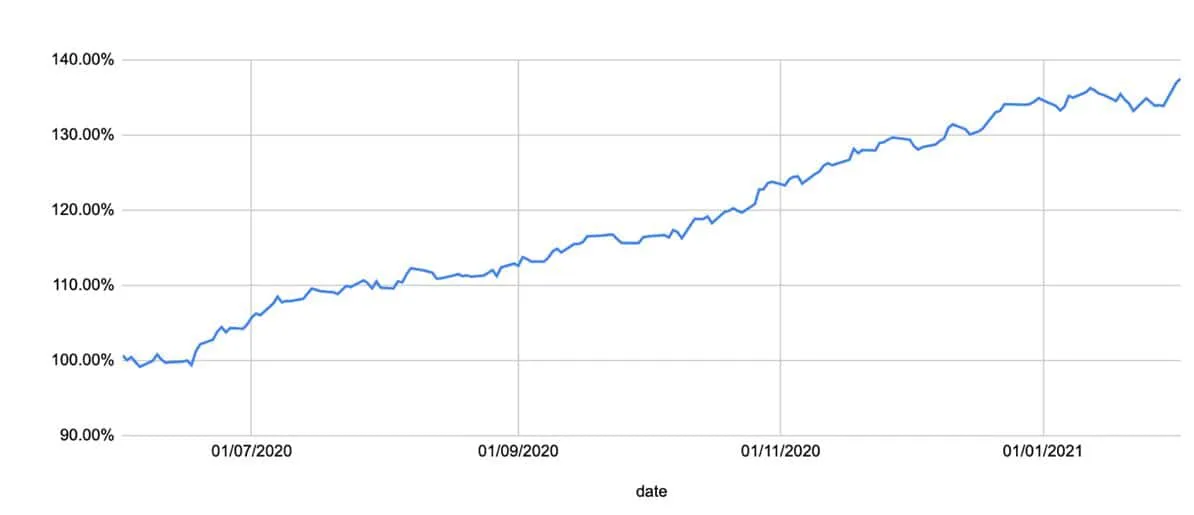
We only recommend thelong-short strategyfor high-risk individuals who have experienced trading derivatives.
Q: Your plans for the future
A: At Wright Research, we believe that we have got the investment philosophy right. The next steps are improving the existing portfolios, stabilizing the data and tech infrastructure, and scaling up. We have built our portfolios with a large scale in mind, and we are looking to reach a broader audience to join our journey of consistent outperformance.
We are also thinking of a B2B model and are looking at wealth distributors, broker partners, and funds to work with us in bringing these well-made and consistent products to a larger audience.
As for new products, we want to add maybe a quality based thematic portfolio and more mid-frequency intraday trading strategies to the mix of offerings from Wright Research.
In the long run, we want to bring our advisory practice to the Portfolio Management scale, which is an uphill task that would require us to gain client traction and raise funds. I also want to scale our alternative products to alternative investment funds for Indian and foreign clients in the long run.