


Quick Answer
SIP and lump sum are the two primary ways to invest in mutual funds. After the 2024–25 Indian market correction, data shows each strategy has distinct advantages depending on market timing, investor psychology, and financial situation. This guide uses real market data to help you decide which approach builds better long-term wealth in 2026.
See what markets are pricing in
Live indices, sector moves and market breadth — the backdrop to every story we publish.
Introduction
There is a question every Indian investor faces at some point: Do I invest everything at once, or do I spread it out? The SIP vs. lump sum debate is not new. But after the 2024–25 market correction, when Nifty 50 fell over 15% from its September 2024 peak before staging a recovery in early 2026, the answer became far more personal and far more data-driven.
Most content on this topic is theoretical. It explains what sip investment and lump sum investments are, maybe throws in a chart comparing two hypothetical investors, and calls it a day. What's missing is a live case study using a real market event that Indian investors actually lived through.
That's what this blog does. We will use the 2024–25 correction as a real-world test to examine which approach protected capital better, which built more wealth, and critically, how smart investors used a hybrid strategy to extract the best of both worlds.
Wright Research, a SEBI-registered investment advisory firm, works with hundreds of investors across PMS, Mutual Funds, and portfolio strategies. Here is what the data and our advisors actually saw on the ground.
The Core Difference: What SIP and Lump Sum Actually Mean for Your Returns
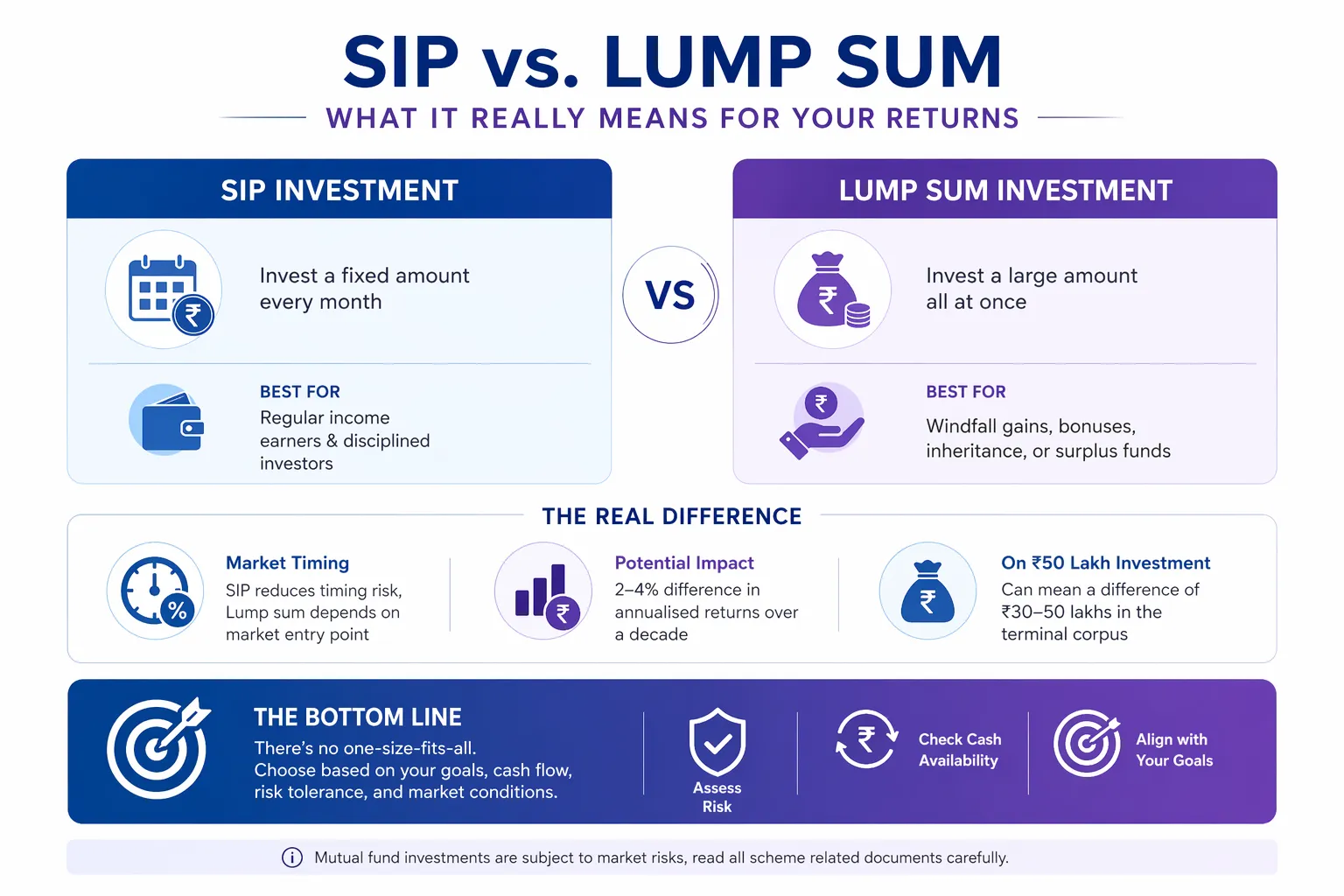
At its most basic, a SIP investment means you invest a fixed amount every month, regardless of market conditions. A lump sum investment means you invest a large amount all at once, at a single price point.
Both approaches access the same universe of high-return mutual funds , balanced mutual funds, and diversified mutual fund portfolios. The difference lies entirely in when you buy and at what price. In a long-term mutual fund portfolio, this timing difference can translate into a gap of 2–4% in annualised returns over a decade, which, on a ₹50 lakh investment, can mean a difference of ₹30–50 lakhs in the terminal corpus.
The SIP vs. lump sum question is really a question about market timing, cash availability, and risk tolerance, three things that vary enormously between investors.
Think of it this way: If you have a large windfall inheritance, bonus, or property sale proceeds, you are facing a lump sum decision. If you have a consistent monthly income you want to put to work, you are a natural SIP candidate. The mistake most investors make is treating these as ideological positions rather than practical tools.
Rupee Cost Averaging: Why SIP Works in Theory and What the Data Shows in Practice
Rupee cost averaging is the mechanism that makes SIP investment compelling. When markets are high, your fixed SIP amount buys fewer units. When markets fall, the same amount buys more units. Over time, your average cost per unit stays lower than the average market price over the same period.
In a textbook with smooth, predictable market curves, rupee cost averaging works perfectly. In India's real markets, which saw a sustained bull run from March 2023 to September 2024, followed by a sharp correction, the data tells a more nuanced story.
Between October 2024 and January 2025, Nifty 50 corrected approximately 15–16% from its highs. An investor running a SIP in a diversified mutual fund portfolio during this period continued buying units at lower and lower prices. By April 2025, when markets began recovering, their average cost of acquisition was meaningfully lower than that of an investor who had paused SIPs due to fear.
Rupee cost averaging, therefore, does not eliminate risk it manages entry risk across time. In volatile, correcting markets, it consistently delivers better average entry prices than trying to pick the bottom. The data from this correction period confirms what theory predicts: SIP investors who stayed invested during the 2024–25 volatility came out with a lower average NAV and were better positioned for the 2025–26 recovery.
The 2024–25 Market Correction as a Live Case Study: What Happened to SIP vs Lump Sum Investors
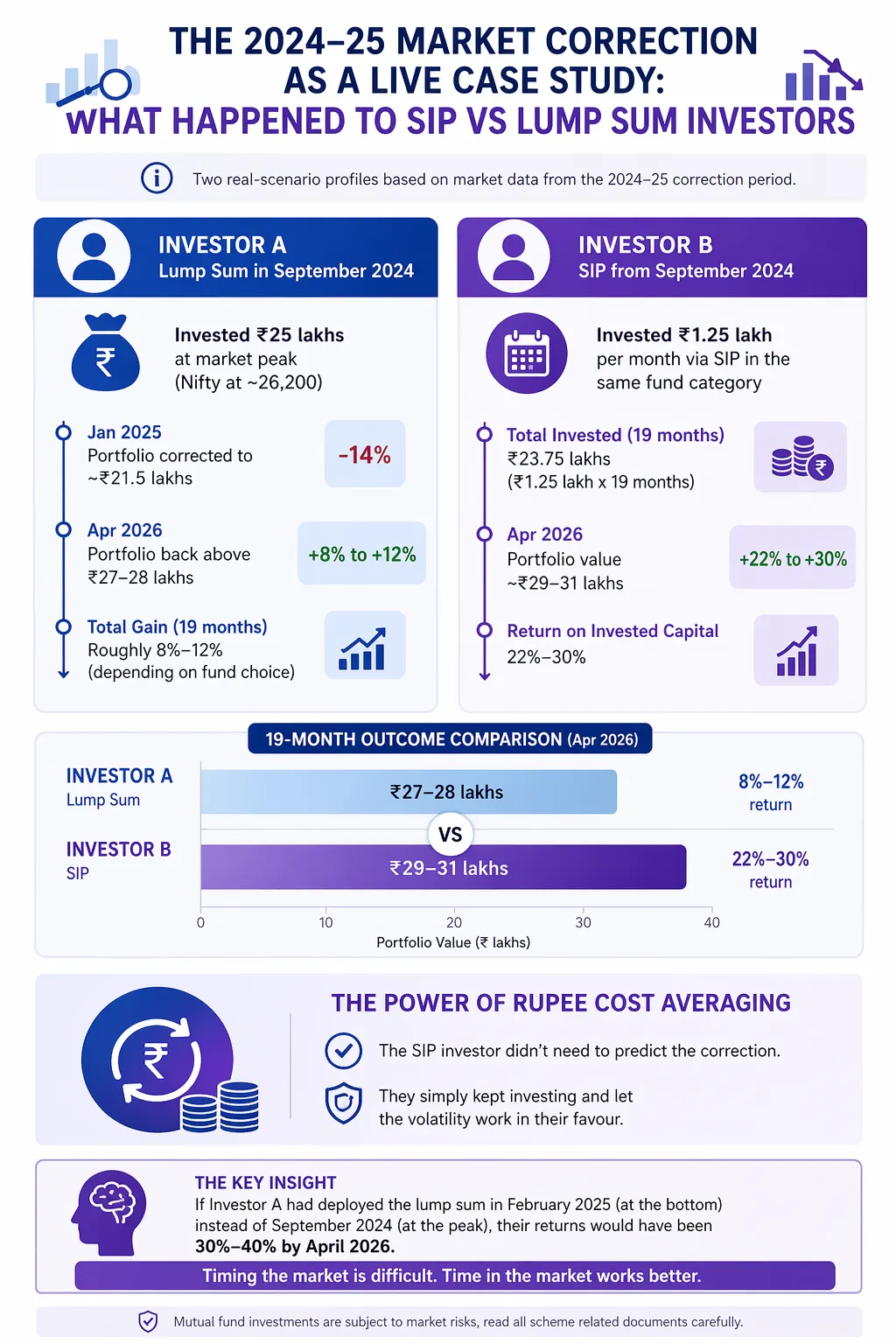
Let us look at two real-scenario profiles, not hypothetical investors, but representative cases drawn from the market data of this specific correction period.
Investor A — Lump Sum in September 2024: This investor deployed ₹25 lakhs into a best mutual fund portfolio at the market peak (Nifty at ~26,200). By January 2025, the portfolio had corrected to approximately ₹21.5 lakhs, a notional loss of ~14%. By April 2026, assuming a reasonable recovery, the portfolio would be back above ₹27–28 lakhs. Total gain over ~19 months: roughly 8–12% depending on fund choice.
Investor B — SIP from September 2024: This investor began a ₹1.25 lakh per month SIP in the same fund category, totaling ₹23.75 lakhs deployed over 19 months. Because they bought units through the fall and recovery, their average NAV was substantially lower than Investor A's entry price. By April 2026, this investor's portfolio was sitting at approximately ₹29–31 lakhs, a return of 22–30% on invested capital.
This is the power of rupee cost averaging in a genuine bear market mutual fund environment. The SIP investor did not need to predict the correction. They simply kept investing and let the volatility work in their favour.
However, and this is the part most blogs miss, if Investor A had deployed the lump sum in February 2025 at the market bottom instead of September 2024 at the peak, their returns would have been 30–40% by April 2026. The lump sum strategy, when timed correctly, beats SIP decisively. The problem is that very few investors successfully call the bottom. This is not a flaw in the lump sum strategy; it is a feature of human psychology.
Get research like this in your inbox
The week’s research that mattered, in five minutes. Joined by 2L+ investors.
When Lump Sum Wins: Bull Market Entry and the Cost of Waiting
The best time to invest a lump sum is during a confirmed market correction or early in a structural bull run. If you are investing in high-return mutual funds at the start of a multi-year growth cycle, a single large deployment will consistently outperform a drip-fed SIP. Every month of delay in a rising market means buying units at a higher price.
Consider the rally from April 2020 (post-COVID crash) to September 2021. An investor who made a lump sum investment in May 2020 in the best balanced mutual fund portfolio saw returns of 80–100% in 16 months. A SIP investor starting the same month and deploying the same total capital over 16 months would have seen returns of 55–65%, still excellent, but materially lower.
In a long-term mutual fund portfolio context, the rule of thumb is: lump sum outperforms SIP in bull markets by 15–25% on an annualised basis. SIP outperforms lump sum in volatile or bearish markets by a similar margin.
The problem, and it bears repeating, is that no one rings a bell at the market bottom. The best time to invest a lump sum is only obvious in hindsight. This is why the hybrid strategy (covered below) is what professional portfolio managers actually recommend for most investors.
When SIP Wins: Corrections, Volatility, and the Psychology of Not Timing the Market
A bear market mutual fund environment is where SIP investment consistently earns its reputation. When markets are falling, human instinct is to stop investing. Every SIP investor who paused their contributions in November or December 2024 missed buying units at the cheapest levels since early 2023.
The investors who kept their SIPs running, particularly in moderate risk mutual funds and best balanced mutual funds , were rewarded disproportionately during the recovery. This is not because SIP is magic. It is because they removed the decision-making step that traps most retail investors.
Behavioural finance research is unambiguous here: the average equity mutual fund investor underperforms the funds they invest in by 2–3% annually, because they buy high and sell low in response to headlines. SIP removes this temptation. When you automate investing, you take emotion out of the equation.
For anyone building a diversified mutual fund portfolio for 10+ years, SIP is the single most effective tool for consistent wealth accumulation, not because the returns are always higher, but because it guarantees that you stay in the market long enough for compounding to work.
The Hybrid Approach: How to Combine Both Strategies in One Portfolio
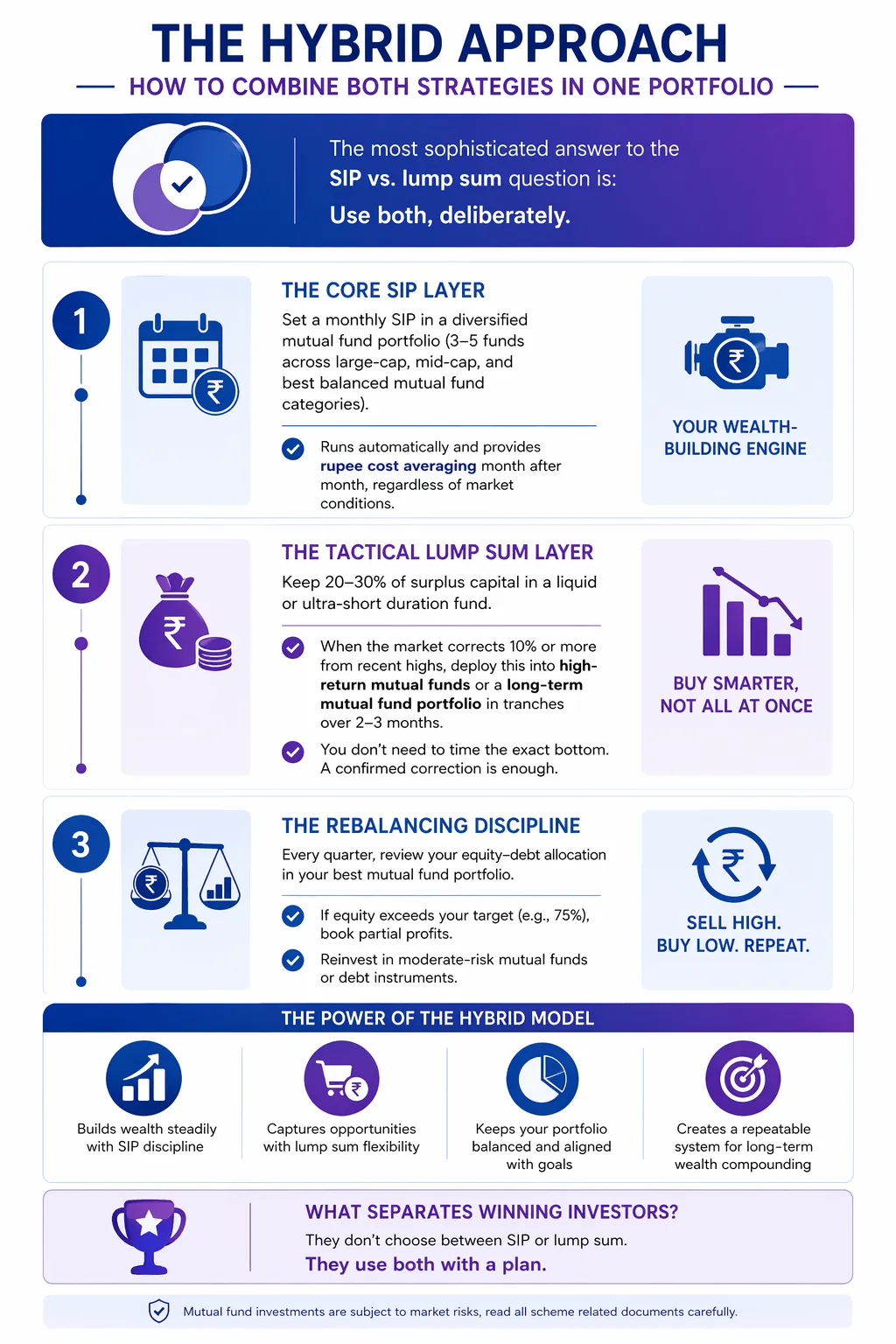
The most sophisticated answer to the SIP vs. lump sum question is: use both, deliberately.
Here is the Wright Research approach for investors with both monthly income and surplus capital:
The Core SIP Layer: Set a monthly SIP in a diversified mutual fund portfolio, typically 3 to 5 funds spanning large-cap, mid-cap, and best balanced mutual fund categories. This runs automatically and provides the rupee cost averaging benefit month after month, regardless of market conditions. This is your wealth-building engine.
The Tactical Lump Sum Layer: Keep a portion of surplus capital (typically 20–30%) in a liquid or ultra-short duration fund. When the market corrects 10% or more from recent highs, as it did in late 2024, deploy this into high-return mutual funds or a long-term mutual fund portfolio in tranches over 2–3 months. You do not need to time the exact bottom. Buying during a confirmed correction is sufficient to meaningfully improve your average cost of acquisition.
The Rebalancing Discipline: Every quarter, assess the equity-debt allocation in your best mutual fund portfolio. If equity has grown to represent more than your target allocation (say, 75% of your portfolio), book partial profits and reinvest in moderate-risk mutual funds or debt instruments. This forces a sell-high, buy-low discipline that most investors claim to follow but rarely do.
This hybrid model is what separates investors who build lasting wealth from those who chase returns and end up median performers.
Which to Choose Based on Your Situation: A Decision Framework
There is no universal answer to the SIP vs. lump sum debate. The right choice depends entirely on your situation. Here is a simple decision framework:
Choose SIP if: You have a regular monthly surplus but no large windfall to deploy. You are a first-time investor or have limited experience managing market volatility. You want to build a long-term mutual fund portfolio without spending time or energy on market timing. Your investment horizon is 7+ years, and you are investing in equity-oriented or balanced mutual funds.
Choose Lump Sum if: You have received a significant windfall bonus, inheritance, or property proceeds, and markets are currently in correction territory (down 10–15%+ from recent highs). You are investing in a diversified mutual fund portfolio primarily for stability and moderate growth. You have a shorter investment horizon (3–5 years) and are targeting moderate risk mutual funds or debt hybrids. The best time to invest a lump sum has arrived: valuations are compressed, sentiment is poor, and your investment horizon is sufficient to absorb further downside if it comes.
Choose Hybrid if: You have both a monthly income and surplus capital. You want the discipline of SIP plus the opportunistic upside of a lump-sum investment. You are building the best mutual fund portfolio for long-term wealth creation and want to be positioned for both sideways and bull market conditions.
Conclusion
The 2024–25 correction gave every Indian investor a real-world lesson in the SIP vs. lump sum debate. SIP investors who stayed the course came out with lower average costs and better portfolio positioning. Lump sum investors who timed the bottom came out with exceptional gains. Most investors who paused, panicked, or waited for certainty missed the best buying opportunity in two years.
The lesson is not that one strategy is superior. The lesson is that the best investors use both with SIP as the foundation and strategic lump sum investment as the tactical lever.
If you are building a long-term mutual fund portfolio in 2026, start your SIP today if you have not already. Keep some dry powder for corrections. And when the market falls, as it always does, deploy it with conviction.
Is your portfolio built for what’s coming?
Get a free AI-powered review of your holdings — risk, overlap and quality in minutes.
Frequently Asked Questions
Is SIP better than a lump sum investment in 2026?
It depends on market conditions and your financial situation. In 2026, with markets recovering after a correction, a hybrid approach often works best — a core SIP for consistent wealth building and opportunistic lump sum deployments when valuations correct. Neither strategy is universally superior; they serve different purposes and work best together.
What is rupee cost averaging, and does it actually work?
Rupee cost averaging means investing a fixed amount regularly, buying more units when prices are low and fewer when prices are high. Yes, it works particularly in volatile or falling markets. Data from the 2024–25 correction confirms that SIP investors who stayed invested achieved significantly lower average NAVs than those who paused or tried to time entries.
Should I invest a lump sum when the market has corrected?
Yes, historically, deploying a lump sum investment when markets have corrected 10–15% from recent highs has produced strong returns. You do not need to catch the exact bottom. Investing in tranches over 2–3 months during a correction balances the timing risk and captures a meaningfully lower average entry price than waiting for a confirmed recovery.
Can I switch from SIP to lump sum in an existing mutual fund?
Yes. You can continue your SIP and make an additional lump sum investment in the same fund; they are independent transactions. You can also stop your SIP and make a lump sum investment, or vice versa. Many investors run both simultaneously to build the best mutual fund portfolio with both consistency and tactical flexibility.
What is the best SIP amount to start with for long-term wealth creation?
Start with whatever is sustainable for your monthly budget. Even ₹5,000 per month invested consistently for 20 years in a diversified mutual fund portfolio can build significant wealth through compounding. The amount matters less than the discipline of starting early and staying invested through market cycles.
Disclaimer: This article is for educational purposes only. Mutual fund investments are subject to market risk. Please read all scheme-related documents carefully before investing.