


Quick Answer:
India's top PSU bank stocks include SBI (gross NPA ~2.5%, ROE ~14.5%, P/B ~1.3x), Bank of Baroda (NPA ~2.8%, ROE ~13%, P/B ~0.9x), Canara Bank (NPA ~3.7%, ROE ~12.5%, P/B ~0.7x), and Punjab National Bank (NPA ~4.5%, ROE ~11%, P/B ~0.7x). PSU banks have undergone a significant fundamental turnaround since 2019 - gross NPAs down from 10–15% to 2.5–5%, ROE recovering above 12%, and capital adequacy above 15%. They still trade at 40–70% discount to private bank P/B multiples, creating a potential mean reversion opportunity.
See what markets are pricing in
Live indices, sector moves and market breadth — the backdrop to every story we publish.
Why PSU Bank Stocks Are Back in the Spotlight
If you have been watching the market in the last couple of years, you already know the story. Bank stocks in India went through a painful period of NPA accumulation, government bailouts, and persistent underperformance. Investors who had loaded up on the psu bank sector stocks in their portfolios watched private sector peers run circles around them.
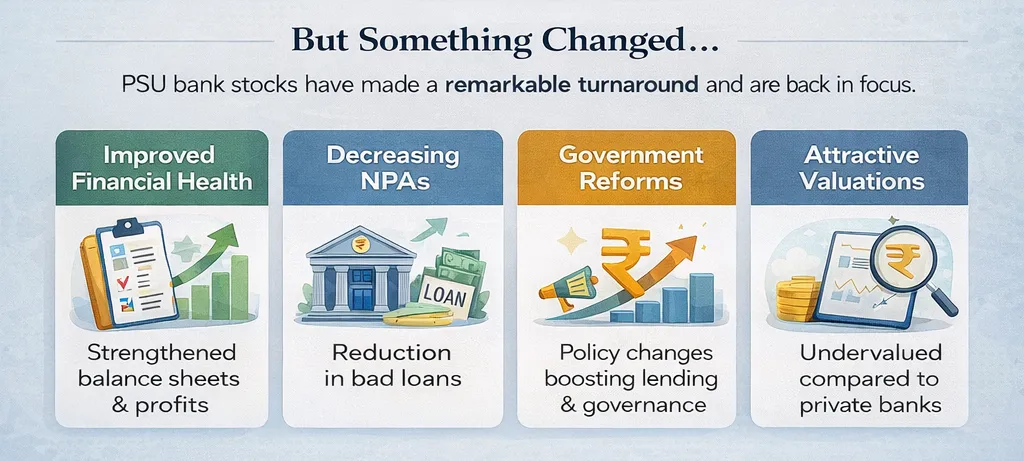
But something shifted.
PSU banks quietly cleaned up their books. Gross NPA ratios fell to multi-year lows. Net interest margins recovered. The government's recapitalisation push started bearing fruit. And suddenly, the best PSU bank stocks were not just defensive plays; they were generating serious returns.
If you are wondering what the bank stocks today picture looks like, or trying to figure out which bank PSU stocks deserve a place in your long-term portfolio, you are in the right place. This guide cuts through the noise and gives you a clear-eyed view of public sector banking in India, the opportunity, the risks, and what the data actually says.
PSU Banks Undervalued Opportunity or Value Trap?
This is the question every serious investor wrestles with. Are the undervalued bank stocks in india genuinely cheap, or are they cheap for a reason?
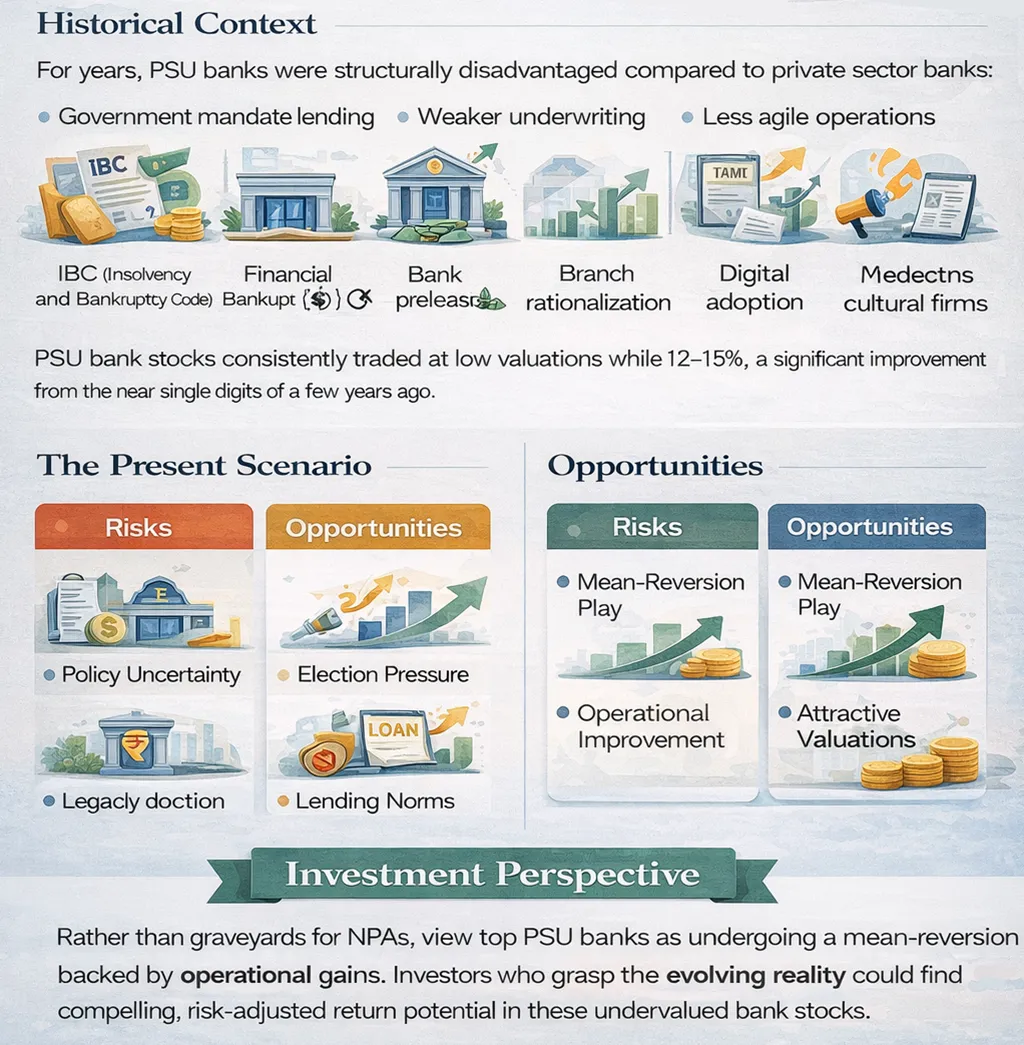
Let's be honest about the history first. For years, PSU banks were structurally disadvantaged. They carried more government mandate lending, had weaker underwriting standards, and operated with less agility than their private-sector counterparts. That is why the psu banks stocks consistently traded at steep discounts to book value, while HDFC Bank or Kotak commanded premiums.
But 2026 is a different context. Several things have changed simultaneously. The IBC (Insolvency and Bankruptcy Code) gave banks a credible resolution mechanism. Government-mandated recapitalisation injected over ₹3.5 lakh crore into the system over the last decade. Operating costs are being brought under control through branch rationalisation and digital adoption. The result: return on equity for top bank psu stocks is now comfortably above 12–15%, territory that was unthinkable five years ago.
That said, the value trap risk is real. PSU banks remain exposed to government policy decisions, credit quality in agriculture and MSME segments, and election-cycle pressures on lending norms. The investor who buys best psu bank shares without understanding these structural constraints is flying blind.
The better framing? Think of PSU banks as a mean-reversion trade with operational improvement as the catalyst. They are not growing at 20% like top-tier fintechs, but they are not the NPL graveyards they once were either. At the right price, the top psu banks stocks offer compelling risk-adjusted return potential.
Top PSU Bank Stocks to Analyse
Before we go through individual names, a quick note: the following analysis is based on publicly available data and Wright Research's independent assessment. This is not a buy/sell recommendation. Always validate current financials before acting.
1. SBI — The Largest Public Sector Lender
When investors talk about top bank stocks in the public sector, SBI is always the anchor of the conversation. It is India's largest bank by assets, deposits, and branch network. And over the last few years, it has quietly become one of the best-performing bank stock stories among all PSU lenders.
SBI's standalone loan book now exceeds ₹35 lakh crore. Its gross NPA ratio has come down sharply from a peak above 10% to around 2.5–3% in recent quarters. ROE has recovered to 14–15%. The best psu bank share price conversation around SBI often comes down to one question: is the current P/B multiple justified relative to its improved fundamentals?
For investors building a psu banks stocks list for long-term allocation, SBI is typically the lowest-risk starting point. Its diversification across retail, corporate, and international business makes it resilient. The SBI Cards, SBI Life, and SBI MF subsidiaries add an unlocking angle that pure-play bank analysis often misses.
Watch: credit cost trajectory in agri and SME portfolios remains the main variable to track quarter on quarter.
2. Bank of Baroda — Turnaround Story
Bank of Baroda is one of the more interesting names in the psu bank share space precisely because its turnaround is still mid-cycle. After the forced merger with Vijaya Bank and Dena Bank in 2019, BOB went through a painful integration period. But the merged entity has emerged leaner, better capitalised, and more focused on profitable growth.
In recent years, BOB's retail loan book has grown aggressively, particularly in home loans and personal loans segments with historically better asset quality. Its CASA ratio has improved, and international operations (it has a meaningful overseas book) contribute solid fee income.
Among the best psu bank share to buy candidates for medium-term investors, BOB sits in an interesting position not as large as SBI, not as neglected as smaller PSU names. At the right valuation entry point, the risk-reward is worth a closer look.
3. Canara Bank & PNB — Mid-Tier PSU Plays
Canara Bank and Punjab National Bank occupy the mid-tier in the PSU banks stocks list, and they tend to divide investor opinion. Both have made real progress on NPA resolution. Both trade at significant discounts to their private sector peers. And both have meaningful exposure to segments, small business lending and agri credit, that can turn sour quickly in a stress cycle.
PNB's history with the Nirav Modi fraud is not forgotten by institutional investors, and the bank has had to work harder to rebuild credibility. But operationally, PNB is a different institution today. Capital ratios are adequate, the management team has been more conservative, and provisioning buffers are healthier.
Canara Bank carries a large government securities portfolio, which gives it some interest rate sensitivity but also balance sheet stability. As part of any diversified all psu bank share review, Canara deserves attention, but investors should not mistake low valuation for automatic value.
For those building a bank stocks list across the PSU segment, owning both SBI as a core position and selective mid-tier exposure (BOB or Canara) gives reasonable diversification without excessive concentration risk.
Get research like this in your inbox
The week’s research that mattered, in five minutes. Joined by 2L+ investors.
Key Metrics: NPA Ratio, ROE, Capital Adequacy
Understanding these three metrics is non-negotiable if you are serious about evaluating banking sector top stocks in the public sector.
The NPA ratio (Non-Performing Assets as a percentage of gross advances) is the most-watched indicator for PSU banks. A gross NPA below 4% is generally considered healthy. Most top bank PSU stocks are now in the 2.5–5% range, a dramatic improvement from the 8–14% levels seen during the 2017–2019 crisis period.
Return on Equity (ROE) measures how efficiently a bank is generating profit from shareholder capital. For the best bank stocks to buy for the long term, a consistent ROE above 12% is a meaningful threshold. PSU banks are now crossing this threshold regularly, though the gap with private sector leaders (some of whom deliver 15–18% ROE) persists.
Capital Adequacy Ratio (CAR) under Basel III norms measures a bank's ability to absorb losses. SEBI and RBI require a minimum of 11.5% for most banks. Most top top bank sector stocks in India in the PSU segment are now comfortably above 15–17%, meaning they have adequate buffers for growth and stress scenarios.
The table below provides a snapshot comparison to help you frame the psu bank sector stocks universe:
Bank | Gross NPA (%) | ROE (%) | CAR (%) | P/B (approx.) |
SBI | ~2.5 | ~14.5 | ~15.5 | ~1.3x |
Bank of Baroda | ~2.8 | ~13.0 | ~16.2 | ~0.9x |
Canara Bank | ~3.7 | ~12.5 | ~16.0 | ~0.7x |
Punjab National Bank | ~4.5 | ~11.0 | ~15.8 | ~0.7x |
Source: Public company filings, NSE data. Data is approximate and should be verified against the latest quarterly results before making decisions.
PSU Banks vs Private Banks: A Comparison
One of the most common questions investors ask when reviewing a nifty bank stocks list is: why consider PSU banks at all when private banks have consistently delivered better returns?
The answer is valuation and mean reversion. Private banks trade at P/B multiples of 2.5x to 4x. Many nifty bank stocks in the private sector have already priced in a significant part of their growth premium. PSU banks, by contrast, trade at 0.7x to 1.4x book, meaning you are paying less for every rupee of net worth.
This does not automatically mean PSU banks will outperform. Private banks have structural advantages: better technology, more agile management, stronger brand recall, and less government interference in credit decisions. These are real moats that justify a premium.
But in a market where private bank valuations are already stretched, and where PSU bank fundamentals have demonstrably improved, the best bank shares to buy from a risk-reward angle might not always be the obvious private sector name. Thoughtful allocation across both segments rather than an all-or-nothing call is how sophisticated investors have navigated this dynamic.
The bank shares today landscape rewards those who understand that the private-vs-PSU debate is not a binary. It is a valuation question.

Nifty PSU Bank Index — The ETF Option
Not every investor wants to pick individual PSU bank names. For those who want broad exposure to the Nifty Bank stocks public sector universe without single-stock risk, the Nifty PSU Bank Index is worth understanding.
The index tracks 12 public sector banks listed on NSE, weighted by free-float market capitalisation. SBI typically accounts for a significant portion of the index weight, followed by Bank of Baroda and Canara Bank. Several ETFs and index funds track this benchmark.
This is a reasonable option for investors who believe in the PSU banking thesis but do not want to take concentrated positions. It provides automatic diversification across bank stocks today in the public sector, rebalances periodically, and is liquid. The downside: you also get exposure to weaker names that may drag returns.
For long-term investors who want to build a position in the best bank stocks across the PSU universe, a combination of ETF exposure for core allocation and selective individual stock picks for higher-conviction bets can work well together.
Wright Research's PSU Banking Thesis
At Wright Research, we approach the best bank stocks to buy question through a data-driven, factor-based lens. Our view on PSU banking in India is rooted in three observations.
First, the NPA cycle has turned. The worst is behind us. Banks that spent five years provisioning and writing down bad loans are now redeploying capital into growth. This is a structural shift, not a cyclical blip. The best PSU bank stocks today are generating returns on equity that would have seemed optimistic forecasts just three years ago.
Second, valuation still offers a margin of safety. Unlike some other sectors where everything has been re-rated already, top bank sector stocks in India in the public sector still trade at discounts to historical averages. That creates room for multiple expansion alongside earnings growth, a double tailwind.
Third, the macro tailwind from India's credit growth story disproportionately benefits banks with large distribution networks. SBI has over 22,500 branches. Bank of Baroda is deeply embedded in rural and semi-urban credit. These networks are hard to replicate and serve as durable distribution advantages as Indian household credit penetration rises.
That said, Wright Research's approach is never to concentrate in one sector. Whether you are exploring best bank stocks to buy for long term allocation or evaluating where PSU banks fit in a diversified equity portfolio, our recommendation is always to contextualise sector exposure within your overall risk profile, time horizon, and financial goals.
If you want to explore how PSU bank exposure fits within a professionally managed equity portfolio, to understand our approach.
Is your portfolio built for what’s coming?
Get a free AI-powered review of your holdings — risk, overlap and quality in minutes.
Frequently Asked Questions
Q: Are PSU bank stocks good for long-term investment?
PSU bank stocks can be good long-term holdings for investors who understand the sector's risks and opportunities. They currently trade at lower valuations than private banks, have significantly improved their asset quality over the last few years, and benefit from India's credit growth story.
Q: Why are PSU bank stocks undervalued?
Undervalued bank stocks in India, particularly in the PSU segment, tend to trade at a discount for structural reasons: government ownership introduces non-commercial lending mandates, management quality is constrained by bureaucratic hierarchies, and historical NPA problems left a credibility gap with institutional investors. Even as fundamentals have improved, the valuation discount has not fully closed.
Q: Which PSU bank has the best fundamentals in 2025–2026?
Based on publicly available data, SBI consistently ranks highest among the best PSU bank shares on a composite fundamentals basis, strong ROE, manageable NPAs, improving capital adequacy, and a diversified revenue model. Bank of Baroda is a close second in terms of improvement trajectory. However, "best fundamentals" depends on which metrics you weight most.
Q: What is the NPA situation in public sector banks?
The NPA situation in psu bank sector stocks has improved materially. Gross NPAs for most major public sector lenders have come down from crisis-era highs of 10–15% to 2.5–5% range as of recent quarterly results. Resolution through IBC, write-offs, and improved underwriting standards have all contributed. However, agri credit and MSME segments remain areas to watch, particularly in stress cycles. Always verify the latest quarterly disclosures before making portfolio decisions.
Q: Is SBI the safest PSU bank stock to own?
SBI is generally considered the lowest-risk option among bank psu stocks for several reasons: it has the largest balance sheet, the most diversified loan book, strong government backing as a sovereign entity, and the best NPA resolution track record among peers. It is also the most liquid, which matters for institutional investors. That said, "safe" is relative in equity investing. SBI stock can still be volatile, and macro factors like interest rate cycles and credit cost fluctuations will affect performance. SBI is typically the first PSU bank investors should analyse, but individual risk tolerance and portfolio context should drive the final decision.