

Portfolio risk management is the process of identifying and mitigating financial risks within an investment portfolio through diversification, rebalancing, and drawdown controls. This guide covers how PMS services in India manage risk systematically, compares active vs. passive portfolio management, explains PMS charges, and details Wright Research's quant-driven approach to portfolio analysis and management for HNI investors.
Introduction
Your portfolio is up 22% this year. Then a rate hike announcement hits, a geopolitical event rattles global markets, and suddenly you're watching months of gains evaporate in a matter of days. Sound familiar? If you've been investing long enough, you know the markets have a way of humbling even the most confident investors.
The truth is, building wealth isn't just about picking the right stocks or timing the market. It's about knowing how to protect what you've built when things get uncertain. That's where portfolio risk management steps in and it's arguably the single most underappreciated skill in the investing world.
In this guide, you'll learn what portfolio risk management actually means, how professional portfolio management services handle it systematically, and what practical steps you can take whether you manage your investments yourself or rely on expert portfolio advisory services like Wright Research.
See what markets are pricing in
Live indices, sector moves and market breadth — the backdrop to every story we publish.
What Is Portfolio Risk Management? (And Why It Matters for HNI Investors)
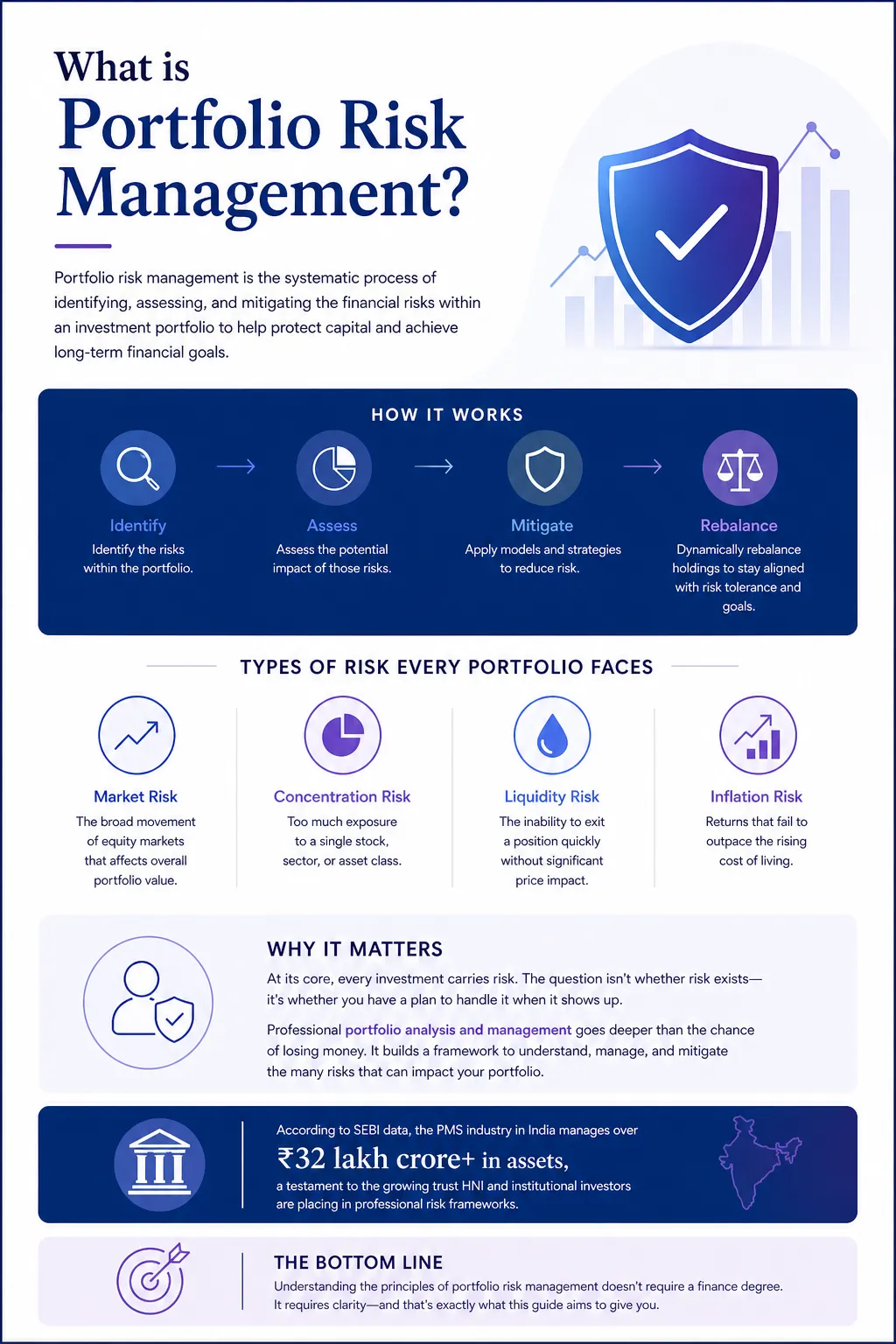
Portfolio risk management is the systematic process of identifying, assessing, and mitigating the financial risks within an investment portfolio. It works by diversifying across asset classes, applying quantitative models to measure volatility and drawdowns, and dynamically rebalancing holdings to ensure the portfolio stays aligned with an investor's risk tolerance and financial goals.
At its core, every investment carries risk. The question isn't whether risk exists, it's whether you have a plan to handle it when it shows up.
Most individual investors think of risk as "the chance of losing money." But professional portfolio analysis and management goes much deeper. There are several types of risk that every portfolio faces: market risk (the broad movement of equity markets), concentration risk (too much exposure to one stock or sector), liquidity risk (inability to exit a position quickly), and inflation risk (returns that fail to outpace the rising cost of living).
When you invest through portfolio management services , one of the key things you're paying for is structured portfolio risk management, a systematic layer of protection that most retail investors simply don't have access to on their own. According to SEBI data, the PMS industry in India manages over ₹32 lakh crore in assets, a testament to the growing trust HNI and institutional investors are placing in professional risk frameworks.
The best part? Understanding the principles of portfolio risk management doesn't require a finance degree. It requires clarity and that's exactly what this guide aims to give you.
How Does Risk Management Work Inside a PMS Portfolio?
When you invest through PMS services , your portfolio isn't simply handed off to a manager who picks "good stocks" based on instinct. A proper active portfolio management strategy involves a disciplined, multi-layered process:
Step 1 Risk Profiling: Before any investment is made, the manager assesses your risk appetite, your capacity to absorb losses without panicking or derailing your financial plan. This is regulatory under SEBI's PMS framework.
Step 2 Portfolio Construction: Based on your risk profile, the pms portfolio is built with intentional diversification across sectors, market caps, and sometimes asset classes. Each position is sized carefully; no single stock typically gets more than a certain percentage of the portfolio.
Step 3 Ongoing Monitoring: Unlike a mutual fund that may rebalance quarterly, active pms in investment means continuous monitoring of portfolio health. Macro shifts, earnings surprises, or sector rotations trigger portfolio reviews.
Step 4 Rebalancing: When a stock becomes overweight (due to price appreciation), or when a sector becomes risky, the portfolio is rebalanced to maintain the intended risk exposure.
Step 5 Drawdown Management: Sophisticated portfolio management services in India often incorporate drawdown controls pre-defined rules that reduce exposure when the portfolio falls below a certain threshold, protecting capital during sharp corrections.
Step 6 Reporting: Regular, transparent reporting ensures you always know what's in your pms portfolio, how it's performing, and why changes were made.
Portfolio Management Services in India: Key Data, SEBI Rules & Frameworks
India's investment landscape has matured significantly over the last decade. Portfolio management services in India are now regulated under SEBI's Portfolio Managers Regulations, 2020, which mandate transparency in fees, reporting, and risk disclosures.
Here's a quick comparison of how portfolio risk management differs across investment options available to Indian investors:
Parameter |
PMS |
Mutual Funds |
Direct Equity (DIY) |
Minimum Investment |
₹50 Lakh (SEBI mandated) |
₹500 (SIP) |
No minimum |
Risk Management |
Personalised, active |
Standardised, passive or active |
Investor's own responsibility |
Customisation |
High |
Low |
Full (but requires expertise) |
Portfolio Transparency |
Full (demat-level) |
NAV-level only |
Full |
Regulatory Body |
SEBI (PMS Regulations, 2020) |
SEBI (MF Regulations) |
NSE/BSE |
PMS Charges |
Fee on AUM or performance-linked |
Expense ratio |
Brokerage + taxes |
Suitable For |
HNI investors (₹50L+) |
Retail investors |
Experienced traders |
A critical factor most investors overlook is PMS charges. Unlike mutual funds that charge a flat expense ratio, PMS charges can be structured as a fixed management fee (typically 1–2.5% of AUM annually) or a performance-linked fee. Some managers charge a combination of both. Understanding this fee structure and what you get for it in terms of portfolio analysis and management is essential before choosing a PMS provider.
According to a 2024 SEBI report, the number of PMS clients in India crossed 1.9 lakh a 35% increase in three years indicating that more Indian investors are now seeking professional portfolio risk management rather than going it alone.
Who Needs Professional Portfolio Advisory Services?
Not everyone needs a PMS. But if you fall into any of these profiles, portfolio advisory services could be a meaningful upgrade to your current approach.
The HNI Investor with a Large Corpus: If you have ₹50 lakh or more in investable assets and your portfolio is spread across random stocks, fixed deposits, and mutual funds without a clear strategy, you need structured portfolio analysis and management. A fragmented portfolio without a coherent risk framework is a ticking time bomb in volatile markets.
The High-Income Professional: Earning well but investing reactively? Many professionals in the 35–55 age bracket accumulate significant wealth but manage it poorly. Professional portfolio management services bring in the discipline, structure, and portfolio risk management frameworks that most individuals simply don't have time to build or maintain.
The Investor Who Has Experienced Significant Losses: If a market crash has hurt you badly in the past not because of bad luck, but because of poor diversification or no drawdown plan it's a clear signal that you need professional portfolio advisory services to build a more resilient portfolio going forward.
The Investor Approaching Retirement: As your financial goals shift from wealth accumulation to wealth preservation, the nature of risk management changes dramatically. PMS services with a conservative or balanced mandate can be tailored to protect capital while generating stable returns.
Get research like this in your inbox
The week’s research that mattered, in five minutes. Joined by 2L+ investors.
Active Portfolio Management Strategy vs. Passive Investing: Risk Compared
This is one of the most debated questions in investing and the honest answer is: it depends on your goals and market conditions.
Passive investing (index funds, ETFs) tracks a benchmark like Nifty 50. It's low cost, transparent, and works beautifully during bull markets. But passive funds cannot reduce risk during downturns they fall with the index. There's no manager making real-time decisions to protect your capital.
Active portfolio management, on the other hand, allows a portfolio manager to take defensive positions, move to cash, reduce exposure to overvalued sectors, or tilt toward defensive stocks when the market environment turns risky. A skilled active portfolio management strategy can meaningfully outperform during bear markets and corrections.
Factor |
Active Portfolio Management |
Passive Investing |
Risk Management |
Personalised and dynamic |
Mirrors index; no active risk control |
Cost |
Higher (PMS charges apply) |
Very low expense ratios |
Potential Alpha |
Yes, if manager is skilled |
No returns mirror the index |
Drawdown Protection |
Built into the strategy |
None falls with index |
Best For |
HNI investors, volatile markets |
Long-term, low-maintenance investors |
Customisation |
High |
None |
The key takeaway: active portfolio management isn't just about chasing higher returns. It's about intelligently managing risk across market cycles something passive investing structurally cannot do.
How Wright Research Does Portfolio Analysis and Management Differently
Most portfolio management services in India rely on discretionary decision-making. A senior fund manager makes calls based on experience and judgment. Wright Research takes a fundamentally different approach.
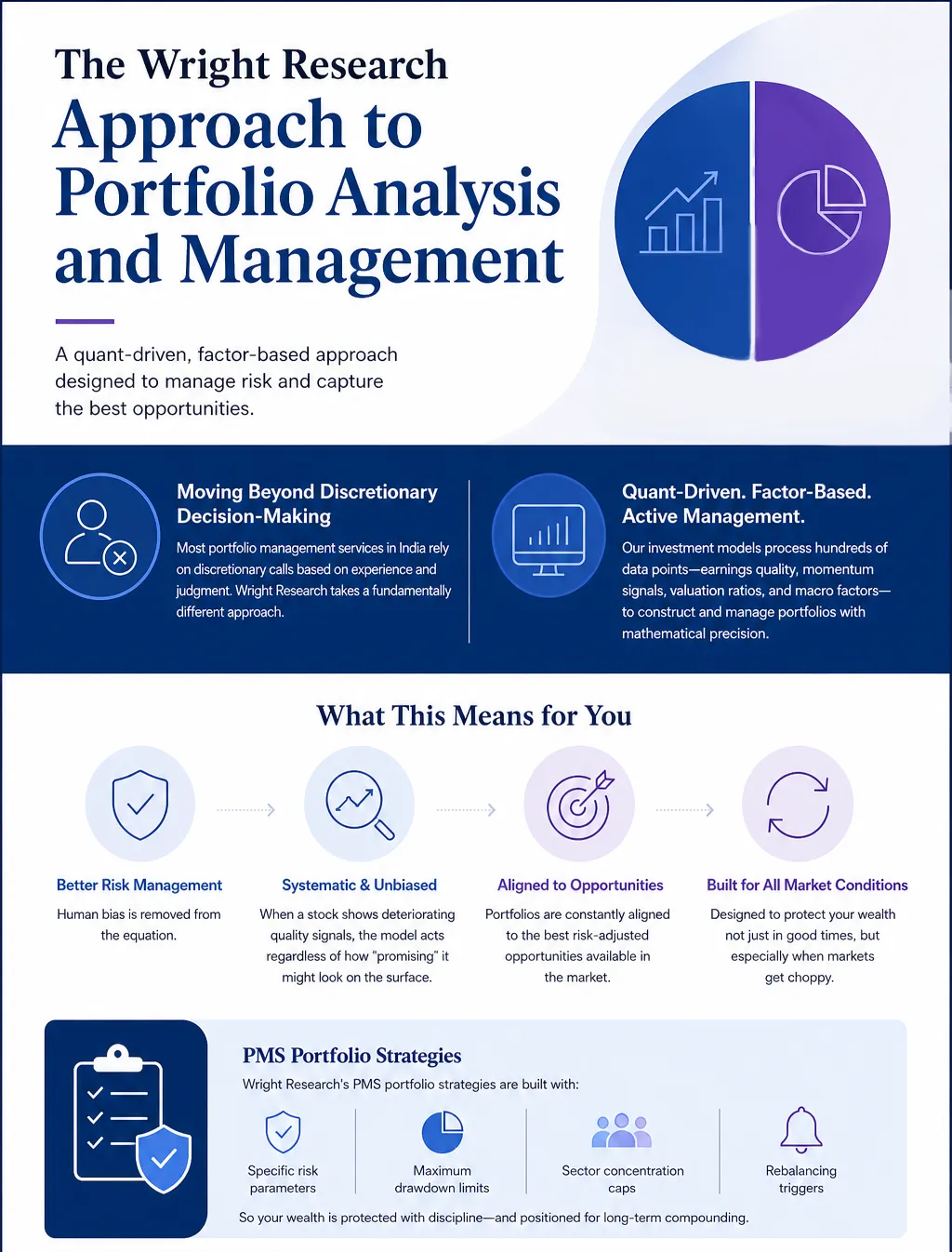
Wright Research uses a quant-driven, factor-based active portfolio management strategy. Instead of relying on intuition, the investment models process hundreds of data points, earnings quality, momentum signals, valuation ratios, and macro factors to construct and manage portfolios with mathematical precision.
What does this mean for portfolio risk management? It means human bias is removed from the equation. When a stock starts showing deteriorating quality signals, the model acts regardless of how "promising" it might look on the surface. This systematic approach to portfolio analysis and management means portfolios are constantly aligned to the best risk-adjusted opportunities available in the market.
Wright Research's PMS portfolio strategies are built with specific risk parameters, maximum drawdown limits, sector concentration caps, and rebalancing triggers so your wealth is protected not just in good times, but especially when markets get choppy.
The PMS charges at Wright Research are structured to align the firm's interests with yours a reflection of their commitment to transparent, performance-focused portfolio advisory services.
How to Get Started With Portfolio Management Services in India
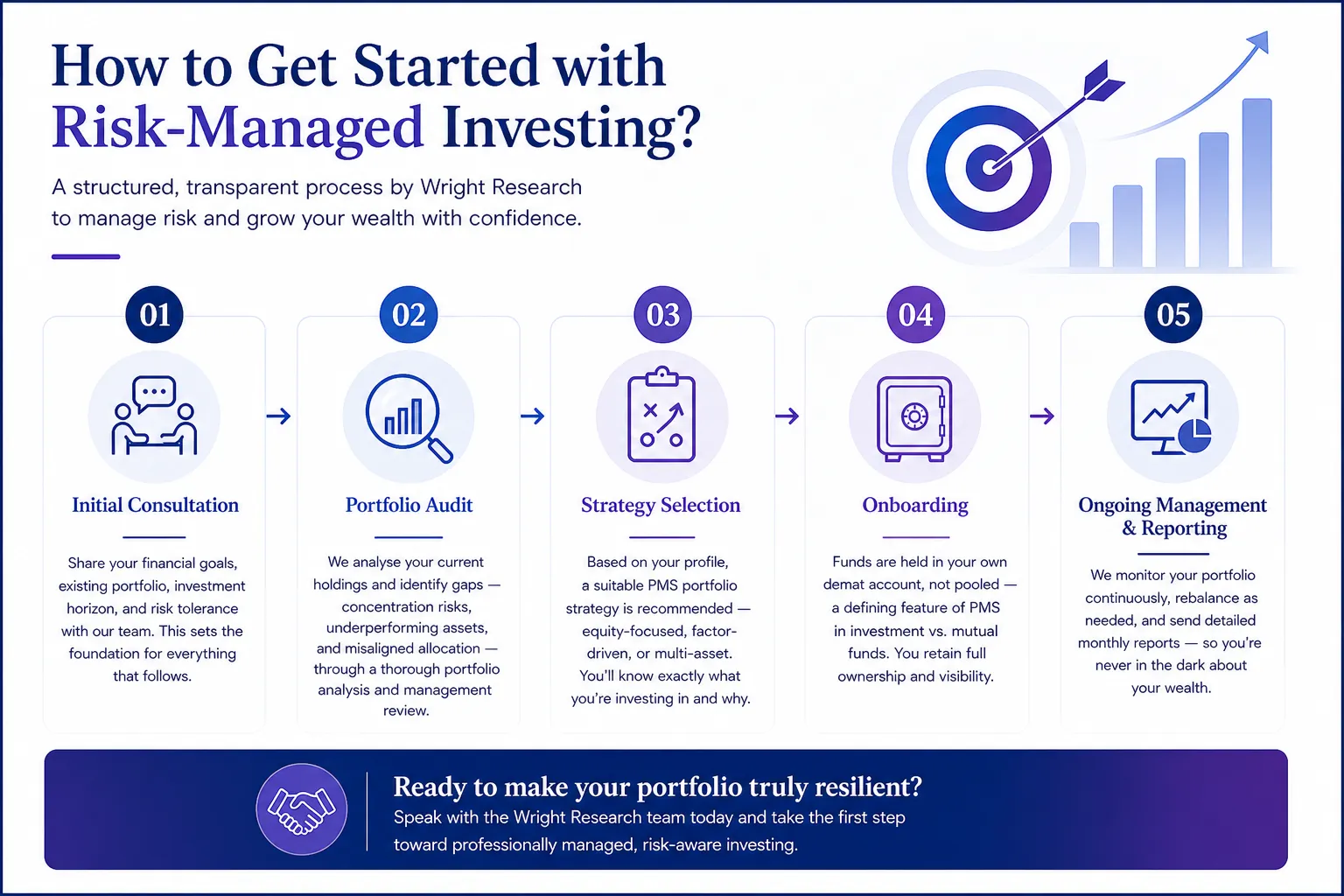
Getting started with professional portfolio risk management through Wright Research is a structured, transparent process:
Step 1 Initial Consultation: Share your financial goals, existing portfolio, investment horizon, and risk tolerance with the Wright Research team. This sets the foundation for everything that follows.
Step 2 Portfolio Audit: Wright Research's team will analyse your current holdings and identify gaps concentration risks, underperforming assets, and misaligned allocation through a thorough portfolio analysis and management review.
Step 3 Strategy Selection: Based on your profile, a suitable pms portfolio strategy is recommended whether that's equity-focused, factor-driven, or a multi-asset approach. You'll understand exactly what you're investing in and why.
Step 4 Onboarding: Funds are held in your own demat account, not pooled, a defining feature of pms in investment vs. mutual funds. You retain full ownership and visibility.
Step 5 Ongoing Management & Reporting: Wright Research's team monitors your portfolio continuously, rebalances as needed, and sends detailed monthly reports so you're never in the dark about your wealth.
Ready to make your portfolio truly resilient? Speak with the Wright Research team today and take the first step toward professionally managed, risk-aware investing.
Conclusion
Markets will always be uncertain. Interest rates will move. Geopolitical events will shock. Earnings will disappoint. None of that is within your control but how your portfolio responds to it absolutely is.
Portfolio risk management isn't a defensive strategy that limits your returns. When done right, it's the foundation that allows you to stay invested through volatility, compound your wealth over time, and avoid the catastrophic drawdowns that set investors back by years. The difference between investors who build lasting wealth and those who don't rarely comes down to stock selection. It comes down to discipline, structure, and the quality of portfolio analysis and management behind their decisions.
Whether you're managing ₹50 lakh or ₹5 crore, the principles are the same: know your risks, diversify with purpose, and never leave your portfolio without a plan for when things go wrong.
Is your portfolio built for what’s coming?
Get a free AI-powered review of your holdings — risk, overlap and quality in minutes.
Frequently Asked Questions
What is portfolio risk management, and why does it matter?
Portfolio risk management is the process of identifying and mitigating risks within an investment portfolio through diversification, rebalancing, and drawdown controls. It matters because markets are unpredictable without a structured risk framework; even a strong portfolio can suffer severe losses during corrections, potentially derailing long-term financial goals.
What are PMS charges, and how are they structured?
PMS charges typically include a fixed management fee (1–2.5% of AUM per year) and/or a performance fee charged on profits above a hurdle rate. Some providers use only one model. Understanding the fee structure is critical; it directly affects your net returns. Wright Research's fee structure is transparent and disclosed upfront as per SEBI regulations.
How is active portfolio management different from a mutual fund?
Active portfolio management through PMS is fully personalised; your holdings sit in your demat account, strategies are tailored to your risk profile, and the manager can take defensive decisions in real time. Mutual funds, by contrast, are pooled vehicles with standardised strategies and limited customisation. PMS is typically suited to investors with ₹50 lakh or more.
Who should consider portfolio management services in India?
Portfolio management services in India are best suited for HNI investors with a minimum of ₹50 lakh in investable assets, high-income professionals seeking structured wealth management, and investors who have experienced portfolio losses due to poor risk management. If your current portfolio lacks a coherent strategy or risk framework, PMS is worth exploring.
What is portfolio analysis and management, and what does it include?
Portfolio analysis and management refer to the ongoing process of evaluating portfolio performance, risk exposure, asset allocation, and individual holding quality. It includes performance attribution (why the portfolio is up or down), risk measurement (volatility, drawdown), and strategy adjustments, all done regularly to ensure the portfolio stays on track with your goals.
Can PMS services help protect wealth during a market crash?
Yes, PMS services with a robust portfolio risk management framework can reduce drawdowns during crashes through defensive repositioning, sector rotation, and cash allocation. While no investment is immune to market falls, a professionally managed PMS portfolio with drawdown controls is significantly better equipped to protect wealth than an unmanaged collection of stocks.
Disclaimer: Investments in securities markets are subject to market risks. Past performance is not indicative of future returns. Please read all related documents carefully and consult your financial advisor before investing. This content does not constitute investment advice.