


Portfolio risk management protects long-term wealth through diversification, position limits, and active portfolio management rather than chasing returns. A well-run PMS portfolio relies on disciplined portfolio analysis and management, transparent PMS charges, and quant-driven portfolio advisory services to control losses. Understanding PMS in investment helps you choose PMS services that prioritise capital protection alongside growth.
Introduction
Most investors only think about risk after the damage is done. The market falls 20%, a portfolio built over a decade loses years of gains in a few weeks, and the question changes from "how much can I earn?" to "how much could I lose?" If you have built real capital and are evaluating portfolio management services, that second question matters far more. Strong returns feel good, but disciplined portfolio risk management decides whether your wealth survives a full market cycle.
This guide explains how risk is actually controlled inside a PMS portfolio, what protections to look for, and how Wright Research approaches portfolio analysis and management for serious long-term investors.
See what markets are pricing in
Live indices, sector moves and market breadth — the backdrop to every story we publish.
What is Portfolio Risk Management in PMS?
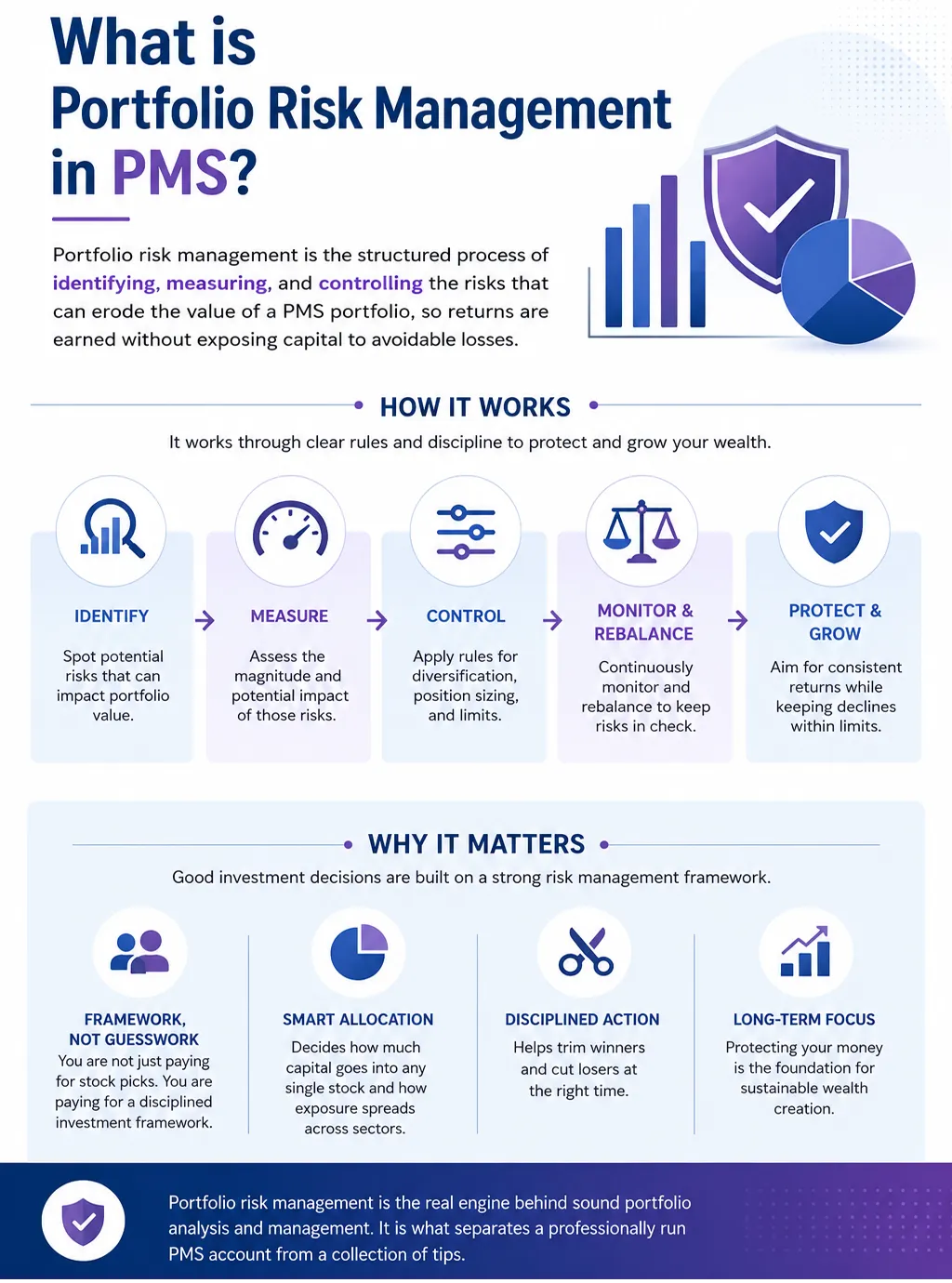
Portfolio risk management is the structured process of identifying, measuring, and controlling the risks that can erode the value of a PMS portfolio, so returns are earned without exposing capital to avoidable losses. It works through clear rules for diversification, position sizing, and rebalancing. It is used by investors who want professional PMS services to grow wealth while keeping declines within limits they can tolerate.
In plain terms, this discipline sits underneath every good investment decision. When you hand your money to a manager, you are not just paying for stock picks. You are paying for a framework that decides how much capital goes into any single stock, how exposure spreads across sectors, and when to trim winners or cut losers. That framework is the real engine behind sound portfolio analysis and management, and it is what separates a professionally run account from a collection of tips. The strongest portfolio management services treat protecting your money as seriously as growing it.
How Risk Management Works Inside a PMS Portfolio
Risk control is not a single action but a continuous loop. It begins by defining your risk profile, then constructing a portfolio that matches it, and finally monitoring and adjusting as markets move. The table below breaks down the core stages a disciplined manager follows.
Stage | What Happens | Why It Protects You |
Risk profiling | The manager assesses your goals, horizon, and tolerance | Prevents a portfolio riskier than you can stomach |
Diversification | Capital spread across stocks, sectors, and market caps | Reduces damage from any single failure |
Position limits | No single holding dominates the account | Caps the loss from one wrong call |
Continuous monitoring | Holdings tracked against signals daily | Problems are caught early, not after the fall |
Rebalancing | Weights adjusted as conditions change | Keeps risk aligned with your original plan |
This loop is where active portfolio management proves its value. A passive index simply rides the market down in a crash. An actively managed PMS portfolio can reduce exposure to weakening sectors, raise cash when signals deteriorate, and protect gains already earned. That responsiveness is the heart of effective portfolio risk management, and a major reason investors pay for professional PMS services instead of going it alone.
Types of Risk Every PMS Investor Faces
Understanding what can go wrong is the first step in portfolio analysis and management. Risk is not one thing; it comes in several forms, and a strong portfolio is built to handle each of them.
Risk Type | What It Means | How It Is Addressed |
Market risk | The whole market declines | Tactical cash, hedging, defensive tilts |
Concentration risk | Too much in one stock or sector | Strict position and sector limits |
Liquidity risk | Hard to exit a holding quickly | Focus on tradeable, liquid names |
Behavioural risk | Panic selling, greedy buying | Rules-based, quant-driven decisions |
Timing risk | Buying high, selling low | Systematic rebalancing, not emotion |
Behavioural risk deserves special attention. Decades of data show the average investor underperforms the very funds they own, simply because they buy and sell at the wrong moments. This is exactly where professional portfolio advisory services add quiet, compounding value. By removing emotion, active portfolio management keeps decisions consistent through both euphoria and fear. For most people, controlling their own behaviour is the hardest part of PMS in investment, and outsourcing it to a disciplined process is worth far more than it appears.
PMS in India: Key Facts, Data, and PMS Charges
Portfolio management services have grown into a serious wealth vehicle in India. According to SEBI data, PMS assets under management run into several lakh crore rupees, with the minimum investment set at ₹50 lakh, a threshold designed so that pms in investment suits high-net-worth and seriously committed investors rather than casual ones.
Cost is a common worry, so it helps to understand how PMS charges work before you commit. Fees are transparent and regulated, and they typically follow one of the structures below.
Fee Model | How It Works | Investor-Friendly When |
Fixed fee | Flat annual percentage of assets | You want predictable, simple costs |
Performance fee | The manager earns a share above a hurdle | You want the manager aligned with gains |
Hybrid | Lower fixed fee plus performance share | You want a balance of both models |
The right PMS charges structure depends on your preference for predictability versus alignment. A performance-linked model means the manager earns more only when you do well, which can sharpen the focus on protecting capital rather than just gathering assets. When comparing providers, look beyond the headline number and ask what you receive: the depth of analysis, the reporting transparency, and the quality of active management all matter more than a fractional difference in fees. Cheap PMS services that ignore risk can cost you far more in a downturn than a slightly higher fee ever would.
Get research like this in your inbox
The week’s research that mattered, in five minutes. Joined by 2L+ investors.
Who Should Consider Professional Portfolio Advisory Services?
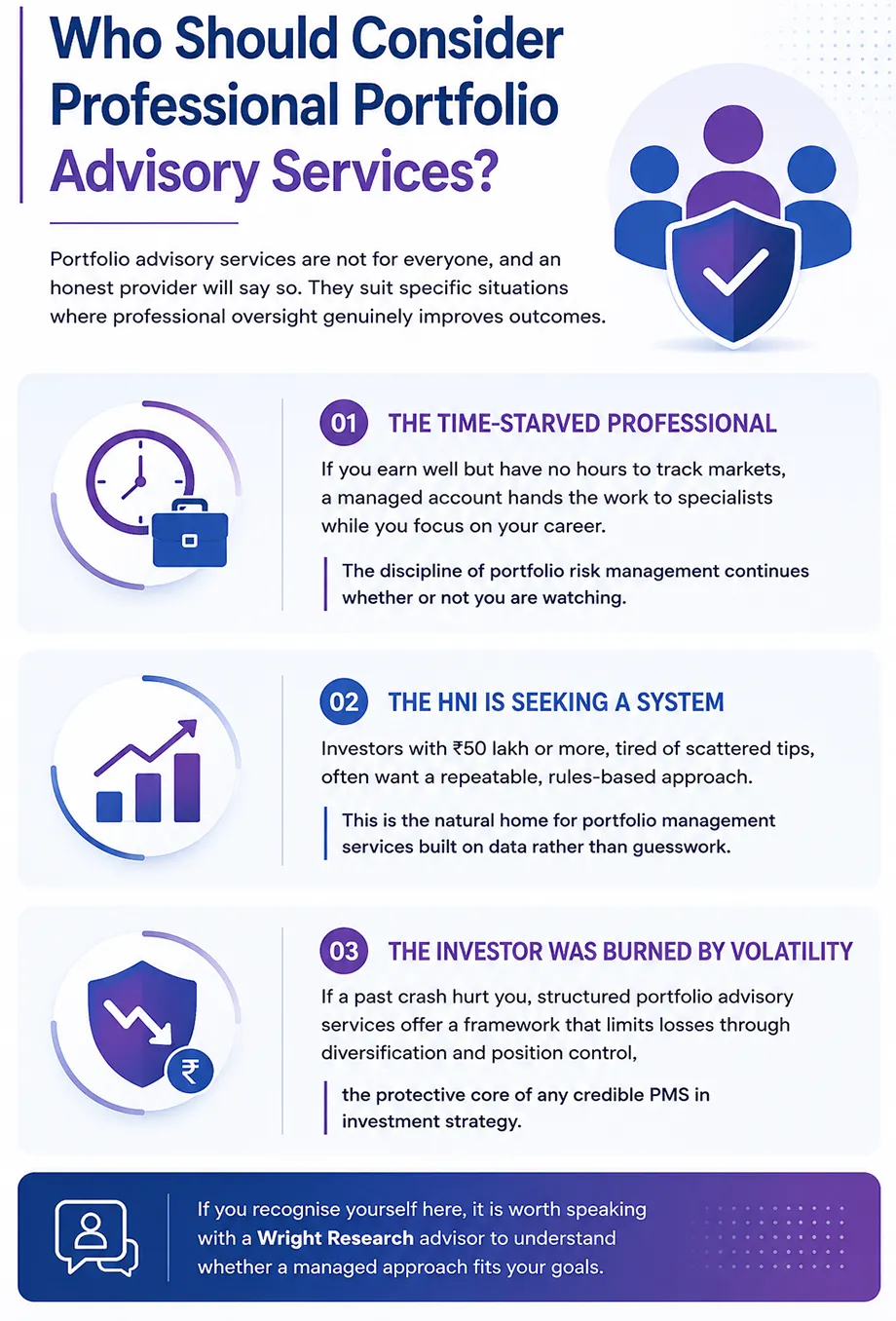
Portfolio advisory services are not for everyone, and an honest provider will say so. They suit specific situations where professional oversight genuinely improves outcomes.
The time-starved professional. If you earn well but have no hours to track markets, a managed account hands the work to specialists while you focus on your career. The discipline of portfolio risk management continues whether or not you are watching.
The HNI is seeking a system. Investors with ₹50 lakh or more, tired of scattered tips, often want a repeatable, rules-based approach. This is the natural home for portfolio management services built on data rather than guesswork.
The investor was burned by volatility. If a past crash hurt you, structured portfolio advisory services offer a framework that limits losses through diversification and position control, the protective core of any credible PMS in investment strategy.
If you recognise yourself here, it is worth speaking with a Wright Research advisor to understand whether a managed approach fits your goals.
How Wright Research Approaches Risk Through Active Portfolio Management
Wright Research takes a quant and factor-based approach to active portfolio management, which means decisions are driven by data rather than instinct. Instead of relying on one manager's gut feel, the process scans hundreds of signals across momentum, quality, value, and volatility to build and rebalance each PMS portfolio. This removes human bias and keeps risk control consistent through every market mood.
The factor framework matters most during turbulence. When volatility rises, the models tilt toward more stable, higher-quality holdings and away from fragile ones, helping cushion the portfolio when it counts. This is portfolio analysis and management working in the background continuously, rather than a once-a-quarter review.
Transparency runs through the whole model. Clients see what they hold, why they hold it, and how fees are applied, because trust in portfolio advisory services is built on clarity, not mystique. For investors who value method over noise, this style of PMS services offers something rare: a repeatable way to pursue growth while keeping risk firmly in view.
PMS vs Mutual Funds: Which Manages Risk Better?
Both mutual funds and portfolio management services are professionally managed, but they handle risk and ownership very differently. The comparison below clarifies where each fits.
Parameter | PMS | Mutual Funds |
Minimum investment | ₹50 lakh | As low as ₹500 |
Ownership | Stocks held in your own demat | Units in a pooled fund |
Customisation | Tailored to your profile | One strategy for all investors |
Transparency | Full visibility of holdings | Periodic disclosures |
Risk control | Personalised, active | Mandate-bound |
The key difference for risk is customisation. A PMS portfolio can be shaped around your specific tolerance, while a mutual fund applies one mandate to thousands of investors at once. For someone with the capital to meet the minimum, this personalisation is the strongest argument for choosing PMS in investment over a pooled product. Either path benefits from genuine active portfolio management.
How to Get Started With Portfolio Management Services
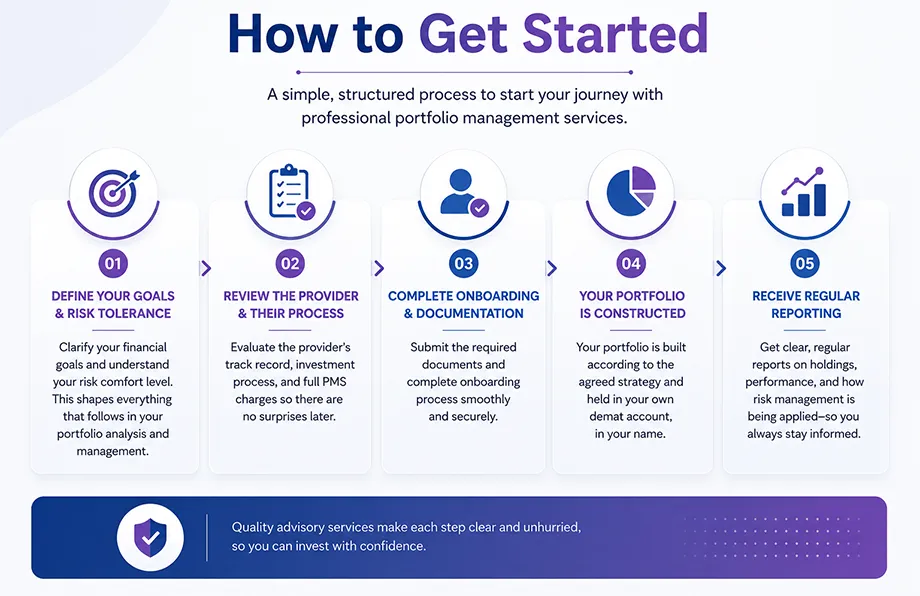
Beginning your journey with portfolio management services is straightforward once you know the steps. First, define your goals and honest risk tolerance, since this shapes everything that follows in your portfolio analysis and management. Second, review the provider's track record, process, and full PMS charges so there are no surprises later.
Third, complete the onboarding and documentation, after which your portfolio is constructed in your own demat account and held in your name. Finally, you receive regular reporting that shows holdings, performance, and how risk management is being applied, so you always understand what is happening with your money. Quality advisory services make each step clear and unhurried.
Ready to protect and grow your wealth with a disciplined approach? Explore Wright Research's PMS strategies.
Is your portfolio built for what’s coming?
Get a free AI-powered review of your holdings — risk, overlap and quality in minutes.
Frequently Asked Questions
What is portfolio risk management in PMS?
Portfolio risk management is the disciplined process of identifying and controlling risks inside a PMS portfolio through diversification, position limits, and continuous monitoring. It ensures returns are pursued without exposing your capital to avoidable losses, forming the protective foundation of any well-run portfolio management service.
How do PMS charges affect my returns?
PMS charges typically follow a fixed, performance, or hybrid model and are deducted from your portfolio. While fees reduce gross returns, well-structured PMS services that prioritise risk control often justify their cost by limiting losses and improving net long-term outcomes far more than a low fee alone could.
Who should consider portfolio management services?
Portfolio management services suit high-net-worth investors with ₹50 lakh or more who want a systematic, professionally managed approach. They especially fit time-starved professionals and those seeking disciplined oversight rather than scattered tips, making structured portfolio advisory services a strong fit for long-term wealth building.
How is a PMS portfolio different from a mutual fund?
A PMS portfolio holds stocks directly in your own demat account and is customised to your risk profile, whereas a mutual fund pools money under one mandate for all investors. This personalisation gives PMS in investment stronger, tailored risk control for those who meet the higher minimum.
What types of risk does active portfolio management control?
Active portfolio management addresses market, concentration, liquidity, behavioural, and timing risk. Through diversification, strict position limits, and rules-based decisions, disciplined portfolio analysis and management reduce the chance that any single event or emotional reaction seriously damages your long-term wealth.
How does Wright Research approach portfolio risk management?
Wright Research uses a quant and factor-based model for active portfolio management, scanning hundreds of signals to build and rebalance each portfolio. This data-driven approach removes human bias, tilts toward quality during volatility, and keeps PMS charges and holdings fully transparent for every client.