


Quick Answer: What Is Portfolio Construction for Moderate-Risk Investors?
Portfolio construction is the disciplined process of combining asset classes in defined proportions to achieve a target return within a defined risk tolerance - by design, not by accident.
For India's moderate-risk investor with a 5–7 year horizon, the recommended starting allocation is:
Asset Class | Allocation | Role |
Large-cap equity | 35% | Stable core returns |
Mid-cap equity | 20% | Growth acceleration |
Flexi-cap / multi-cap | 10% | Tactical flexibility |
Fixed income (debt funds) | 25% | Shock absorber |
Gold / Sovereign Gold Bonds | 5–7% | Inflation and equity hedge |
See what markets are pricing in
Live indices, sector moves and market breadth — the backdrop to every story we publish.
Introduction
Most Indian investors face the same dilemma when they sit down to invest. They are neither willing to park everything in fixed deposits and watch inflation quietly erode their savings, nor are they comfortable watching their entire portfolio swing 40% in a single market correction. They want growth, but measured, structured, and purposeful growth.
This is precisely the space where portfolio construction for the moderate risk investment profile becomes a discipline of its own.
The equity markets, particularly in India, reward investors who understand that a well-designed balanced portfolio is not a compromise between ambition and caution — it is a deliberate architectural decision. It is a choice to systematically capture market upside while insulating against the kind of drawdowns that trigger panic-selling.
This blog presents a practical framework for portfolio construction tailored to the balanced investor , one who has the patience for a 5 to 7-year horizon, a genuine appetite for equity participation, and a clear-eyed understanding that portfolio risk management is not about avoiding risk but about pricing it correctly.
Also Read: https://www.wrightresearch.in/blog/top-5-reversal-trading-strategies-for-traders/
Who Is the Moderate-Risk Investor? Defining the Balanced Investor Profile
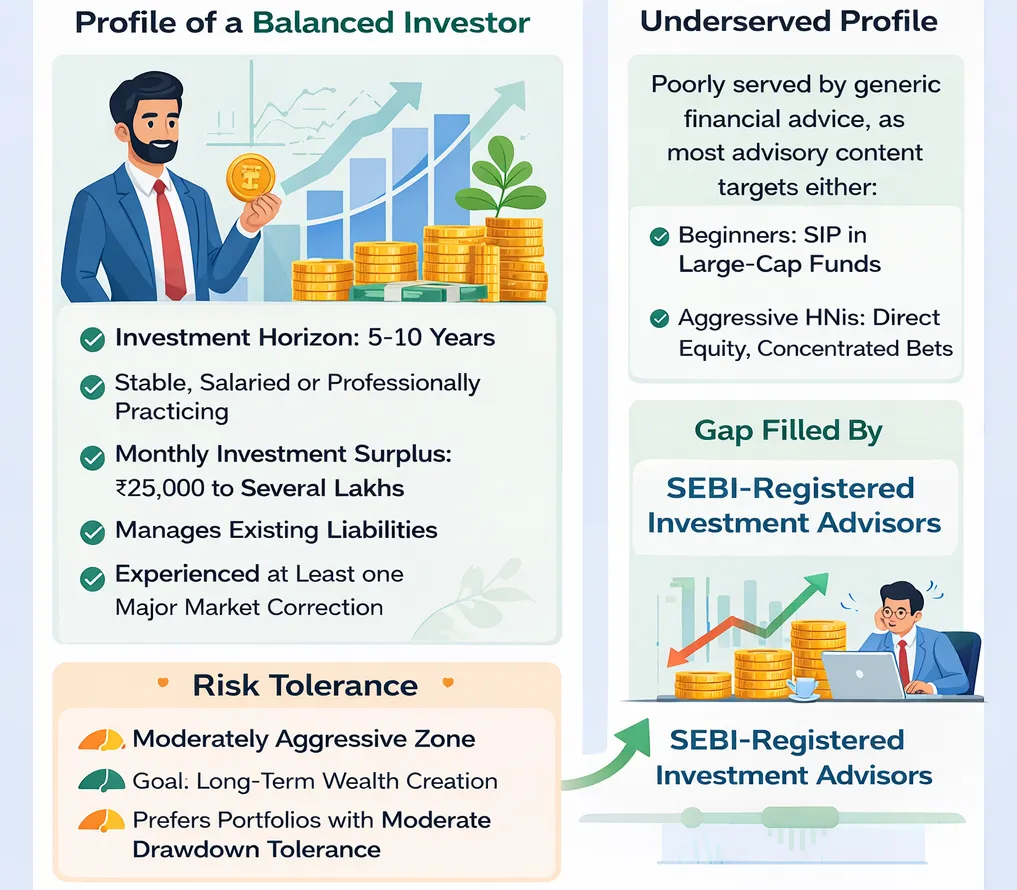
Before discussing the framework, it is important to define the investor archetype. A balanced investor in the Indian context typically presents the following profile:
The investment horizon stretches between five and ten years. Monthly income is stable, either from a salaried or from a professional practice. Existing liabilities are manageable, and the surplus available for investment ranges from ₹25,000 to several lakhs per month. The investor has lived through at least one significant market correction and understands intellectually that volatility is not loss, though the emotional reality in a sharp downturn is always harder than the intellectual understanding.
This investor's risk tolerance sits at what behavioural finance calls the "moderately aggressive" zone. The moderately aggressive portfolio goal is long-term wealth creation, but with an active preference for portfolios that do not require nerve-of-steel levels of drawdown tolerance.
This is also the investor profile most underserved by generic financial advice in India. Most advisory content is either written for beginners ("just start an SIP in a large-cap fund") or for aggressive HNI investors pursuing maximum alpha through direct equity or concentrated bets. The structured, evidence-based approach to moderate risk investment sits in a gap that SEBI-registered investment advisors are uniquely positioned to fill.
What Is Portfolio Construction and Why Does It Matter More Than Stock-Picking
What is portfolio construction at its core? In the most precise sense, portfolio construction meaning is the disciplined process of combining multiple asset classes, investment instruments, and securities in proportions that are explicitly designed to achieve a defined return objective within a defined risk tolerance, not by accident, but by design.
Most retail investors in India conflate portfolio construction with product selection. They ask "which mutual fund should I buy?" when the more important question is "what role does each fund play in my overall allocation?" This is the fundamental difference between product accumulation and genuine portfolio construction.
The distinction matters enormously at the level of outcomes. A diversified mutual fund portfolio built on a clear construction framework will, over time, consistently outperform an ad hoc collection of "top-rated" funds even if each fund in the ad hoc collection had a stronger one-year track record.
Portfolio construction's meaning becomes clearest when viewed through three lenses:
Through the return lens, construction determines what the portfolio is designed to earn and over what period, separating aspirational targets from empirically grounded ones. Through the risk lens, construction defines the maximum acceptable drawdown, volatility budget, and correlation structure of holdings.
Through the liquidity lens, construction ensures that the portfolio can meet the investor's actual cash requirements without forced liquidation at inopportune times.
A SEBI-registered investment advisor approaches portfolio construction as an ongoing engineering process, not a one-time product recommendation. This is the distinction that separates structured wealth management from transactional financial sales.
Also Read: https://www.wrightresearch.in/blog/what-is-stt-in-stock-market-and-how-it-is-calculated/
The Core Framework: How to Build a Balanced Portfolio
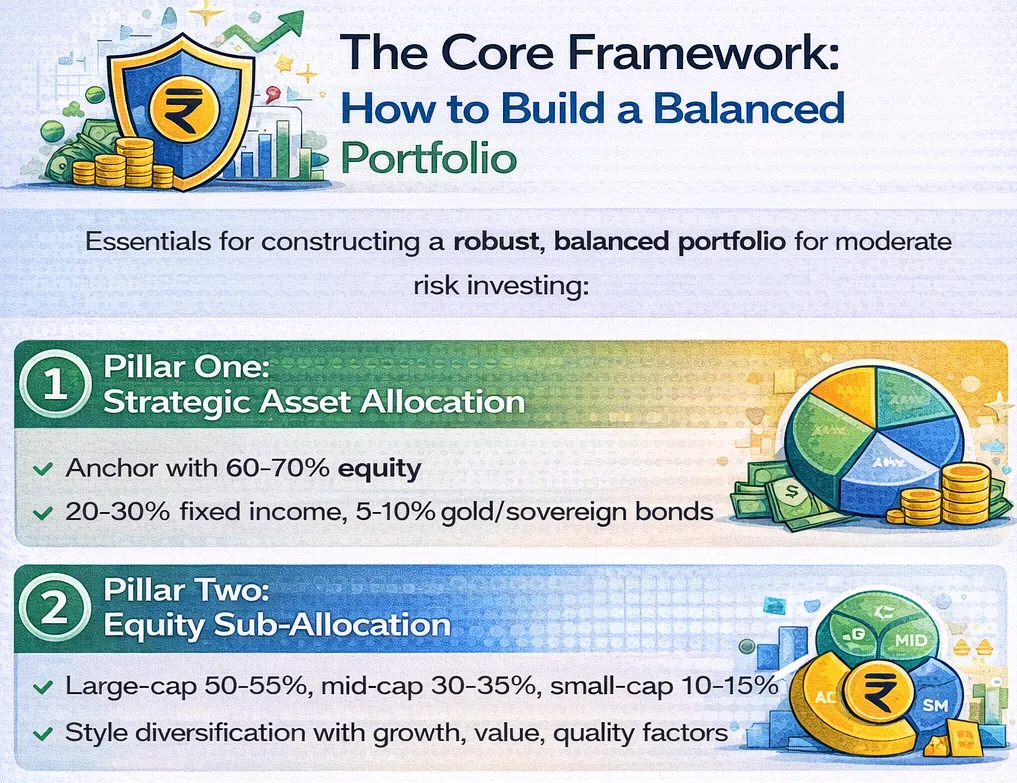
A robust, balanced portfolio for the moderate risk investment profile in India rests on four structural pillars.
Pillar One: Strategic Asset Allocation
This is the foundational decision on what percentage goes into equity, debt, gold, and cash equivalents. For the balanced investor, a starting allocation of 60–70% equity with 20–30% in fixed income and 5–10% in gold or sovereign bonds represents a well-anchored baseline. This is not a number pulled from convention; it is derived from historical Sharpe ratio analysis of Indian market cycles between 1995 and 2024, where this range has consistently delivered the best balanced risk-return investment outcomes at moderate drawdown levels.
Pillar Two: Equity Sub-Allocation
Within the equity portion, the portfolio construction framework must define sub-allocations across market capitalization, sectors, and investment styles. For a moderately aggressive portfolio, large-cap exposure of 50–55%, mid-cap of 30–35%, and small-cap of 10–15% has historically offered the right risk-adjusted return profile. Style diversification between growth, value, and quality factors adds another layer of resilience.
Pillar Three: Instrument Selection
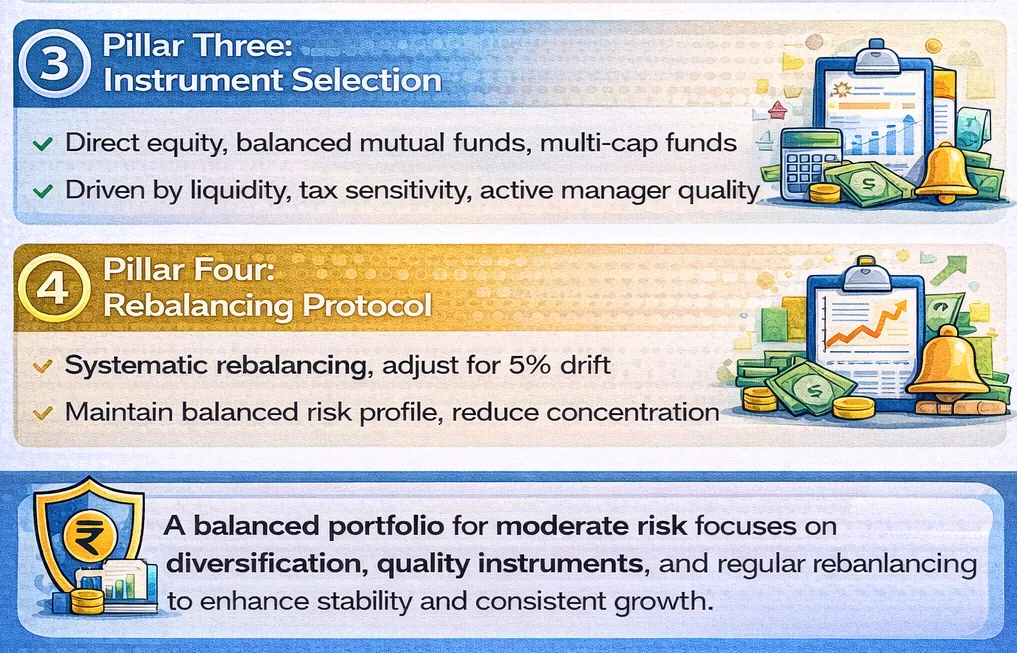
This is where mutual fund investment portfolio decisions actually get made. The choice between direct equity, balanced mutual funds, multi-cap funds, and hybrid instruments is driven by the investor's liquidity preference, tax sensitivity, and the availability of quality active managers in each category.
Pillar Four: Rebalancing Protocol
The most underappreciated element of portfolio construction is systematic rebalancing. Without it, equity outperformance silently drifts the portfolio into a higher-risk profile than the investor actually intended, increasing concentration in expensive assets precisely when they are most vulnerable to correction.
Also Read: https://www.wrightresearch.in/blog/breakout-pattern-meaning-and-trading-strategy/
Asset Allocation for a Moderately Aggressive Portfolio: India FY2025–26
The moderately aggressive portfolio sits at the intersection of growth ambition and structural caution. It is designed to capture approximately 80–85% of equity market upside while limiting drawdowns to roughly 60–70% of what an all-equity portfolio would experience in a sharp correction.
For Indian investors in FY2025–26, a practical, moderately aggressive portfolio allocation looks as follows:
The right asset allocation depends on your risk profile and investment horizon. Here is how the four main investor profiles compare for Indian investors in FY2025–26 - and where the moderately aggressive portfolio sits within the spectrum:
Asset Allocation by Investor Risk Profile - India (FY2025–26)
Risk Profile | Equity | Fixed Income | Gold / SGBs | Expected CAGR (7Y Rolling) | Max Drawdown (Historical) | Best Suited For |
Conservative | 20–30% | 55–65% | 10–15% | 7–9% | ~10–12% | Retirees; capital preservation; 1–3 yr horizon |
Balanced / Moderate | 45–55% | 35–45% | 5–10% | 10–12% | ~15–20% | Stable earners; wealth creation; 3–5 yr horizon |
Moderately Aggressive ★ | 60–70% | 20–30% | 5–7% | 12–14% | ~20–25% | Salaried investors; long-term growth; 5–7 yr horizon |
Aggressive | 80–90% | 5–15% | 0–5% | 14–16% | ~35–45% | HNI / early career; maximum growth; 7–10 yr horizon |
★ This blog focuses on the moderately aggressive profile. Source: Wright Research analysis of NSE/BSE market cycles, 1995–2024
Note: CAGR and drawdown ranges are based on Wright Research's proprietary analysis of NSE/BSE market data across rolling 7-year periods from 1995–2024. Figures are indicative and illustrative only - actual returns will vary based on fund selection, market conditions, and timing. Investments are subject to market risk. Past performance does not guarantee future results. This table is for informational purposes only and does not constitute investment advice. Consult a SEBI-registered investment advisor before making allocation decisions.
Within equity, large-cap domestic equity accounts for 35% of the total portfolio. This provides stable exposure to India's best-capitalized companies, Reliance Industries, HDFC Bank, Infosys, with lower volatility than broader market indices.
Mid-cap equity at 20% captures India's structural growth story in sectors like capital goods, specialty chemicals, and consumer discretionary. Flexi-cap or multi-cap funds at 10% provide the portfolio manager with tactical flexibility to shift allocation dynamically as market valuations shift.
Fixed income exposure of 25% acts as the portfolio's shock absorber. Short-duration debt funds or banking and PSU debt funds serve this role most efficiently for the balanced investor, offering better post-tax returns than traditional fixed deposits while maintaining liquidity.
Gold and sovereign gold bonds at 5–7% provide a genuine hedge against both rupee depreciation and systemic equity stress. Historical data show that gold's correlation with Indian equity markets turns sharply negative precisely during periods of maximum equity drawdown, making it a structurally valuable element of any balanced portfolio.
This allocation, maintained with annual rebalancing, has historically delivered CAGR in the range of 12–14% over seven-year rolling periods in India, with maximum drawdowns staying below 25% even during 2008 and 2020 stress events.
Also Read: https://www.wrightresearch.in/blog/decoding-the-march-effect-why-stocks-can-be-volatile-in-march/
Get research like this in your inbox
The week’s research that mattered, in five minutes. Joined by 2L+ investors.
Choosing the Right Mutual Funds for a Moderate-Risk Investment Strategy
Moderate risk mutual funds represent a broad universe of fund categories in India, and the moderate risk investment investor has access to some of the most intelligently designed products in the Indian mutual fund industry.
Balanced mutual funds , or hybrid equity funds as SEBI classifies them, are the most intuitive starting point. These funds maintain a dynamic allocation between equity and debt within a single structure, rebalancing internally according to the fund manager's market view.
The Balanced Advantage Fund (BAF) category is particularly well-suited to the balanced investor, as it manages equity allocation dynamically, reducing equity exposure as valuations rise and increasing it as they fall. Investors looking for a ready-made implementation can explore Wright Research's balanced mutual fund basket - an AI-powered, auto-rebalancing allocation optimized for moderate-risk investors.
Diversified mutual fund portfolio construction for the moderate-risk investor typically combines three to five carefully selected funds across categories: a large-cap or Nifty 50 index fund for stable core equity exposure; a mid-cap active fund for superior alpha generation in the ₹500 crore to ₹25,000 crore market-cap range; a flexi-cap fund for tactical allocation flexibility; and a short-duration debt fund for fixed-income exposure with manageable interest rate risk.
The critical discipline in building a mutual fund investment portfolio is avoiding over-diversification. Twelve funds that overlap substantially in their top holdings are not a diversified mutual fund portfolio; they are the illusion of diversification layered over concentrated underlying exposure. A truly diversified mutual fund portfolio is one where each fund occupies a distinct, non-overlapping role in the overall allocation architecture.
When evaluating moderate risk mutual funds, three metrics deserve particular scrutiny: rolling returns over three and five-year periods (not point-to-point returns, which are highly sensitive to start and end dates); maximum drawdown in stress periods; and information ratio — how consistently the fund delivers alpha over its benchmark.
The Role of Active Portfolio Management in Balancing Risk and Return
Active portfolio management plays a qualitatively different role for the moderate risk investment investor than it does for either the conservative or the aggressive investor.
For the conservative investor, active portfolio management is largely about capital preservation, optimizing within fixed income, managing duration, and minimizing drawdowns. For the aggressive investor, it is about maximizing alpha through concentrated bets and high-conviction sector calls.
For the balanced investor, active portfolio management must accomplish something more nuanced: it must generate meaningful alpha over passive benchmarks while simultaneously managing the risk architecture of the overall portfolio.
The case for active portfolio management in Indian equity markets remains stronger than in more mature markets. India's mid-cap and small-cap universe, where information asymmetry is significant and institutional coverage is uneven, continues to offer active managers genuine alpha opportunities.
In large-cap Indian equity, the evidence for active outperformance is mixed, which is why many SEBI-registered investment advisors recommend a hybrid approach: passive index exposure in large caps paired with active management in mid and small caps.
A well-designed stock portfolio management strategy for the moderate-risk profile uses factor-based selection within the mid-cap space: screening for quality (return on equity, low debt), value (PE relative to sector peers), and momentum (price trend strength). Investors seeking a quantitatively managed implementation of this approach can explore the Wright Quality portfolio for low-volatility equity exposure - a defensive strategy selecting 20–25 stocks based on profitability, growth, and safety factors.
This is the approach embedded in Wright Research's quant-driven equity strategies using systematic models to make active portfolio management decisions that are reproducible and free of behavioural biases.
Balanced risk-return investment outcomes are, in large part, a function of how well the active portfolio management process adapts to changing market regimes rotating between defensive and cyclical sectors as the economic cycle evolves, without making the kind of concentrated macro bets that introduce excessive volatility.
Portfolio Risk Management: How to Stress-Test Your Equity Holdings
Portfolio risk management is not an event that happens when markets fall. It is a continuous process embedded in how the portfolio is constructed, monitored, and rebalanced from day one. For a detailed breakdown, read our guide on what portfolio risk is and how to reduce it - covering correlation management, drawdown budgeting, and the role of asset allocation in risk control.
For the moderate risk investment investor, portfolio risk management operates across three layers.
The first layer is correlation management. A well-constructed, balanced portfolio must hold assets whose price movements are not perfectly correlated with each other. In practice, this means ensuring that the equity portion of the portfolio does not have excessive sector concentration, particularly in high-beta sectors like banking, IT, and real estate, which tend to move together during market stress.
The second layer is drawdown budgeting. Every portfolio should be built with an explicit maximum acceptable drawdown, the level of portfolio decline at which the investor would begin to feel genuine financial or psychological distress. For most moderate risk investment profiles, this threshold sits between 20% and 30%.
The portfolio's construction should be stress-tested against historical Indian market drawdowns, the 2008 financial crisis (Sensex fell 61%), the 2020 COVID crash (Sensex fell 38%), and the 2022 mid-cap correction to verify that the balanced portfolio would not breach this threshold.
The third layer is concentration risk monitoring. In a stock portfolio management context, this means ensuring that no single stock represents more than 7–8% of total equity exposure, no single sector exceeds 25%, and no single fund overlaps excessively with other funds in the mutual fund portion of the portfolio.
Portfolio risk management also includes the often-overlooked risk of inflation erosion and liquidity mismatch. A balanced risk-return investment strategy must ensure that the portfolio's expected real return (post inflation) is positive on a sustained basis, and that the liquidity profile of the portfolio matches the investor's anticipated cash flow needs.
Common Mistakes Moderate-Risk Investors Make
The most common mistake in portfolio construction for the moderate risk investment profile is confusing a diversified product list with a genuinely diversified mutual fund portfolio. Holding eight equity funds does not create diversification if all eight are invested in the same Nifty 50 stocks.
The second mistake is treating balanced mutual funds as a permanent substitute for doing proper asset allocation. Hybrid funds offer internal rebalancing, but they cannot replace the investor-level decision about what overall equity-to-debt ratio is appropriate for a given financial plan.
The third and most consequential mistake is abandoning the balanced investor framework during sharp corrections. When markets fall 25–30%, the portfolio construction logic that felt compelling in calm conditions suddenly feels insufficient. This is exactly when portfolio risk management discipline matters most, holding course, rebalancing into equities, and not liquidating at the point of maximum market fear.
Active portfolio management cannot protect an investor who makes emotional decisions that override the portfolio's structure. The best SEBI-registered investment advisor is ultimately only as effective as the investor's willingness to stay committed to the framework through full market cycles.
The fourth mistake is ignoring taxes in stock portfolio management. India's long-term capital gains tax on equity at 12.5% (post July 2024 Budget) and short-term capital gains at 20% means that excessive churning, even when driven by sound active portfolio management logic, can significantly erode the balanced risk-return investment outcomes that the portfolio was designed to deliver.
Conclusion
Wright Research brings a data-driven, quantitative philosophy to portfolio construction for Indian investors across wealth segments.
This produces a diversified mutual fund portfolio that is systematically diversified at the factor level, not just at the product label level.
For investors seeking stock portfolio management services through Wright Research's Portfolio Management Services (PMS), the moderately aggressive portfolio is structured to capture India's mid-cap growth opportunity through quantitatively selected stocks, with dynamic sector rotation built into the rebalancing protocol.
For investors in mutual fund strategies, Wright Research constructs balanced mutual fund-led allocations optimized for the moderate risk investment profile using rolling return analysis, drawdown comparison, and overlap analysis to ensure that each fund in the mutual fund investment portfolio adds genuine, non-redundant exposure.
The Wright Research team monitors portfolio risk management on an ongoing basis, with regular rebalancing triggers tied to both calendar intervals and market-event thresholds, ensuring that the balanced investor never inadvertently drifts into a risk profile higher or lower than their original mandate.
Is your portfolio built for what’s coming?
Get a free AI-powered review of your holdings — risk, overlap and quality in minutes.
Frequently Asked Questions
1. Who is a SEBI-registered investment advisor?
A SEBI-registered investment advisor (RIA) is an individual or firm authorized by the Securities and Exchange Board of India to provide financial advice. They must follow strict regulations, act in clients’ best interests, and disclose fees transparently.
2. What is meant by portfolio construction?
Portfolio construction is the process of selecting and allocating assets like equities, bonds, and cash to balance risk and return based on an investor’s goals, time horizon, and risk tolerance.
3. Is a mutual fund a moderate risk investment?
Mutual funds can be moderate risk, but it depends on the type. Equity funds are higher risk, debt funds are lower risk, while hybrid funds generally fall in the moderate-risk category.
4. What is an example of an aggressive portfolio?
An aggressive portfolio mainly invests in high-growth assets like equities (70–90%), especially mid and small caps, with minimal allocation to debt. It targets higher returns but comes with higher volatility and risk.