


Quick Answer
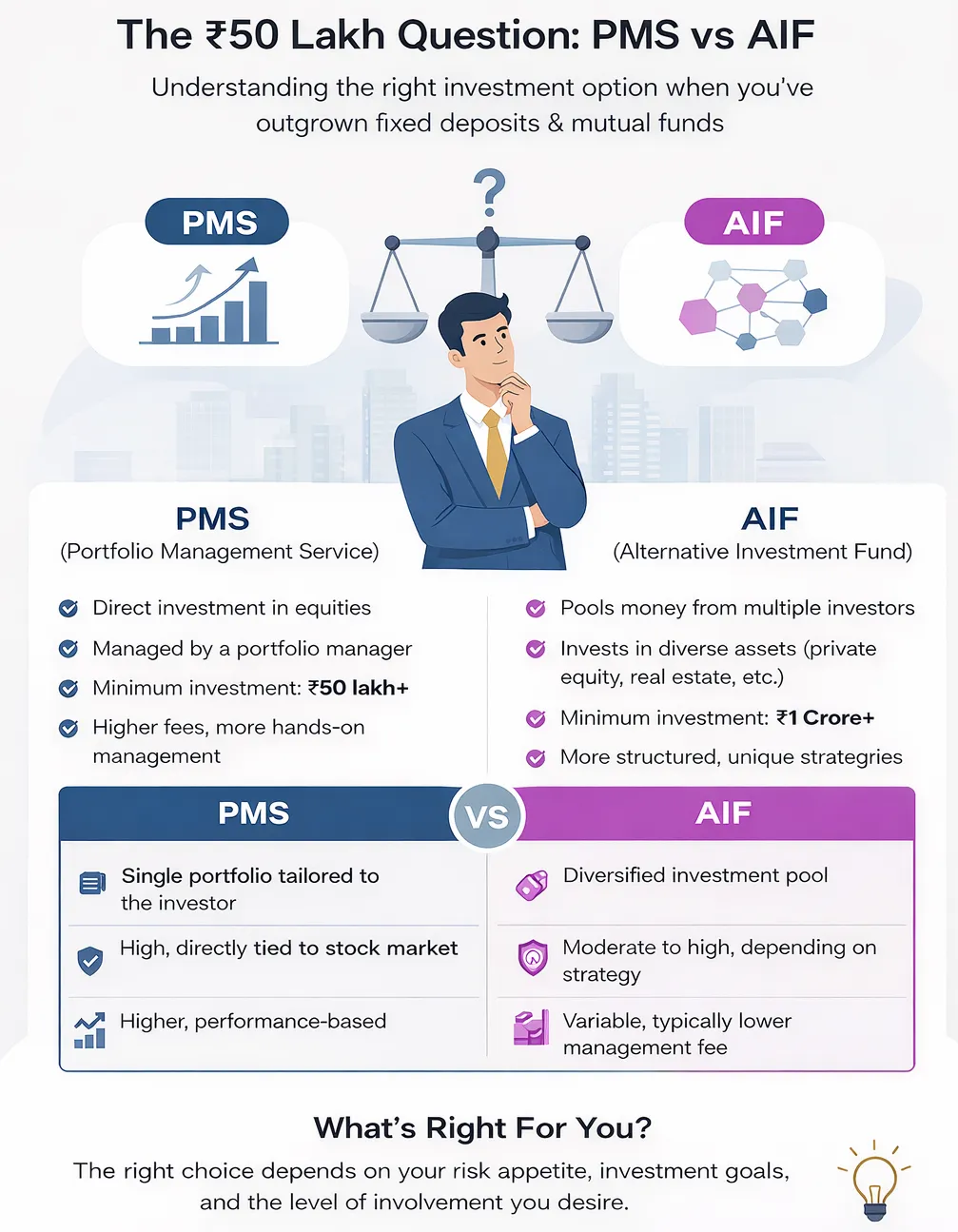
PMS (Portfolio Management Services) requires a minimum investment of ₹50 lakh and gives investors direct ownership of stocks, managed by a SEBI-registered portfolio manager. An AIF (Alternative Investment Fund) requires at least ₹1 crore and pools capital across investors. PMS suits hands-on HNIs; AIF suits those seeking diversified, alternative strategies. Both differ in fees, taxation, and liquidity.
The ₹50 Lakh Question Nobody Prepares You For
You have worked hard to accumulate ₹50 lakh or more. You have already outgrown fixed deposits and regular mutual funds. Now your wealth manager, or maybe a friend in finance, drops two terms on you, PMS and AIF and suddenly a decision that should feel exciting starts feeling complicated.
Here is the truth: most investors at this stage make their choice based on whichever product their advisor pushes hardest. That is a mistake. PMS investment and AIF investment in India are genuinely different beasts, different in structure, risk profile, fees, tax treatment, and who they are actually designed for. Getting this decision right can mean the difference between a portfolio that compounds quietly in your favour and one that costs you more than you realise.
This guide breaks both products down clearly, compares them head-to-head, and gives you a practical framework to figure out which one actually fits your situation without the jargon overload.
See what markets are pricing in
Live indices, sector moves and market breadth — the backdrop to every story we publish.
What Is PMS? How It Works, Who Regulates It and Who It Is For
Portfolio management services, in plain English, are a professionally managed equity portfolio where you own the underlying stocks directly in your own demat account. A SEBI-registered portfolio manager builds and manages a pms portfolio on your behalf, buying, selling, and rebalancing stocks according to a defined investment strategy.
SEBI regulates pms services tightly. Every portfolio manager must be registered with the regulator, must maintain transparent reporting to clients, and must disclose performance data publicly. This is not a grey area if someone is offering you pms in investment without SEBI registration, that is a serious red flag.
Who Should Use PMS?
PMS investment is designed for High Net Worth Individuals (HNIs) specifically those who can invest a minimum of ₹50 lakh. The product works well for investors who want concentrated, high-conviction equity exposure, want visibility into exactly which stocks they own, and prefer active portfolio management over passively tracking an index.
The key advantage of the direct ownership structure is that you see every trade. There is no opacity. Your portfolio manager at Wright Research, for instance, can explain why a specific stock was bought or sold in any given week. For investors who care about understanding their money not just the returns, transparency matters.
What Is PMS Investment in Practice?
When you ask what is pms investment, the simplest answer is this: imagine hiring a full-time equity analyst and fund manager, exclusively for your portfolio. They run a specific strategy — value, momentum, quality, or a quantitative factor-based approach — and your ₹50 lakh or more is deployed into a focused set of 15 to 25 stocks. Unlike a mutual fund, no other investor's money is mixed with yours.
What Is an AIF (Alternative Investment Fund) in India?
An alternative investment fund in India refers to a SEBI-regulated pooled investment vehicle that collects funds from sophisticated investors and deploys them into strategies that go beyond conventional equity and debt. Think private equity, venture capital, hedge funds, and long-short strategies. All of these fall under the AIF umbrella.
SEBI has structured AIF Investment India into three distinct categories:
Category I AIFs invest in early-stage startups, social ventures, infrastructure projects, and SMEs. The government actively encourages these through regulatory relaxations because they deploy capital into sectors that need long-term patient money.
Category II AIFs include private equity funds, debt funds, and fund-of-funds that do not use leverage in any significant way. Most institutional-grade PE funds in India fall here. If you have heard of a private equity firm raising a "fund" with a 5-year lock-in, that is almost certainly a Category II AIF.
Category III AIFs use diverse or complex trading strategies, including derivatives and leverage. Hedge funds and long-short equity funds sit in this category. Returns can be higher but so is the risk, and the regulatory oversight reflects that.
The minimum investment in an alternative investment portfolio through an AIF is ₹1 crore for most categories double the PMS threshold.

PMS vs AIF: The Head-to-Head Comparison
Parameter | PMS | AIF |
Minimum Investment | ₹50 lakh | ₹1 crore |
Ownership Structure | Direct (stocks in your demat) | Pooled (units in a fund) |
Regulation | SEBI (Portfolio Managers Regulations) | SEBI (AIF Regulations) |
Investor Control | Higher — can customise strategy | Lower — fund manager decides |
Transparency | High — full portfolio visibility | Moderate — periodic disclosures |
Lock-In | Generally, none (most PMS are open-ended) | 3–7 years typically |
Underlying Assets | Primarily listed equities | Equities, PE, debt, alternatives |
Tax Applicability | Pass-through to investor | Varies by category and structure |
Ideal For | HNIs want control and transparency | HNIs seeking diversification beyond listed markets |
This table gives you the skeleton. The flesh on those bones, particularly around fees and taxation, deserves its own discussion.
Fee Structures Compared: Fixed Fee, Performance Fee and Carried Interest
This is where a lot of investors get caught off guard. PMS charges can feel opaque if you do not ask the right questions upfront.
How PMS Charges Work
Most PMS service providers charge in one of three ways. A flat management fee, typically between 1.5% and 2.5% of AUM per year, is the most straightforward model. A performance fee structure charges a lower base fee but takes a percentage of the profits above a pre-agreed hurdle rate, often 15% to 20% of gains above a 10% benchmark. Some providers offer a combination of both.
PMS charges also include brokerage on every transaction, depository fees, and audit charges, and these are charged at the individual portfolio level, not shared across investors as they would be in a mutual fund. Over time, this can add up. A good financial advisor in India will walk you through the full cost picture before you invest, not after.
How AIF Fees Work
Alternative investment fund India vehicles typically charge a management fee of 1% to 2% annually on committed capital, plus a performance fee called carried interest, usually 20% of profits above the hurdle rate. Category III AIFs, because of their complexity, often charge at the higher end of this range.
The important distinction: AIF fees are charged at the fund level. This means you do not see individual transaction costs the way you do in PMS, but the carried interest can represent a significant slice of your gains in high-return years.
Consulting the best financial advisor in India before committing to any fee structure is not optional; it is essential. The difference between two structures can cost or save you lakhs over a five-year horizon.
Get research like this in your inbox
The week’s research that mattered, in five minutes. Joined by 2L+ investors.
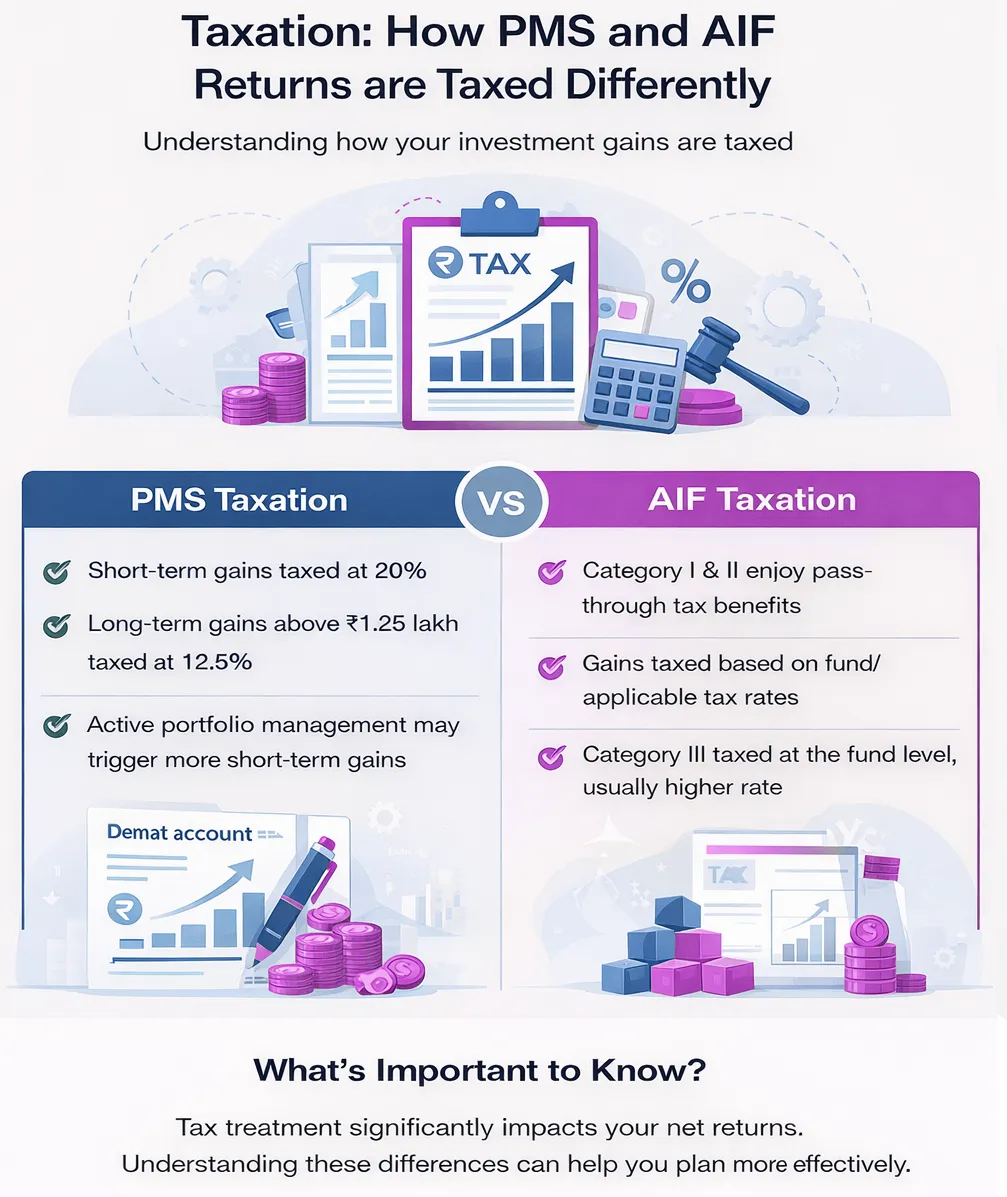
Taxation: How PMS and AIF Returns Are Taxed Differently
Taxation is probably the most misunderstood part of both products and it directly affects your actual take-home return.
PMS Taxation
In portfolio management services, since you own the stocks directly in your own demat account, the tax treatment mirrors what it would be if you held those stocks yourself. Short-term capital gains (for stocks held less than 12 months) are taxed at 20% (revised from 15% post the 2024 budget). Long-term capital gains above ₹1.25 lakh are taxed at 12.5%. The active portfolio management style of most PMS providers which involves more frequent rebalancing can sometimes generate more short-term gains than a buy-and-hold approach. This is worth discussing with your manager.
AIF Taxation
Taxation for an alternative investment portfolio in AIF structures is more complex and depends heavily on which category the fund falls under.
Category I and Category II AIFs enjoy pass-through tax status meaning the fund itself does not pay tax, and gains are passed to investors who are taxed based on their own applicable rates and holding periods. Category III AIFs do not get this benefit; the fund is taxed at the fund level, which in practice means investors in Category III AIFs pay a higher effective tax rate.
For investors in the highest tax brackets, the Category III AIF tax treatment can materially reduce net returns. This is a conversation that does not happen enough at the point of sale — and it should.
Liquidity and Lock-In: When Can You Exit Each Structure?
One of the most practical questions any investor should ask is: "When can I get my money back if I need it?"
PMS investment is generally open-ended. Most pms portfolio strategies allow redemptions with a notice period of anywhere from a few days to 30 days. There is no mandatory lock-in, though some specific strategies may have soft lock-in periods for operational reasons. The flexibility is one of the structural advantages of pms in investment over pooled vehicles.
AIF investment india works very differently. Category II AIFs in particular — private equity and debt funds — typically have lock-in periods of three to seven years. Your capital is committed and is not available for withdrawal. Some AIFs offer secondary market liquidity through limited secondary transactions, but these are not always available and can involve discounts to NAV.
Category III AIFs vary. Some are open-ended with monthly or quarterly redemption windows; others are closed-ended for the full fund tenure. Read the fund documentation carefully.
The bottom line: if there is any possibility you may need to access this capital within three to five years, portfolio management services gives you far more flexibility than most AIF structures.
Which Should You Choose? A Decision Framework for the ₹50L–₹5 Cr Investor
Rather than giving you a generic answer, here is a practical framework based on investor situations we see regularly.
Choose PMS If…
You have ₹50 lakh to ₹2 crore available for investment, you prefer to invest in listed equities, you value transparency and want to see every position in your portfolio, you may need some liquidity within a five-year window, and you want a genuinely personalised relationship with your portfolio manager. Active portfolio management through a well-run PMS services provider, combined with a quantitative investment philosophy, can generate compelling long-term returns with full visibility.
Working with the best financial advisor in India who specialises in PMS selection, not just any distributor, will help you match the right strategy to your goals.
Choose AIF If…
You have ₹1 crore or more that you can commit with a long time horizon, you want exposure to private equity, venture capital, or alternative strategies that go beyond listed equities, you are comfortable with less liquidity and periodic reporting rather than daily transparency, and you understand the tax implications of the category you are investing in. An alternative investment portfolio through AIF can be a powerful diversification tool but only for investors who genuinely understand what they are signing up for.
The Blended Approach
Many sophisticated investors at the ₹2 crore+ level hold both. A core allocation to portfolio management services provides listed equity exposure with control and flexibility. A satellite allocation to an alternative investment fund India vehicle, particularly a Category II debt or PE fund, provides diversification and potentially uncorrelated returns. This is not a complex idea. It is just a structured way of thinking about where different pools of your capital should live.
Conclusion
Whether you are evaluating PMS investment for the first time or exploring how an alternative investment portfolio fits into your existing wealth structure, our team is here to give you an honest, research-backed perspective.
Investments are subject to market risk. Past performance does not guarantee future returns. Please read all scheme-related documents carefully before investing.
Is your portfolio built for what’s coming?
Get a free AI-powered review of your holdings — risk, overlap and quality in minutes.
Frequently Asked Questions
What is the minimum investment for PMS vs AIF in India?
The minimum investment for portfolio management services in India is ₹50 lakh, as mandated by SEBI. For AIF Investment India, the minimum is ₹1 crore for most categories. These thresholds make both products exclusively available to High Net Worth Individuals.
Is AIF better than PMS for high-net-worth investors?
Neither is universally better. PMS investment is better for investors who want listed equity exposure, transparency, and liquidity. Alternative investment fund india is better for those seeking diversification into private markets, alternative strategies, and uncorrelated asset classes. The right choice depends on your investment horizon, liquidity needs, and risk appetite.
How is an AIF taxed in India?
Taxation for aif investment india depends on the category. Category I and II AIFs have pass-through tax status — investors are taxed directly based on their applicable rates. Category III AIFs are taxed at the fund level, which often results in a higher effective tax burden for investors. Consult a qualified advisor before investing.
What is the difference between PMS and a mutual fund?
In pms in investment, you own the stocks directly in your own demat account — there is no pooling of investor money. Mutual funds pool capital from thousands of investors into a single NAV-based vehicle. PMS allows for customisation, direct stock ownership, and a personalised strategy; mutual funds are standardised and more accessible at lower investment amounts.
Can a retail investor invest in an AIF in India?
No. Alternative investment fund india structures require a minimum investment of ₹1 crore, which places them firmly in the HNI and ultra-HNI investor segment. Retail investors looking for actively managed equity exposure are better served by mutual funds or, once they cross the ₹50 lakh threshold, PMS services.