


Quick Answer
A PMS performance report contains metrics like alpha, Sharpe ratio, and maximum drawdown that most investors find confusing. This guide explains each metric in plain English, what it measures, what a "good" number looks like in India, and how to use it to compare and evaluate any portfolio management services provider.
What’s the market feeling today?
Our India Fear & Greed index tracks sentiment so you don’t trade on headlines.
Introduction
You finally received your monthly PMS performance report. You open it and see a table full of numbers: XIRR of 18%, alpha of 4.2%, Sharpe ratio of 0.9, and maximum drawdown of 22%. The fund manager calls it a "stellar year." But you have no idea whether to be impressed or alarmed.
This is the reality for most investors in portfolio management services in India. You're handing over ₹50 lakhs or more, and the report that's supposed to keep you informed reads like a quant research paper.
Here's the thing: these numbers aren't complicated once someone explains them in plain English. And once you understand them, you stop relying on a fund manager's framing and start evaluating PMS performance on your own terms.
This guide will walk you through every major metric in a PMS factsheet, what it measures, what a good score looks like, and what combinations of numbers should raise your eyebrows. No jargon. No hand-waving. Just clear, honest answers.
Why PMS Performance Reports Are Confusing: The Problem With How Returns Are Presented
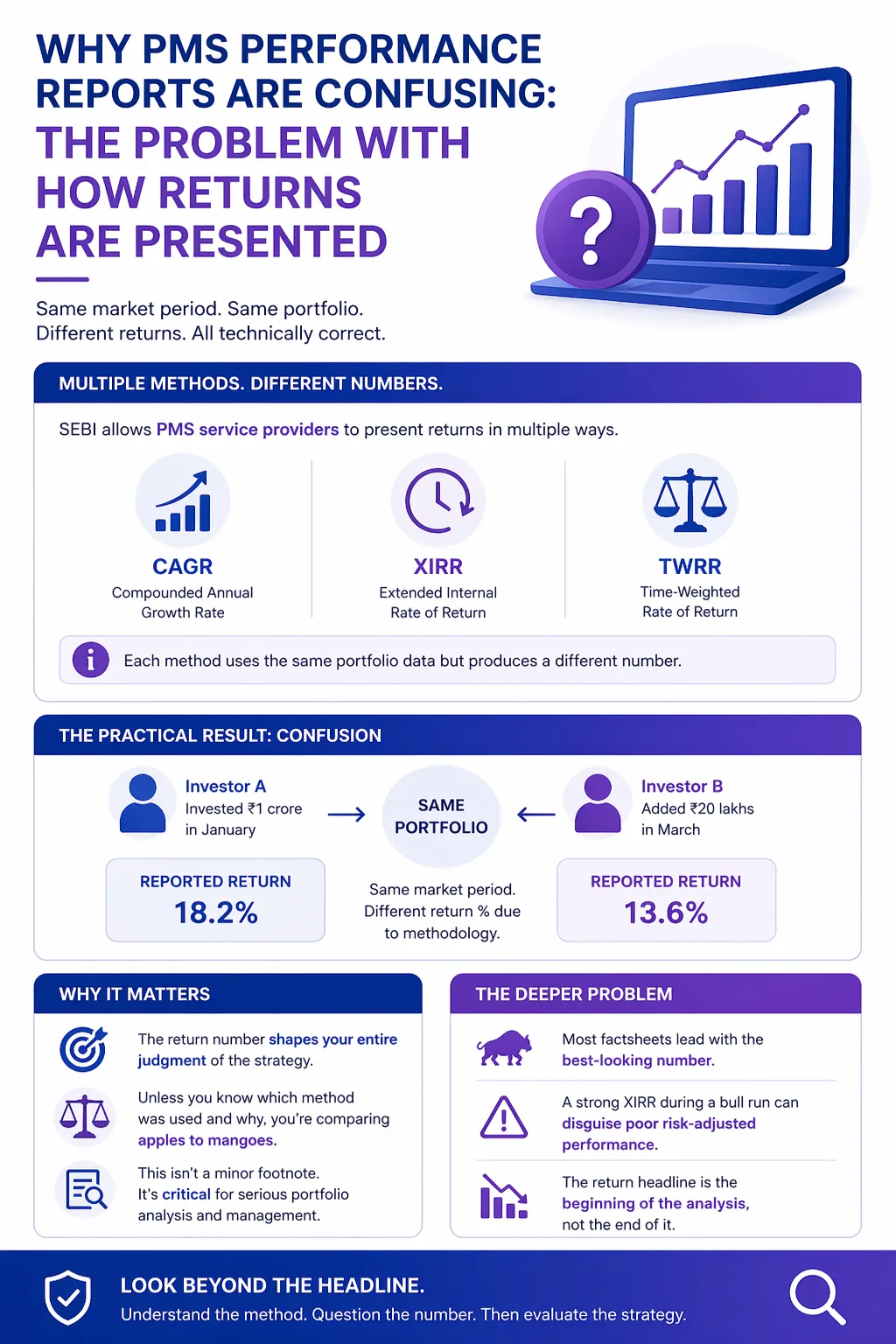
Here's what nobody tells you upfront: two PMS investment providers can show wildly different return figures for the same market period, and both are technically correct.
That's because India's SEBI regulations allow PMS service providers to present returns in multiple ways. You'll see CAGR (Compounded Annual Growth Rate), XIRR (Extended Internal Rate of Return), and TWRR (Time-Weighted Rate of Return) used interchangeably in the same document. Each calculation method produces a different number from the same underlying portfolio data.
The practical result is confusion. A client who invested ₹1 crore in January might see a different return percentage than someone who added ₹20 lakhs in March, even with the same portfolio. The methodology determines the output.
For any serious portfolio analysis and management, this isn't a minor footnote. The return number you're looking at shapes your entire judgment of the strategy. And unless you know which method was used and why, you're comparing apples to mangoes across providers.
The deeper problem is that most factsheets lead with the best-looking number. A strong XIRR during a bull run can disguise poor risk-adjusted performance. The return headline is the beginning of the analysis, not the end of it.
TWRR vs XIRR: Which Return Number Are You Actually Looking At?
TWRR (Time-Weighted Rate of Return) measures how the portfolio itself performed, independent of when you added or withdrew money. It's the number that tells you how good the fund manager actually is at managing money. SEBI requires portfolio management services providers to report TWRR for standardised comparison.
XIRR (Extended Internal Rate of Return) measures how your specific investment performed, accounting for the timing of your cash flows. If you invested ₹1 crore and added ₹50 lakhs during a dip, your XIRR will differ from another investor's even in the same fund.
For comparing two PMS service providers head-to-head, always use TWRR. It's the fair comparison number.
For understanding your personal wealth creation, XIRR is more relevant. It reflects your experience.
Here's a quick reference table:
Metric | What It Measures | Best Used For |
TWRR | Portfolio manager's performance | Comparing PMS providers |
XIRR | Your personal investment return | Understanding your actual wealth creation |
CAGR | Annualised return (lump sum) | Rough benchmark comparisons |
The problem in most PMS in investment factsheets is that XIRR is often shown prominently when it flatters the manager, and TWRR is buried in a footnote. Always check which one is which before drawing any conclusions.
Alpha Explained: What It Means and How to Tell If It's Real or Lucky
Alpha in investing is the return a portfolio generates above and beyond what the benchmark index returned. If the Nifty 50 returned 14% and your PMS returned 19%, the alpha in investing is 5%. Simple enough.
But here's the question that separates sophisticated investors from casual ones: Is that alpha skill, or luck?
A manager who generated 5% alpha in one year might have simply taken on more risk in the right sectors at the right time. True alpha in investing is consistent, risk-adjusted outperformance over multiple market cycles, not a single year's lucky sector bet.
For any rigorous portfolio analysis and management, you want to see alpha across at least three to five years, and ideally across both bull and bear phases. A manager who generated 8% alpha in 2020–21 and then destroyed wealth in 2022's correction isn't demonstrating skill. They're demonstrating high-beta exposure that happened to pay off temporarily.
Factor investing strategies, which are Wright Research's core philosophy, can help explain alpha more rigorously. When a portfolio is exposed to known factors like momentum, quality, or low volatility, alpha can be decomposed into factor premiums versus genuine manager skill. This is more honest than a raw alpha number, and it's exactly what a good PMS services provider should be able to explain.
Questions to ask your manager about alpha:
How does your alpha hold up after adjusting for factor exposures? Is the outperformance driven by systematic risk factors or stock selection? And has it been consistent across down markets, not just up ones?
Get research like this in your inbox
The week’s research that mattered, in five minutes. Joined by 2L+ investors.
Sharpe Ratio: How to Know If the Returns Were Worth the Risk Taken
The Sharpe ratio is arguably the most important single number in any PMS performance report. It tells you how much return the portfolio generated per unit of risk taken.
The formula is straightforward: take the portfolio's return, subtract the risk-free rate (India's 10-year G-Sec yield, roughly 7% currently), and divide by the standard deviation of returns. A higher number means better risk-adjusted performance.
For sharpe ratio in the Indian context, here's a rough benchmark guide:
Sharpe Ratio | What It Signals |
Below 0.5 | Poor returns don't justify the risk |
0.5 to 1.0 | Acceptable — reasonable risk-adjusted return |
1.0 to 1.5 | Good — strong risk-adjusted performance |
Above 1.5 | Excellent — exceptional risk management |
For sharpe ratio, India specifically, it's important to use Indian risk-free rates, not US Treasury yields. Some fact sheets omit this detail. Always check what risk-free rate was used in the calculation, as it materially affects the number.
Here's what makes the Sharpe ratio particularly valuable in an active portfolio management strategy context: Two funds can have identical 20% CAGR returns, but if one achieved that with a Sharpe ratio of 1.2 and the other with 0.6, the first manager is doing far more with less. The second manager may have simply taken on twice the volatility to reach the same destination.
Good portfolio advisory services will help you interpret Sharpe ratios in the context of your own risk tolerance, investment horizon, and financial goals. A retiree and an aggressive 35-year-old have very different thresholds for acceptable Sharpe ratios.
Maximum Drawdown: The Number That Tells You How Much Pain You'd Have Faced
Maximum drawdown is the largest peak-to-trough decline a portfolio experienced during a specific period. If a portfolio was worth ₹1 crore at its peak and fell to ₹72 lakhs before recovering, the maximum drawdown is 28%.
This number matters more than most investors realise, and it's central to serious portfolio risk management . Here's why: human psychology is terrible at handling large losses. Studies consistently show that the pain of a 30% drawdown is emotionally felt as far worse than double the pleasure of a 30% gain.
A portfolio that earned 25% annually but experienced a 45% drawdown along the way would have tested most investors beyond their limit. Many would have panic-sold near the bottom, converting a temporary paper loss into a real one.
Strong portfolio risk management means managing drawdowns explicitly, not just chasing maximum returns. When evaluating PMS investment options, compare maximum drawdowns during the same periods for both the strategy and the benchmark.
What to Look For | Why It Matters |
Drawdown vs benchmark | Did the PMS limit losses better than the index? |
Recovery time | How long did it take to return to peak? |
Drawdown frequency | One bad year, or consistently volatile? |
An active portfolio management strategy that limits maximum drawdown to 15–20% while the market fell 35% is generating real value, even if headline returns are modest. Conversely, outperformance in bull markets means little if the portfolio is halved in a correction.
Benchmark Selection: Why the Benchmark Your PMS Uses Matters Enormously
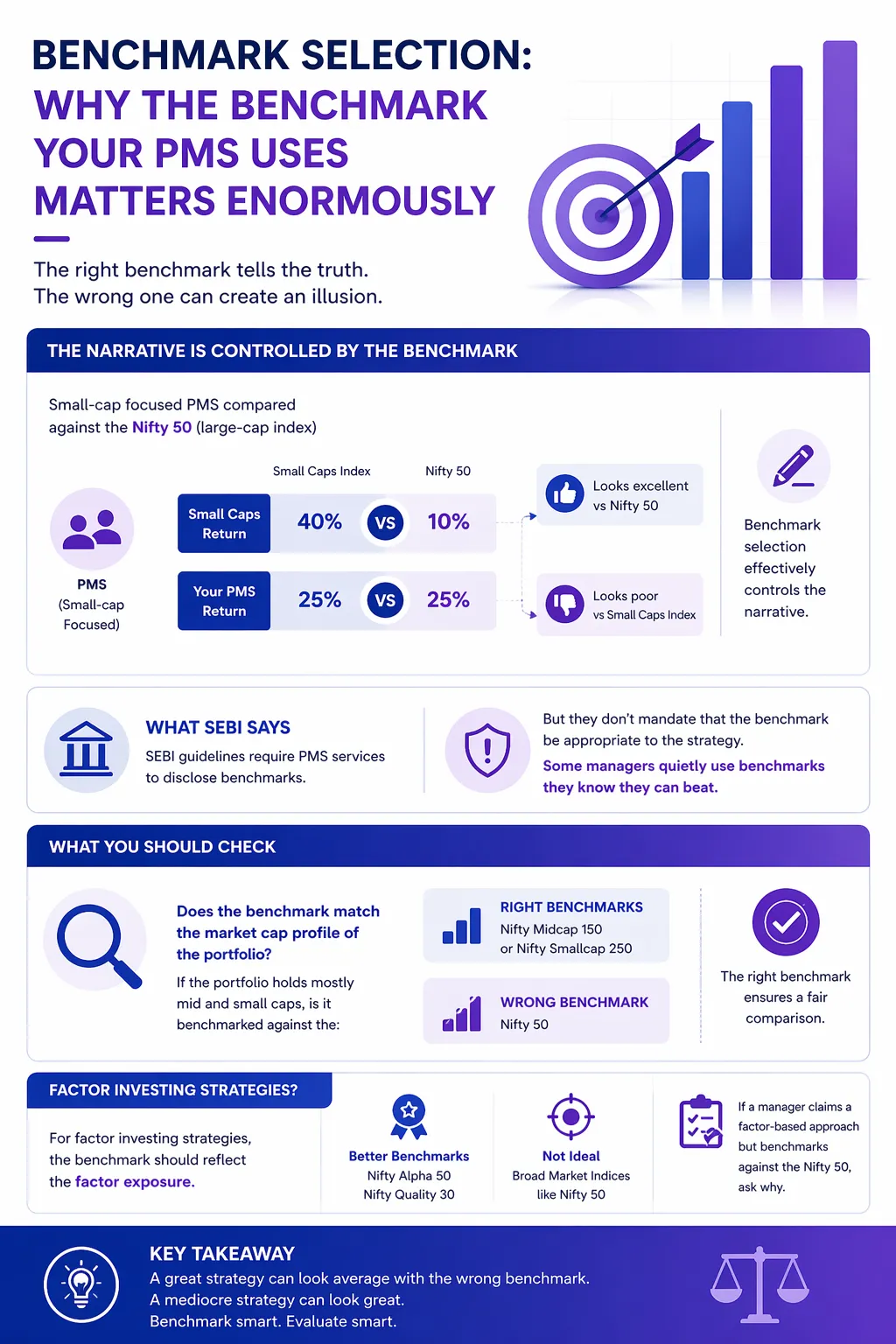
This is the most underappreciated issue in evaluating PMS performance. The benchmark a manager compares against can make mediocre performance look outstanding.
A small-cap focused portfolio management services provider compared against the Nifty 50 is a large-cap index. In a year when small caps returned 40%, and the Nifty returned 10%, a 25% return looks terrible against small-cap indices but excellent against the Nifty. The benchmark selection effectively controls the narrative.
SEBI guidelines require PMS services to disclose benchmarks, but they don't mandate that the benchmark be appropriate to the strategy. Some managers quietly use benchmarks they know they can beat.
What to check: Does the benchmark match the market cap profile of the portfolio? If the portfolio holds mostly mid and small caps, is it benchmarked against the Nifty Midcap 150 or the Nifty Smallcap 250, not the Nifty 50?
For factor investing strategies specifically, pure factor indices like Nifty Alpha 50 or Nifty Quality 30 are more honest benchmarks than broad market indices. If a manager claims a factor-based approach but benchmarks against the Nifty 50, ask why.
A Step-by-Step Guide to Reading Any PMS Monthly Factsheet
Here's a practical sequence for evaluating any PMS in the investment factsheet you receive, from the first page to the last.
Step 1 — Start with the benchmark and strategy description. Before looking at any return numbers, understand what the portfolio is supposed to do and what it's being measured against. This context frames everything else.
Step 2 — Check the return methodology. Find out whether the primary return figure is TWRR or XIRR. For comparison purposes, use TWRR.
Step 3 — Evaluate alpha over multiple timeframes. Look at 1-year, 3-year, and since-inception alpha figures. If alpha in investing exists only in the 1-year number, it's too short a track record to conclude.
Step 4 — Read the Sharpe ratio in context. For the Sharpe ratio India benchmarks, a ratio above 1.0 over 3 years is genuinely strong. Cross-reference with the benchmark's own Sharpe ratio for the same period.
Step 5 — Find the maximum drawdown number. It's often buried at the back. Compare it to what the Nifty or relevant benchmark experienced in the same period.
Step 6 — Read the portfolio concentration data. A portfolio with 80% in five stocks is very different from a diversified 30-stock portfolio. Concentration amplifies both returns and risk.
Step 7 — Check the portfolio turnover. Very high turnover in a PMS can indicate excessive trading, which generates costs that eat into returns. Portfolio advisory services that trade excessively may be generating activity, not returns.
Red Flags in a PMS Report: What to Watch Out For
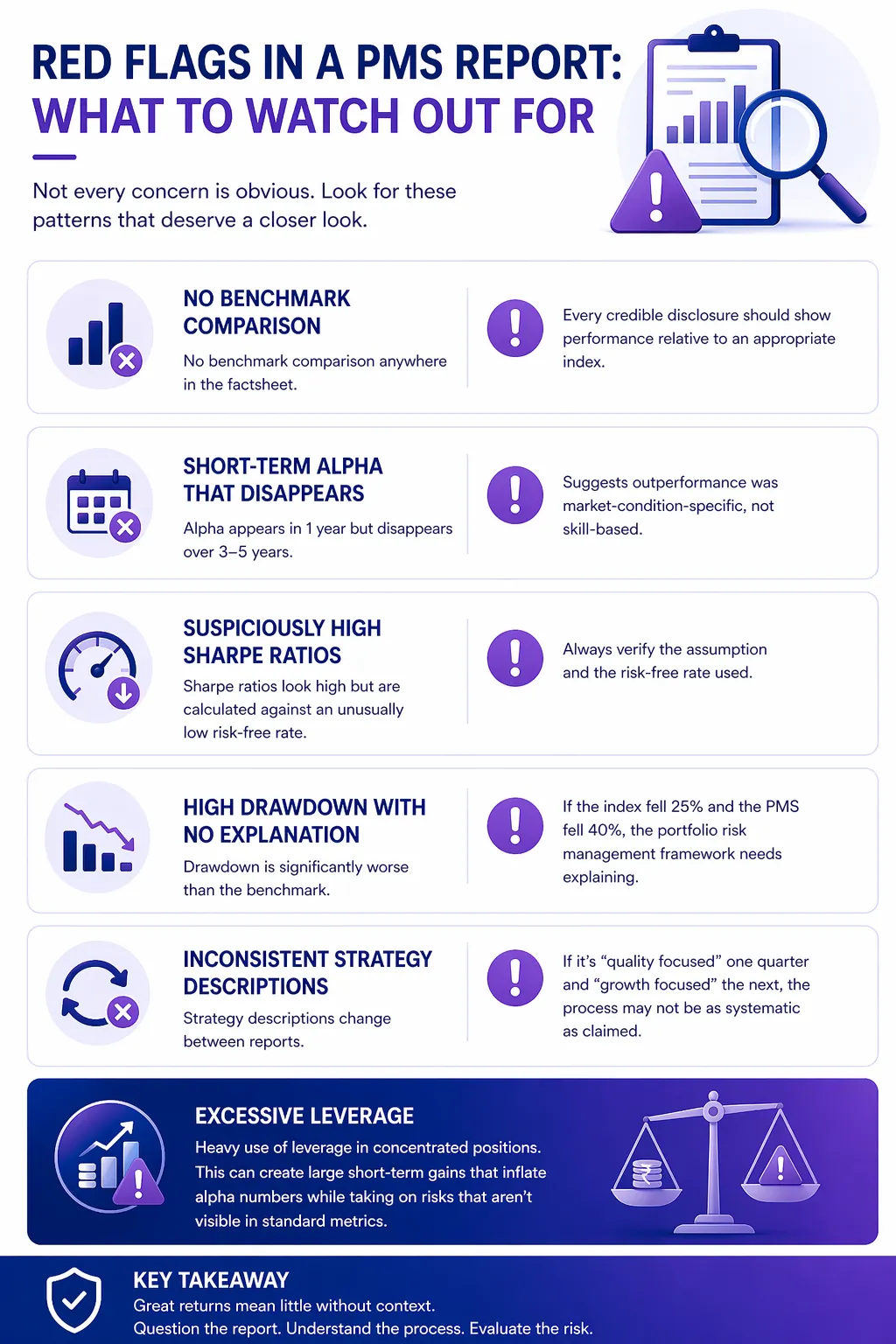
Not every concern in a PMS performance report is obvious. Here are the patterns that should prompt harder questions.
No benchmark comparison anywhere in the factsheet is a red flag. Every credible portfolio analysis and management disclosure should show how the portfolio performed relative to an appropriate index.
Alpha that only appears in one-year data but disappears over three or five years suggests the outperformance was market-condition-specific rather than skill-based.
Sharpe ratios that look high but are calculated against an unusually low risk-free rate. Always verify the assumption used.
The maximum drawdown significantly worse than the benchmark with no explanation. If the index fell 25% and the PMS fell 40%, the portfolio risk management framework needs explaining.
Strategy descriptions that change between reports are worth noting. If an active portfolio management strategy is described as "quality focused" one quarter and "growth focused" the next, the investment process may not be as systematic as claimed.
Heavy use of leverage in concentrated positions. This can create large short-term gains that inflate alpha numbers while taking on risks that aren't visible in the standard metrics.
Know your risk profile in 2 minutes
A short quiz that maps how much drawdown you can actually live with.
FAQ
What is alpha in a PMS performance report?
Alpha in investing measures how much a portfolio outperformed its benchmark index, after accounting for market movements. A positive alpha means the manager added returns above what the market alone produced. Consistent alpha over three to five years is a stronger signal than alpha in a single year.
What is a good Sharpe ratio for a PMS in India?
For sharpe ratio in the Indian context, a Sharpe ratio above 1.0 over three years is considered strong. Between 0.5 and 1.0 is acceptable. Below 0.5 means the returns didn't adequately compensate for the risk taken. Always use Indian risk-free rates (current 10-year G-Sec yield) in the calculation.
What is maximum drawdown, and why does it matter?
Maximum drawdown is the largest peak-to-trough decline a portfolio experienced. It matters because large losses test investor psychology and often trigger panic selling. Sound portfolio risk management limits drawdowns, protecting both capital and investor behaviour during corrections.
Why do different PMS providers show different return numbers?
Different PMS service providers use different calculation methodologies, such as TWRR, XIRR, or CAGR and different benchmark comparisons. SEBI mandates TWRR for standardised comparison, but XIRR is often shown more prominently when it flatters performance. Always check which methodology is being presented.
How do I compare two PMS strategies using their performance reports?
Use TWRR for returns (not XIRR), compare Sharpe ratios over the same three-year period using the same risk-free rate, check maximum drawdowns during the same market correction, and verify that both strategies use comparable benchmarks. For portfolio analysis and management comparisons, three to five-year track records are more meaningful than one-year data.