

The India US trade deal is the single biggest macro catalyst for India-US trade deal investment in 2026. It creates direct tailwinds for exporters, IT, pharma, and textiles the best stocks to buy 2026 and high-return mutual funds tied to these sectors. A sharp investment strategy using portfolio management services or active investing can help investors capture this opportunity systematically.
Why the India-US Trade Deal Is the Biggest Macro Event of 2026
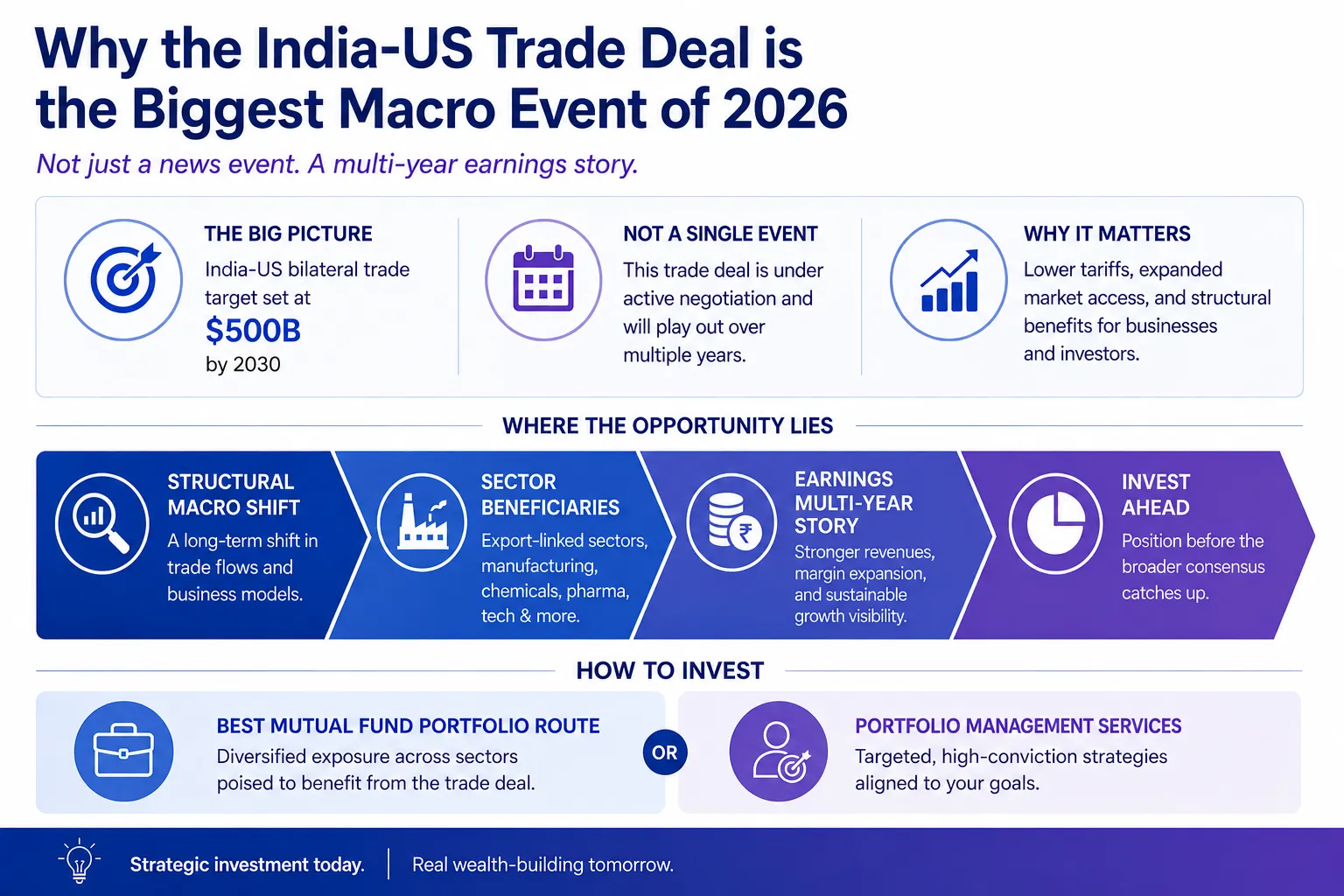
Most Indian investors are sitting on a question they haven't fully answered yet: Is this trade deal already priced in, or is the real money still ahead?
It's a fair question. Markets moved on the initial news, export-linked stocks got a quick re-rating, and suddenly everyone has an opinion on the India-US trade deal investment. But opinions aren't investment strategies. What actually matters is understanding which businesses structurally benefit from lower tariffs and expanded market access, and then positioning your portfolio around those businesses before the broader consensus catches up.
The India-US trade deal, currently under active negotiation with bilateral trade targets set at $500 billion by 2030, is not a single news event. It's a multi-year earnings story. Getting your investment strategy right now, before every mutual fund manager and media commentator has already moved, is where real wealth-building happens.
Wright Research's data-driven approach has consistently identified structural macro shifts before they became crowded trades. This blog breaks down exactly where the opportunity sits, which sectors carry the most substance, and how to build a portfolio around it, whether you prefer the best mutual fund portfolio route or want the precision of portfolio management services .
See what markets are pricing in
Live indices, sector moves and market breadth — the backdrop to every story we publish.
What Does the India US Trade Deal Mean for Indian Markets and Stocks?
The India-US trade deal is a bilateral trade and tariff agreement between India and the United States aimed at reducing customs duties, easing non-tariff barriers, and expanding market access across key sectors including pharmaceuticals, IT services, textiles, electronics, and agriculture. For Indian markets, it translates into improved export competitiveness, higher earnings visibility for exporter companies, and increased FDI flows into India-linked supply chains.
The structural backdrop matters here. India is already the US's 9th largest trading partner. The deal, if fully executed, is expected to bring India's weighted average tariff on American goods down meaningfully, while the US offers reciprocal tariff reductions on Indian exports, particularly in pharma generics, IT-enabled services, and apparel.
From a market's perspective, what this triggers is a re-rating of earnings for companies with significant US revenue exposure. It also positions India as the preferred alternative to China in global supply chains, a narrative that has been building since 2020, and that this trade deal effectively cements.
What Changes |
Impact on Indian Markets |
Lower US tariffs on Indian pharma generics |
Margin expansion for export-focused pharma companies |
Easier IT services visa norms |
Revenue and headcount growth for mid-cap IT |
Textile and apparel access |
Earnings upgrade for garment exporters |
Electronics manufacturing preferences |
FDI inflows into India's semiconductor/EMS ecosystem |
Agriculture market access |
Selective opportunity in agri-exports |
Which Sectors and Value Stocks India Benefit Most From the Trade Deal?
Not every sector benefits equally, and this is where most investors go wrong. They buy a broad "India trade deal" basket without understanding which businesses actually see their unit economics improve.
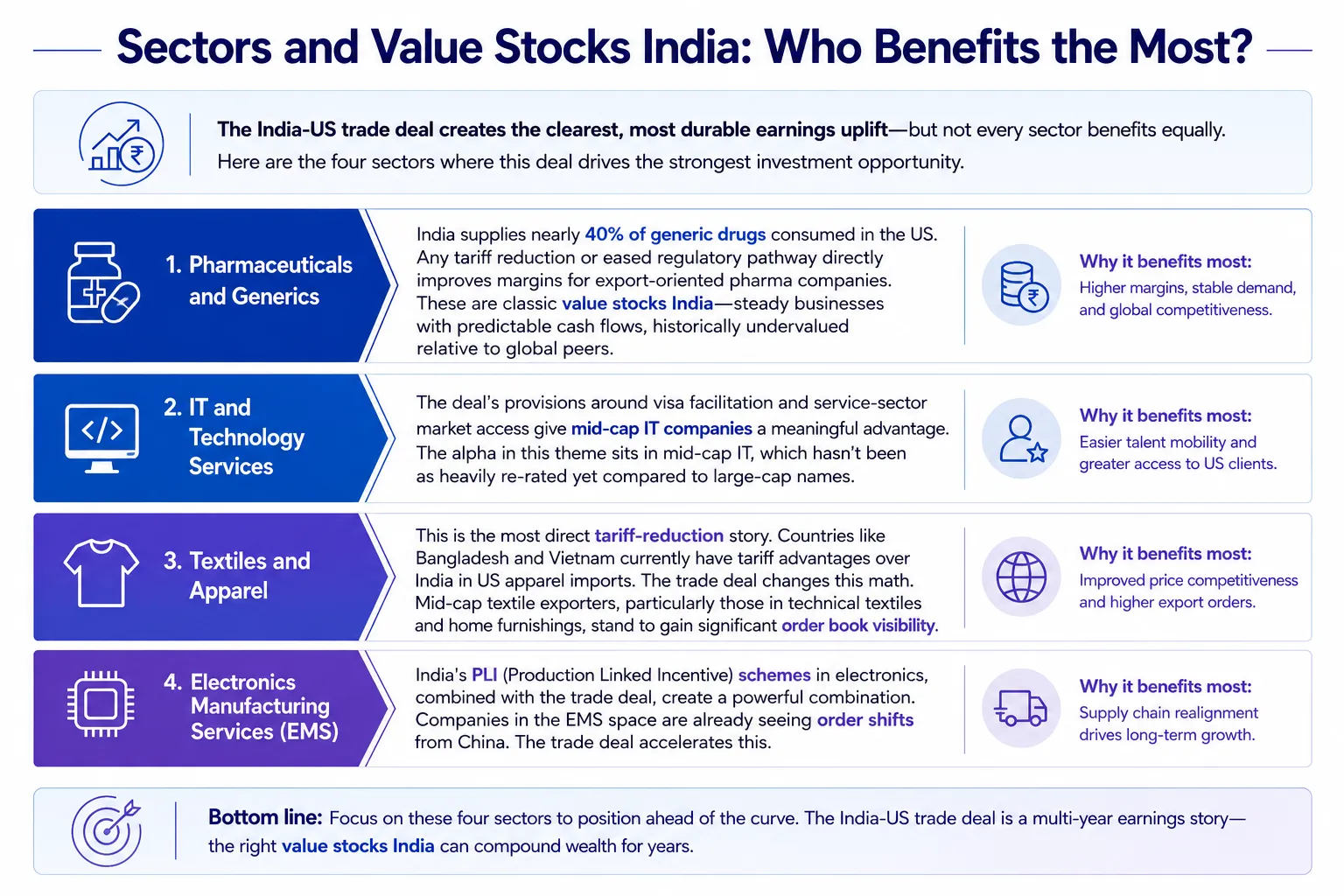
Here are the four sectors where India-US trade deal investment creates the clearest, most durable earnings uplift:
Pharmaceuticals and Generics India supplies nearly 40% of generic drugs consumed in the US. Any tariff reduction or eased regulatory pathway directly improves margins for export-oriented pharma companies. These are classic value stocks India, steady businesses with predictable cash flows, historically undervalued relative to global peers.
IT and Technology Services The deal's provisions around visa facilitation and service-sector market access give mid-cap IT companies a meaningful advantage. The alpha in this theme sits in mid-cap IT, which hasn't been as heavily re-rated yet compared to large-cap names.
Textiles and Apparel: This is the most direct tariff-reduction story. Countries like Bangladesh and Vietnam currently have tariff advantages over India in US apparel imports. The trade deal changes this math. Mid-cap textile exporters, particularly those in technical textiles and home furnishings, stand to gain significant order book visibility.
Electronics Manufacturing Services (EMS) India's PLI (Production Linked Incentive) schemes in electronics, combined with the trade deal, create a powerful combination. Companies in the EMS space are already seeing order shifts from China. The trade deal accelerates this.
Best Stocks to Buy in 2026 Tied to the Trade Deal
Identifying the best stocks to buy 2026 in this theme requires a systematic filter, not a tip sheet. The following table presents a framework for screening trade-deal beneficiaries using quantitative parameters:
Screening Parameter |
What to Look For |
US Revenue Exposure |
More than 30% of revenues from the US markets |
Earnings Growth Visibility |
Analyst upgrades post-deal announcement |
Valuation |
Trading at a discount to the 3-year average P/E (value stocks India filter) |
Balance Sheet |
Low debt, strong operating cash flow |
Management Track Record |
Consistent execution on export targets |
Using this framework, the sectors that produce the highest-quality candidates for the best stocks to buy 2026 are pharma generics, mid-cap IT, and EMS manufacturers. Within these, the specific names worth deep-diving into are those where the trade deal creates a non-consensus earnings revision, meaning the market hasn't fully repriced the business yet.
Wright Research's quant models systematically screen for exactly this kind of setup, businesses where the fundamental signal has changed but the price hasn't fully adjusted. This is the edge that systematic active investing and factor investing methodologies provide over simple theme-chasing.
The India US trade deal is the single biggest macro catalyst for India-US trade deal investment in 2026. It creates direct tailwinds for exporters, IT, pharma, and textiles the best stocks to buy 2026 and high-return mutual funds tied to these sectors. A sharp investment strategy using portfolio management services or active investing can help investors capture this opportunity systematically.
Why the India-US Trade Deal Is the Biggest Macro Event of 2026
Most Indian investors are sitting on a question they haven't fully answered yet: Is this trade deal already priced in, or is the real money still ahead?
It's a fair question. Markets moved on the initial news, export-linked stocks got a quick re-rating, and suddenly everyone has an opinion on the India-US trade deal investment. But opinions aren't investment strategies. What actually matters is understanding which businesses structurally benefit from lower tariffs and expanded market access, and then positioning your portfolio around those businesses before the broader consensus catches up.
The India-US trade deal, currently under active negotiation with bilateral trade targets set at $500 billion by 2030, is not a single news event. It's a multi-year earnings story. Getting your investment strategy right now, before every mutual fund manager and media commentator has already moved, is where real wealth-building happens.
Wright Research's data-driven approach has consistently identified structural macro shifts before they became crowded trades. This blog breaks down exactly where the opportunity sits, which sectors carry the most substance, and how to build a portfolio around it, whether you prefer the best mutual fund portfolio route or want the precision of portfolio management services.
What Does the India US Trade Deal Mean for Indian Markets and Stocks?
The India-US trade deal is a bilateral trade and tariff agreement between India and the United States aimed at reducing customs duties, easing non-tariff barriers, and expanding market access across key sectors including pharmaceuticals, IT services, textiles, electronics, and agriculture. For Indian markets, it translates into improved export competitiveness, higher earnings visibility for exporter companies, and increased FDI flows into India-linked supply chains.
The structural backdrop matters here. India is already the US's 9th largest trading partner. The deal, if fully executed, is expected to bring India's weighted average tariff on American goods down meaningfully, while the US offers reciprocal tariff reductions on Indian exports, particularly in pharma generics, IT-enabled services, and apparel.
From a market's perspective, what this triggers is a re-rating of earnings for companies with significant US revenue exposure. It also positions India as the preferred alternative to China in global supply chains, a narrative that has been building since 2020, and that this trade deal effectively cements.
What Changes |
Impact on Indian Markets |
Lower US tariffs on Indian pharma generics |
Margin expansion for export-focused pharma companies |
Easier IT services visa norms |
Revenue and headcount growth for mid-cap IT |
Textile and apparel access |
Earnings upgrade for garment exporters |
Electronics manufacturing preferences |
FDI inflows into India's semiconductor/EMS ecosystem |
Agriculture market access |
Selective opportunity in agri-exports |
Which Sectors and Value Stocks India Benefit Most From the Trade Deal?
Not every sector benefits equally, and this is where most investors go wrong. They buy a broad "India trade deal" basket without understanding which businesses actually see their unit economics improve.
Here are the four sectors where India-US trade deal investment creates the clearest, most durable earnings uplift:
Pharmaceuticals and Generics India supplies nearly 40% of generic drugs consumed in the US. Any tariff reduction or eased regulatory pathway directly improves margins for export-oriented pharma companies. These are classic value stocks India, steady businesses with predictable cash flows, historically undervalued relative to global peers.
IT and Technology Services The deal's provisions around visa facilitation and service-sector market access give mid-cap IT companies a meaningful advantage. The alpha in this theme sits in mid-cap IT, which hasn't been as heavily re-rated yet compared to large-cap names.
Textiles and Apparel: This is the most direct tariff-reduction story. Countries like Bangladesh and Vietnam currently have tariff advantages over India in US apparel imports. The trade deal changes this math. Mid-cap textile exporters, particularly those in technical textiles and home furnishings, stand to gain significant order book visibility.
Electronics Manufacturing Services (EMS) India's PLI (Production Linked Incentive) schemes in electronics, combined with the trade deal, create a powerful combination. Companies in the EMS space are already seeing order shifts from China. The trade deal accelerates this.
Best Stocks to Buy in 2026 Tied to the Trade Deal
Identifying the best stocks to buy 2026 in this theme requires a systematic filter, not a tip sheet. The following table presents a framework for screening trade-deal beneficiaries using quantitative parameters:
Screening Parameter |
What to Look For |
US Revenue Exposure |
More than 30% of revenues from the US markets |
Earnings Growth Visibility |
Analyst upgrades post-deal announcement |
Valuation |
Trading at a discount to the 3-year average P/E (value stocks India filter) |
Balance Sheet |
Low debt, strong operating cash flow |
Management Track Record |
Consistent execution on export targets |
Using this framework, the sectors that produce the highest-quality candidates for the best stocks to buy 2026 are pharma generics, mid-cap IT, and EMS manufacturers. Within these, the specific names worth deep-diving into are those where the trade deal creates a non-consensus earnings revision, meaning the market hasn't fully repriced the business yet.
Wright Research's quant models systematically screen for exactly this kind of setup, businesses where the fundamental signal has changed but the price hasn't fully adjusted. This is the edge that systematic active investing and factor investing methodologies provide over simple theme-chasing.
How to Build the Right Investment Strategy Around the India US Trade Deal
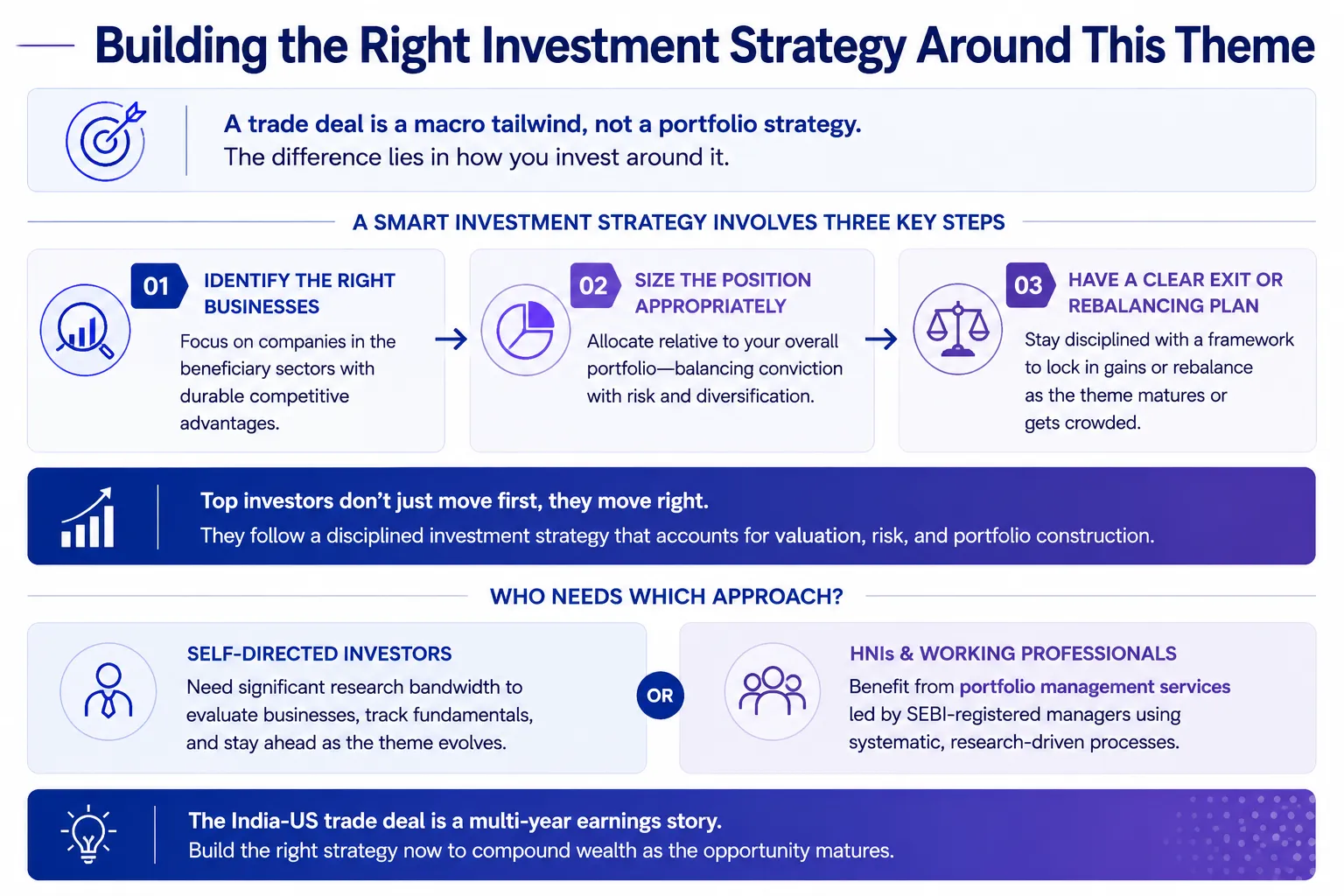
Here's what most investors miss: a trade deal is a macro tailwind, not a portfolio strategy. The difference matters enormously.
A smart investment strategy around the India-US trade deal doesn't mean buying everything in the mentioned sectors and hoping for the best. It means first identifying which companies in the beneficiary sectors have durable competitive advantages, not just short-term tariff arbitrage. Second, sizing the position appropriately relative to your overall portfolio. Third, having a clear exit or rebalancing framework when the theme matures or gets crowded.
The investors who make the most from macro events like this are not the ones who moved first. They're the ones who moved right, with a disciplined investment strategy that accounts for valuation, risk, and portfolio construction principles.
For a self-directed investor, this requires significant research bandwidth. For most HNIs and working professionals, this is precisely the use case for portfolio management services, where a SEBI-registered manager with systematic processes can run this research continuously and rebalance as the theme evolves.
Active Investing vs Factor Investing: Which Approach Wins Here?
Both active investing and factor investing can capture the India-US trade deal opportunity, but they do it differently.
Active investing in this context means a portfolio manager making concentrated, high-conviction bets on specific trade-deal beneficiaries. The upside is higher potential alpha if the calls are right. The risk is concentration and manager bias.
Factor investing is systematic. Wright Research's factor models, for example, would screen the entire market for companies with the right combination of momentum (recent earnings upgrades), quality (strong balance sheet), and value (trading below intrinsic value). A company that scores high on all three factors and happens to be a trade-deal beneficiary gets a position. This removes emotional bias from the trade, and historically, factor investing portfolios have delivered more consistent risk-adjusted returns than discretionary active bets.
Dimension |
Active Investing |
Factor Investing |
Decision basis |
Manager conviction |
Systematic data signals |
Bias risk |
High |
Low |
Scalability |
Limited |
High |
Rebalancing |
Discretionary |
Rule-based |
Track record consistency |
Variable |
More consistent |
Best suited for |
High-conviction themes |
All-weather portfolio |
For the India-US trade deal theme specifically, a combination approach works best, using factor investing screens to identify the highest-quality trade-deal beneficiaries, then applying active investing judgment to size positions based on deal progress and earnings momentum.
Best Mutual Fund Portfolio and High Return Mutual Funds for This Theme
If you prefer the mutual fund route, building the best mutual fund portfolio around the trade deal theme requires a clear view on which fund categories are most exposed to the right sectors.
Thematic / Sectoral Funds: Funds with explicit US-export themes, IT sector funds, and pharma funds are the most direct play. However, these carry higher concentration risk and should be sized as a satellite allocation, not the core of your portfolio.
Mid-cap Diversified Funds: Many of the highest-conviction trade-deal beneficiaries are mid-cap companies. Well-managed mid-cap funds with active stock-picking mandates will likely capture this theme as fund managers upgrade their holdings.
Flexicap / Multi-cap Funds: These offer a cleaner risk-adjusted exposure. A good flexicap fund manager can move across large, mid, and small cap as the theme develops, giving you the high return mutual funds potential without locking you into a single segment.
Fund Category |
Trade Deal Exposure |
Risk Level |
Suggested Allocation |
IT Sector Fund |
High (mid-cap IT) |
High |
10-15% satellite |
Pharma / Healthcare Fund |
High (generics exporters) |
High |
10-15% satellite |
Mid-cap Diversified |
Moderate-High |
Medium-High |
20-25% |
Flexicap / Multi-cap |
Moderate |
Medium |
Core 30-40% |
Large-cap Index |
Low-Moderate |
Low |
Base 15-20% |
The key insight: high return mutual funds in the current cycle will likely come from fund managers who identified trade-deal beneficiaries early and maintained their conviction through volatility. Chasing last year's returns, or rotating purely on AUM size, won't capture this theme effectively.
How Portfolio Management Services Can Help You Navigate This
For investors with Rs. 50 lakh and above looking to go beyond mutual funds, portfolio management services (PMS) offer a materially different level of precision.
Unlike a mutual fund, a PMS holds stocks directly in your demat account, which means you have full visibility into every position, entry price, and the rationale behind each holding. For a theme like the India-US trade deal, where the nuance of which companies benefit matters far more than just which sector benefits, this level of transparency is valuable.
Portfolio management services at Wright Research are built on quantitative models that systematically evaluate every listed stock across multiple quality, value, and momentum parameters. When the India US trade deal investment thesis creates an earnings catalyst in a specific company, say, a mid-cap pharma company with a strong US generic pipeline, the model identifies it before it becomes consensus, builds a position at the right price, and continues to monitor the thesis.
This is the key difference between systematic portfolio management services and discretionary approaches: the process doesn't depend on any one analyst's judgment or a fund manager's mood on any given day. It's data-driven, repeatable, and auditable.
Frequently Asked Questions
Q1. How should I approach India-US trade deal investment in 2026?
Focus on sectors with the clearest tariff and market-access benefits: pharma generics, mid-cap IT, and EMS manufacturers. Use either a diversified mid-cap fund or a systematic portfolio management services provider to build exposure. Avoid concentrated bets on individual stocks without a clear fundamental thesis and exit strategy.
Q2. What are the best stocks to buy 2026 linked to the India-US trade deal?
The best stocks to buy 2026 in this theme include companies with more than 30% US revenue exposure, recent analyst earnings upgrades, and valuations below their 3-year average. Mid-cap pharma exporters, IT services companies, and EMS manufacturers are the most compelling. A factor investing screen helps identify the highest-quality names within these categories.
Q3. How is factor investing useful in a trade deal theme?
Factor investing applies quantitative filters, momentum, quality, value, to identify the best trade-deal beneficiaries systematically. Unlike discretionary active investing, it removes emotional bias and ensures positions are sized based on data signals. Wright Research's factor models are specifically designed to capture these kinds of structural earnings upgrades.
Q4. Are high return mutual funds available for this specific theme?
Yes. Pharma funds, IT sector funds, and well-managed mid-cap diversified funds offer exposure to trade-deal beneficiaries. However, high return mutual funds in sectoral categories carry higher concentration risk. A flexicap or multi-cap fund that actively rotates into beneficiary sectors offers a more balanced approach to capturing this theme.
Q5. What is the minimum investment for portfolio management services at Wright Research?
SEBI mandates a minimum investment of Rs. 50 lakh for portfolio management services in India. PMS is designed for HNI investors who want direct equity exposure with professional, systematic management, including full transparency on holdings, rationale, and performance attribution.
Q6. How does the India-US trade deal affect value stocks india specifically?
The trade deal improves earnings visibility for export-oriented businesses that were previously undervalued due to tariff uncertainty. Value stocks india in sectors like pharma generics and textiles, businesses trading at discounts to their intrinsic value, often re-rate significantly once a structural earnings catalyst like this deal reduces their risk profile and improves margin visibility.
Get research like this in your inbox
The week’s research that mattered, in five minutes. Joined by 2L+ investors.
How to Build the Right Investment Strategy Around the India US Trade Deal
Here's what most investors miss: a trade deal is a macro tailwind, not a portfolio strategy. The difference matters enormously.
A smart investment strategy around the India-US trade deal doesn't mean buying everything in the mentioned sectors and hoping for the best. It means first identifying which companies in the beneficiary sectors have durable competitive advantages, not just short-term tariff arbitrage. Second, sizing the position appropriately relative to your overall portfolio. Third, having a clear exit or rebalancing framework when the theme matures or gets crowded.
The investors who make the most from macro events like this are not the ones who moved first. They're the ones who moved right, with a disciplined investment strategy that accounts for valuation, risk, and portfolio construction principles.
For a self-directed investor, this requires significant research bandwidth. For most HNIs and working professionals, this is precisely the use case for portfolio management services , where a SEBI-registered manager with systematic processes can run this research continuously and rebalance as the theme evolves.
Active Investing vs Factor Investing: Which Approach Wins Here?
Both active investing and factor investing can capture the India-US trade deal opportunity, but they do it differently.
Active investing in this context means a portfolio manager making concentrated, high-conviction bets on specific trade-deal beneficiaries. The upside is higher potential alpha if the calls are right. The risk is concentration and manager bias.
Factor investing is systematic. Wright Research's factor models, for example, would screen the entire market for companies with the right combination of momentum (recent earnings upgrades), quality (strong balance sheet), and value (trading below intrinsic value). A company that scores high on all three factors and happens to be a trade-deal beneficiary gets a position. This removes emotional bias from the trade, and historically, factor investing portfolios have delivered more consistent risk-adjusted returns than discretionary active bets.
Dimension |
Active Investing |
Factor Investing |
Decision basis |
Manager conviction |
Systematic data signals |
Bias risk |
High |
Low |
Scalability |
Limited |
High |
Rebalancing |
Discretionary |
Rule-based |
Track record consistency |
Variable |
More consistent |
Best suited for |
High-conviction themes |
All-weather portfolio |
For the India-US trade deal theme specifically, a combination approach works best, using factor investing screens to identify the highest-quality trade-deal beneficiaries, then applying active investing judgment to size positions based on deal progress and earnings momentum.
Best Mutual Fund Portfolio and High Return Mutual Funds for This Theme
If you prefer the mutual fund route, building the best mutual fund portfolio around the trade deal theme requires a clear view on which fund categories are most exposed to the right sectors.
Thematic / Sectoral Funds: Funds with explicit US-export themes, IT sector funds, and pharma funds are the most direct play. However, these carry higher concentration risk and should be sized as a satellite allocation, not the core of your portfolio.
Mid-cap Diversified Funds: Many of the highest-conviction trade-deal beneficiaries are mid-cap companies. Well-managed mid-cap funds with active stock-picking mandates will likely capture this theme as fund managers upgrade their holdings.
Flexicap / Multi-cap Funds: These offer a cleaner risk-adjusted exposure. A good flexicap fund manager can move across large, mid, and small cap as the theme develops, giving you the high return mutual funds potential without locking you into a single segment.
Fund Category |
Trade Deal Exposure |
Risk Level |
Suggested Allocation |
IT Sector Fund |
High (mid-cap IT) |
High |
10-15% satellite |
Pharma / Healthcare Fund |
High (generics exporters) |
High |
10-15% satellite |
Mid-cap Diversified |
Moderate-High |
Medium-High |
20-25% |
Flexicap / Multi-cap |
Moderate |
Medium |
Core 30-40% |
Large-cap Index |
Low-Moderate |
Low |
Base 15-20% |
The key insight: high return mutual funds in the current cycle will likely come from fund managers who identified trade-deal beneficiaries early and maintained their conviction through volatility. Chasing last year's returns, or rotating purely on AUM size, won't capture this theme effectively.
How Portfolio Management Services Can Help You Navigate This
For investors with Rs. 50 lakh and above looking to go beyond mutual funds, portfolio management services (PMS) offer a materially different level of precision.
Unlike a mutual fund, a PMS holds stocks directly in your demat account, which means you have full visibility into every position, entry price, and the rationale behind each holding. For a theme like the India-US trade deal, where the nuance of which companies benefit matters far more than just which sector benefits, this level of transparency is valuable.
Portfolio management services at Wright Research are built on quantitative models that systematically evaluate every listed stock across multiple quality, value, and momentum parameters. When the India US trade deal investment thesis creates an earnings catalyst in a specific company, say, a mid-cap pharma company with a strong US generic pipeline, the model identifies it before it becomes consensus, builds a position at the right price, and continues to monitor the thesis.
This is the key difference between systematic portfolio management services and discretionary approaches: the process doesn't depend on any one analyst's judgment or a fund manager's mood on any given day. It's data-driven, repeatable, and auditable.
The India US trade deal is the single biggest macro catalyst for India-US trade deal investment in 2026. It creates direct tailwinds for exporters, IT, pharma, and textiles the best stocks to buy 2026 and high-return mutual funds tied to these sectors. A sharp investment strategy using portfolio management services or active investing can help investors capture this opportunity systematically.
Why the India-US Trade Deal Is the Biggest Macro Event of 2026
Most Indian investors are sitting on a question they haven't fully answered yet: Is this trade deal already priced in, or is the real money still ahead?
It's a fair question. Markets moved on the initial news, export-linked stocks got a quick re-rating, and suddenly everyone has an opinion on the India-US trade deal investment. But opinions aren't investment strategies. What actually matters is understanding which businesses structurally benefit from lower tariffs and expanded market access, and then positioning your portfolio around those businesses before the broader consensus catches up.
The India-US trade deal, currently under active negotiation with bilateral trade targets set at $500 billion by 2030, is not a single news event. It's a multi-year earnings story. Getting your investment strategy right now, before every mutual fund manager and media commentator has already moved, is where real wealth-building happens.
Wright Research's data-driven approach has consistently identified structural macro shifts before they became crowded trades. This blog breaks down exactly where the opportunity sits, which sectors carry the most substance, and how to build a portfolio around it, whether you prefer the best mutual fund portfolio route or want the precision of portfolio management services.
What Does the India US Trade Deal Mean for Indian Markets and Stocks?
The India-US trade deal is a bilateral trade and tariff agreement between India and the United States aimed at reducing customs duties, easing non-tariff barriers, and expanding market access across key sectors including pharmaceuticals, IT services, textiles, electronics, and agriculture. For Indian markets, it translates into improved export competitiveness, higher earnings visibility for exporter companies, and increased FDI flows into India-linked supply chains.
The structural backdrop matters here. India is already the US's 9th largest trading partner. The deal, if fully executed, is expected to bring India's weighted average tariff on American goods down meaningfully, while the US offers reciprocal tariff reductions on Indian exports, particularly in pharma generics, IT-enabled services, and apparel.
From a market's perspective, what this triggers is a re-rating of earnings for companies with significant US revenue exposure. It also positions India as the preferred alternative to China in global supply chains, a narrative that has been building since 2020, and that this trade deal effectively cements.
What Changes |
Impact on Indian Markets |
Lower US tariffs on Indian pharma generics |
Margin expansion for export-focused pharma companies |
Easier IT services visa norms |
Revenue and headcount growth for mid-cap IT |
Textile and apparel access |
Earnings upgrade for garment exporters |
Electronics manufacturing preferences |
FDI inflows into India's semiconductor/EMS ecosystem |
Agriculture market access |
Selective opportunity in agri-exports |
Which Sectors and Value Stocks India Benefit Most From the Trade Deal?
Not every sector benefits equally, and this is where most investors go wrong. They buy a broad "India trade deal" basket without understanding which businesses actually see their unit economics improve.
Here are the four sectors where India-US trade deal investment creates the clearest, most durable earnings uplift:
Pharmaceuticals and Generics India supplies nearly 40% of generic drugs consumed in the US. Any tariff reduction or eased regulatory pathway directly improves margins for export-oriented pharma companies. These are classic value stocks India, steady businesses with predictable cash flows, historically undervalued relative to global peers.
IT and Technology Services The deal's provisions around visa facilitation and service-sector market access give mid-cap IT companies a meaningful advantage. The alpha in this theme sits in mid-cap IT, which hasn't been as heavily re-rated yet compared to large-cap names.
Textiles and Apparel: This is the most direct tariff-reduction story. Countries like Bangladesh and Vietnam currently have tariff advantages over India in US apparel imports. The trade deal changes this math. Mid-cap textile exporters, particularly those in technical textiles and home furnishings, stand to gain significant order book visibility.
Electronics Manufacturing Services (EMS) India's PLI (Production Linked Incentive) schemes in electronics, combined with the trade deal, create a powerful combination. Companies in the EMS space are already seeing order shifts from China. The trade deal accelerates this.
Best Stocks to Buy in 2026 Tied to the Trade Deal
Identifying the best stocks to buy 2026 in this theme requires a systematic filter, not a tip sheet. The following table presents a framework for screening trade-deal beneficiaries using quantitative parameters:
Screening Parameter |
What to Look For |
US Revenue Exposure |
More than 30% of revenues from the US markets |
Earnings Growth Visibility |
Analyst upgrades post-deal announcement |
Valuation |
Trading at a discount to the 3-year average P/E (value stocks India filter) |
Balance Sheet |
Low debt, strong operating cash flow |
Management Track Record |
Consistent execution on export targets |
Using this framework, the sectors that produce the highest-quality candidates for the best stocks to buy 2026 are pharma generics, mid-cap IT, and EMS manufacturers. Within these, the specific names worth deep-diving into are those where the trade deal creates a non-consensus earnings revision, meaning the market hasn't fully repriced the business yet.
Wright Research's quant models systematically screen for exactly this kind of setup, businesses where the fundamental signal has changed but the price hasn't fully adjusted. This is the edge that systematic active investing and factor investing methodologies provide over simple theme-chasing.
How to Build the Right Investment Strategy Around the India US Trade Deal
Here's what most investors miss: a trade deal is a macro tailwind, not a portfolio strategy. The difference matters enormously.
A smart investment strategy around the India-US trade deal doesn't mean buying everything in the mentioned sectors and hoping for the best. It means first identifying which companies in the beneficiary sectors have durable competitive advantages, not just short-term tariff arbitrage. Second, sizing the position appropriately relative to your overall portfolio. Third, having a clear exit or rebalancing framework when the theme matures or gets crowded.
The investors who make the most from macro events like this are not the ones who moved first. They're the ones who moved right, with a disciplined investment strategy that accounts for valuation, risk, and portfolio construction principles.
For a self-directed investor, this requires significant research bandwidth. For most HNIs and working professionals, this is precisely the use case for portfolio management services, where a SEBI-registered manager with systematic processes can run this research continuously and rebalance as the theme evolves.
Active Investing vs Factor Investing: Which Approach Wins Here?
Both active investing and factor investing can capture the India-US trade deal opportunity, but they do it differently.
Active investing in this context means a portfolio manager making concentrated, high-conviction bets on specific trade-deal beneficiaries. The upside is higher potential alpha if the calls are right. The risk is concentration and manager bias.
Factor investing is systematic. Wright Research's factor models, for example, would screen the entire market for companies with the right combination of momentum (recent earnings upgrades), quality (strong balance sheet), and value (trading below intrinsic value). A company that scores high on all three factors and happens to be a trade-deal beneficiary gets a position. This removes emotional bias from the trade, and historically, factor investing portfolios have delivered more consistent risk-adjusted returns than discretionary active bets.
Dimension |
Active Investing |
Factor Investing |
Decision basis |
Manager conviction |
Systematic data signals |
Bias risk |
High |
Low |
Scalability |
Limited |
High |
Rebalancing |
Discretionary |
Rule-based |
Track record consistency |
Variable |
More consistent |
Best suited for |
High-conviction themes |
All-weather portfolio |
For the India-US trade deal theme specifically, a combination approach works best, using factor investing screens to identify the highest-quality trade-deal beneficiaries, then applying active investing judgment to size positions based on deal progress and earnings momentum.
Best Mutual Fund Portfolio and High Return Mutual Funds for This Theme
If you prefer the mutual fund route, building the best mutual fund portfolio around the trade deal theme requires a clear view on which fund categories are most exposed to the right sectors.
Thematic / Sectoral Funds: Funds with explicit US-export themes, IT sector funds, and pharma funds are the most direct play. However, these carry higher concentration risk and should be sized as a satellite allocation, not the core of your portfolio.
Mid-cap Diversified Funds: Many of the highest-conviction trade-deal beneficiaries are mid-cap companies. Well-managed mid-cap funds with active stock-picking mandates will likely capture this theme as fund managers upgrade their holdings.
Flexicap / Multi-cap Funds: These offer a cleaner risk-adjusted exposure. A good flexicap fund manager can move across large, mid, and small cap as the theme develops, giving you the high return mutual funds potential without locking you into a single segment.
Fund Category |
Trade Deal Exposure |
Risk Level |
Suggested Allocation |
IT Sector Fund |
High (mid-cap IT) |
High |
10-15% satellite |
Pharma / Healthcare Fund |
High (generics exporters) |
High |
10-15% satellite |
Mid-cap Diversified |
Moderate-High |
Medium-High |
20-25% |
Flexicap / Multi-cap |
Moderate |
Medium |
Core 30-40% |
Large-cap Index |
Low-Moderate |
Low |
Base 15-20% |
The key insight: high return mutual funds in the current cycle will likely come from fund managers who identified trade-deal beneficiaries early and maintained their conviction through volatility. Chasing last year's returns, or rotating purely on AUM size, won't capture this theme effectively.
How Portfolio Management Services Can Help You Navigate This
For investors with Rs. 50 lakh and above looking to go beyond mutual funds, portfolio management services (PMS) offer a materially different level of precision.
Unlike a mutual fund, a PMS holds stocks directly in your demat account, which means you have full visibility into every position, entry price, and the rationale behind each holding. For a theme like the India-US trade deal, where the nuance of which companies benefit matters far more than just which sector benefits, this level of transparency is valuable.
Portfolio management services at Wright Research are built on quantitative models that systematically evaluate every listed stock across multiple quality, value, and momentum parameters. When the India US trade deal investment thesis creates an earnings catalyst in a specific company, say, a mid-cap pharma company with a strong US generic pipeline, the model identifies it before it becomes consensus, builds a position at the right price, and continues to monitor the thesis.
This is the key difference between systematic portfolio management services and discretionary approaches: the process doesn't depend on any one analyst's judgment or a fund manager's mood on any given day. It's data-driven, repeatable, and auditable.
Frequently Asked Questions
Q1. How should I approach India-US trade deal investment in 2026?
Focus on sectors with the clearest tariff and market-access benefits: pharma generics, mid-cap IT, and EMS manufacturers. Use either a diversified mid-cap fund or a systematic portfolio management services provider to build exposure. Avoid concentrated bets on individual stocks without a clear fundamental thesis and exit strategy.
Q2. What are the best stocks to buy 2026 linked to the India-US trade deal?
The best stocks to buy 2026 in this theme include companies with more than 30% US revenue exposure, recent analyst earnings upgrades, and valuations below their 3-year average. Mid-cap pharma exporters, IT services companies, and EMS manufacturers are the most compelling. A factor investing screen helps identify the highest-quality names within these categories.
Q3. How is factor investing useful in a trade deal theme?
Factor investing applies quantitative filters, momentum, quality, value, to identify the best trade-deal beneficiaries systematically. Unlike discretionary active investing, it removes emotional bias and ensures positions are sized based on data signals. Wright Research's factor models are specifically designed to capture these kinds of structural earnings upgrades.
Q4. Are high return mutual funds available for this specific theme?
Yes. Pharma funds, IT sector funds, and well-managed mid-cap diversified funds offer exposure to trade-deal beneficiaries. However, high return mutual funds in sectoral categories carry higher concentration risk. A flexicap or multi-cap fund that actively rotates into beneficiary sectors offers a more balanced approach to capturing this theme.
Q5. What is the minimum investment for portfolio management services at Wright Research?
SEBI mandates a minimum investment of Rs. 50 lakh for portfolio management services in India. PMS is designed for HNI investors who want direct equity exposure with professional, systematic management, including full transparency on holdings, rationale, and performance attribution.
Q6. How does the India-US trade deal affect value stocks india specifically?
The trade deal improves earnings visibility for export-oriented businesses that were previously undervalued due to tariff uncertainty. Value stocks india in sectors like pharma generics and textiles, businesses trading at discounts to their intrinsic value, often re-rate significantly once a structural earnings catalyst like this deal reduces their risk profile and improves margin visibility.
Is your portfolio built for what’s coming?
Get a free AI-powered review of your holdings — risk, overlap and quality in minutes.
Frequently Asked Questions
Q1. How should I approach India-US trade deal investment in 2026?
Focus on sectors with the clearest tariff and market-access benefits: pharma generics, mid-cap IT, and EMS manufacturers. Use either a diversified mid-cap fund or a systematic portfolio management services provider to build exposure. Avoid concentrated bets on individual stocks without a clear fundamental thesis and exit strategy.
Q2. What are the best stocks to buy 2026 linked to the India-US trade deal?
The best stocks to buy 2026 in this theme include companies with more than 30% US revenue exposure, recent analyst earnings upgrades, and valuations below their 3-year average. Mid-cap pharma exporters, IT services companies, and EMS manufacturers are the most compelling. A factor investing screen helps identify the highest-quality names within these categories.
Q3. How is factor investing useful in a trade deal theme?
Factor investing applies quantitative filters, momentum, quality, value, to identify the best trade-deal beneficiaries systematically. Unlike discretionary active investing, it removes emotional bias and ensures positions are sized based on data signals. Wright Research's factor models are specifically designed to capture these kinds of structural earnings upgrades.
Q4. Are high return mutual funds available for this specific theme?
Yes. Pharma funds, IT sector funds, and well-managed mid-cap diversified funds offer exposure to trade-deal beneficiaries. However, high return mutual funds in sectoral categories carry higher concentration risk. A flexicap or multi-cap fund that actively rotates into beneficiary sectors offers a more balanced approach to capturing this theme.
Q5. What is the minimum investment for portfolio management services at Wright Research?
SEBI mandates a minimum investment of Rs. 50 lakh for portfolio management services in India. PMS is designed for HNI investors who want direct equity exposure with professional, systematic management, including full transparency on holdings, rationale, and performance attribution.
Q6. How does the India-US trade deal affect value stocks india specifically?
The trade deal improves earnings visibility for export-oriented businesses that were previously undervalued due to tariff uncertainty. Value stocks india in sectors like pharma generics and textiles, businesses trading at discounts to their intrinsic value, often re-rate significantly once a structural earnings catalyst like this deal reduces their risk profile and improves margin visibility.