


Quick Answer:
Index funds consistently outperform the majority of active mutual funds in large-cap categories, with ~75–80% of active funds failing to beat the Nifty 50 TRI over 10 years. For Indian investors, index funds offer the best combination of low cost (0.10–0.30%), tax efficiency, and predictable returns. ETFs are slightly cheaper on expense ratios but add brokerage and spread costs. For most SIP investors, index funds are the better practical choice over both ETFs and high-return mutual funds.
Run the numbers on your next investment
Project returns on a lumpsum or SIP with our free calculators.
Introduction
Most Indian investors stepping into equity markets with a long-term mindset eventually hit the same confusing crossroads. You want diversification, you’ve heard passive investing works, and you open an app only to see ETFs, mutual funds, and index funds all tracking similar benchmarks but looking completely different. It’s no surprise that even experienced investors struggle to decide what truly belongs in their mutual fund portfolio.
The reality is, while high-return mutual funds promise to beat the market, data show that low-cost index funds often deliver more consistent outcomes over time. This is why more investors today are choosing to invest in index funds instead of relying purely on active strategies. But even within index funds, the presence of ETFs adds another layer of complexity.
This guide cuts through the noise. We’ll break down how each structure works, what the real cost differences are, and what Indian market data actually reveals about performance. If you’ve been unsure whether to stick with high-return mutual funds, build a smarter mutual fund portfolio, or simply invest in index funds for long-term stability, this will help you make a clear, confident decision.
What Are Index Funds, Mutual Funds, and ETFs? Definitions for Indian Investors
Let’s start simple.
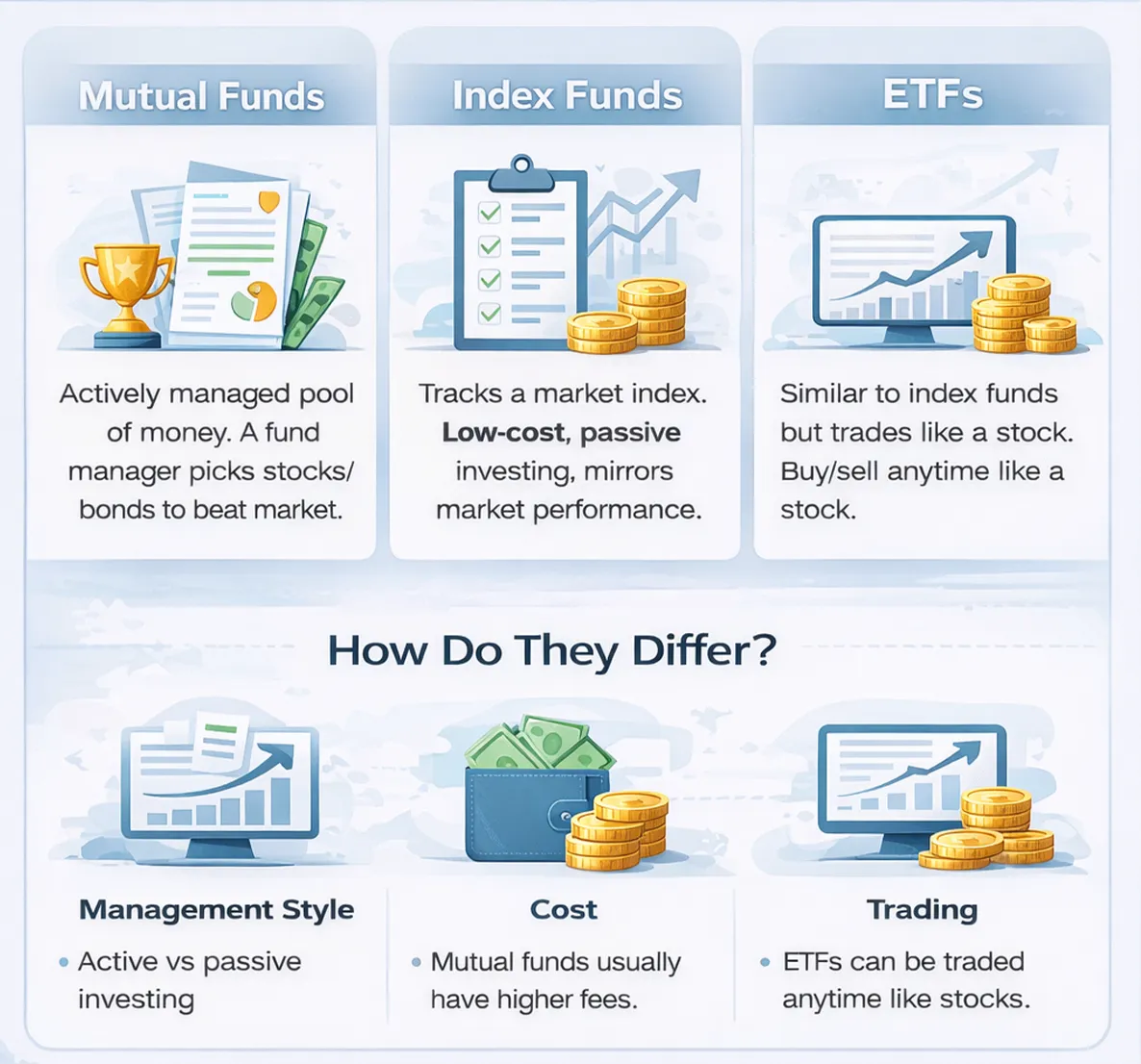
A mutual fund is a professionally managed pool of money where a fund manager actively selects stocks or bonds to generate returns. These can include high-return mutual funds that aim to outperform the market using research and active decisions.
Index funds are a subset of mutual funds. Instead of trying to beat the market, they simply replicate a market index like the Nifty 50. This makes index funds low-cost and predictable. For beginners, index funds for beginners are often the safest entry point into equity investing.
ETFs (Exchange-Traded Funds) are similar to index funds but trade like stocks on the stock exchange. You can buy and sell them anytime during market hours.
If you’re looking to invest in index funds, you’re essentially choosing a passive strategy, one that mirrors the market rather than trying to outsmart it.
 Also Read: Battery Energy Storage Systems: India’s Missing Power Link
How Each Structure Works: Ownership, Trading & Management?
Understanding the mechanics of each structure matters because it shapes your experience as an investor, how you buy, how you sell, and what happens to your money in between.
When you invest in an active mutual fund, your money is pooled with other investors' capital and managed by a fund manager whose mandate is to generate returns above a benchmark. The fund publishes its NAV once a day, after market close. You can invest through a platform or directly with the AMC, no demat account needed, with SIPs starting as low as ₹100 per month.
These are typically positioned as high-return mutual funds and often form the core of an actively managed mutual fund portfolio . Index funds work mechanically rather than through human judgment. The portfolio rebalances automatically whenever the underlying benchmark changes its constituents or their weights. Because there is no research team to pay and trading is minimal, operating costs are far lower.
The investment process is identical to a regular mutual fund: no demat account required, SIP available, units allotted at end-of-day NAV. This simplicity is exactly why many investors prefer to invest in index funds , especially when building a long-term mutual fund portfolio.
ETFs are structured differently. The AMC creates ETF units in large blocks by purchasing the underlying index basket and listing those units on an exchange. Retail investors buy these listed units through a broker at live prices during trading hours. ETF pricing is continuous throughout the day, and you need both a demat account and a trading account to hold them.
Like index funds, ETFs follow a passive strategy, but with more flexibility in execution for investors who actively manage their mutual fund portfolio.
Structure Comparison Table
Feature | Active Mutual Fund | Index Fund | ETF |
Management Style | Active — fund manager picks stocks | Passive — tracks index automatically | Passive — tracks index automatically |
How You Buy | AMC or platform; no demat required | AMC or platform; no demat required | Stock exchange via broker; demat required |
Pricing | End-of-day NAV | End-of-day NAV | Real-time market price during trading hours |
SIP Available | Yes | Yes | Yes, via broker (brokerage applies per instalment) |
Minimum Investment | ₹100–₹500 | ₹100–₹500 | 1 unit (typically ₹50–₹300 for large-cap ETFs) |
Typical Direct Expense Ratio | 0.50%–1.80% | 0.10%–0.30% | 0.05%–0.20% |
Also Read: What History Tells Us About Indian Stock Market Corrections?
Cost Comparison: Expense Ratios, Exit Loads & Hidden Charges in Index Funds vs ETFs vs Mutual Funds
Cost is where the real long-term difference between these structures emerges. Even a small difference in fees can significantly impact your final returns over time.
1. Expense Ratios: The Visible Cost Gap
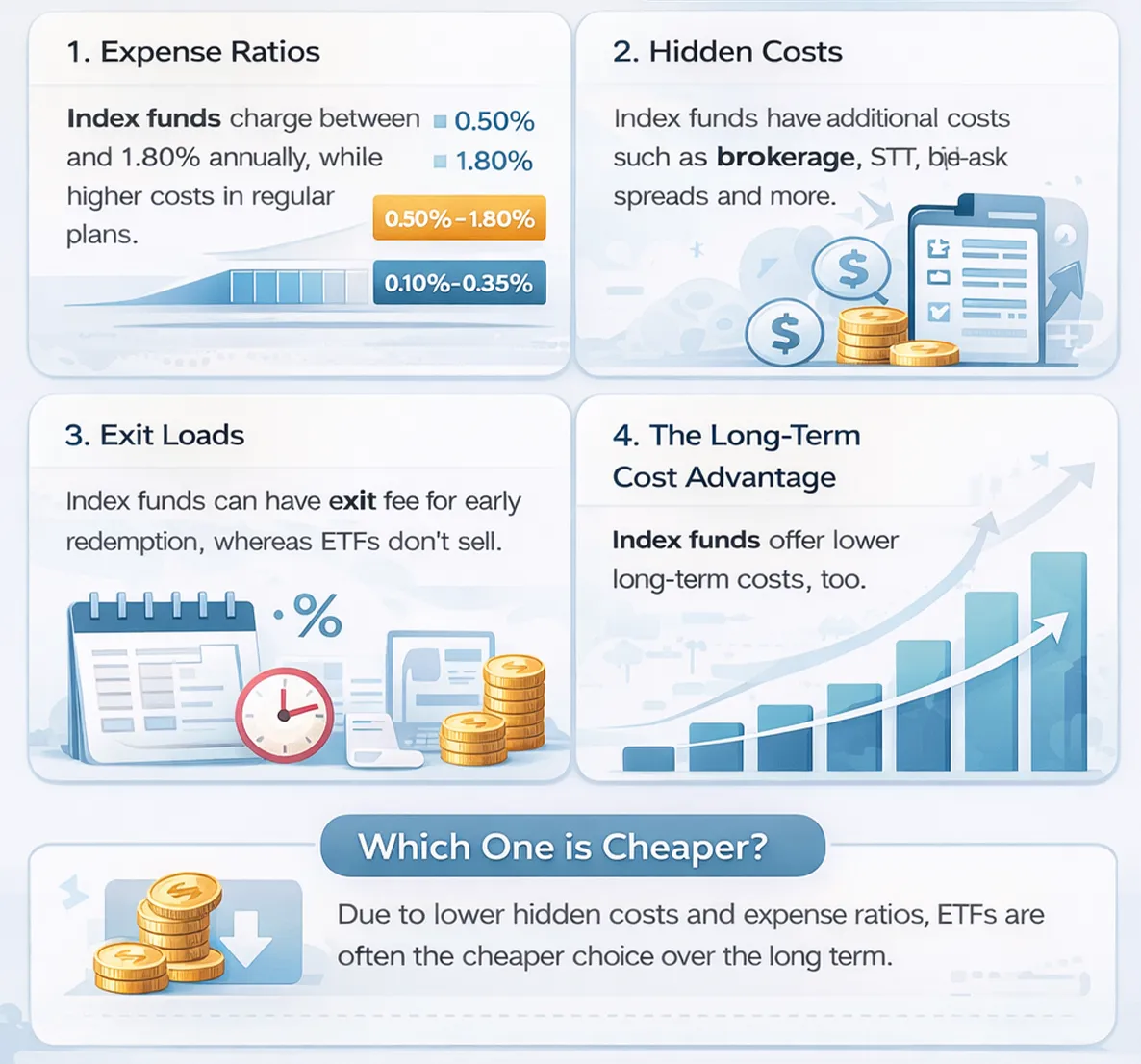
Active mutual funds typically charge between 0.50% and 1.80% annually on direct plans, with higher costs in regular plans. These charges are deducted from NAV daily, quietly reducing returns.
In contrast, popular index funds are far more cost-efficient. A large-cap index fund or Multi-cap index fund tracking broader benchmarks usually falls between 0.10% and 0.35%, while a small-cap index fund may go slightly higher but remains relatively low. ETFs often have the lowest expense ratios on paper.
2. Hidden Costs in ETFs
While ETFs look cheaper, they come with additional costs. Every transaction includes brokerage, STT, and bid-ask spreads. For less liquid funds, these spreads can add up.
For investors building a mutual fund portfolio through SIPs, these repeated costs can outweigh the lower expense ratio advantage of ETFs over time.
3. Exit Loads and Transaction Costs
Most index funds have minimal or no exit load after a short holding period. Active funds may charge up to 1% if redeemed early. ETFs don’t have exit loads, but every sale incurs brokerage and taxes.
4. The Long-Term Cost Advantage
If you consistently invest in index funds, especially through SIPs, the lower and predictable cost structure often leads to better long-term outcomes. This is why many investors prefer to buy index funds instead of relying heavily on higher-cost active strategies like high-return mutual funds.
Returns Comparison: Which Has Actually Delivered More Over 5 and 10 Years?
This is what most investors really care about: actual returns. And in India, the data tells a clear story: where you invest matters more than what structure you pick.
1. Large-Cap: Passive Has the Edge
In the large-cap space, index funds have consistently outperformed most active funds. Over the past decade, nearly 75%–80% of active large-cap funds have failed to beat the Nifty 50 TRI, which delivered ~13%–14% CAGR.
The reason is simple—large-cap stocks are heavily researched and efficiently priced. This makes it difficult for even high-return mutual funds to consistently generate alpha after costs. That’s why many investors now prefer to invest in index funds like a large-cap index fund for stable, market-matching returns.
2. Mid & Small Cap: Active Still Has a Case
In mid and small caps, inefficiencies still exist. Skilled fund managers can outperform here, which is why some high-return mutual funds have delivered strong returns.
However, the best small-cap index funds have also generated impressive performance around 16%–19% CAGR in recent 5-year periods. The advantage? Predictability, lower costs, and no manager risk. A small-cap index fund ensures you capture the full market upside without worrying about picking the wrong fund.
3. Index Funds vs ETFs: Is There a Real Difference?
When tracking the same benchmark, index funds and ETFs deliver very similar returns. The difference is usually within 0.10%–0.30% annually.
However, ETFs can sometimes show higher tracking error due to liquidity issues, especially in niche categories like Multi-cap index funds or less liquid global exposures. For most retail investors, this makes traditional index funds a more reliable choice.
4. Global Exposure: Diversification Beyond India
For international diversification, a global index fund or an international index fund tracking indices like the S&P 500 has delivered ~15%–18% CAGR (INR-adjusted) over the recent 5-year periods.
Many investors are now exploring the best global index funds to diversify their mutual fund portfolios and reduce dependence on the Indian market.
Performance Snapshot
Category | Benchmark Returns (Approx.) | Active Funds | Passive Funds | Key Insight |
Large-Cap | Nifty 50 TRI: ~13%–14% (10Y) | ~12%–13% | ~13%–14% | The majority of active funds underperform |
Mid-Cap | Nifty Midcap 150 TRI: ~16%–18% (10Y) | ~16%–18%+ | ~15%–17% | Some alpha is possible, but inconsistent |
Small-Cap | Nifty Smallcap 250 TRI: ~16%–19% (5Y) | ~17%–21%* | ~16%–18% | High risk, high variance |
Global / International | S&P 500 (INR): ~15%–18% (5Y) | N/A | ~15%–18% | Currency + global growth advantage |
If your goal is consistency, low cost, and long-term compounding, the data strongly support choosing index funds. While high-return mutual funds may outperform in certain pockets like small caps, they come with higher risk and selection complexity.
For most investors, the smarter strategy is simple: invest in index funds, combine a large-cap index fund with selective exposure to the best small-cap index funds and even a global index fund, and build a well-diversified mutual fund portfolio that compounds steadily over time.
Also Read: Fall of the Petrodollar and the Rise of the PetroYuan
Get research like this in your inbox
The week’s research that mattered, in five minutes. Joined by 2L+ investors.
Liquidity & Flexibility: When Can You Buy, Sell & Switch Index Funds, Mutual Funds, and ETFs?
Liquidity is often overlooked, but it directly impacts how efficiently you can manage your investments.
1. Mutual Funds: Simple, But Not Real-Time
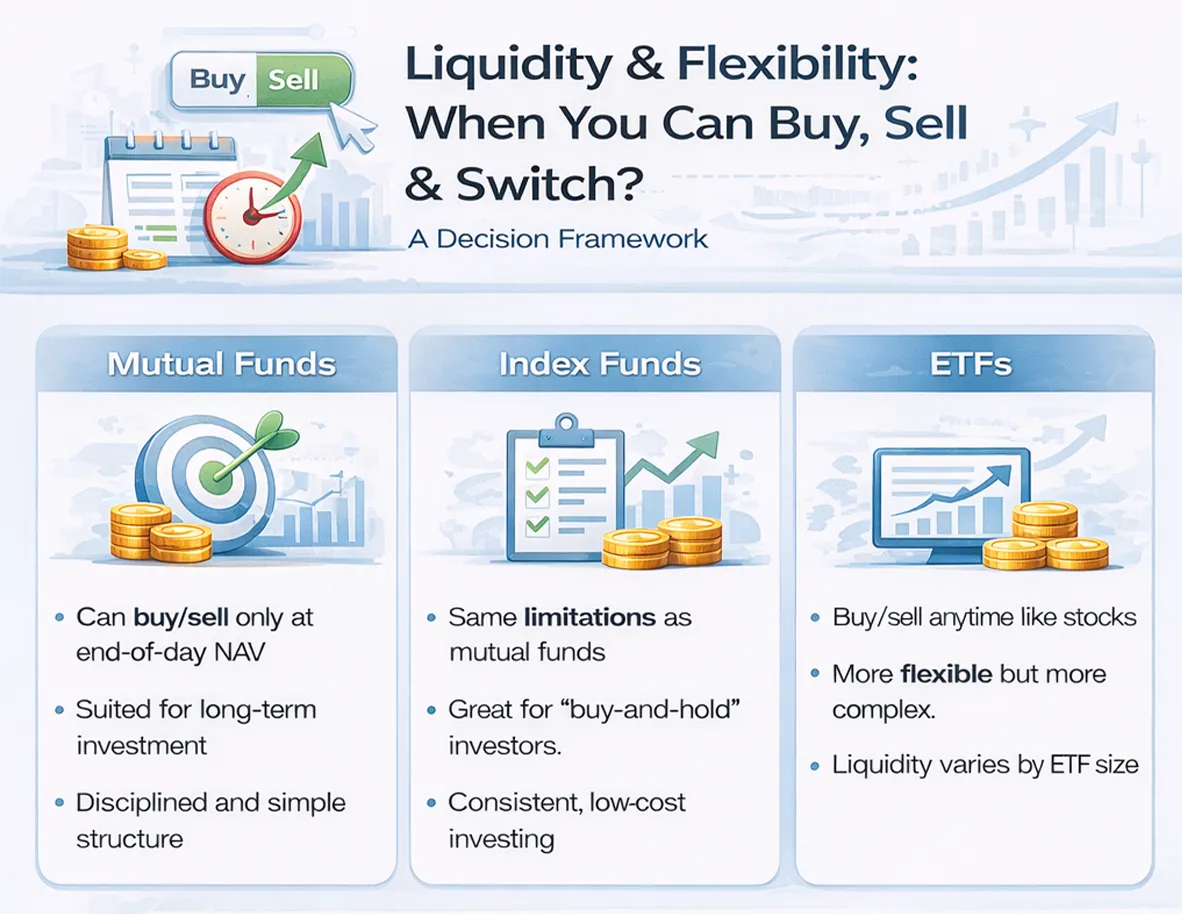
Mutual funds allow you to buy or redeem units at end-of-day NAV. This works perfectly for long-term investors but lacks intraday flexibility. If you're building a long-term mutual fund portfolio, this structure keeps things simple and disciplined.
2. Index Funds: Built for Consistent, Long-Term Investing
Index funds follow the same NAV-based system. While you can’t trade them in real time, they are ideal if your goal is to invest in index funds for long-term wealth creation. For most investors, this limitation is not a drawback—it actually prevents impulsive decisions.
3. ETFs: Maximum Flexibility, With a Catch
ETFs offer complete flexibility. You can buy and sell them anytime during market hours, just like stocks. However, liquidity depends on trading volumes, and in India some ETFs may have lower participation, which can impact execution prices.
4. The Smart Balance: Flexibility vs Discipline
If you actively manage your mutual fund portfolio, ETFs can give you tactical control. But for most investors, index funds provide a more stable, stress-free way to stay invested and benefit from long-term compounding.
Tax Treatment: How ETFs, Mutual Funds & Index Funds Are Taxed Differently
Taxation is often underestimated, but it can significantly impact your real, post-return gains.
1. Equity Funds (Mutual Funds, Index Funds & ETFs): Same Tax Rules
For equity-oriented investments, whether active mutual funds, index funds, or ETFs, the tax treatment is identical in India.
Short-term gains (under 12 months) are taxed at 20%, while long-term gains (over 12 months) are taxed at 12.5%, with the first ₹1.25 lakh exempt annually. This applies across the board, even if you invest in popular index funds like a large-cap index fund.
2. The Hidden Tax Drag in Active Mutual Funds
While tax rates are the same, the real difference lies in turnover. High-return mutual funds tend to buy and sell frequently, creating internal tax liabilities that reduce returns indirectly.
In contrast, index funds follow a passive strategy with minimal churn. Lower turnover means lower hidden tax impact, making them more tax-efficient over time.
3. International & Global Index Funds: The Big Exception
This is where things change. Any International index fund or global index fund registered in India is taxed like a debt fund.
This means gains are taxed at your income slab rate, with no LTCG exemption. For investors in higher tax brackets, even the best global index funds can face a significant post-tax return impact.
4. Why Tax Efficiency Matters for Long-Term Investors?
If you plan to invest in index funds for the long run, tax efficiency becomes a major advantage. Lower turnover and predictable taxation make index funds a strong choice for building a stable mutual fund portfolio.
Tax Comparison Table
Fund Type | STCG (Under 12 Months) | LTCG (Over 12 Months) | ₹1.25L Exemption |
Equity Active Mutual Fund | 20% | 12.5% | Yes |
Equity Passive Fund — Domestic (Index funds) | 20% | 12.5% | Yes |
Equity ETF — Domestic | 20% | 12.5% | Yes |
International index fund / Global index fund | Slab rate | Slab rate | No |
Debt Fund | Slab rate | Slab rate | No |
Which Structure Is Right for Which Investor? A Decision Framework
There is no one-size-fits-all answer.
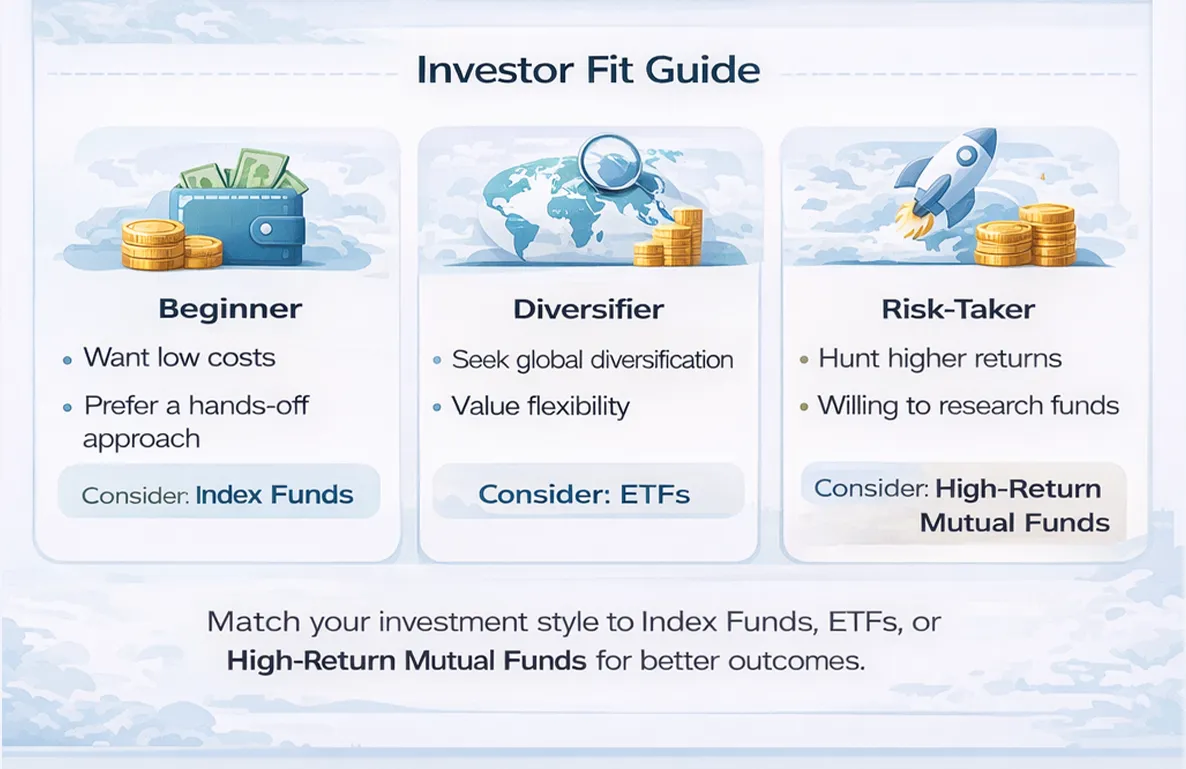
If you want simplicity, low cost, and predictable returns, index funds are ideal. They are especially suitable for beginner index funds that want to avoid complexity.
If you believe in fund managers and are willing to take some risk for potentially higher returns, high-return mutual funds can be considered. However, careful selection is crucial when building your mutual fund portfolio.
If you value flexibility and real-time trading, ETFs might suit you better. But they require more involvement and understanding of market mechanics.
For diversification, combining large index funds, small-cap index fund options, and even Multi-cap index funds can create a well-balanced portfolio.
Investors looking to diversify globally should explore the best global index funds or an International index fund to hedge against domestic market risks.
Best ETFs and Index Funds to Consider in India in 2026–27
Choosing the right funds isn’t about chasing trends; it’s about picking reliable, low-cost options that fit your long-term strategy. Below are widely tracked, proven choices across categories. Always verify details before you invest in index funds.
1. Large-Cap Index Funds & ETFs: The Core of Every Portfolio
For stable, market-linked returns, a large-cap index fund should form the foundation. Options like UTI Nifty 50 Index Fund and HDFC Nifty 50 Index Fund are among the most popular index funds with low costs and strong tracking.
If you prefer ETFs, Nippon India ETF Nifty BeES is a go-to choice for investors who want to buy index funds via demat and benefit from liquidity.
2. Mid-Cap & Multi-Cap Index Funds: Growth with Diversification
For higher growth potential, Multi-cap index funds and mid-cap trackers like Motilal Oswal Nifty Midcap 150 Index Fund offer broader exposure.
These large index funds (tracking wider markets like Nifty 500) reduce the need for constant rebalancing, ideal for investors who want simplicity without compromising diversification.
3. Small-Cap Index Funds: High Risk, High Reward
Among the best small-cap index funds, Nippon India Nifty Smallcap 250 Index Fund stands out. A small-cap index fund can deliver strong long-term returns but comes with volatility, making it suitable only for investors with a long horizon.
4. Global & International Index Funds: Diversify Beyond India
For global exposure, options like Motilal Oswal S&P 500 Index Fund are well-known International index fund choices.
Many investors now explore the best global index funds tracking indices like S&P 500 and the MSCI World. A global index fund helps reduce dependence on India, though taxation at slab rates must be considered.
Fund Type | Example | Benchmark | Expense Ratio (Approx.) | Best Suited For |
Large-cap index fund | UTI Nifty 50 Index Fund | Nifty 50 | ~0.10%–0.20% | All investors; core portfolio |
Large-Cap ETF | Nippon India ETF Nifty BeES | Nifty 50 | ~0.05% | Demat users; lump-sum investors |
Mid-Cap Index Fund | Motilal Oswal Nifty Midcap 150 Index Fund | Nifty Midcap 150 | ~0.30% | Long-term growth seekers |
Small-cap index fund | Nippon India Nifty Smallcap 250 Index Fund | Nifty Smallcap 250 | ~0.35% | Aggressive investors |
Multi-cap index funds | UTI Nifty 500 Index Fund | Nifty 500 | ~0.25%–0.35% | Broad market exposure |
International index fund | Motilal Oswal S&P 500 Index Fund | S&P 500 | ~0.50%+ | Global diversification |
Also Read: What the Iran-Israel-US War Means For India's & World's Fertilizer Industry?
Conclusion
If we strip away marketing noise and focus on data, index funds consistently emerge as strong performers for most investors. Their low cost, transparency, and reliability make them a powerful tool for long-term wealth creation.
While high-return mutual funds can outperform in certain periods, the lack of consistency and higher costs make them less predictable.
ETFs offer flexibility but require a more hands-on approach.
For most Indian investors, especially those starting, the smartest move is to invest in index funds, build a diversified portfolio using a large-cap index fund, a small-cap index fund, and even global index fund exposure, and stay invested for the long term.
Because in the end, it’s not about chasing returns, it’s about capturing them consistently.
See what markets are pricing in
Live indices, sector moves and market breadth — the backdrop to every story we publish.
Frequently Asked Questions
1. What is the difference between an ETF and an index fund in India?
ETFs trade on stock exchanges in real time and require a demat account. Index funds are bought from AMCs at end-of-day NAV and don’t need a demat account. Both track indices, but ETFs offer intraday liquidity while index funds offer simplicity and easier SIP investing.
2. Are ETFs better than mutual funds for long-term investing?
Not always. ETFs have lower expense ratios, but brokerage and bid-ask spreads can reduce returns. For SIP investors, index mutual funds are often more cost-efficient and convenient. ETFs suit lump-sum investors comfortable with trading platforms.
3. Is it better to invest in index funds or actively managed mutual funds?
Index funds offer consistency, low cost, and predictability. Actively managed mutual funds can outperform but are less consistent and costlier. For most investors, index funds are a reliable core, while active funds may complement in mid and small caps.
4. Do ETFs have expense ratios in India?
Yes, ETFs in India have expense ratios, typically lower than mutual funds (around 0.05%–0.20%). However, investors should also consider brokerage charges and bid-ask spreads, which add to the total cost of investing.
5. Can I do SIP in ETFs in India?
Yes, SIP in ETFs is possible through brokers. However, each instalment is treated as a separate trade, attracting brokerage charges. This makes ETF SIPs less cost-efficient compared to mutual fund SIPs for most retail investors.