


The Cost You Don't See Is the One That Hurts You Most
Most investors obsess over which scheme to pick. They compare past returns, study fund manager track records, and debate whether to go with the best mid-cap mutual funds or large-cap mutual funds. That is a reasonable thing to do. But there is a quieter number sitting in every fund's documents, the expense ratio mutual fund figure, and for years, it has been either misunderstood or completely overlooked.
The expense ratio is the annual cost deducted from your fund's assets to cover management, operations, and other charges. You do not write a cheque for it. It simply reduces the NAV day by day, silently compounding against you over time. For a ₹50 lakh portfolio, even a 0.5% difference in expense ratio can mean over ₹10 lakh less at the end of 20 years.
SEBI noticed this problem a long time ago. The regulator has been tightening SEBI mutual fund rules on expense ratios for years, cutting caps progressively since 2018. But April 1, 2026, marks something bigger: a structural overhaul, not just a tweak. The SEBI (Mutual Funds) Regulations, 2026, approved in December 2025 and effective from April 1, replace a framework that had been in place since 1996. This blog breaks down exactly what changed, what it means for your mutual fund portfolio, and whether you need to do anything about it.
Run the numbers on your next investment
Project returns on a lumpsum or SIP with our free calculators.
What Is Expense Ratio in Mutual Funds and Why Does It Matter
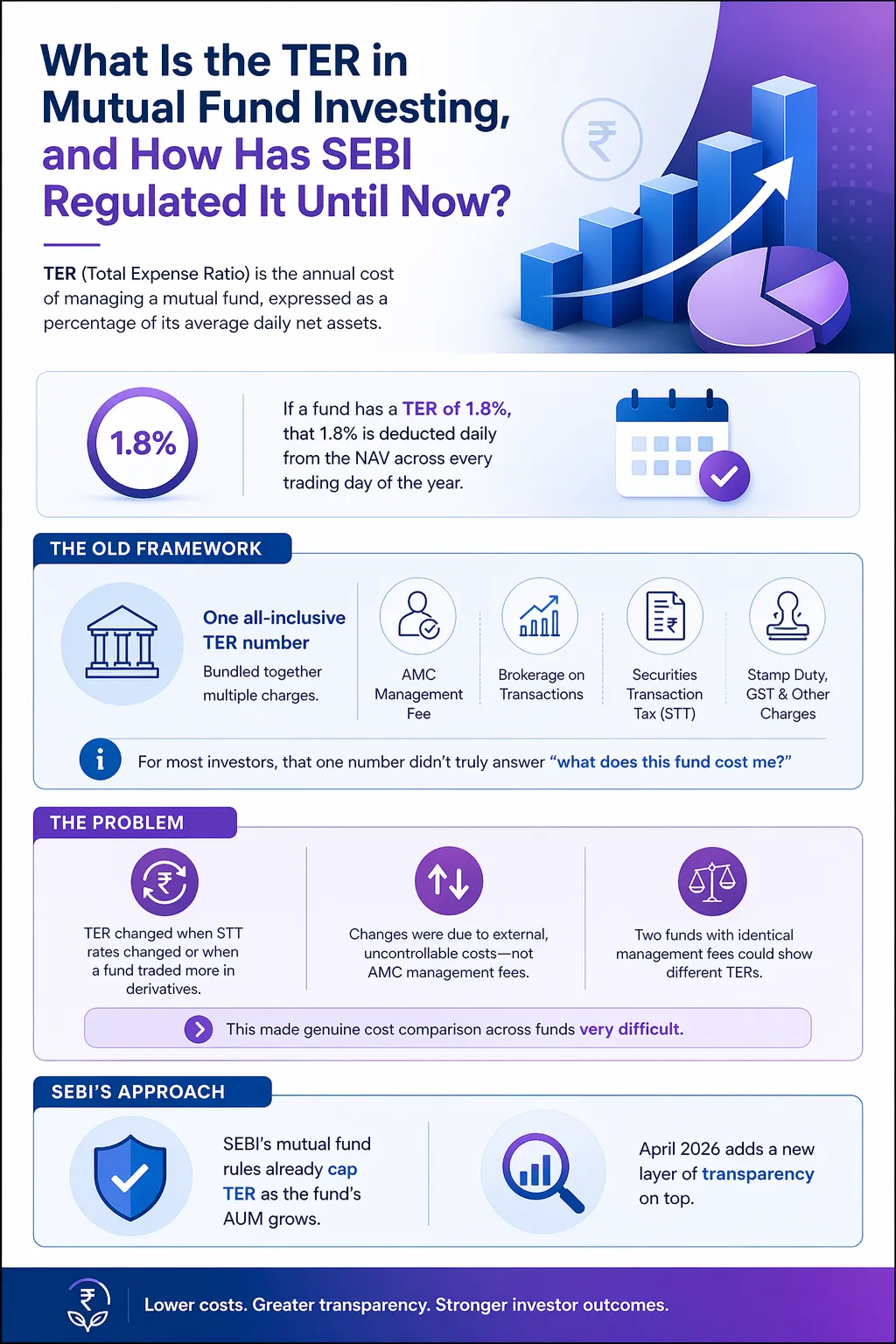
The TER in mutual fund terminology stands for Total Expense Ratio. It is expressed as a percentage of the average daily net assets of a scheme, charged annually. If a fund has a TER of 1.8%, that 1.8% is deducted proportionally from the NAV across every trading day of the year.
Under the old framework, essentially the one that governed India's ₹68 lakh crore mutual fund industry since 1996, the TER was a single, all-inclusive number. It bundled together the AMC's management fee, brokerage on transactions, securities transaction tax (STT), stamp duty, GST, and other regulatory charges. For most investors, that one number was the answer to "what does this fund cost me?" That was both convenient and misleading.
The problem was structural. When STT rates changed, or when a fund traded more actively in derivatives, the TER changed too, not because the AMC changed its management fee, but because external, uncontrollable costs fluctuated. Two funds with identical management fees could show different TERs simply because one traded more. This made genuine cost comparison across funds very difficult.
SEBI's SEBI mutual fund rules had already introduced slabs where the TER cap reduces as a fund's AUM grows. Larger funds pass on the benefits of scale to investors through lower expense ratios. That principle stays intact. But April 2026 adds a new layer of transparency on top.
SEBI Mutual Fund Rules 2026 Explained
The single biggest structural change in the 2026 regulations is the unbundling of the TER. From April 1, 2026, the expense ratio mutual fund disclosure works like this:
The TER is now defined as the sum of three components. First, the Base Expense Ratio (BER), which is only the fee the AMC charges for managing the fund. Second, brokerage and transaction costs are disclosed separately. Third, statutory and regulatory levies GST, STT, stamp duty, and exchange fees charged on actuals rather than bundled into a cap.
| Component | Old TER Framework | New TER Framework (April 2026) |
| AMC Management Fee | Bundled into the TER cap | Disclosed as Base Expense Ratio (BER) |
| Brokerage (Cash Market) | Bundled, cap ~12 bps | Separate, cap reduced to 6 bps |
| Brokerage (Derivatives) | Bundled, cap ~5 bps | Separate, cap reduced to 2 bps |
| GST, STT, Stamp Duty | Within TER limits | Charged on actuals, outside BER cap |
| Exit Load Add-on (5 bps) | Allowed | Removed entirely |
| NFO Expenses | Sometimes passed to investors | Must be borne by AMC, not investors |
This is not a cosmetic change. When statutory levies sit outside the BER cap, the AMC's fee is now clearly ringfenced. You can compare the true management cost of a fund without worrying about whether a change in STT or GST rates has inflated the number.
Beyond the unbundling, SEBI has also reduced the caps outright. Index funds and ETFs, for instance, see their expense limit cut from 1.00% to 0.90%. For equity-oriented Fund of Funds, the cap drops from 2.25% to 2.10%. Close-ended equity schemes see their cap fall from 1.25% to 1.00%. These numbers look small. The compounding impact over a decade or two is not.
Index Funds vs Active Mutual Funds Which Benefits More
The impact of the new SEBI mutual fund rules varies by fund type, and it is worth understanding the differences clearly.
Active equity funds, including best mid-cap mutual funds and large-cap mutual funds, operate with higher management fees because they require ongoing research and portfolio construction. The BER for active equity funds is still higher than for passive funds, typically estimated at around 1.5–1.8% for direct plans post-April 2026. However, the removal of the 5 bps exit load add-on and tighter brokerage caps does reduce their overall cost structure slightly.
Index funds are the biggest long-term winners from these changes. Index funds were already the go-to choice for cost-conscious investors, and the reduction in their TER cap from 1.00% to 0.90% pushes them even lower. A well-run index fund tracking the Nifty 50 or Nifty 500 in the direct plan format can now operate at under 0.10% for large AMCs. This is a meaningful gap compared to active management costs.
Tax-saving funds, also known as ELSS, are equity-oriented and follow the same expense structure as active equity funds. Best tax-saving mutual funds that operate as ELSS schemes will benefit from the same brokerage cap reductions. Investors building a mutual fund portfolio with an ELSS component should check whether their fund's updated SID reflects revised cost structures.
For investors focused on building the best mutual fund portfolio across categories, the key takeaway is that the cost gap between active and passive investing has not changed dramatically. What has changed is that you can now see it more clearly than before.
How Much of a Difference Does 0.1% in TER Actually Make Over 10–20 Years?
Here is where the numbers become impossible to ignore. Consider a ₹25 lakh lump sum investment in an equity mutual fund earning a gross return of 12% per annum over 20 years.
| Scenario | Expense Ratio | Corpus After 20 Years |
| Scenario A | 2.00% (Regular Plan) | ₹1.16 Crore |
| Scenario B | 1.90% (0.10% lower) | ₹1.19 Crore |
| Scenario C | 0.50% (Direct Index Fund) | ₹1.51 Crore |
A seemingly trivial 0.1% reduction in the expense ratio mutual fund translates to roughly ₹2–3 lakh in additional corpus. A shift from a regular plan active fund at 2% to a direct index fund at 0.5% results in a difference of over ₹35 lakh on the same investment and timeline.
This is why the conversation about TER in mutual fund investing is not academic. Every basis point you save in annual charges is a basis point your money compounds for you instead. This is also why direct MF recommendation platforms and SEBI-registered advisors consistently advocate for direct plans over regular ones for long-term wealth creation.
Get research like this in your inbox
The week’s research that mattered, in five minutes. Joined by 2L+ investors.
Direct Plan vs Regular Plan Mutual Fund Which Is Better
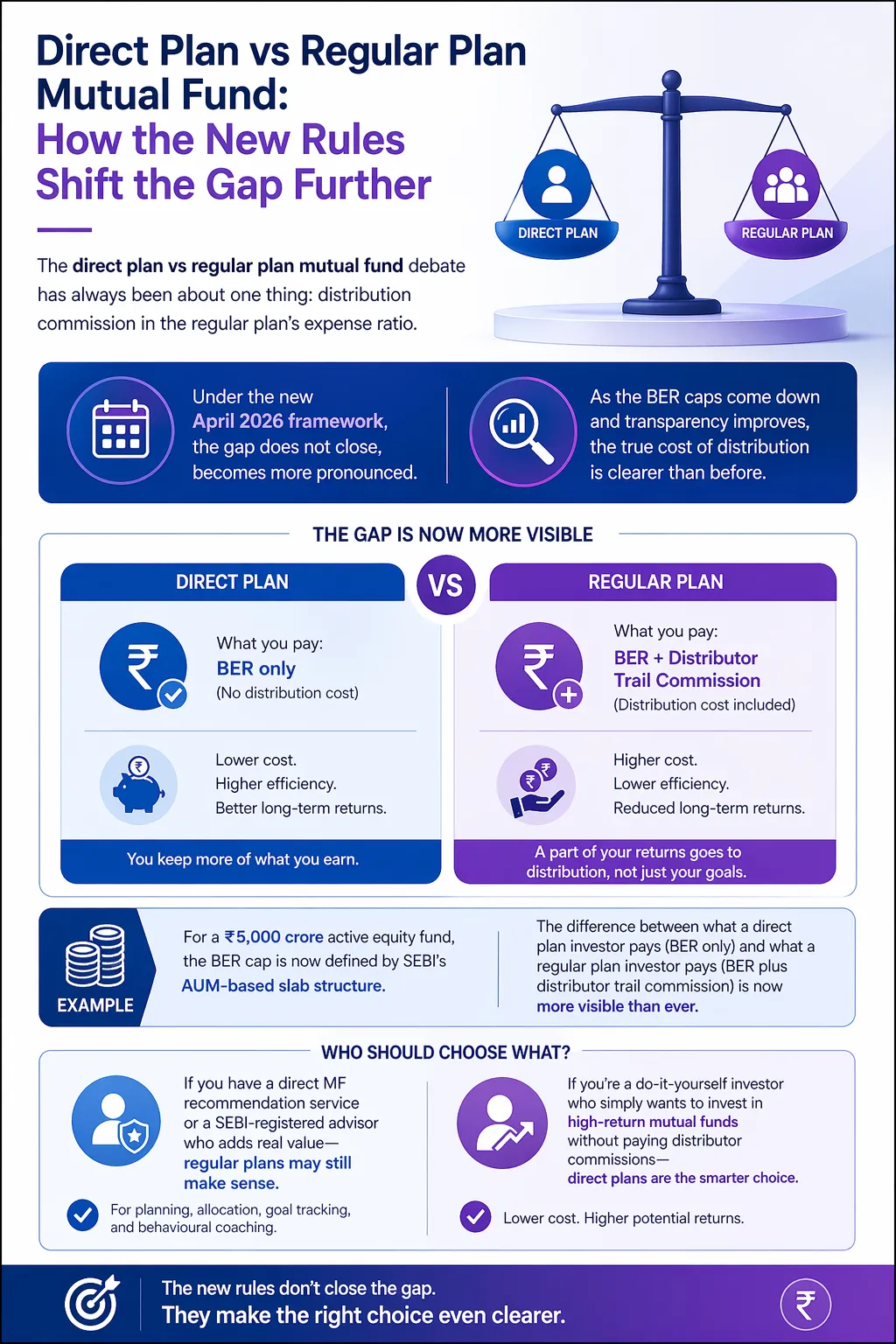
The direct plan vs regular plan mutual fund debate has always been about one thing: the distribution commission embedded in the regular plan's expense ratio. Regular plans carry a higher TER because the AMC uses part of that expense budget to pay distributors and brokers for bringing in the investor.
Under the new April 2026 framework, the direct plan vs regular plan mutual fund gap does not close. It arguably becomes more pronounced.
As BER caps come down and transparency improves, the true cost of distribution is clearer than before. The difference between what a direct plan investor pays and what a regular plan investor pays is now far more visible.
For do-it-yourself investors who simply want to invest in high-return mutual funds without paying distributor commissions, the case for direct plans just got stronger.
Should You Change Your Mutual Fund Portfolio After SEBI Rules
The short answer is no, not immediately. Your existing investments continue as-is.
What you should do is review the updated Scheme Information Documents for your existing funds and compare revised BER structures.
If you are building or reviewing your best mutual fund portfolio, this is actually a strong opportunity to compare funds more meaningfully than before.
For investors in large-cap mutual funds, mid-cap mutual funds, or ELSS categories, the investment thesis remains the same, but cost comparison is now clearer.
How Mutual Fund Companies Are Responding to New Rules
The mutual fund industry moved quickly once the April 1 deadline arrived. Major AMCs have revised scheme documents and expense disclosures.
The updates primarily affect recurring expenses and TER disclosures, while investment mandates remain unchanged.
For active funds, tighter brokerage caps may subtly reduce excessive portfolio churn, potentially benefiting long-term investors.
For index funds, operational impact is minimal, making them even more attractive for cost-conscious investors.
Best Strategy to Build a High Return Mutual Fund Portfolio
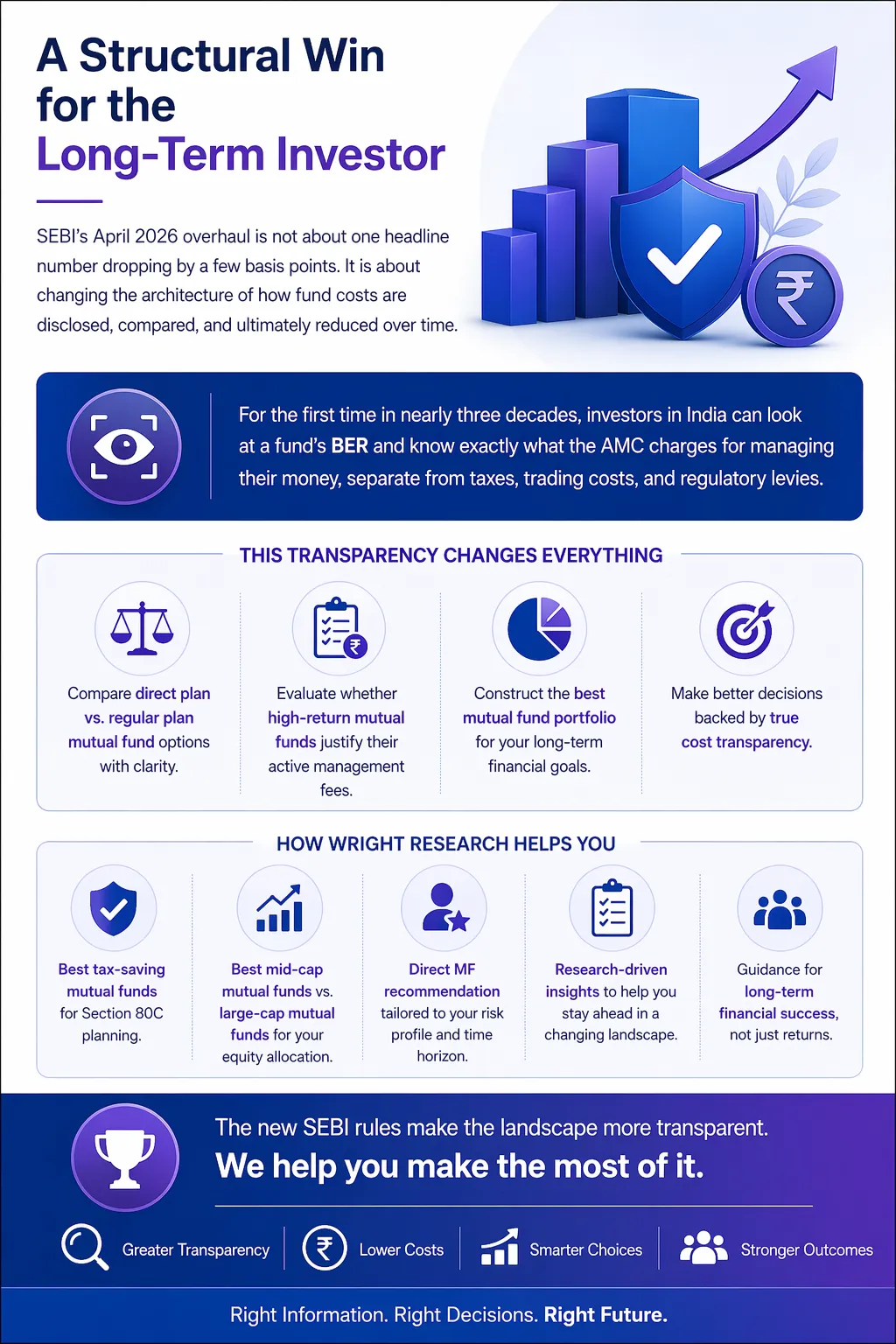
SEBI's April 2026 overhaul is about transforming how fund costs are disclosed and compared.
For the first time in decades, investors can clearly identify what they pay for fund management separately from taxes and statutory costs.
This transparency changes how investors evaluate direct plans, regular plans, active funds, passive funds, and portfolio construction strategies.
A strong portfolio should combine low-cost passive options, carefully selected active funds, tax-efficient investments, and disciplined long-term planning.
Disclaimer
Investments in mutual funds are subject to market risks. Past performance is not indicative of future results. Please read all scheme-related documents carefully before investing.
See what markets are pricing in
Live indices, sector moves and market breadth — the backdrop to every story we publish.
Frequently Asked Questions
1. What is the new SEBI expense ratio rule for mutual funds in 2026?
From April 1, 2026, SEBI requires TER to be split into BER, brokerage, and statutory charges separately for greater transparency.
2. Which mutual funds have the lowest expense ratios in India?
Direct plan index funds and ETFs generally have the lowest expense ratios, often below 0.10%.
3. Does a lower expense ratio mean better returns?
Not automatically, but lower costs improve net returns when gross performance is comparable.
4. How does SEBI's TER cap work?
SEBI uses AUM-based slabs where larger funds must lower BER as assets grow.
5. Should I switch from regular to direct plans?
If you do not require distributor support, direct plans generally improve long-term net returns due to lower expenses.