


Introduction: The Fund Choice That Actually Matters
Most Indian investors building a long-term mutual fund portfolio run into the same problem at some point. They open their AMC app, browse through equity fund categories, and find themselves staring at two options that sound almost identical: a flexi cap fund and a multicap fund. Both invest across large, mid, and small-cap stocks. Both are equity funds. Both are recommended for long-term wealth creation.
So what is actually different? And more importantly, which one belongs in your portfolio?
The answer is not as simple as picking whichever has a better star rating this quarter. The difference between a flexi-cap mutual fund and a multi-cap mutual fund runs much deeper, right down to their SEBI-defined mandates, how they behave during market corrections, the kind of risk you actually take on, and whether the outcome depends more on market conditions or on the fund manager sitting at the desk.
If you are building a serious mutual funds portfolio for wealth creation over the next five to ten years, you need to understand these two categories from first principles. That is exactly what this guide covers.
Also Read: Why You Should Review Your Mutual Fund Portfolio for Long-Term Wealth Preservation
Run the numbers on your next investment
Project returns on a lumpsum or SIP with our free calculators.
What Is a Flexi Cap Fund? How SEBI Defines It and Why It Was Created
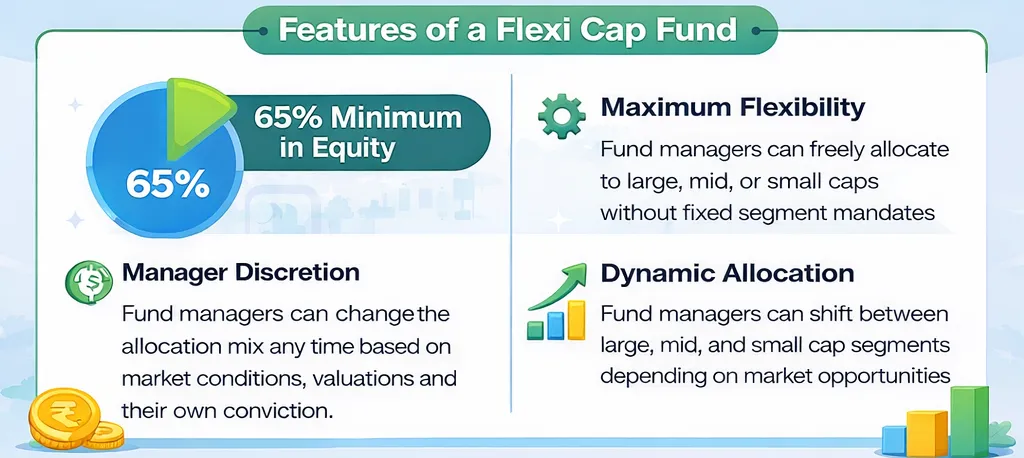
A flexi cap fund is an open-ended dynamic equity scheme that invests across large-cap, mid-cap, and small-cap stocks, with a minimum of 65% in equity. That is essentially where the rules stop. There is no prescribed allocation between market capitalization segments. The fund manager has complete freedom to decide how much goes into large caps, how much into mid caps, and how much into small caps, and to change that mix at any time based on market conditions, valuations, and their own conviction.
SEBI created the flexi cap category in November 2020, separating it from the multi cap category following the 2020 circular that mandated strict allocations for multi cap funds. Before this, most funds that were labelled multi-cap were essentially operating the way a flexi cap mutual fund does today, heavy in large caps with tactical exposure to mid and small caps based on manager discretion. The creation of the flexi cap category gave fund managers a formal structure to continue doing what they had always done.
The defining characteristic of a flexi-cap fund is therefore the absence of a mandate. It has maximum flexibility, bounded only by the 65% equity floor. When markets are expensive in mid and small caps, a good manager can simply move the majority of the corpus into large caps and wait. When valuations become attractive at the bottom of a market cycle, the manager can rapidly shift into mid and small caps to capture the recovery.
This is an extremely powerful tool in the hands of the right manager. And a meaningless one in the hands of the wrong one, which is something we will come back to later in this piece.
Also Read: How Wright Research Builds Equity Portfolios Differently
What Is a Multi-Cap Fund? The Mandatory 25-25-25 Allocation Rule Explained
A multicap fund is an open-ended equity scheme that is required by SEBI to maintain a minimum of 25% in large-cap stocks, 25% in mid-cap stocks, and 25% in small-cap stocks at all times. The remaining 25% gives the fund manager some flexibility.
This is the rule that makes multi-cap mutual funds structurally different from every other diversified equity category in India. The 25-25-25 mandate is always-on. It does not matter whether small caps are at a valuation peak or a decade low; the fund must maintain at least 25% exposure. It does not matter whether mid-caps have run up 80% in twelve months; the fund must stay invested at or above the 25% floor.
SEBI introduced this circular in September 2020, and it created significant disruption. Many existing multicap fund products at the time had barely 10–15% in small caps. To comply, they had to either buy small-cap stocks in size or convert to the newly created flexi-cap category. A large number chose the latter, which is why today's best multicap fund landscape looks different from the multi-cap universe of 2019.
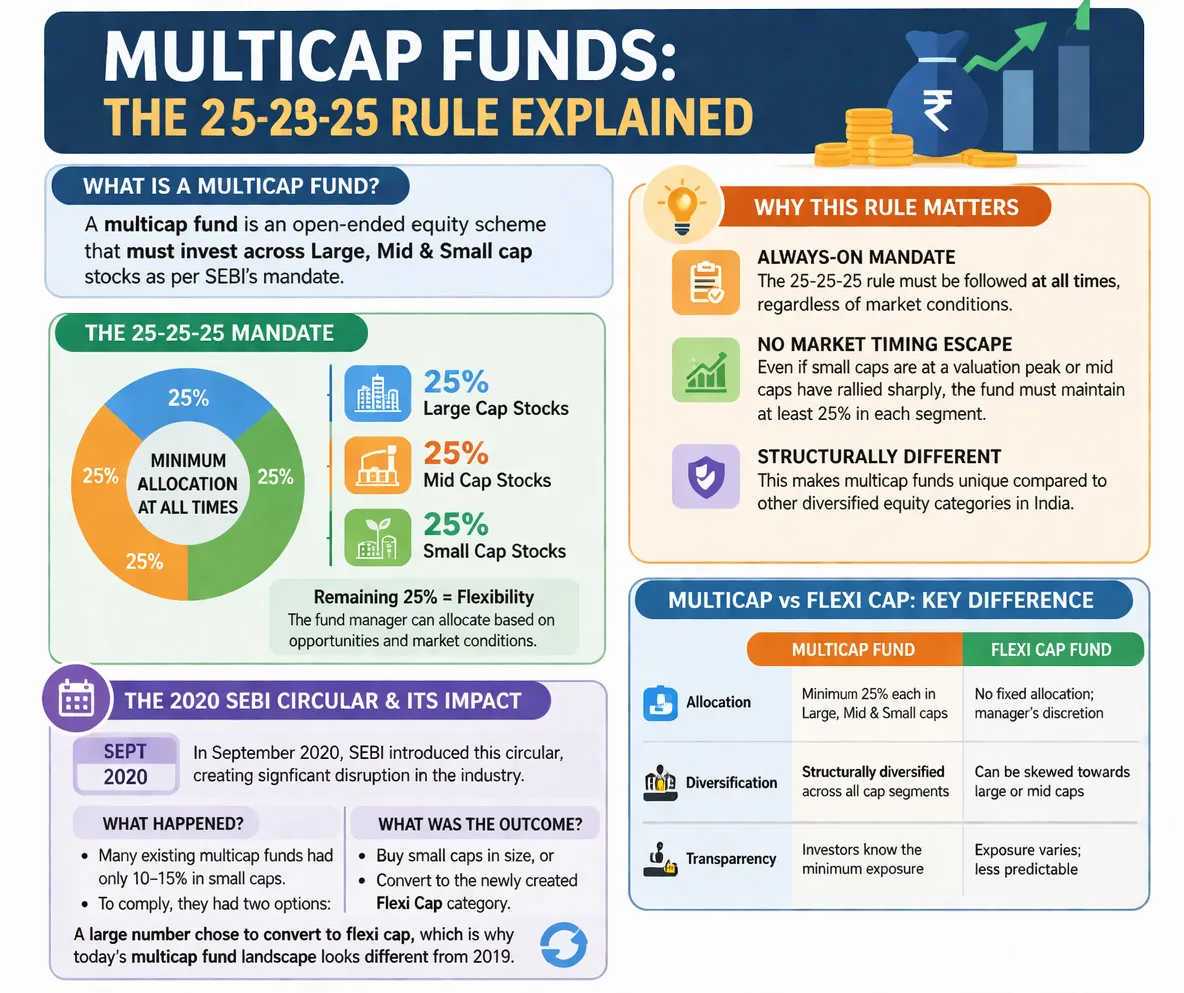
The practical implication is significant. A multicap fund is structurally more diversified across market cap segments than a flexi cap fund, which will often be in practice. It is a more transparent product; investors know exactly the minimum exposure profile they are getting. A large and mid-cap fund provides large and mid-cap exposure without small-cap risk; a multicap fund adds that small-cap component mandatorily.
It is also worth noting that the mandatory small-cap and mid-cap allocations make a multicap fund inherently more volatile. Small-cap stocks can fall 40–50% in a correction. Having 25% of your fund in them always is a risk that must be understood clearly before investing.
Flexi Cap vs Multi Cap: The Key Differences Side by Side
Understanding these two categories becomes much clearer when you lay the structural differences out directly.
Parameter | Flexi Cap Fund | Multi-Cap Fund |
SEBI Category Created | November 2020 | Pre-existing, re-mandated September 2020 |
Minimum Equity Allocation | 65% | 75% |
Large Cap Floor | None | 25% |
Mid Cap Floor | None | 25% |
Small Cap Floor | None | 25% |
Allocation Flexibility | Complete (within equity minimum) | Limited to the top 25% |
Volatility Profile | Depends on the manager's positioning | Structurally higher due to forced small/mid allocation |
Manager Dependency | Very High | Moderate |
Predictability for Investors | Lower | Higher |
Suited For | Investors who trust the fund manager | Investors wanting guaranteed broad market exposure |
The single most important row in that table is the small cap floor. A flexi-cap mutual fund manager can choose to hold zero small caps if they believe valuations are stretched. A best multicap mutual fund manager cannot they must always hold at least 25%. This one rule determines much of the risk profile difference between the two.
For investors comparing a large and mid-cap fund versus a multicap fund, note that the large and mid-cap fund category completely excludes small caps (50% large, 30% mid), giving yet another distinct risk-return profile. A multicap fund sits above that on the risk spectrum due to its mandatory small-cap component.
How Each Fund Navigates Bull Markets vs Corrections
The structural differences above translate into very different behaviours across market cycles.
During a Bull Market (especially mid and small cap-led rallies)
A multicap fund tends to shine in these environments. The forced 25% mid cap and 25% small cap floors mean the fund participates fully in the rally across all market cap segments. Investors in the best multicap fund products tend to see strong absolute returns when the broader market is rising, because a third of their corpus is always in the highest-beta segments.
A flexi-cap fund may underperform a multicap fund in these phases, but only if the manager has chosen to be conservative and maintain high large-cap weights. If the manager has correctly anticipated the rally and positioned the portfolio with higher mid and small cap weights, a flexi cap fund can match or even beat a multicap fund. The catch is that this depends on the manager making the right call in advance.
During a Market Correction
This is where the structural difference becomes most consequential. In a deep correction, small caps typically fall the hardest and recover the slowest. A multicap fund must maintain its 25% small cap exposure even as those stocks are falling; there is no escape clause. If small caps drop 45% and large caps drop 20%, the multicap fund will suffer disproportionately.
A skilled flexi-cap fund manager, on the other hand, can significantly reduce small-cap and mid-cap exposure ahead of or during a correction, moving capital into large-cap safety. The best flexi cap managers have demonstrated exactly this, tactically reducing risk in deteriorating markets and then re-entering the small and mid-cap space aggressively as valuations recover.
The important word in that paragraph is "skilled." This is a capability that not all flexi-cap fund managers exercise well, which brings us to the most critical consideration for investors.
Also Read: Equity Market Volatility: How Wright Research Manages Risk
Get research like this in your inbox
The week’s research that mattered, in five minutes. Joined by 2L+ investors.
Manager Dependency: Why Flexi Cap Is a High-Conviction Bet on the Fund Manager
When you invest in a flexi cap mutual fund, you are not just buying a category; you are buying a philosophy. You are buying the conviction that a specific fund manager or investment team will make better allocation decisions across market cap segments over time than a rules-based approach would.
This is a fundamentally different bet from investing in a multicap fund, where SEBI's 25-25-25 mandate provides a guardrail. In a multicap fund, even an average manager cannot deviate too far from the market because the portfolio must stay diversified across segments. The mandate itself provides a floor of rationality.
In a flexi cap fund, there is no such guardrail. A manager with high conviction might move 80% into large caps and sit there for two years, missing a mid-cap rally. Or they might chase mid and small cap momentum at the top of a cycle, only to see their high-allocation portfolio collapse in the correction. When a flexi cap fund goes wrong, it tends to go badly wrong, not because the category is flawed, but because the latitude the category provides is only as good as the person using it.
What does this mean practically? Before investing in any best flexi cap mutual funds, look at the following: How has the manager changed the allocation across market caps over the past five to seven years? Did they reduce small-cap exposure before major corrections (2018, 2022)? Did they add it back at the lows? What is the fund's historical standard deviation compared to a benchmark? Is the manager still the same person who delivered historical performance?
These questions do not apply with the same force to a multicap fund, where the mandate itself provides structural consistency regardless of who the manager is.
Returns Comparison: Which Has Delivered More Over 3, 5 and 7 Years?
This is the question most investors ask first, and it deserves an honest answer.
Category Avg. Returns | 3-Year CAGR | 5-Year CAGR | 7-Year CAGR |
Flexi Cap Fund Category Avg. | ~18–20% | ~18–22% | ~14–17% |
Multi Cap Fund Category Avg. | ~22–26% | ~22–26% | ~15–18% |
Large and Mid Cap Fund Avg. | ~18–21% | ~19–22% | ~13–16% |
Nifty 500 TRI (Benchmark) | ~16–18% | ~17–20% | ~13–15% |
Note: Returns are approximate category averages based on historical data as of early 2025–26. Individual fund performance varies significantly. Past performance is not indicative of future returns.
The data tells an interesting story. Over the 3-year and 5-year windows that capture the post-pandemic bull market in mid and small caps, multi-cap mutual funds as a category have delivered stronger average returns than flexi-cap funds. This is largely a function of the mandated mid and small cap exposure; those segments delivered exceptional returns in the 2020–2024 cycle, and multicap funds were structurally forced to hold them.
Over the longer 7-year window, which includes the 2018 mid-small cap bear market and multiple corrections, the gap narrows considerably. This is where skilled flexi-cap managers have been able to protect capital better than mandated multicap funds.
The honest conclusion is this: in a trending, broad-based bull market where mid and small caps outperform, multicap funds win structurally. In volatile, uneven markets with sharp corrections, the best flexi cap mutual funds with skilled active management win. Over a full market cycle, the returns are comparable, but the journey is very different.
Also Read: How to Build a Long-Term Equity Portfolio in India
Which Is Right for You? A Decision Framework by Risk Profile
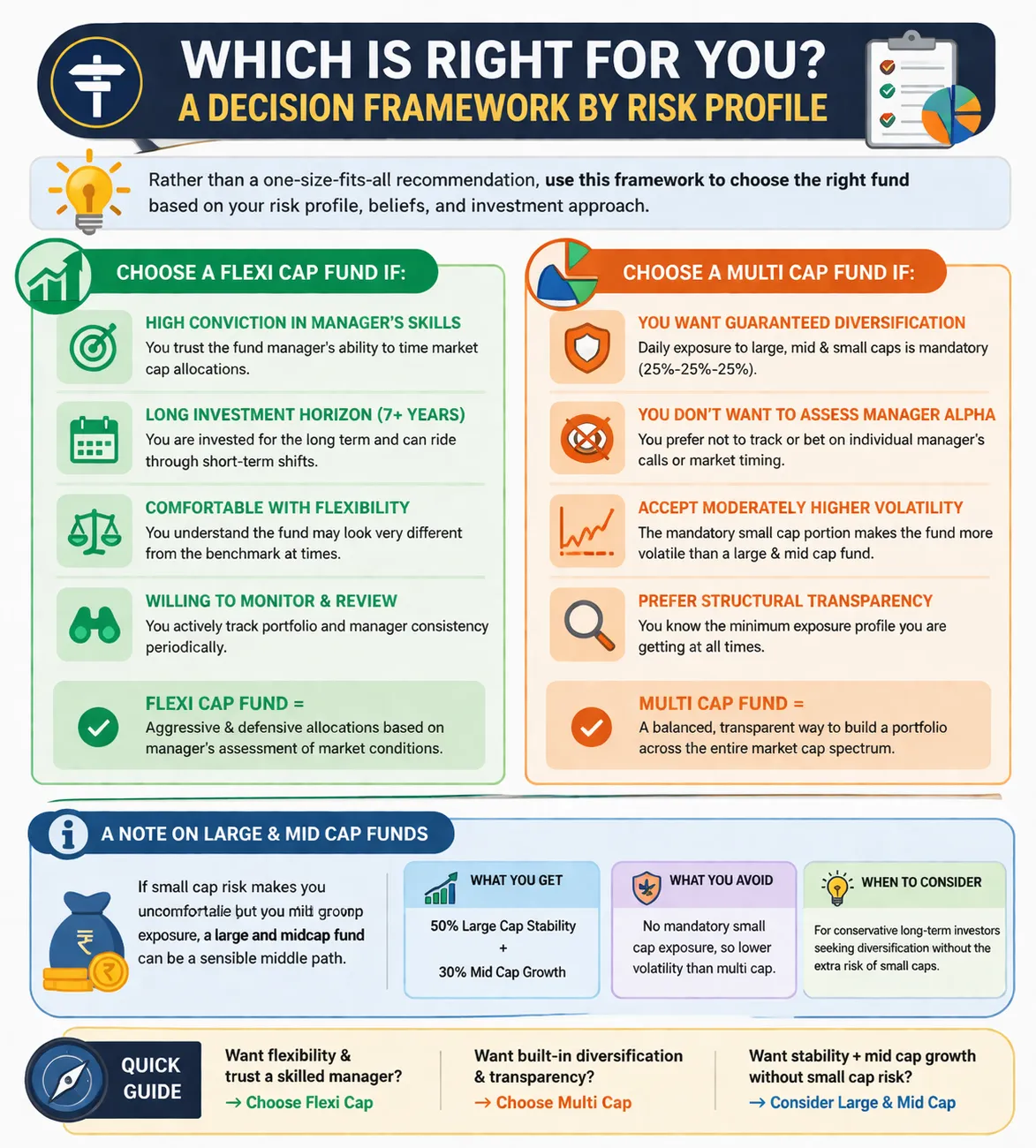
Rather than a one-size-fits-all recommendation, this is better answered through a decision framework.
Choose a Flexi Cap Fund If:
You have a high-conviction view on a specific fund manager's ability to time market cap allocations. You have a long investment horizon of at least 7+ years. You are comfortable with the possibility that the fund may look very different from the benchmark at any given time. You are willing to monitor the portfolio and manager consistency periodically. You want a flexi cap fund that can be both aggressive and defensive depending on the manager's assessment of market conditions.
Choose a Multi-Cap Fund If:
You want guaranteed broad-market diversification across large, mid, and small caps from day one. You do not want to assess or track individual manager alpha; you want the category mandate to do the heavy lifting. You have a moderately high risk appetite and understand that the mandatory small-cap floor will make this multicap fund more volatile than a large and mid-cap fund. You want a structurally transparent fund, and you know the minimum exposure profile you are getting. You are building a mutual fund portfolio across multiple categories and want one fund to cover the entire market cap spectrum.
A Note on Large and Mid Cap Funds
If small-cap risk makes you uncomfortable but you still want mid-cap growth exposure, a large and mid-cap fund is worth considering as a middle path. It provides 50% large cap stability and 30% mid cap growth exposure without mandatory small cap risk. For conservative long-term investors, a combination of a large and a mid-cap fund and a selective flexi-cap fund can provide diversification without excessive volatility.
Top Flexi Cap and Multi Cap Funds to Consider in 2025–26
Disclaimer: This is not investment advice. All fund mentions are for educational and analytical purposes only. Please consult a SEBI-registered investment advisor before making any investment decisions. Past performance does not guarantee future returns.
Best Flexi Cap Funds Worth Researching
Parag Parikh Flexi Cap Fund — Consistently regarded among the best flexi cap mutual funds for its international diversification overlay, low turnover, and valuation-driven approach. Among the few flexi cap products with a clearly articulated, non-benchmark-hugging philosophy.
Quant Flexi Cap Fund — Among the top performers in the flexi cap fund category over recent years, with a quantitative, momentum-driven approach. Higher volatility but strong return delivery in trending markets.
HDFC Flexi Cap Fund — Long track record, large AUM, and a value-oriented manager. One of the more defensively positioned best flexi cap fund options for conservative equity investors.
Kotak Flexi Cap Fund — Consistent category-level performer with a large-cap-heavy approach that makes it one of the lower-volatility flexi-cap mutual fund options in the category.
Top 5 Multicap Funds for Long Term
Nippon India Multi Cap Fund — One of the most consistent performers in the best multicap mutual fund shortlists, with a strong long-term track record and disciplined sector allocation. A firm entry in any top 5 multicap funds for the long-term list.
HDFC Multi Cap Fund — Value-oriented approach to multicap fund investing, regularly featured in the top 5 multicap funds for long-term recommendations across advisory platforms.
Quant Active Fund — Aggressive quantitative approach with strong recent returns in the multi-cap mutual funds category, though higher volatility than category peers.
Mahindra Manulife Multi Cap Fund — A consistently performing fund in the multicap fund space with an interesting mid and small cap-oriented approach for long-term investors.
Baroda BNP Paribas Multi Cap Fund — Among the best multicap fund options over 5-year horizons, with a disciplined approach that leans into mid-cap research quality.
Fund | Category | 5-Year CAGR (Approx.) | Risk Level |
Parag Parikh Flexi Cap | Flexi Cap Fund | ~22% | Moderate |
HDFC Flexi Cap | Flexi Cap Fund | ~19% | Moderate |
Quant Flexi Cap | Flexi Cap Fund | ~28%+ | High |
Nippon India Multi Cap | Multicap Fund | ~25% | Moderate-High |
HDFC Multi Cap | Multicap Fund | ~23% | Moderate-High |
Returns are approximate and based on historical category data. Verify current performance on AMFI/fund house websites before investing.
FAQs: Flexi Cap vs Multi Cap Fund
Q1. What is the main difference between a flexi-cap fund and a multicap fund?
The core difference is mandated allocation. A flexi cap fund has no required allocation across large, mid, or small caps — the manager decides entirely. A multicap fund is required by SEBI to maintain at least 25% each in large cap, mid cap, and small cap stocks at all times.
Q2. Which is better for long-term investment — flexi cap or multi cap?
There is no universal answer. Best flexi cap mutual funds with strong managers can protect capital better in corrections and deliver superior risk-adjusted returns. The best multicap mutual fund products tend to deliver stronger absolute returns in broad bull markets due to their mandatory mid and small cap floors. The right choice depends on your risk tolerance and conviction in the fund manager.
Q3. Is a flexi-cap fund safer than a multi-cap fund?
Not necessarily. A flexi cap fund can be positioned conservatively (heavy large cap) or aggressively (heavy small cap), depending on the manager's view. A multicap fund is structurally more volatile due to its mandatory small-cap exposure. However, flexi-cap funds carry higher manager risk; the outcome depends heavily on individual decisions.
Q4. What is a large and mid-cap fund, and how does it compare?
A large and mid-cap fund mandates 50% in large caps and 30% in mid caps, with no small-cap requirement. A large and midcap fund sits below both flexi cap and multicap on the risk spectrum. Suitable for investors who want mid-cap growth without small-cap volatility.
Q5. Can I hold both a flexi-cap fund and a multi-cap fund in my portfolio?
You can, but examine the overlap carefully. If the flexi cap fund you hold is heavily large-cap weighted, combining it with a multicap fund that adds mandatory mid and small-cap exposure creates a sensible complement in your mutual fund portfolio.
Q6. What are the top 5 multicap funds for long-term investing in 2025–26?
Among the most consistently cited in the top 5 multicap funds for long-term shortlists are Nippon India Multi Cap Fund, HDFC Multi Cap Fund, Quant Active Fund, Mahindra Manulife Multi Cap Mutual Funds, and Baroda BNP Paribas Best Multicap Fund. Always verify current performance before investing.
Q7. How does Wright Research approach flexi-cap and multi-cap allocation?
Wright Research uses a quant-driven, evidence-based approach to building equity portfolios. Our PMS strategies and Smallcase portfolios are built on systematic factor models rather than relying solely on a single fund manager's view. For investors who want professionally managed equity exposure without the manager dependency risk inherent to flexi cap funds, exploring our portfolio management services is a logical next step.
See what markets are pricing in
Live indices, sector moves and market breadth — the backdrop to every story we publish.
Closing Thoughts
The debate between the flexi-cap fund and the multicap fund is not really about which category is better. It is about understanding what you are actually buying and whether it matches what you need.
A multicap fund gives you mandated, transparent diversification across the entire market cap spectrum. You know what you are getting, and the category mandate prevents any single manager from concentrating the portfolio dangerously. The mandatory small-cap and mid-cap floors will make the ride more volatile, but they will also ensure you participate in broad market rallies.
A flexi cap mutual fund gives you a skilled pilot with full control of the aircraft. In the right hands, that is enormously valuable, the ability to raise or lower market cap risk in real time, based on conditions, rather than being forced to hold small caps at a market peak. But in the wrong hands, or with the wrong expectations, that same freedom is a liability.
For most long-term investors building a diversified mutual fund portfolio, the practical answer is often to own one of each a strong flexi cap fund with a proven manager for tactical flexibility, and a disciplined multicap fund for structural market cap coverage. Complement those with a large and mid-cap fund for the core allocation, and you have a portfolio that navigates different market environments with multiple layers of diversification.
If you are unsure about how to allocate across these categories based on your specific financial goals and risk profile, speak with a Wright Research advisor who can help you build a portfolio grounded in data, not guesswork.
Disclaimer: This blog is for educational and informational purposes only and does not constitute investment advice. Mutual fund investments are subject to market risks. Please read all scheme-related documents carefully before investing. Wright Research & Capital Pvt Ltd is a SEBI-registered Research Analyst (INH000007235) and Portfolio Manager (INP000007979). Past performance does not guarantee future returns.