


Introduction
India’s defence space is no longer the quiet, government-controlled corner it once was. Over the past three years, defence stocks have rapidly become one of the most talked-about themes in the market, driven by strong policy backing, heightened geopolitical focus, and extensive long-term order visibility.
What’s fueling this shift in defence sector stocks isn’t just headlines around “Make in India” or border tensions, it’s a deeper structural transformation that’s reshaping how investors view growth in India defence stocks.
Yet, despite the buzz, most investors still don’t fully understand what truly moves these companies. Why do some defence industry stocks rally sharply and then go silent for months? Are current valuations in defence stocks justified, or is the optimism already priced in? And more importantly, how should one think about defence sector stocks beyond just narratives?
This blog cuts through the noise to explain what really drives India's defence stocks , how defence industry stocks behave across cycles, and what investors often miss when evaluating defence stocks in a rapidly evolving sector.
See what markets are pricing in
Live indices, sector moves and market breadth — the backdrop to every story we publish.
Why Defence Stocks Have Investors Paying Close Attention?
If you've been tracking the Indian stock market over the last three years, one theme has been impossible to ignore. Defence sector stocks have gone from being a boring, government-dominated corner of the market to one of the most actively discussed investment themes in the country.
And yet, if you ask most retail investors what actually drives the price of India defence stocks, the answers tend to be vague. "Government spending." "China tensions." "Make in India." All of these are real factors, but none of them alone explains why HAL or BEL move 30% in a month and then consolidate for six months.
None of them tells you whether the current valuations in the list of defence sector stocks in India are justified or whether the sector is pricing in several years of optimism all at once.

Also Read: Fall of the Petrodollar and the Rise of the PetroYuan
What Drives Defence Stock Prices: The 5 Key Factors Investors Track
Defence sector stocks in India don’t move the way most cyclical stocks do. There’s no quarterly demand signal from retailers or a global commodity price that gives you a leading indicator. The sector has its own drivers, and understanding them changes how you read the news.
Factor 1: Defence Budget Announcements
The Union Budget is the single most-watched event for anyone tracking defence stocks. When the government raises capital expenditure (capex) for defence, the money that actually goes toward buying equipment, not just paying salaries, directly signals future orders for domestic manufacturers.
The keyword here is capital allocation, not overall defence spending. Revenue expenditure pays for fuel, salaries, and maintenance. Capital expenditure is what funds new orders for HAL aircraft, BEL radars, and BEML vehicles.
Factor 2: Order Book Accumulation
Professional investors watching defence sector stocks in India live and die by order book data. A company's order book is the pipeline of confirmed contracts that haven't yet been executed and billed. A large, growing order book gives revenue visibility that most sectors simply cannot offer.
When HAL announces an order for 156 Light Combat Helicopters from the Indian Army, the question analysts immediately ask is: what's the delivery timeline, and what does this do to revenue recognition over the next five years?
Factor 3: Indigenisation Mandates and the Positive Indigenisation List
The Ministry of Defence has been publishing what it calls a "Positive Indigenisation List", essentially a catalogue of defence items that can no longer be imported and must be sourced domestically. As of 2024, more than 500 items across three separate lists have been notified. Every item added to that list is a potential order for an Indian manufacturer.
This structural driver is one of the reasons top defence sector stocks in India have rerated so sharply since 2020.
Factor 4: Geopolitical Tensions and Budget Revisions
India shares contested borders with both China and Pakistan. Each time tensions escalate, the government tends to fast-track procurement decisions and sometimes revises defence spending mid-year. The 2020 Galwan Valley clash, for example, accelerated multiple procurement programs and triggered a renewed push for domestic sourcing.
Investors in indian defence sector stocks learned quickly that geopolitical events create short-term catalysts, but sustainable price performance requires actual order execution.
Factor 5: Export Momentum
India’s defence export ambitions, the government’s stated target was ₹50,000 crore by 2028–29, adding a dimension most investors didn’t factor in when they first started looking at defence industry stocks. Export orders, particularly to Southeast Asia and Africa, diversify revenue beyond the single-customer risk that comes with depending on the Indian government for 90%+ of revenues.
Also Read: What History Tells Us About Indian Stock Market Corrections?
Get research like this in your inbox
The week’s research that mattered, in five minutes. Joined by 2L+ investors.
How to Evaluate a Defence Stock: Order Book, EBITDA Margins & Execution Risk
Most investors look at defence stocks the wrong way. They see the government contracts and assume the revenue is guaranteed. What they miss is that the translation of contracts to revenue to profit is far more complicated in defence than in most sectors.
Here’s a framework that professional analysts use:
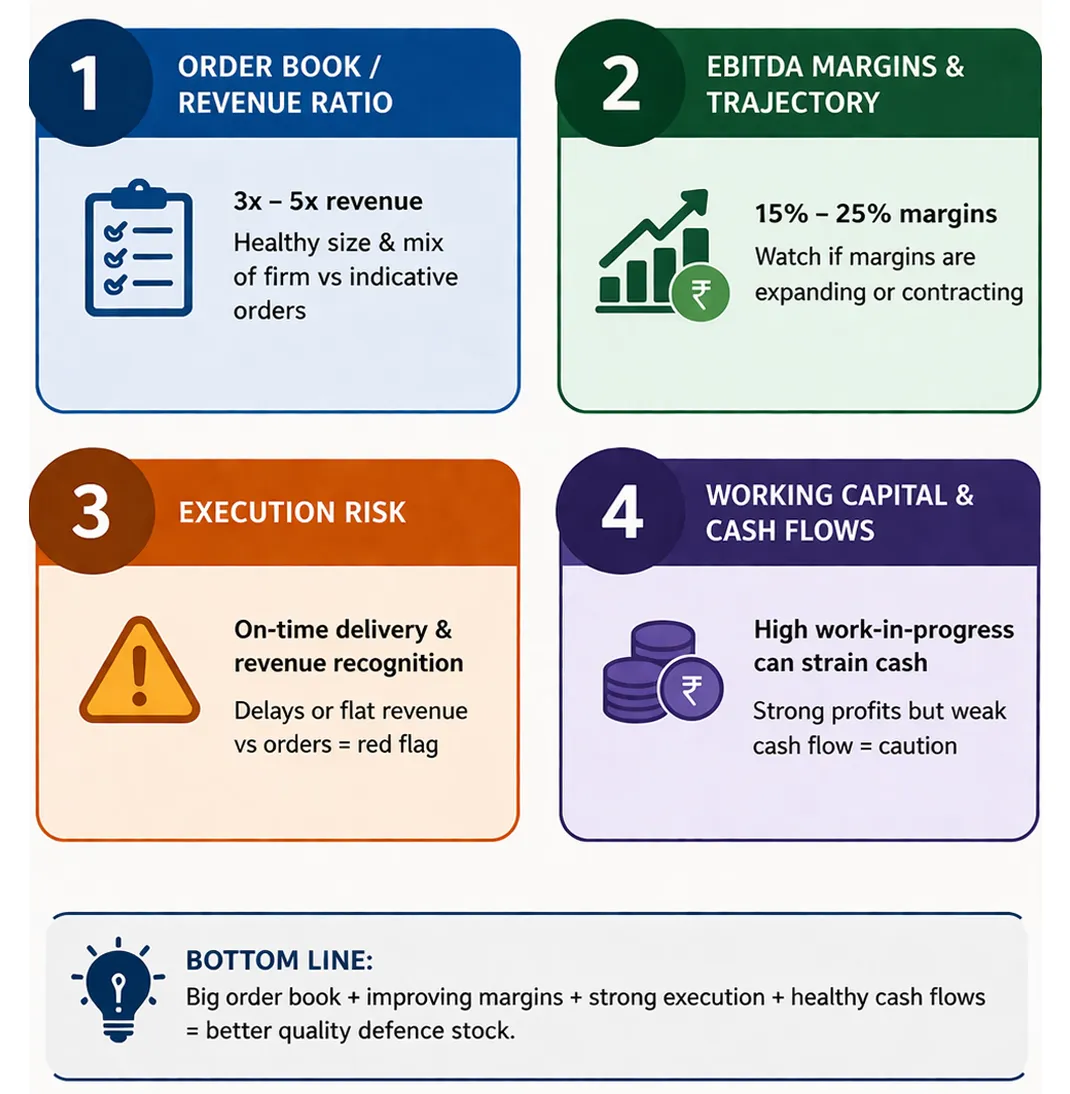
1. Order Book to Revenue Ratio
A healthy defence company should have an order book that is 3x to 5x its annual revenue, providing 3–5 years of revenue visibility. But more important than the size of the order book is its composition: what’s the proportion of "firm" orders versus "indicative" orders? What’s the mix of products (high margin vs. low margin)? How much of the order book is milestone-based (revenue recognised as project milestones are achieved)?
2. EBITDA Margins and Their Trajectory
Defence PSUs have historically operated at EBITDA margins of 15–25%, which sounds decent but masks the capital intensity of the business and the long cash conversion cycles. Private companies typically target higher margins as they scale, but they’re investing heavily right now, which compresses current margins.
When evaluating any company from the defence stocks list , look at whether margins are expanding or contracting as the order book scales expansion signals operating leverage, contraction signals cost overruns or pricing pressure.
3. Execution Risk
This is the variable that causes the most damage to investors who don’t account for it. Indian defence procurement has a history of delays in trials, in vendor selection, in contract negotiations, and in actual delivery. A company with a ₹50,000 crore order book is worth much less if its execution track record shows consistent two-year delays on every program.
Look at revenue recognition patterns relative to order intake. If a company has been announcing orders for three years but revenue growth has been flat, something is structurally wrong.
4. Working Capital and Cash Flows
Defence contracts often front-load payment milestones toward delivery, which means companies carry significant work-in-progress on their balance sheets. This capital intensity, combined with slow government payment cycles, means many companies within the defence sector stocks have stretched working capital positions.
Cash flow from operations can look weak even when profits look strong. This doesn’t make a company uninvestable, but it should factor into your valuation thinking.
Best Defence Stocks in India: What Analysts Are Watching
The list of top defence stocks in India that professional investors and analysts actively track includes a mix of PSUs and private players. Below is a structured snapshot. Note that this is an analytical context, not a buy recommendation.
Company | Segment | Why Analysts Watch It |
HAL (Hindustan Aeronautics) | Aircraft, Helicopters | LCA Tejas Mk2, LCH orders, strong order book visibility |
BEL (Bharat Electronics) | Radar, Electronics, EW | Diversified order book, consistent execution, export capability |
Mazagon Dock | Naval shipbuilding | Submarine & destroyer orders; strong revenue visibility |
Garden Reach Shipbuilders | Naval vessels | P17A frigate program; improving margins |
BEML | Ground vehicles | Mining + metro exposure reduces pure-play defence risk |
L&T (Defence segment) | Missiles, Ships, Artillery | Scale, private sector capital allocation, K9 Vajra execution |
Bharat Forge | Artillery, Ammunition | Export wins; transitioning from auto-cyclical to defence steady |
Data Patterns | Defence electronics | Niche, high-margin, small-cap with disproportionate order book growth |
Paras Defence | Space & defence optics | Niche electronics and optics; export potential |
Solar Industries | Ammunition & explosives | Defence ammunition exports: strong margins |
This is not an exhaustive defence stocks list, and it is not meant to be treated as investment advice. Each of these companies has specific risks, valuation contexts, and business model nuances that deserve individual analysis.
What analysts watching the best defence sector stocks tend to look for right now: companies where order book growth is outpacing stock price appreciation (meaning the market hasn’t fully priced in the order pipeline), companies with demonstrated export traction, and companies with improving EBITDA margins as scale increases.
The broader all defence sector stocks universe includes dozens of smaller companies defence electronics manufacturers, specialised component makers, software companies serving defence, many of which have seen sharp rerating but have thinner order books and shorter operating histories than the names above.
Also Read: Battery Energy Storage Systems: India’s Missing Power Link
Conclusion
The rally in defence stocks has been significant, but the structural story remains intact. India’s push for self-reliance, increasing defence budgets, and growing export ambitions create a strong foundation for long-term growth.
However, not all defence sector stocks are equal. Investors need to be selective and focus on fundamentals rather than momentum. The list of defence sector stocks in India includes both high-quality businesses and speculative names.
For those building exposure to Indian defence stocks, diversification and disciplined investing are key. Instead of chasing short-term rallies, focusing on companies with strong order books and execution capabilities can yield better outcomes.
As the sector evolves, top defence sector stocks are likely to become integral to long-term portfolios. Whether you are exploring the defence stocks list for the first time or looking to refine your holdings, understanding the underlying drivers is essential.
In a market driven by narratives, the defence sector stands out because its growth is backed by policy, capital allocation, and global demand. That’s precisely why defence stocks to buy continue to attract serious investor attention.

Is your portfolio built for what’s coming?
Get a free AI-powered review of your holdings — risk, overlap and quality in minutes.
Frequently Asked Questions
1. Are defence stocks a good long-term investment in India?
Yes, defence stocks can be strong long-term bets due to policy support, rising budgets, and export potential. However, returns depend on execution and valuations. Investors should focus on fundamentally strong defence sector stocks with consistent order inflows and margin visibility rather than chasing momentum.
2. Which is the best defence stock to buy in India right now?
There’s no single “best” pick. The best defence stocks are those with strong order books, execution track record, and export growth. Leaders like HAL, BEL, and emerging private players often feature among top defence stocks, but valuation and timing matter more than popularity.
3. How does the Union Budget affect defence stocks?
The Union Budget impacts India's defence stocks mainly through capital expenditure allocation. Higher capex signals future orders for companies, boosting sentiment. However, markets often price expectations early, so actual stock movement depends on execution timelines, not just budget announcements.
4. is the difference between defence PSU stocks and private defence stocks?
PSU defence sector stocks offer stability, large order books, and government backing. Private defence industry stocks focus on innovation, efficiency, and exports, often delivering faster growth. PSUs are predictable, while private players can offer higher upside with slightly higher execution risk.
5. Why are defence stocks falling despite strong order books?
Even strong defence stocks can fall due to valuation corrections, delayed execution, or profit booking after sharp rallies. Markets also react to margin pressure and slower revenue recognition. A large order book doesn’t guarantee near-term earnings, which often impacts the sentiment of defence sector stocks.