


The best textile stocks in India span large caps like Page Industries and KPR Mill to high-risk small-cap textile stocks like LS Industries and Garware Technical Fibres. Key catalysts for textile sector stocks include the China+1 sourcing shift, India-UK FTA, and the PLI scheme, making 2025-26 a pivotal year for identifying multibagger textile stocks and top textile stocks with strong earnings recovery potential.
Introduction
Every investor who has chased the next big pharma or IT multibagger knows the feeling. Sectors rotate, narratives shift, and the stocks that fly next are often the ones most overlooked today. Textiles are one such sector. For years, it sat in the shadow of more glamorous industries. But the data, the trade policy tailwinds, and the earnings recovery cycle all point to one clear signal: textile stocks are back in focus, and they deserve a serious look in your portfolio.
This blog covers the full landscape, from stable large-cap textile stocks to high-growth small-cap textile stocks , and breaks down what actually makes a multibagger textile stock worth holding. If you are wondering which textile stocks to buy right now, this guide will help you think it through clearly.
See what markets are pricing in
Live indices, sector moves and market breadth — the backdrop to every story we publish.
Why Textile Stocks Are Back in Focus in 2025-26
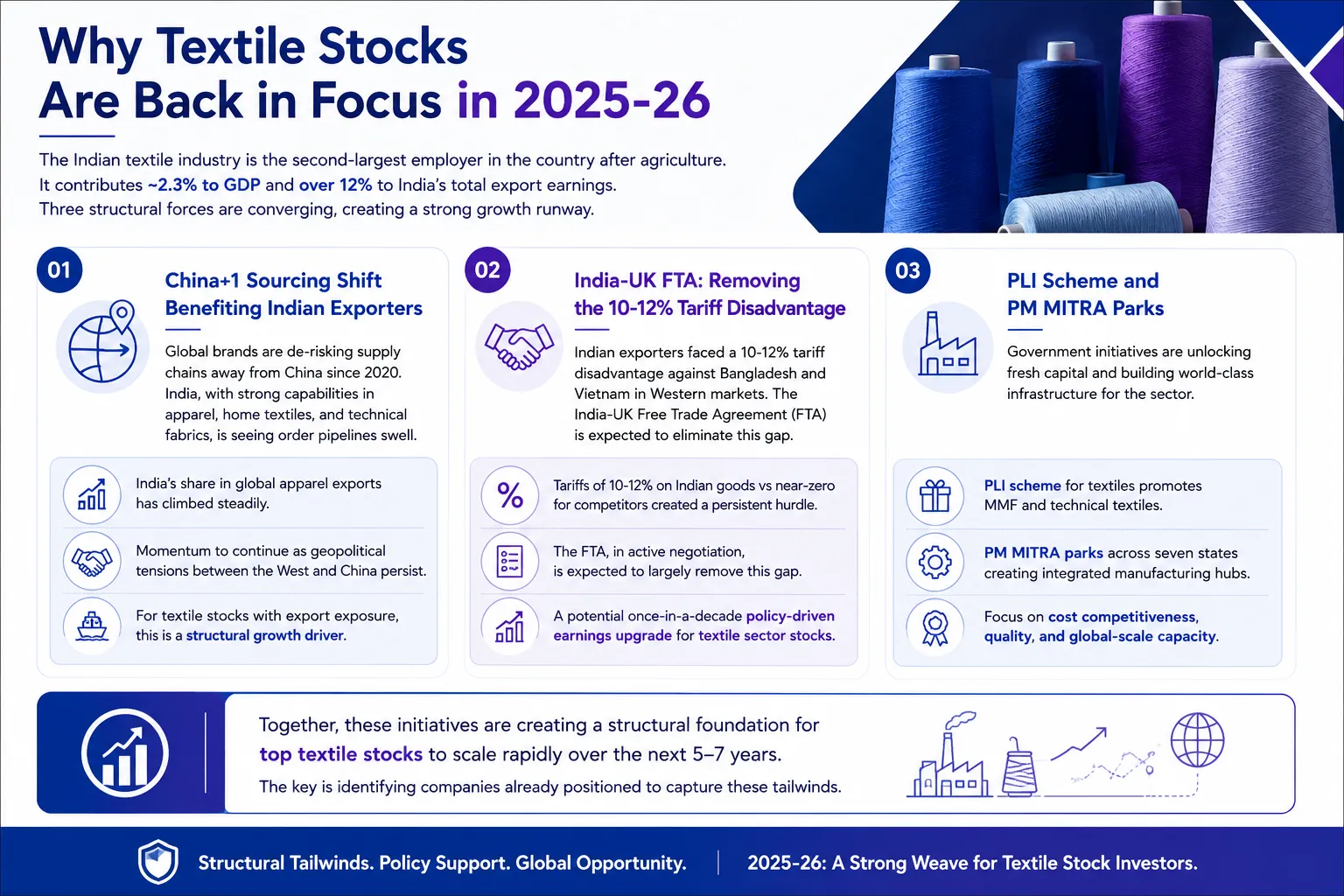
The Indian textile industry is the second-largest employer in the country after agriculture. It contributes approximately 2.3% to GDP and over 12% to India's total export earnings. Yet for long stretches, textile sector stocks were considered slow-moving, cyclical, and vulnerable to global demand shocks. What changed?
Three structural forces are converging, and smart investors are paying attention.
China+1 Sourcing Shift Benefiting Indian Exporters
Global brands from H&M to Nike to Walmart have been actively de-risking their supply chains away from China since 2020. India is the primary beneficiary of this shift. Indian textile exporters, particularly those with capacity in apparel, home textiles, and technical fabrics, are seeing order pipelines swell.
The share of India in global apparel exports has climbed steadily, and the momentum is expected to continue as geopolitical tensions between the West and China persist. For textile stocks with significant export exposure, this is a structural growth driver, not a one-quarter phenomenon.
India-UK FTA: Removing the 10-12% Tariff Disadvantage
Indian textile exporters have long faced a significant handicap against Bangladesh and Vietnam in accessing Western markets. Tariffs of 10-12% on Indian goods versus near-zero for competitors have created a persistent disadvantage. The India-UK Free Trade Agreement (FTA), which has been in active negotiation, is expected to largely eliminate this tariff gap for Indian exporters.
If and when it comes into full effect, this could be the single biggest policy-driven earnings upgrade for textile sector stocks in a decade. Companies with strong UK and European export exposure stand to see meaningful margin expansion.
PLI Scheme and PM MITRA Parks
The government's Production Linked Incentive (PLI) scheme for textiles, focused on man-made fibre (MMF) and technical textiles, is unlocking fresh capital investment in modernising the sector. PM MITRA (Mega Integrated Textile Region and Apparel) parks, being set up across seven states, aim to create integrated manufacturing hubs that can compete globally on cost and quality.
Together, these initiatives are creating a structural foundation for top textile stocks to scale rapidly over the next five to seven years. The key is identifying companies already positioned to capture PLI incentives or benefit from MITRA infrastructure.
Large Cap Textile Stocks: Stable Foundation
For investors seeking lower volatility within the textile stocks universe, large caps offer an attractive entry point.
Page Industries, Vardhman, KPR Mill, Welspun Living
Page Industries is the exclusive licensee of Jockey in India, a brand as much as a textile play. Its consistent earnings, strong ROCE, and premium positioning make it a core holding for quality-focused investors. It is not going to be a 5x in three years, but it is the kind of best textile share that compounds quietly and reliably.
- Vardhman Textiles is one of India's largest integrated textile companies, with cotton yarn, fabric, and acrylic fibre businesses. Its focus on export-linked revenue and capacity expansion positions it well as global sourcing shifts accelerate.
- KPR Mill stands out for its consistent execution, backward integration, and growing knitwear exports. It has repeatedly posted strong EBITDA margins and cash flows, rare qualities in a traditionally low-margin sector.
- Welspun Living is India's largest home textile exporter, supplying to Walmart, Target, and Ikea. With a heavy US and Europe export mix, it stands to benefit significantly from both the China+1 shift and any FTA-linked tariff relief.
Company |
Segment |
Key Strength |
Export Focus |
Page Industries |
Innerwear / Branded |
Brand moat, high ROCE |
Domestic dominant |
Vardhman Textiles |
Yarn, Fabric |
Scale, integration |
High export |
KPR Mill |
Knitwear, Apparel |
Margins, execution |
Growing exports |
Welspun Living |
Home Textiles |
Walmart/Target supply |
Very high export |
Mid Cap Textile Stocks: Growth with Manageable Risk
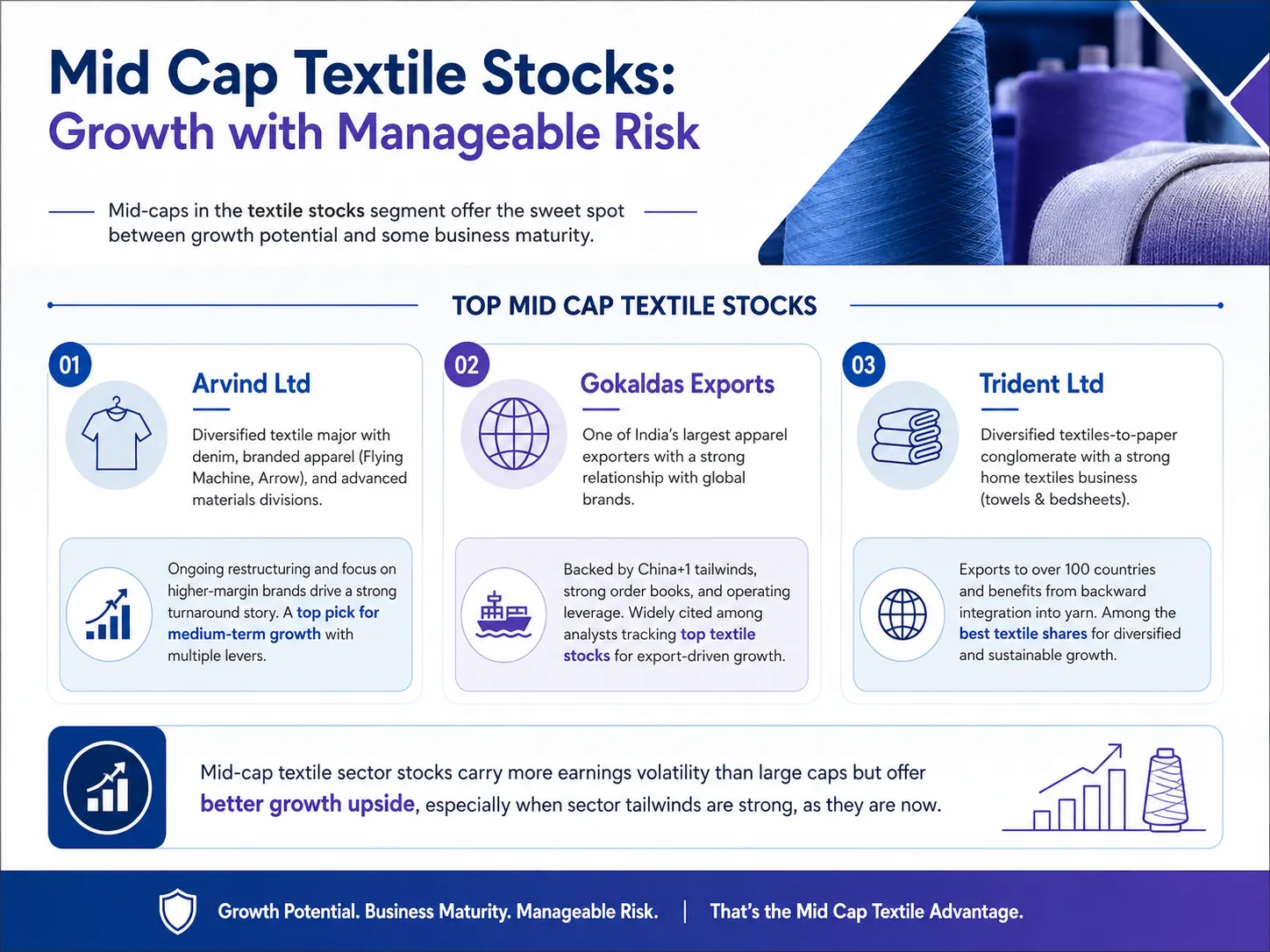
Mid-caps in the textile stocks segment offer the sweet spot between growth potential and some business maturity.
Arvind Ltd, Gokaldas Exports, Trident Ltd
Arvind Ltd is a diversified textile major with denim, branded apparel (Flying Machine, Arrow), and advanced materials divisions. Its ongoing restructuring and focus on higher-margin branded segments make it a compelling turnaround story. As the best textile stock to buy for medium-term growth, Arvind offers multiple levers.
Gokaldas Exports is one of India's largest apparel exporters, with a direct relationship with global brands. As order books strengthen due to China+1 tailwinds, Gokaldas is well-placed to deliver strong revenue and operating leverage. The stock is widely cited among analysts tracking top textile stocks for export-driven growth.
Trident Ltd is a diversified textiles-to-paper conglomerate. Its home textiles division (towels and bedsheets) exports to over 100 countries, and it benefits from backward integration into yarn. For investors seeking the best textile share with some diversification across businesses, Trident warrants attention.
Mid-cap textile sector stocks carry more earnings volatility than large caps but offer better growth upside, especially when sector tailwinds are strong, as they are now.
Get research like this in your inbox
The week’s research that mattered, in five minutes. Joined by 2L+ investors.
Small Cap Textile Stocks: High Growth and Higher Risk in 2026
This is where the multibagger narratives originate, and where careful stock selection matters most.
The Technical Textiles Segment Is the Fastest-Growing Sub-Sector
Technical textiles, meaning fabrics used in agriculture, defence, infrastructure, medical applications, and sports, are growing at nearly 12-15% annually. This segment is significantly underpenetrated in India relative to global averages, and government policy is actively pushing domestic manufacturing. Small-cap textile stocks in this sub-segment often carry both high growth potential and significant risk, demanding thorough due diligence.
Garware Technical Fibres, LS Industries
Garware Technical Fibres is arguably the most sophisticated company in the Indian technical textiles space. It supplies high-performance nets and ropes to aquaculture, agriculture, sports, and industrial sectors globally. Its R&D moat and export mix make it a unique holding among the best textile stocks in India. The stock has delivered strong returns historically and continues to attract institutional interest.
LS Industries (formerly known as Lippi Systems) operates in the technical textiles and industrial segment. As a small-cap textile stock, it carries higher liquidity risk but also higher upside potential if its order book expands alongside sector growth. Investors considering this stock should apply position-sizing discipline given its smaller scale.
The best stocks in the textile industry within the small-cap space require you to assess capacity utilisation rates, order book disclosures, export dependence, and balance sheet quality, not just a compelling narrative.
Multibagger Textile Stocks: 3 Signals to Look for Before Investing
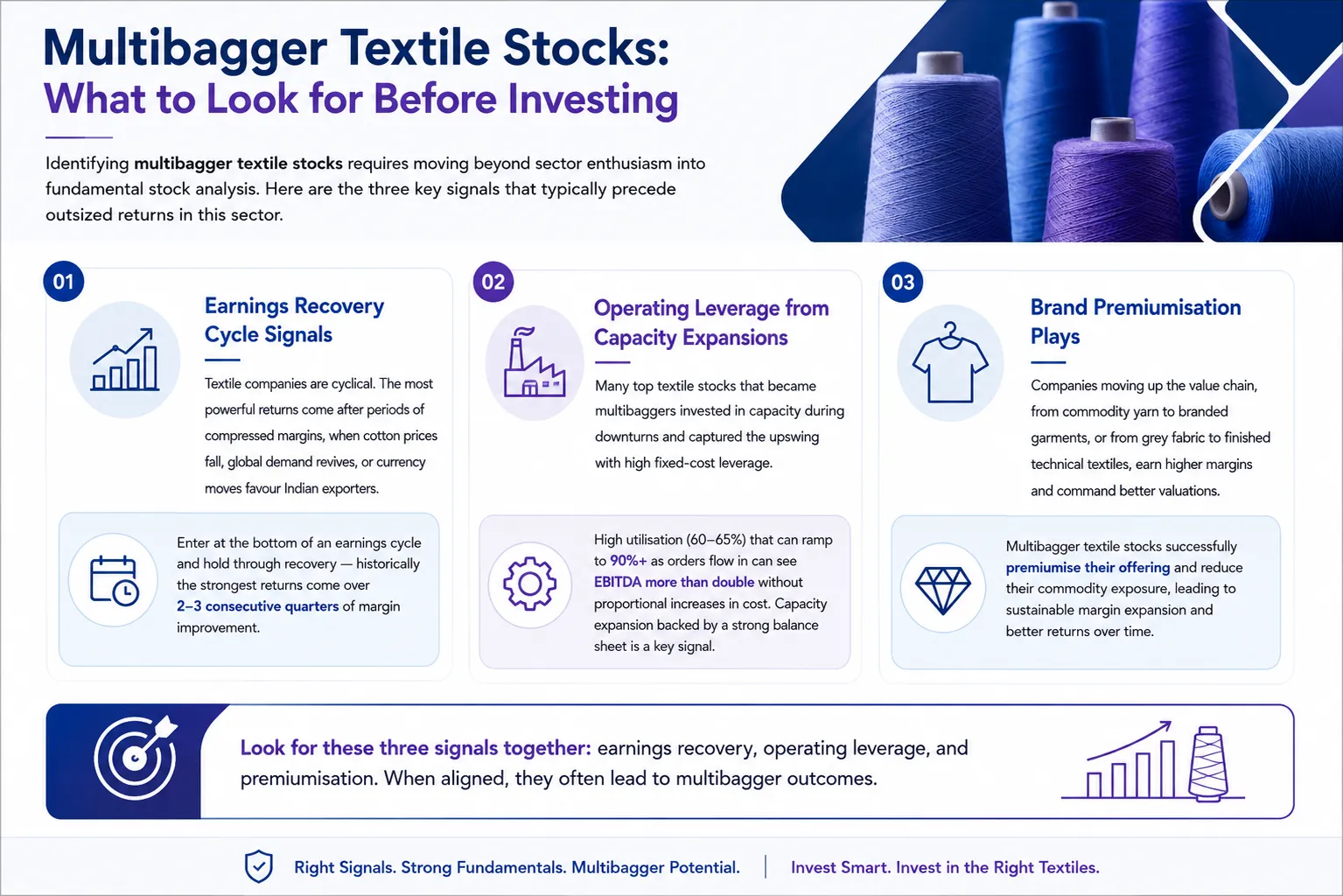
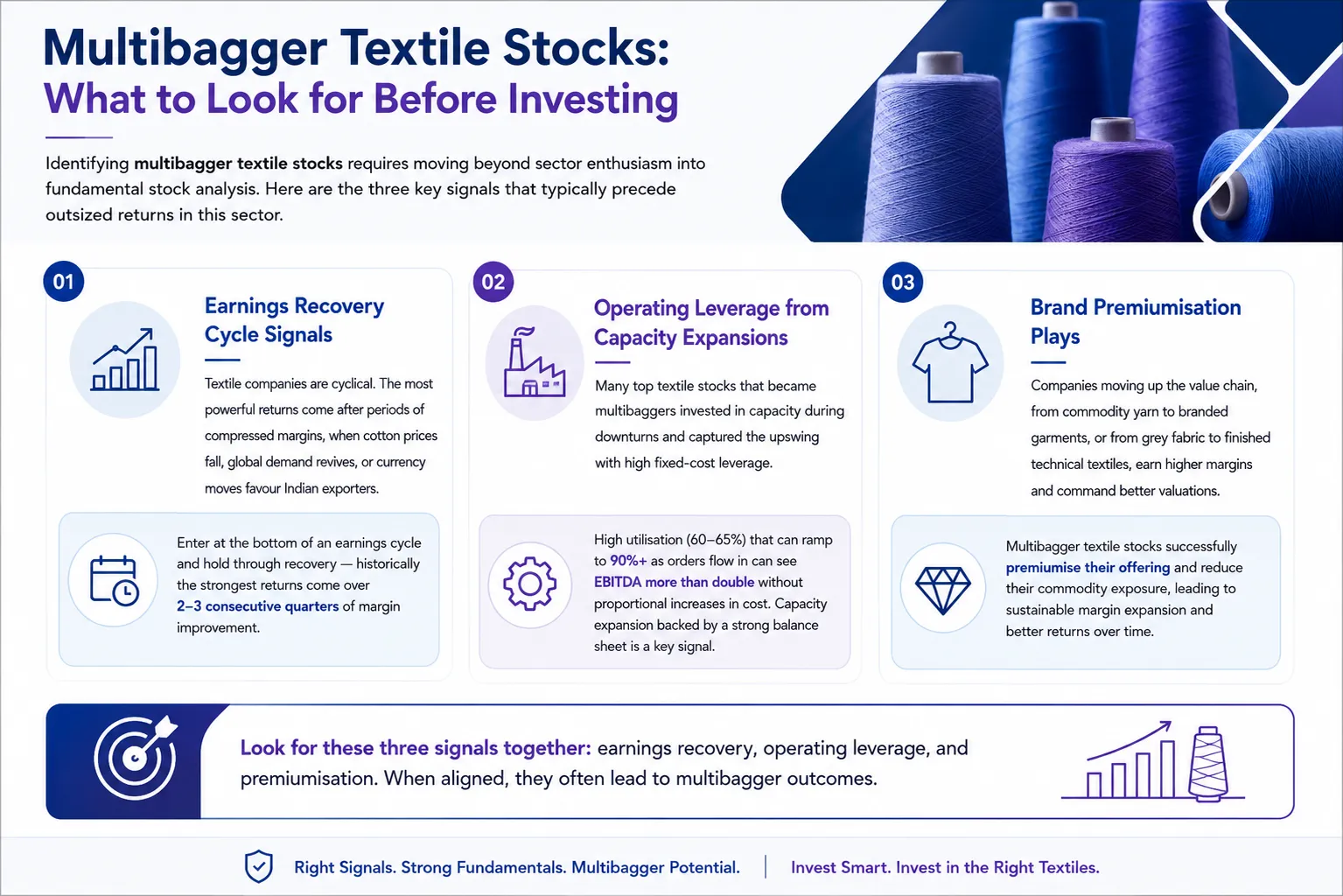
Identifying multibagger textile stocks requires moving beyond sector enthusiasm into fundamental stock analysis. Here are the three signals that typically precede outsized returns in this sector.
Earnings Recovery Cycle Signals
Textile companies are cyclical. The most powerful returns come after periods of compressed margins, when cotton prices fall, global demand revives, or currency moves favour Indian exporters. Investors who enter textile stocks at the bottom of an earnings cycle and hold through the recovery have historically generated the strongest returns. Watch for two or three consecutive quarters of margin improvement as a confirmation signal.
Operating Leverage from Capacity Expansions
Many top textile stocks that became multibaggers did so because they had invested in capacity during downturns and captured the upswing with high fixed-cost leverage. A company running at 60-65% utilisation that ramps to 90%+ as orders flow in can see EBITDA more than double without proportional increases in cost. Capacity expansion announcements, when backed by credible balance sheets, are a key signal.
Brand Premiumisation Plays
Companies moving up the value chain, from commodity yarn to branded garments, or from grey fabric to finished technical textiles, tend to earn higher margins and command better valuations over time. Multibagger textile stocks are often those that have successfully premiumised their offering and reduced their commodity exposure.
Key Risks in Textile Stocks: What Could Go Wrong
No honest discussion of textile sector stocks can skip the risks. Here is what can derail even the most well-researched thesis.
Cotton Price Volatility
India's textile industry is heavily dependent on cotton, and cotton prices are influenced by global crop yields, monsoon patterns, and US export policy. A sharp spike in cotton prices can compress margins overnight, particularly for companies without backward integration or hedging mechanisms. This is why vertically integrated players tend to command valuation premiums among the best textile stocks to buy.
Global Demand Slowdown
A recession in the US or Europe, India's two largest export markets for textiles, can quickly translate into order cancellations and inventory buildup at Indian manufacturers. The 2023 slowdown in global retail spending was a reminder of how quickly export-linked textile stocks can de-rate when end demand falters.
Regulatory and Sustainability Risks
Global brands are increasingly enforcing sustainability standards on their supply chains. Companies that fail to meet environmental compliance requirements, particularly around water usage and effluent treatment, risk losing marquee customers. Regulatory risk is growing, especially for dye and process houses. When evaluating the best stocks in textile industry, sustainability track records are no longer optional to assess.
Risk Factor | Who Is Most Exposed | Mitigation |
Cotton price spike | Non-integrated spinners | Backward integration, hedging |
Global demand slowdown | Export-heavy players | Domestic business diversification |
Sustainability non-compliance | Process/dye houses | ESG investment, certifications |
Currency risk | USD-heavy exporters | Natural hedging, forex strategy |
Conclusion
The best textile stocks in India for 2025-26 are not a monolith. They span large caps with brand moats, mid-caps with export growth stories, and small-cap textile stocks with technical innovation plays. The sector has three structural tailwinds working simultaneously: China+1 sourcing, India-UK FTA, and government PLI/MITRA support. But none of that eliminates stock-specific risk.
If you are looking to build a position in textile sector stocks, the approach that tends to work best is a tiered one. Anchor the portfolio with quality large caps, add selective mid caps with strong export books, and maintain a small, high-conviction allocation to small-cap textile stocks if you can tolerate the volatility.
Our quant-based approach to portfolio construction evaluates textiles and other cyclical sectors through the lens of momentum, quality, and value signals, removing the emotional bias that often leads investors to buy at peaks and sell at troughs.
If you would like to explore how textiles and other high-conviction sector themes fit into a professionally managed portfolio, speak with the Wright Research investment team or explore our PMS and smallcase strategies.
The textile story is just getting started. The question is whether you are positioned for it.
Is your portfolio built for what’s coming?
Get a free AI-powered review of your holdings — risk, overlap and quality in minutes.
Frequently Asked Questions
Which textile stocks in India have the highest potential for multibagger returns?
Multibagger textile stocks tend to emerge from companies undergoing earnings recovery after margin compression, scaling capacity with operating leverage, or moving up the value chain through premiumisation. Stocks like Garware Technical Fibres in technical textiles, and select export-focused mid-caps like Gokaldas Exports, are frequently cited by analysts for their multibagger potential, but stock selection requires thorough fundamental analysis and risk assessment.
What factors should I look at before investing in textile stocks in India?
Before investing in textile stocks, evaluate cotton price exposure and hedging mechanisms, export revenue mix and key customer concentration, capacity utilisation trends, debt levels, EBITDA margin trajectory, and ESG compliance. For export-linked best textile stocks to buy, also assess the company's sensitivity to rupee-dollar movement and global retail demand cycles.
Are small-cap textile stocks worth investing in for high growth in 2026?
Small-cap textile stocks carry higher return potential but also significantly higher risk, including lower liquidity, earnings volatility, and dependence on a few large customers. Investors with a high-risk tolerance and a long-term horizon of 3 to 5 years may find value in selectively picking technically differentiated or export-driven small caps. Position sizing is critical.
How do the PLI scheme and India-UK FTA impact textile stocks and returns?
The PLI scheme incentivises production of man-made fibres and technical textiles, encouraging investment in modernisation. The India-UK FTA, once operational, is expected to eliminate the 10-12% tariff gap Indian exporters face against Bangladesh and Vietnam in UK markets. Together, these policies could meaningfully improve the revenue and margin outlook for top textile stocks with MMF and export exposure over the next two to three years.
What is the difference between large-cap and small-cap textile stocks in India?
Large-cap textile stocks (like Page Industries, Welspun Living) offer relative stability, brand moats, institutional coverage, and lower volatility, suited to conservative to moderate investors. Small-cap textile stocks (like Garware Technical Fibres, LS Industries) are higher-risk, less liquid, and more sensitive to earnings shocks but offer larger upside potential when the sector cycle turns. A diversified mix across market caps is generally a more balanced approach.