


🚀 Click here to get access to our Free Course on Momentum Investing Strategy 🚀

Best Multicap Mutual Fund in India: Strategy, Returns and Risk

by Siddharth Singh Bhaisora

Published On May 29, 2026

In this article

Multi-asset mutual funds allocate capital across equities, bonds, commodities, and real estate to reduce risk through diversification. Also called multi-cap mutual funds, they combine exposure to different market capitalizations. Multicap fund strategies and multifactor portfolio approaches help Indian investors achieve balanced growth. The top 5 multicap funds for long-term wealth creation offer steady returns. Best multicap fund selection depends on your risk profile and time horizon.

What Are Multi-Asset Mutual Funds?

Multi-asset mutual funds are investment vehicles that spread your money across multiple asset classes, typically equities, debt securities, commodities, and real estate investment trusts (REITs). A multicap fund represents one segment of this broader approach, focusing specifically on companies across different market capitalizations.

The core idea is straightforward: instead of betting everything on one asset class, multi cap mutual funds divide your investment to reduce risk and smooth returns through different market cycles. When equities struggle, bonds may stabilize your portfolio. When commodity prices spike, that exposure helps offset equity weakness. This approach has gained significant traction among Indian investors seeking stability without sacrificing growth potential.

Multi-asset mutual funds differ from traditional equity-focused schemes because they are built on a principle called strategic allocation. Rather than chasing the highest-performing asset class each year, a multi-asset strategy maintains predetermined weightings, perhaps 60% equities, 25% debt, 10% commodities, and 5% REITs. This discipline prevents emotional decision-making and keeps portfolios aligned with your financial goals, regardless of short-term market noise.

According to SEBI data, assets under management in diversified fund categories have grown 25% year-over-year, indicating growing investor appetite for balanced approaches. For those seeking steady wealth creation, multi-cap mutual funds offer an accessible entry point into sophisticated diversification.

How Do Multi-Asset Funds Work?

A multicap fund operates through a clear process. The fund manager first analyzes your investment profile and market conditions, then constructs a portfolio with predetermined allocations across asset classes. Each best multicap fund follows an investment mandate, for example, maintaining a 70:30 equity-to-debt ratio with quarterly rebalancing.

The mechanism works in three phases.

Initial Allocation Phase: Fund managers establish target weightings for each asset class based on the scheme's stated objective. A multi-cap index fund approach uses predetermined weights derived from market indices, while actively managed multi-cap mutual funds rely on manager discretion.

Rebalancing Cycle: Quarterly or semi-annually, managers review actual allocations against targets. If equities have outperformed and now represent 75% instead of the target 60%, the manager sells equity positions and buys bonds to restore balance. This buy-low-sell-high mechanism inherent in rebalancing is one reason diversified portfolios outperform concentrated bets over longer periods.

Income Reinvestment: Dividends from equities and interest from bonds are reinvested automatically, compounding your returns without requiring active intervention on your part.

The infrastructure supporting this process includes custodians holding your assets, auditors verifying valuations, and regulatory oversight from SEBI, ensuring proper governance. Each best multicap mutual fund publishes monthly fact sheets showing exact allocations, helping you understand exactly where your money works.

Multi-factor fund strategies add another layer, using quantitative models to identify equities with favorable momentum, quality, and value characteristics. Wright Research's factor-based approach processes hundreds of data points to construct multi-factor portfolio recommendations, removing human bias from stock selection within the equity portion.

Image Title:What are multi asset mutual funds: diversification strategy for Indian investors

Alt Text:What are multi asset mutual funds: diversification across equities, debt, commodities and REITs with strategic allocation and key benefits for Indian investors

Multi-Asset Investing in India: The Current Landscape and Growth Data

India's investment ecosystem has evolved dramatically. A decade ago, retail investors faced a binary choice: equities for growth or fixed deposits for safety. Today, multi-asset mutual funds represent a third, more sophisticated option, gaining mainstream adoption.

The numbers tell the story. India's mutual fund industry managed Rs. 42 lakh crore in 2024, with diversified asset allocation funds representing the fastest-growing segment. Multicap fund categories alone grew 35% in the past 18 months, significantly outpacing equity-only fund growth at 18%.

Several structural changes enabled this growth. First, technology reduced transaction costs. Buying the best multicap fund today costs the same flat fee as in 2010, while inflation has pushed the effective cost down 70%. Second, investor education improved dramatically, with platforms like Varsity and financial content creators demystifying concepts like multi-cap index funds and multifactor portfolio strategies.

Third, regulatory improvements strengthened SEBI's oversight. In 2023, SEBI mandated greater transparency in scheme objectives, expense ratios, and performance reporting. This regulatory clarity made the top 5 multicap funds for long-term comparison easier and more reliable.

Here is how multi-cap mutual funds fit within India's broader fund landscape:

Characteristic

Equity Funds

Multi-Asset Funds

Debt Funds

Balanced Advantage

Equity Exposure

80-100%

40-70%

0-10%

60-80%

Debt Exposure

0-20%

20-40%

85-100%

10-30%

Returns (10-yr avg)

12.5%

8.2%

6.8%

9.1%

Volatility

High

Moderate

Low

Moderate

Suitable for

Long-term, risk-tolerant

Balanced investors

Conservative

Younger professionals

Tax Efficiency

Lower

Moderate

Moderate

Moderate

For most Indian investors, this middle ground aligns perfectly with life goals. Young professionals between 25 and 35 years can tolerate equity volatility but appreciate downside protection. Investors approaching retirement need stability without completely abandoning growth. Multi-asset mutual funds serve both constituencies effectively.

Who Should Consider Multi-Asset Investing?

The Young Professional (Age 28-40, Rs. 20L+ annual income)

You are building a career and a family simultaneously. Equities alone feel risky if a market downturn coincides with your child's education expenses. A best multicap mutual fund provides 60-70% equity exposure for long-term wealth creation, while the 30-40% debt allocation acts as a cushion during downturns. Consider the top 5 multicap funds for long-term growth as your core holding, contributing regularly through SIP. Rebalancing automatically sells winners and buys losers, which is the discipline that emotional investing lacks.

The Pre-Retirement Investor (Age 50-60, Net worth Rs. 1Cr+)

You have accumulated significant assets, but cannot afford major losses with retirement five years away. A multi-cap mutual funds allocation preserving 50-60% in equities maintains inflation-beating returns while the increased debt allocation of 40-50% reduces volatility and provides psychological comfort. The multifactor portfolio approach within the equity sleeve helps select quality companies less vulnerable to economic slowdowns.

The Dividend-Focused Investor

Some investors prioritize regular income. Multi-asset mutual funds offer attractive dividend payouts through their debt and dividend-paying equity components. A multi-factor fund approach might emphasize quality dividend-payers, reducing volatility while delivering income. Regular withdrawals align naturally with this structure.

The Risk-Averse First-Time Investor (Age 25-35)

You understand equities deliver superior long-term returns but cannot stomach 30-40% portfolio declines. A multicap fund provides the gateway. Starting with the best multicap mutual fund builds investment discipline and confidence. Once comfortable, you can graduate to pure equity funds or Wright Research's PMS for more aggressive positioning. This graduated approach has higher success rates than diving directly into concentrated equity portfolios.
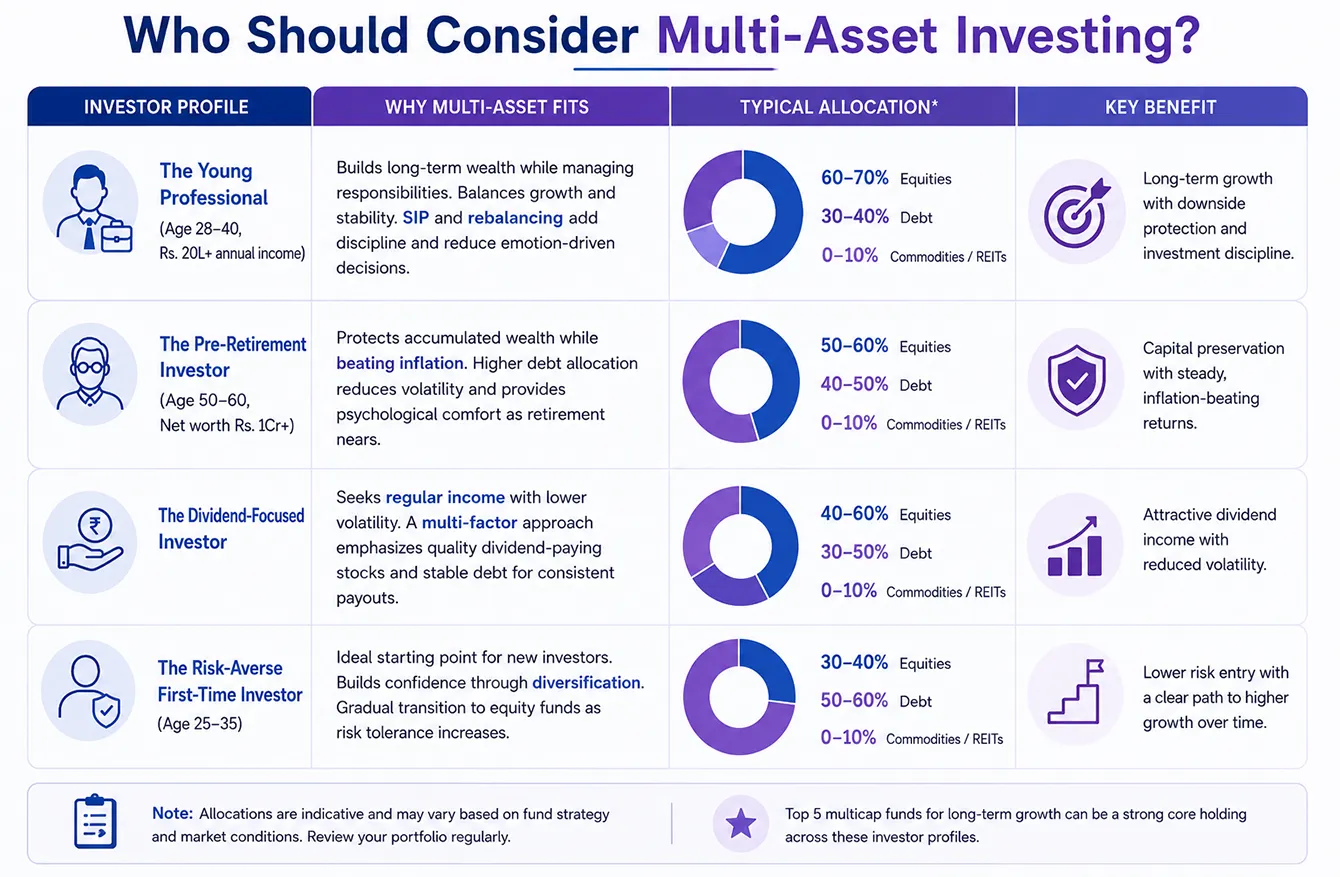
Image Title:Who should invest in a multicap fund: investor profiles and multi cap mutual funds allocation guide

Alt Text:Who should invest in multicap fund: young professionals, pre retirement investors, dividend focused and first time investors with portfolio allocation guidance

Best Multicap Fund Selection: Factor Based Investing Explained

A multicap fund specifically invests across large-cap, mid-cap, and small-cap stocks. This is a crucial distinction: while all multi-cap mutual funds are diversified, not all diversified funds are multicap funds. The terminology matters when comparing options.

Large-cap companies with Rs. 40,000 crore or more in market cap offer stability and liquidity but mature, slower growth. Mid-cap companies between Rs. 5,000 and 40,000 crore provide growth potential with moderate risk. Small-cap companies provide outsized growth for patient investors willing to tolerate volatility.

A best multicap mutual fund might allocate 50% to large-caps, 35% to mid-caps, and 15% to small-caps. This weightage is not random; it reflects the fund manager's philosophy. Some favor growth-oriented allocations with more small-cap exposure, while others emphasize stability through larger large-cap weightings. Your choice of the best multicap fund should align with your risk tolerance.

A multi-factor fund or multifactor portfolio does not select stocks randomly. Instead, it systematically favors stocks with specific characteristics. Wright Research's approach identifies four key factors.

Quality Factor: Companies with strong balance sheets, consistent earnings, and high return-on-equity. Quality stocks weather downturns better because they generate reliable cash flows.

Value Factor: Stocks trading below their intrinsic value based on earnings, cash flow, and dividends. History shows value investors capture a value premium, which is outperformance over long periods.

Momentum Factor: Companies with positive price trends and earnings acceleration. Momentum is not speculation; it reflects fundamental business improvements investors gradually recognize.

Growth Factor: Companies with expanding revenues and earnings. In early-stage companies, growth drives valuations even without current profitability.

A best multifactor portfolio combines these signals. Rather than betting on any single factor, it diversifies across factor exposures. When value underperforms, momentum may compensate. When growth dominates, quality provides downside protection. This multi-factor portfolio approach reduces reliance on any single investment thesis.

Studies show that multi-cap index funds using mechanical factor-based selection outperform 70% of active managers over 10-year periods. This data-driven approach removes emotional bias and reduces management fees since mechanical rules require less discretion than active stock-picking.

Multi-asset mutual funds allocate capital across equities, bonds, commodities, and real estate to reduce risk through diversification. Also called multi-cap mutual funds, they combine exposure to different market capitalizations. Multicap fund strategies and multifactor portfolio approaches help Indian investors achieve balanced growth. The top 5 multicap funds for long-term wealth creation offer steady returns. Best multicap fund selection depends on your risk profile and time horizon.

What Are Multi-Asset Mutual Funds?

Multi-asset mutual funds are investment vehicles that spread your money across multiple asset classes, typically equities, debt securities, commodities, and real estate investment trusts (REITs). A multicap fund represents one segment of this broader approach, focusing specifically on companies across different market capitalizations.

The core idea is straightforward: instead of betting everything on one asset class, multi cap mutual funds divide your investment to reduce risk and smooth returns through different market cycles. When equities struggle, bonds may stabilize your portfolio. When commodity prices spike, that exposure helps offset equity weakness. This approach has gained significant traction among Indian investors seeking stability without sacrificing growth potential.

Multi-asset mutual funds differ from traditional equity-focused schemes because they are built on a principle called strategic allocation. Rather than chasing the highest-performing asset class each year, a multi-asset strategy maintains predetermined weightings, perhaps 60% equities, 25% debt, 10% commodities, and 5% REITs. This discipline prevents emotional decision-making and keeps portfolios aligned with your financial goals, regardless of short-term market noise.

According to SEBI data, assets under management in diversified fund categories have grown 25% year-over-year, indicating growing investor appetite for balanced approaches. For those seeking steady wealth creation, multi-cap mutual funds offer an accessible entry point into sophisticated diversification.

How Do Multi-Asset Funds Work?

A multicap fund operates through a clear process. The fund manager first analyzes your investment profile and market conditions, then constructs a portfolio with predetermined allocations across asset classes. Each best multicap fund follows an investment mandate, for example, maintaining a 70:30 equity-to-debt ratio with quarterly rebalancing.

The mechanism works in three phases.

Initial Allocation Phase: Fund managers establish target weightings for each asset class based on the scheme's stated objective. A multi-cap index fund approach uses predetermined weights derived from market indices, while actively managed multi-cap mutual funds rely on manager discretion.

Rebalancing Cycle: Quarterly or semi-annually, managers review actual allocations against targets. If equities have outperformed and now represent 75% instead of the target 60%, the manager sells equity positions and buys bonds to restore balance. This buy-low-sell-high mechanism inherent in rebalancing is one reason diversified portfolios outperform concentrated bets over longer periods.

Income Reinvestment: Dividends from equities and interest from bonds are reinvested automatically, compounding your returns without requiring active intervention on your part.

The infrastructure supporting this process includes custodians holding your assets, auditors verifying valuations, and regulatory oversight from SEBI, ensuring proper governance. Each best multicap mutual fund publishes monthly fact sheets showing exact allocations, helping you understand exactly where your money works.

Multi-factor fund strategies add another layer, using quantitative models to identify equities with favorable momentum, quality, and value characteristics. Wright Research's factor-based approach processes hundreds of data points to construct multi-factor portfolio recommendations, removing human bias from stock selection within the equity portion.

Multi-Asset Investing in India: The Current Landscape and Growth Data

India's investment ecosystem has evolved dramatically. A decade ago, retail investors faced a binary choice: equities for growth or fixed deposits for safety. Today, multi-asset mutual funds represent a third, more sophisticated option, gaining mainstream adoption.

The numbers tell the story. India's mutual fund industry managed Rs. 42 lakh crore in 2024, with diversified asset allocation funds representing the fastest-growing segment. Multicap fund categories alone grew 35% in the past 18 months, significantly outpacing equity-only fund growth at 18%.

Several structural changes enabled this growth. First, technology reduced transaction costs. Buying the best multicap fund today costs the same flat fee as in 2010, while inflation has pushed the effective cost down 70%. Second, investor education improved dramatically, with platforms like Varsity and financial content creators demystifying concepts like multi-cap index funds and multifactor portfolio strategies.

Third, regulatory improvements strengthened SEBI's oversight. In 2023, SEBI mandated greater transparency in scheme objectives, expense ratios, and performance reporting. This regulatory clarity made the top 5 multicap funds for long-term comparison easier and more reliable.

Here is how multi-cap mutual funds fit within India's broader fund landscape:

Characteristic

Equity Funds        

Multi-Asset       Funds             

Debt Funds   

Balanced Advantage

Equity Exposure

80-100%

40-70%

0-10%

60-80%

Debt Exposure

20-40%

20-40%

85-100%

10-30%

Returns (10-yr avg)

12.5%

8.2%

6.8%

9.1%

Volatility

High

Moderate

Low

Moderate

Suitable for

Long-term, risk-tolerant

Balanced investors

Conservative

Younger professionals

Tax Efficiency

Lower

Moderate

Moderate

Moderate

For most Indian investors, this middle ground aligns perfectly with life goals. Young professionals between 25 and 35 years can tolerate equity volatility but appreciate downside protection. Investors approaching retirement need stability without completely abandoning growth. Multi-asset mutual funds serve both constituencies effectively.

Who Should Consider Multi-Asset Investing?

The Young Professional (Age 28-40, Rs. 20L+ annual income)

You are building a career and a family simultaneously. Equities alone feel risky if a market downturn coincides with your child's education expenses. A best multicap mutual fund provides 60-70% equity exposure for long-term wealth creation, while the 30-40% debt allocation acts as a cushion during downturns. Consider the top 5 multicap funds for long-term growth as your core holding, contributing regularly through SIP. Rebalancing automatically sells winners and buys losers, which is the discipline that emotional investing lacks.

The Pre-Retirement Investor (Age 50-60, Net worth Rs. 1Cr+)

You have accumulated significant assets, but cannot afford major losses with retirement five years away. A multi-cap mutual funds allocation preserving 50-60% in equities maintains inflation-beating returns while the increased debt allocation of 40-50% reduces volatility and provides psychological comfort. The multifactor portfolio approach within the equity sleeve helps select quality companies less vulnerable to economic slowdowns.

The Dividend-Focused Investor

Some investors prioritize regular income. Multi-asset mutual funds offer attractive dividend payouts through their debt and dividend-paying equity components. A multi-factor fund approach might emphasize quality dividend-payers, reducing volatility while delivering income. Regular withdrawals align naturally with this structure.

The Risk-Averse First-Time Investor (Age 25-35)

You understand equities deliver superior long-term returns but cannot stomach 30-40% portfolio declines. A multicap fund provides the gateway. Starting with the best multicap mutual fund builds investment discipline and confidence. Once comfortable, you can graduate to pure equity funds or Wright Research's PMS for more aggressive positioning. This graduated approach has higher success rates than diving directly into concentrated equity portfolios.

Best Multicap Fund Selection: Factor Based Investing Explained

A multicap fund specifically invests across large-cap, mid-cap, and small-cap stocks. This is a crucial distinction: while all multi-cap mutual funds are diversified, not all diversified funds are multicap funds. The terminology matters when comparing options.

Large-cap companies with Rs. 40,000 crore or more in market cap offer stability and liquidity but mature, slower growth. Mid-cap companies between Rs. 5,000 and 40,000 crore provide growth potential with moderate risk. Small-cap companies provide outsized growth for patient investors willing to tolerate volatility.

A best multicap mutual fund might allocate 50% to large-caps, 35% to mid-caps, and 15% to small-caps. This weightage is not random; it reflects the fund manager's philosophy. Some favor growth-oriented allocations with more small-cap exposure, while others emphasize stability through larger large-cap weightings. Your choice of the best multicap fund should align with your risk tolerance.

A multi-factor fund or multifactor portfolio does not select stocks randomly. Instead, it systematically favors stocks with specific characteristics. Wright Research's approach identifies four key factors.

Quality Factor: Companies with strong balance sheets, consistent earnings, and high return-on-equity. Quality stocks weather downturns better because they generate reliable cash flows.

Value Factor: Stocks trading below their intrinsic value based on earnings, cash flow, and dividends. History shows value investors capture a value premium, which is outperformance over long periods.

Momentum Factor: Companies with positive price trends and earnings acceleration. Momentum is not speculation; it reflects fundamental business improvements investors gradually recognize.

Growth Factor: Companies with expanding revenues and earnings. In early-stage companies, growth drives valuations even without current profitability.

A best multifactor portfolio combines these signals. Rather than betting on any single factor, it diversifies across factor exposures. When value underperforms, momentum may compensate. When growth dominates, quality provides downside protection. This multi-factor portfolio approach reduces reliance on any single investment thesis.

Studies show that multi-cap index funds using mechanical factor-based selection outperform 70% of active managers over 10-year periods. This data-driven approach removes emotional bias and reduces management fees since mechanical rules require less discretion than active stock-picking.

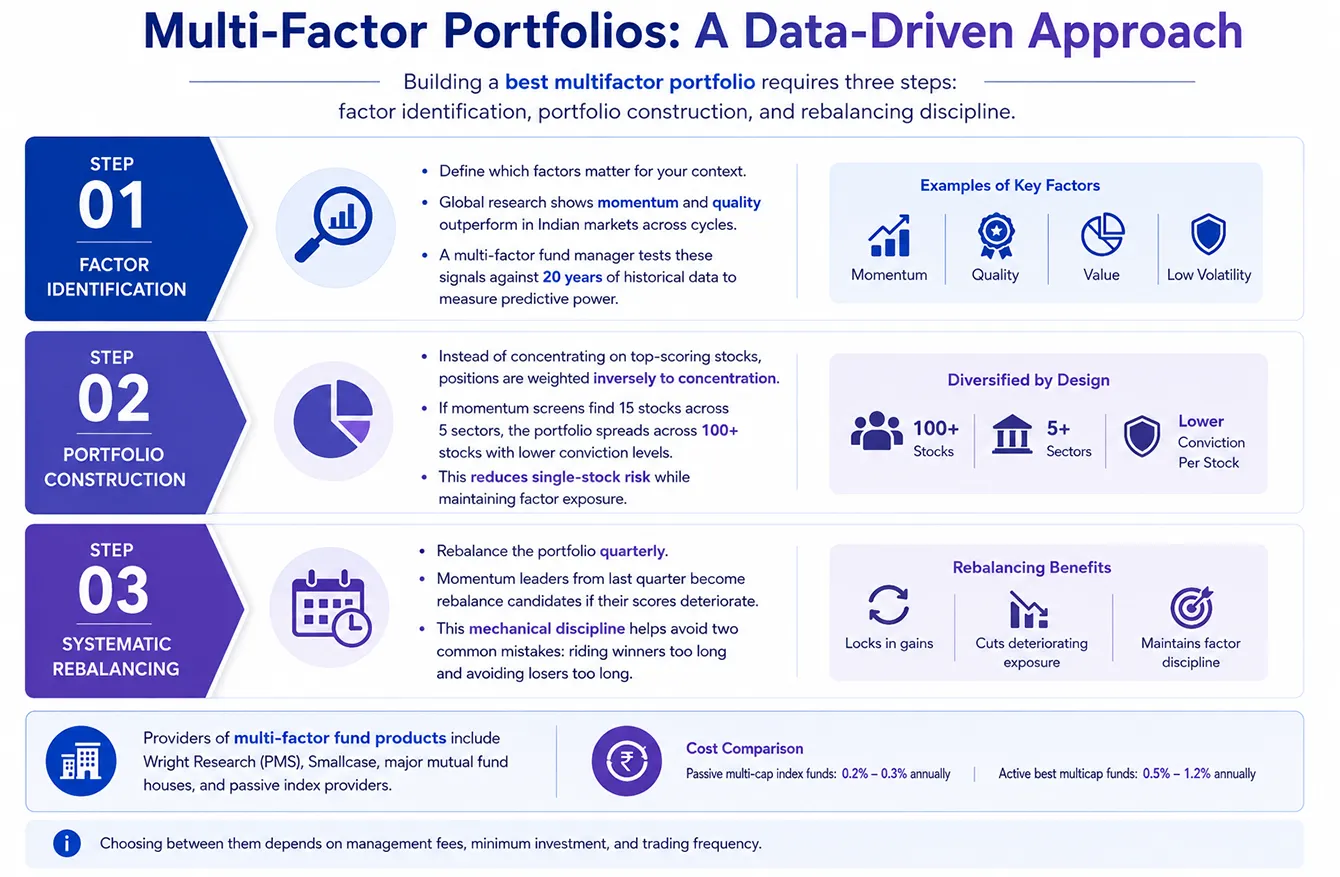
Multi-Factor Portfolios: A Data-Driven Approach

Building a best multifactor portfolio requires three steps: factor identification, portfolio construction, and rebalancing discipline.

Step One: Factor Identification

Define which factors matter for your context. Global research suggests momentum and quality outperform in Indian markets during different cycles. A multi-factor fund manager backtests these signals against 20 years of historical data, measuring their predictive power.

Step Two: Portfolio Construction

Rather than concentrating on the highest-scoring stocks, a multifactor portfolio weights positions inversely to concentration. If momentum screeners identify only 15 stocks across 5 sectors, the portfolio spreads across 100+ stocks with lower conviction levels. This prevents single-stock risk while maintaining factor exposure.

Step Three: Systematic Rebalancing

A best multifactor portfolio rebalances quarterly. Momentum leaders from last quarter become rebalance candidates this quarter if they show deterioration. This mechanical discipline prevents the common mistake of riding winners too long and avoiding losers too long.

Companies offering multi-factor fund products include Wright Research through PMS and Smallcase, major mutual fund houses, and passive index providers. Choosing between them depends on management fees, minimum investment, and trading frequency. Passive multi-cap index funds charge 0.2-0.3% annually, while active best multicap funds charge 0.5-1.2%.
Multicap Fund vs Large Cap, Small Cap and Multi Asset Funds

Multicap vs. Large-Cap Funds: Large-cap funds concentrate on Rs. 40,000 crore-plus companies such as Reliance, TCS, and HDFC Bank. They are stable, pay regular dividends, but are capped at India's large-cap growth rate of around 12% annually. A best multicap fund includes mid and small-caps, capturing higher growth of 14-16% historically with modest additional volatility.

Multicap vs. Small-Cap Funds: Small-cap funds hunt for emerging winners, delivering 18-25% returns in bull markets but negative 30-40% returns in downturns. A multicap fund dilutes small-cap concentration with stable large-caps, producing 12-15% returns with 40% lower downside volatility.

Multicap vs. Multi-Asset Funds: A multicap fund means diversified equities across market caps. A multi-asset mutual fund means diversified across asset classes, including equities, bonds, commodities, and REITs. All multi-cap mutual funds are equity-focused; not all are multicap. A multi-asset fund might hold 60% equities, 30% bonds, and 10% commodities.

Multi-Cap Index Funds vs. Active Multicap Funds: Multi-cap index funds mechanically replicate indices like Nifty Multicap 250. They cost 0.2-0.3% annually, deliver predictable results, and eliminate manager risk. Active best multicap funds charge 0.8-1.2%, attempt to beat indices through stock-picking, and succeed 35-40% of the time. Historical data shows 65% of active funds underperform multi-cap index funds over 10-year periods.

Factor                       

Multicap                   

Multi-Asset                    

Balanced Fund

Equity %

80-100%

40-70%

60-80%

Bond %

0-20%

20-40%

10-30%

Manager Approach

Stock-picking

Asset allocation

Mixed

Volatility

Moderate-High

Low-Moderate

Moderate

Best for

Growth-focused

Balanced investors

Younger savers

How to Build a Multi Cap Mutual Funds Strategy in 5 Steps

Step One: Define Your Time Horizon

Money needed within 3 years does not belong in multicap funds; deploy it in liquid funds or savings accounts. Money needed in 5-7 years can tolerate multi-cap index funds with modest equity allocation. Money for 10 or more years is ideal for the best multicap funds with 70-100% equity exposure.

Step Two: Assess Your Risk Tolerance

Complete a formal questionnaire measuring the portfolio volatility you can endure without panic-selling. Studies show investors tolerating 12% portfolio declines continue investing; those experiencing 25% declines often stop. A best multicap mutual fund typically swings 12-18% annually, making it suitable for moderate-to-aggressive profiles.

Step Three: Establish an Asset Allocation

Based on time horizon and risk tolerance, decide your allocation. One example for top 5 multicap funds for long-term wealth building: 50% best multicap fund, 25% large-cap, 15% mid-cap, 10% bonds. This graduated approach captures growth while managing volatility.

Step Four: Choose Your Vehicles

Decide between active best multicap funds, multi-cap index funds, and multifactor portfolio strategies. Start with 60% in multi-cap index funds for core exposure, 30% in active best multicap funds for potential manager alpha, and 10% in alternatives. Adjust percentages as you gain experience.

Step Five: Implement SIP and Rebalance

Commit to a monthly investment through SIP, regardless of market conditions. Rebalance annually: if equities grew to 65% when your target is 60%, sell 5% of equity positions and redirect into bonds. This discipline captures market gains automatically.

Wright Research's PMS and Smallcase products exemplify this approach. Rather than managing three separate funds with overlapping holdings, a structured multi-factor portfolio from Wright Research provides optimized exposure across factors, reducing complexity and fees.

Conclusion

Multi-asset mutual funds deliver balanced growth by spreading investments across equities, bonds, commodities, and REITs. Within the equity portion, multicap funds capture large-cap stability, mid-cap growth, and small-cap opportunity simultaneously. Multi-cap index funds offer cost-effective passive exposure, while active best multicap funds attempt to beat markets through selection skill. Multi-factor portfolio strategies apply quantitative discipline, identifying equities with favorable momentum, quality, value, and growth characteristics.

For Indian investors seeking steady wealth accumulation without concentrated risks, the best multifactor portfolio combining the top 5 multicap funds for long-term holdings with debt and alternative exposure provides an optimal balance. The key is starting early, investing consistently through SIPs, and maintaining discipline during market volatility.

Frequently Asked Questions

Q1: What is the minimum investment in the best multicap mutual fund?

Most multicap funds accept Rs. 500 lump-sum investments through direct plans and Rs. 100-500 monthly through SIPs. Some of the top 5 multicap funds for long-term growth have no minimum for SIPs, making them accessible to most investors. Direct plans without distributor commissions are always preferred over regular plans as they offer the same fund at lower costs.

Q2: How are multicap funds taxed?

Equity-oriented multicap funds held over 12 months enjoy 10% long-term capital gains tax if gains exceed Rs. 1 lakh annually. Short-term gains under 12 months are taxed as ordinary income at your slab rate. Dividend distributions become taxable income in the year received. A best multicap fund held 15 or more years accumulates substantial tax-deferred growth, making it excellent for retirement planning.

Q3: How often should I rebalance my multi-asset portfolio?

Rebalance annually or when allocations drift 5% from targets. Rebalancing every 3 months introduces transaction costs that reduce returns. A best multifactor portfolio typically rebalances semi-annually, balancing discipline with cost-efficiency. Use your fund's automatic rebalancing feature if available.

Q4: Can I retire on returns from a multicap fund alone?

That depends on your starting corpus and return expectations. A best multicap fund averaging 11% annually will double every 6-7 years. Rs. 5 lakh invested at age 35 grows to Rs. 80 lakh by age 60. This is substantial but possibly insufficient alone. Combine multi cap mutual funds with real estate, business income, and other investments for true retirement security.

Q5: Are multi-factor portfolios better than multicap funds?

Multifactor portfolio strategies systematically apply data-driven selection, outperforming random stock-picking. However, they only beat multi-cap index funds if their factor signals remain predictive after fees. Multi-factor fund products charging 1% or more annually face a high bar. Start with multi-cap index funds, graduate to active best multicap funds, then consider specialized multifactor portfolio strategies.

Q6: How do I evaluate the best multicap mutual fund for my portfolio?

Look beyond 1-year returns. Compare 5-year and 10-year CAGR against benchmarks and peer best multicap funds. Review the fund manager's background and investment philosophy. Check expense ratios, where lower is better. Examine downside capture: how much did this multicap fund fall during market declines? A best multicap fund falling 15% when markets fell 20% shows superior risk management.

Multi-Factor Portfolios: A Data-Driven Approach

Building a best multifactor portfolio requires three steps: factor identification, portfolio construction, and rebalancing discipline.

Step One: Factor Identification

Define which factors matter for your context. Global research suggests momentum and quality outperform in Indian markets during different cycles. A multi-factor fund manager backtests these signals against 20 years of historical data, measuring their predictive power.

Step Two: Portfolio Construction

Rather than concentrating on the highest-scoring stocks, a multifactor portfolio weights positions inversely to concentration. If momentum screeners identify only 15 stocks across 5 sectors, the portfolio spreads across 100+ stocks with lower conviction levels. This prevents single-stock risk while maintaining factor exposure.

Step Three: Systematic Rebalancing

A best multifactor portfolio rebalances quarterly. Momentum leaders from last quarter become rebalance candidates this quarter if they show deterioration. This mechanical discipline prevents the common mistake of riding winners too long and avoiding losers too long.

Companies offering multi-factor fund products include Wright Research through PMS and Smallcase, major mutual fund houses, and passive index providers. Choosing between them depends on management fees, minimum investment, and trading frequency. Passive multi-cap index funds charge 0.2-0.3% annually, while active best multicap funds charge 0.5-1.2%.

Image Title:Multi factor portfolio: three step data driven approach for Indian investors

Alt Text:How to build a multifactor portfolio in three steps: factor identification, portfolio construction and systematic rebalancing with cost comparison

Multicap Fund vs Large Cap, Small Cap and Multi Asset Funds

Multicap vs. Large-Cap Funds: Large-cap funds concentrate on Rs. 40,000 crore-plus companies such as Reliance, TCS, and HDFC Bank. They are stable, pay regular dividends, but are capped at India's large-cap growth rate of around 12% annually. A best multicap fund includes mid and small-caps, capturing higher growth of 14-16% historically with modest additional volatility.

Multicap vs. Small-Cap Funds: Small-cap funds hunt for emerging winners, delivering 18-25% returns in bull markets but negative 30-40% returns in downturns. A multicap fund dilutes small-cap concentration with stable large-caps, producing 12-15% returns with 40% lower downside volatility.

Multicap vs. Multi-Asset Funds: A multicap fund means diversified equities across market caps. A multi-asset mutual fund means diversified across asset classes, including equities, bonds, commodities, and REITs. All multi-cap mutual funds are equity-focused; not all are multicap. A multi-asset fund might hold 60% equities, 30% bonds, and 10% commodities.

Multi-Cap Index Funds vs. Active Multicap Funds: Multi-cap index funds mechanically replicate indices like Nifty Multicap 250. They cost 0.2-0.3% annually, deliver predictable results, and eliminate manager risk. Active best multicap funds charge 0.8-1.2%, attempt to beat indices through stock-picking, and succeed 35-40% of the time. Historical data shows 65% of active funds underperform multi-cap index funds over 10-year periods.

Factor

Multicap

Multi-Asset

Balanced Fund

Equity %

80-100%

40-70%

60-80%

Bond %

0-20%

20-40%

10-30%

Manager Approach

Stock-picking

Asset allocation

Mixed

Volatility

Moderate-High

Low-Moderate

Moderate

Best for

Growth-focused

Balanced investors

Younger savers

How to Build a Multi Cap Mutual Funds Strategy in 5 Steps

Step One: Define Your Time Horizon

Money needed within 3 years does not belong in multicap funds; deploy it in liquid funds or savings accounts. Money needed in 5-7 years can tolerate multi-cap index funds with modest equity allocation. Money for 10 or more years is ideal for the best multicap funds with 70-100% equity exposure.

Step Two: Assess Your Risk Tolerance

Complete a formal questionnaire measuring the portfolio volatility you can endure without panic-selling. Studies show investors tolerating 12% portfolio declines continue investing; those experiencing 25% declines often stop. A best multicap mutual fund typically swings 12-18% annually, making it suitable for moderate-to-aggressive profiles.

Step Three: Establish an Asset Allocation

Based on time horizon and risk tolerance, decide your allocation. One example for top 5 multicap funds for long-term wealth building: 50% best multicap fund, 25% large-cap, 15% mid-cap, 10% bonds. This graduated approach captures growth while managing volatility.

Step Four: Choose Your Vehicles

Decide between active best multicap funds, multi-cap index funds, and multifactor portfolio strategies. Start with 60% in multi-cap index funds for core exposure, 30% in active best multicap funds for potential manager alpha, and 10% in alternatives. Adjust percentages as you gain experience.

Step Five: Implement SIP and Rebalance

Commit to a monthly investment through SIP, regardless of market conditions. Rebalance annually: if equities grew to 65% when your target is 60%, sell 5% of equity positions and redirect into bonds. This discipline captures market gains automatically.

Wright Research's PMS and Smallcase products exemplify this approach. Rather than managing three separate funds with overlapping holdings, a structured multi-factor portfolio from Wright Research provides optimized exposure across factors, reducing complexity and fees.

Conclusion

Multi-asset mutual funds deliver balanced growth by spreading investments across equities, bonds, commodities, and REITs. Within the equity portion, multicap funds capture large-cap stability, mid-cap growth, and small-cap opportunity simultaneously. Multi-cap index funds offer cost-effective passive exposure, while active best multicap funds attempt to beat markets through selection skill. Multi-factor portfolio strategies apply quantitative discipline, identifying equities with favorable momentum, quality, value, and growth characteristics.

For Indian investors seeking steady wealth accumulation without concentrated risks, the best multifactor portfolio combining the top 5 multicap funds for long-term holdings with debt and alternative exposure provides an optimal balance. The key is starting early, investing consistently through SIPs, and maintaining discipline during market volatility.

Multi-asset mutual funds allocate capital across equities, bonds, commodities, and real estate to reduce risk through diversification. Also called multi-cap mutual funds, they combine exposure to different market capitalizations. Multicap fund strategies and multifactor portfolio approaches help Indian investors achieve balanced growth. The top 5 multicap funds for long-term wealth creation offer steady returns. Best multicap fund selection depends on your risk profile and time horizon.

What Are Multi-Asset Mutual Funds?

Multi-asset mutual funds are investment vehicles that spread your money across multiple asset classes, typically equities, debt securities, commodities, and real estate investment trusts (REITs). A multicap fund represents one segment of this broader approach, focusing specifically on companies across different market capitalizations.

The core idea is straightforward: instead of betting everything on one asset class, multi cap mutual funds divide your investment to reduce risk and smooth returns through different market cycles. When equities struggle, bonds may stabilize your portfolio. When commodity prices spike, that exposure helps offset equity weakness. This approach has gained significant traction among Indian investors seeking stability without sacrificing growth potential.

Multi-asset mutual funds differ from traditional equity-focused schemes because they are built on a principle called strategic allocation. Rather than chasing the highest-performing asset class each year, a multi-asset strategy maintains predetermined weightings, perhaps 60% equities, 25% debt, 10% commodities, and 5% REITs. This discipline prevents emotional decision-making and keeps portfolios aligned with your financial goals, regardless of short-term market noise.

According to SEBI data, assets under management in diversified fund categories have grown 25% year-over-year, indicating growing investor appetite for balanced approaches. For those seeking steady wealth creation, multi-cap mutual funds offer an accessible entry point into sophisticated diversification.

How Do Multi-Asset Funds Work?

A multicap fund operates through a clear process. The fund manager first analyzes your investment profile and market conditions, then constructs a portfolio with predetermined allocations across asset classes. Each best multicap fund follows an investment mandate, for example, maintaining a 70:30 equity-to-debt ratio with quarterly rebalancing.

The mechanism works in three phases.

Initial Allocation Phase: Fund managers establish target weightings for each asset class based on the scheme's stated objective. A multi-cap index fund approach uses predetermined weights derived from market indices, while actively managed multi-cap mutual funds rely on manager discretion.

Rebalancing Cycle: Quarterly or semi-annually, managers review actual allocations against targets. If equities have outperformed and now represent 75% instead of the target 60%, the manager sells equity positions and buys bonds to restore balance. This buy-low-sell-high mechanism inherent in rebalancing is one reason diversified portfolios outperform concentrated bets over longer periods.

Income Reinvestment: Dividends from equities and interest from bonds are reinvested automatically, compounding your returns without requiring active intervention on your part.

The infrastructure supporting this process includes custodians holding your assets, auditors verifying valuations, and regulatory oversight from SEBI, ensuring proper governance. Each best multicap mutual fund publishes monthly fact sheets showing exact allocations, helping you understand exactly where your money works.

Multi-factor fund strategies add another layer, using quantitative models to identify equities with favorable momentum, quality, and value characteristics. Wright Research's factor-based approach processes hundreds of data points to construct multi-factor portfolio recommendations, removing human bias from stock selection within the equity portion.

Multi-Asset Investing in India: The Current Landscape and Growth Data

India's investment ecosystem has evolved dramatically. A decade ago, retail investors faced a binary choice: equities for growth or fixed deposits for safety. Today, multi-asset mutual funds represent a third, more sophisticated option, gaining mainstream adoption.

The numbers tell the story. India's mutual fund industry managed Rs. 42 lakh crore in 2024, with diversified asset allocation funds representing the fastest-growing segment. Multicap fund categories alone grew 35% in the past 18 months, significantly outpacing equity-only fund growth at 18%.

Several structural changes enabled this growth. First, technology reduced transaction costs. Buying the best multicap fund today costs the same flat fee as in 2010, while inflation has pushed the effective cost down 70%. Second, investor education improved dramatically, with platforms like Varsity and financial content creators demystifying concepts like multi-cap index funds and multifactor portfolio strategies.

Third, regulatory improvements strengthened SEBI's oversight. In 2023, SEBI mandated greater transparency in scheme objectives, expense ratios, and performance reporting. This regulatory clarity made the top 5 multicap funds for long-term comparison easier and more reliable.

Here is how multi-cap mutual funds fit within India's broader fund landscape:

Characteristic

Equity Funds        

Multi-Asset       Funds             

Debt Funds   

Balanced Advantage

Equity Exposure

80-100%

40-70%

0-10%

60-80%

Debt Exposure

20-40%

20-40%

85-100%

10-30%

Returns (10-yr avg)

12.5%

8.2%

6.8%

9.1%

Volatility

High

Moderate

Low

Moderate

Suitable for

Long-term, risk-tolerant

Balanced investors

Conservative

Younger professionals

Tax Efficiency

Lower

Moderate

Moderate

Moderate

For most Indian investors, this middle ground aligns perfectly with life goals. Young professionals between 25 and 35 years can tolerate equity volatility but appreciate downside protection. Investors approaching retirement need stability without completely abandoning growth. Multi-asset mutual funds serve both constituencies effectively.

Who Should Consider Multi-Asset Investing?

The Young Professional (Age 28-40, Rs. 20L+ annual income)

You are building a career and a family simultaneously. Equities alone feel risky if a market downturn coincides with your child's education expenses. A best multicap mutual fund provides 60-70% equity exposure for long-term wealth creation, while the 30-40% debt allocation acts as a cushion during downturns. Consider the top 5 multicap funds for long-term growth as your core holding, contributing regularly through SIP. Rebalancing automatically sells winners and buys losers, which is the discipline that emotional investing lacks.

The Pre-Retirement Investor (Age 50-60, Net worth Rs. 1Cr+)

You have accumulated significant assets, but cannot afford major losses with retirement five years away. A multi-cap mutual funds allocation preserving 50-60% in equities maintains inflation-beating returns while the increased debt allocation of 40-50% reduces volatility and provides psychological comfort. The multifactor portfolio approach within the equity sleeve helps select quality companies less vulnerable to economic slowdowns.

The Dividend-Focused Investor

Some investors prioritize regular income. Multi-asset mutual funds offer attractive dividend payouts through their debt and dividend-paying equity components. A multi-factor fund approach might emphasize quality dividend-payers, reducing volatility while delivering income. Regular withdrawals align naturally with this structure.

The Risk-Averse First-Time Investor (Age 25-35)

You understand equities deliver superior long-term returns but cannot stomach 30-40% portfolio declines. A multicap fund provides the gateway. Starting with the best multicap mutual fund builds investment discipline and confidence. Once comfortable, you can graduate to pure equity funds or Wright Research's PMS for more aggressive positioning. This graduated approach has higher success rates than diving directly into concentrated equity portfolios.

Best Multicap Fund Selection: Factor Based Investing Explained

A multicap fund specifically invests across large-cap, mid-cap, and small-cap stocks. This is a crucial distinction: while all multi-cap mutual funds are diversified, not all diversified funds are multicap funds. The terminology matters when comparing options.

Large-cap companies with Rs. 40,000 crore or more in market cap offer stability and liquidity but mature, slower growth. Mid-cap companies between Rs. 5,000 and 40,000 crore provide growth potential with moderate risk. Small-cap companies provide outsized growth for patient investors willing to tolerate volatility.

A best multicap mutual fund might allocate 50% to large-caps, 35% to mid-caps, and 15% to small-caps. This weightage is not random; it reflects the fund manager's philosophy. Some favor growth-oriented allocations with more small-cap exposure, while others emphasize stability through larger large-cap weightings. Your choice of the best multicap fund should align with your risk tolerance.

A multi-factor fund or multifactor portfolio does not select stocks randomly. Instead, it systematically favors stocks with specific characteristics. Wright Research's approach identifies four key factors.

Quality Factor: Companies with strong balance sheets, consistent earnings, and high return-on-equity. Quality stocks weather downturns better because they generate reliable cash flows.

Value Factor: Stocks trading below their intrinsic value based on earnings, cash flow, and dividends. History shows value investors capture a value premium, which is outperformance over long periods.

Momentum Factor: Companies with positive price trends and earnings acceleration. Momentum is not speculation; it reflects fundamental business improvements investors gradually recognize.

Growth Factor: Companies with expanding revenues and earnings. In early-stage companies, growth drives valuations even without current profitability.

A best multifactor portfolio combines these signals. Rather than betting on any single factor, it diversifies across factor exposures. When value underperforms, momentum may compensate. When growth dominates, quality provides downside protection. This multi-factor portfolio approach reduces reliance on any single investment thesis.

Studies show that multi-cap index funds using mechanical factor-based selection outperform 70% of active managers over 10-year periods. This data-driven approach removes emotional bias and reduces management fees since mechanical rules require less discretion than active stock-picking.

Multi-Factor Portfolios: A Data-Driven Approach

Building a best multifactor portfolio requires three steps: factor identification, portfolio construction, and rebalancing discipline.

Step One: Factor Identification

Define which factors matter for your context. Global research suggests momentum and quality outperform in Indian markets during different cycles. A multi-factor fund manager backtests these signals against 20 years of historical data, measuring their predictive power.

Step Two: Portfolio Construction

Rather than concentrating on the highest-scoring stocks, a multifactor portfolio weights positions inversely to concentration. If momentum screeners identify only 15 stocks across 5 sectors, the portfolio spreads across 100+ stocks with lower conviction levels. This prevents single-stock risk while maintaining factor exposure.

Step Three: Systematic Rebalancing

A best multifactor portfolio rebalances quarterly. Momentum leaders from last quarter become rebalance candidates this quarter if they show deterioration. This mechanical discipline prevents the common mistake of riding winners too long and avoiding losers too long.

Companies offering multi-factor fund products include Wright Research through PMS and Smallcase, major mutual fund houses, and passive index providers. Choosing between them depends on management fees, minimum investment, and trading frequency. Passive multi-cap index funds charge 0.2-0.3% annually, while active best multicap funds charge 0.5-1.2%.

Multicap Fund vs Large Cap, Small Cap and Multi Asset Funds

Multicap vs. Large-Cap Funds: Large-cap funds concentrate on Rs. 40,000 crore-plus companies such as Reliance, TCS, and HDFC Bank. They are stable, pay regular dividends, but are capped at India's large-cap growth rate of around 12% annually. A best multicap fund includes mid and small-caps, capturing higher growth of 14-16% historically with modest additional volatility.

Multicap vs. Small-Cap Funds: Small-cap funds hunt for emerging winners, delivering 18-25% returns in bull markets but negative 30-40% returns in downturns. A multicap fund dilutes small-cap concentration with stable large-caps, producing 12-15% returns with 40% lower downside volatility.

Multicap vs. Multi-Asset Funds: A multicap fund means diversified equities across market caps. A multi-asset mutual fund means diversified across asset classes, including equities, bonds, commodities, and REITs. All multi-cap mutual funds are equity-focused; not all are multicap. A multi-asset fund might hold 60% equities, 30% bonds, and 10% commodities.

Multi-Cap Index Funds vs. Active Multicap Funds: Multi-cap index funds mechanically replicate indices like Nifty Multicap 250. They cost 0.2-0.3% annually, deliver predictable results, and eliminate manager risk. Active best multicap funds charge 0.8-1.2%, attempt to beat indices through stock-picking, and succeed 35-40% of the time. Historical data shows 65% of active funds underperform multi-cap index funds over 10-year periods.

Factor                       

Multicap                   

Multi-Asset                    

Balanced Fund

Equity %

80-100%

40-70%

60-80%

Bond %

0-20%

20-40%

10-30%

Manager Approach

Stock-picking

Asset allocation

Mixed

Volatility

Moderate-High

Low-Moderate

Moderate

Best for

Growth-focused

Balanced investors

Younger savers

How to Build a Multi Cap Mutual Funds Strategy in 5 Steps

Step One: Define Your Time Horizon

Money needed within 3 years does not belong in multicap funds; deploy it in liquid funds or savings accounts. Money needed in 5-7 years can tolerate multi-cap index funds with modest equity allocation. Money for 10 or more years is ideal for the best multicap funds with 70-100% equity exposure.

Step Two: Assess Your Risk Tolerance

Complete a formal questionnaire measuring the portfolio volatility you can endure without panic-selling. Studies show investors tolerating 12% portfolio declines continue investing; those experiencing 25% declines often stop. A best multicap mutual fund typically swings 12-18% annually, making it suitable for moderate-to-aggressive profiles.

Step Three: Establish an Asset Allocation

Based on time horizon and risk tolerance, decide your allocation. One example for top 5 multicap funds for long-term wealth building: 50% best multicap fund, 25% large-cap, 15% mid-cap, 10% bonds. This graduated approach captures growth while managing volatility.

Step Four: Choose Your Vehicles

Decide between active best multicap funds, multi-cap index funds, and multifactor portfolio strategies. Start with 60% in multi-cap index funds for core exposure, 30% in active best multicap funds for potential manager alpha, and 10% in alternatives. Adjust percentages as you gain experience.

Step Five: Implement SIP and Rebalance

Commit to a monthly investment through SIP, regardless of market conditions. Rebalance annually: if equities grew to 65% when your target is 60%, sell 5% of equity positions and redirect into bonds. This discipline captures market gains automatically.

Wright Research's PMS and Smallcase products exemplify this approach. Rather than managing three separate funds with overlapping holdings, a structured multi-factor portfolio from Wright Research provides optimized exposure across factors, reducing complexity and fees.

Conclusion

Multi-asset mutual funds deliver balanced growth by spreading investments across equities, bonds, commodities, and REITs. Within the equity portion, multicap funds capture large-cap stability, mid-cap growth, and small-cap opportunity simultaneously. Multi-cap index funds offer cost-effective passive exposure, while active best multicap funds attempt to beat markets through selection skill. Multi-factor portfolio strategies apply quantitative discipline, identifying equities with favorable momentum, quality, value, and growth characteristics.

For Indian investors seeking steady wealth accumulation without concentrated risks, the best multifactor portfolio combining the top 5 multicap funds for long-term holdings with debt and alternative exposure provides an optimal balance. The key is starting early, investing consistently through SIPs, and maintaining discipline during market volatility.

Frequently Asked Questions

Q1: What is the minimum investment in the best multicap mutual fund?

Most multicap funds accept Rs. 500 lump-sum investments through direct plans and Rs. 100-500 monthly through SIPs. Some of the top 5 multicap funds for long-term growth have no minimum for SIPs, making them accessible to most investors. Direct plans without distributor commissions are always preferred over regular plans as they offer the same fund at lower costs.

Q2: How are multicap funds taxed?

Equity-oriented multicap funds held over 12 months enjoy 10% long-term capital gains tax if gains exceed Rs. 1 lakh annually. Short-term gains under 12 months are taxed as ordinary income at your slab rate. Dividend distributions become taxable income in the year received. A best multicap fund held 15 or more years accumulates substantial tax-deferred growth, making it excellent for retirement planning.

Q3: How often should I rebalance my multi-asset portfolio?

Rebalance annually or when allocations drift 5% from targets. Rebalancing every 3 months introduces transaction costs that reduce returns. A best multifactor portfolio typically rebalances semi-annually, balancing discipline with cost-efficiency. Use your fund's automatic rebalancing feature if available.

Q4: Can I retire on returns from a multicap fund alone?

That depends on your starting corpus and return expectations. A best multicap fund averaging 11% annually will double every 6-7 years. Rs. 5 lakh invested at age 35 grows to Rs. 80 lakh by age 60. This is substantial but possibly insufficient alone. Combine multi cap mutual funds with real estate, business income, and other investments for true retirement security.

Q5: Are multi-factor portfolios better than multicap funds?

Multifactor portfolio strategies systematically apply data-driven selection, outperforming random stock-picking. However, they only beat multi-cap index funds if their factor signals remain predictive after fees. Multi-factor fund products charging 1% or more annually face a high bar. Start with multi-cap index funds, graduate to active best multicap funds, then consider specialized multifactor portfolio strategies.

Q6: How do I evaluate the best multicap mutual fund for my portfolio?

Look beyond 1-year returns. Compare 5-year and 10-year CAGR against benchmarks and peer best multicap funds. Review the fund manager's background and investment philosophy. Check expense ratios, where lower is better. Examine downside capture: how much did this multicap fund fall during market declines? A best multicap fund falling 15% when markets fell 20% shows superior risk management.

Frequently Asked Questions

Q1: What is the minimum investment in the best multicap mutual fund?

Most multicap funds accept Rs. 500 lump-sum investments through direct plans and Rs. 100-500 monthly through SIPs. Some of the top 5 multicap funds for long-term growth have no minimum for SIPs, making them accessible to most investors. Direct plans without distributor commissions are always preferred over regular plans as they offer the same fund at lower costs.

Q2: How are multicap funds taxed?

Equity-oriented multicap funds held over 12 months enjoy 10% long-term capital gains tax if gains exceed Rs. 1 lakh annually. Short-term gains under 12 months are taxed as ordinary income at your slab rate. Dividend distributions become taxable income in the year received. A best multicap fund held 15 or more years accumulates substantial tax-deferred growth, making it excellent for retirement planning.

Q3: How often should I rebalance my multi-asset portfolio?

Rebalance annually or when allocations drift 5% from targets. Rebalancing every 3 months introduces transaction costs that reduce returns. A best multifactor portfolio typically rebalances semi-annually, balancing discipline with cost-efficiency. Use your fund's automatic rebalancing feature if available.

Q4: Can I retire on returns from a multicap fund alone?

That depends on your starting corpus and return expectations. A best multicap fund averaging 11% annually will double every 6-7 years. Rs. 5 lakh invested at age 35 grows to Rs. 80 lakh by age 60. This is substantial but possibly insufficient alone. Combine multi cap mutual funds with real estate, business income, and other investments for true retirement security.

Q5: Are multi-factor portfolios better than multicap funds?

Multifactor portfolio strategies systematically apply data-driven selection, outperforming random stock-picking. However, they only beat multi-cap index funds if their factor signals remain predictive after fees. Multi-factor fund products charging 1% or more annually face a high bar. Start with multi-cap index funds, graduate to active best multicap funds, then consider specialized multifactor portfolio strategies.

Q6: How do I evaluate the best multicap mutual fund for my portfolio?

Look beyond 1-year returns. Compare 5-year and 10-year CAGR against benchmarks and peer best multicap funds. Review the fund manager's background and investment philosophy. Check expense ratios, where lower is better. Examine downside capture: how much did this multicap fund fall during market declines? A best multicap fund falling 15% when markets fell 20% shows superior risk management.

Our Investment Philosophy

Learn how we choose the right asset mix for your risk profile across all market conditions.

Subscribe to our Newsletter

Get weekly market insights and facts right in your inbox

Subscribe
Newsletter signup